
TL;DR:
- Modern commercial design in 2026 emphasizes modular infrastructure, integrated technology, and biophilic materials. These elements enable adaptable, sustainable, and human-centered spaces that attract tenants and improve productivity. Early planning of infrastructure and acoustics is essential for cost-effective, functional, and future-proof interiors.
Modern commercial design trends define how businesses shape their physical spaces to support flexible work, technology integration, and human wellbeing. In 2026, the industry standard has shifted decisively: commercial interiors must accommodate hybrid work models, AI-assisted workflows, and biophilic baselines simultaneously. Design professionals and business owners who understand these shifts gain a direct advantage in leasing, brand positioning, and operational efficiency. This guide covers the core trends shaping contemporary office design and commercial space aesthetics right now, with practical application for Metro Vancouver projects.
What are the key modern commercial design trends in 2026?
Flexible, technology-enabled, and human-centred design are the three pillars defining commercial interiors this year. These are not aesthetic preferences. They are operational requirements driven by how people work, what investors fund, and what tenants demand from their spaces.
The shift is measurable. JLL research confirms that real estate leaders now implement modular partition systems designed for reconfiguration timelines spanning 3 months to 30 years. That range reflects the reality of hybrid work and AI-driven business change. A space built only for today's headcount and workflow will cost significantly more to adapt in three years.
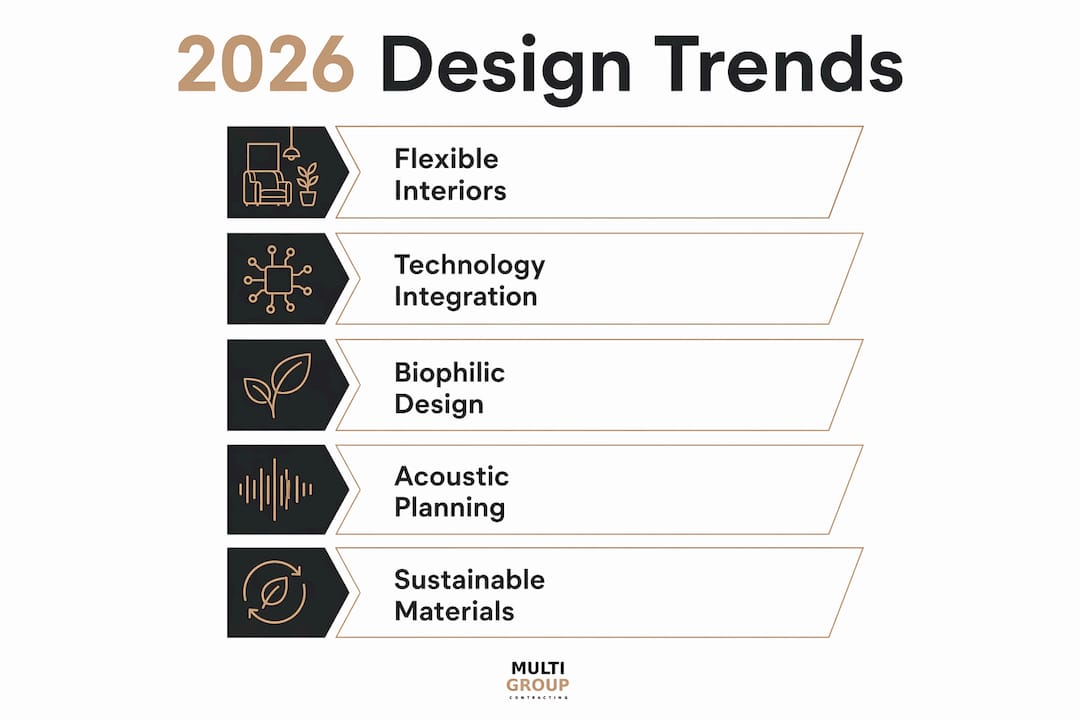
Biophilic design has moved from premium feature to baseline expectation. Natural materials, plants, and maximised daylight are now standard in well-specified commercial interiors because the wellbeing and productivity evidence is conclusive. Spaces that lack these elements feel dated and underperform in tenant satisfaction surveys.
How does flexible design shape modern commercial interiors?
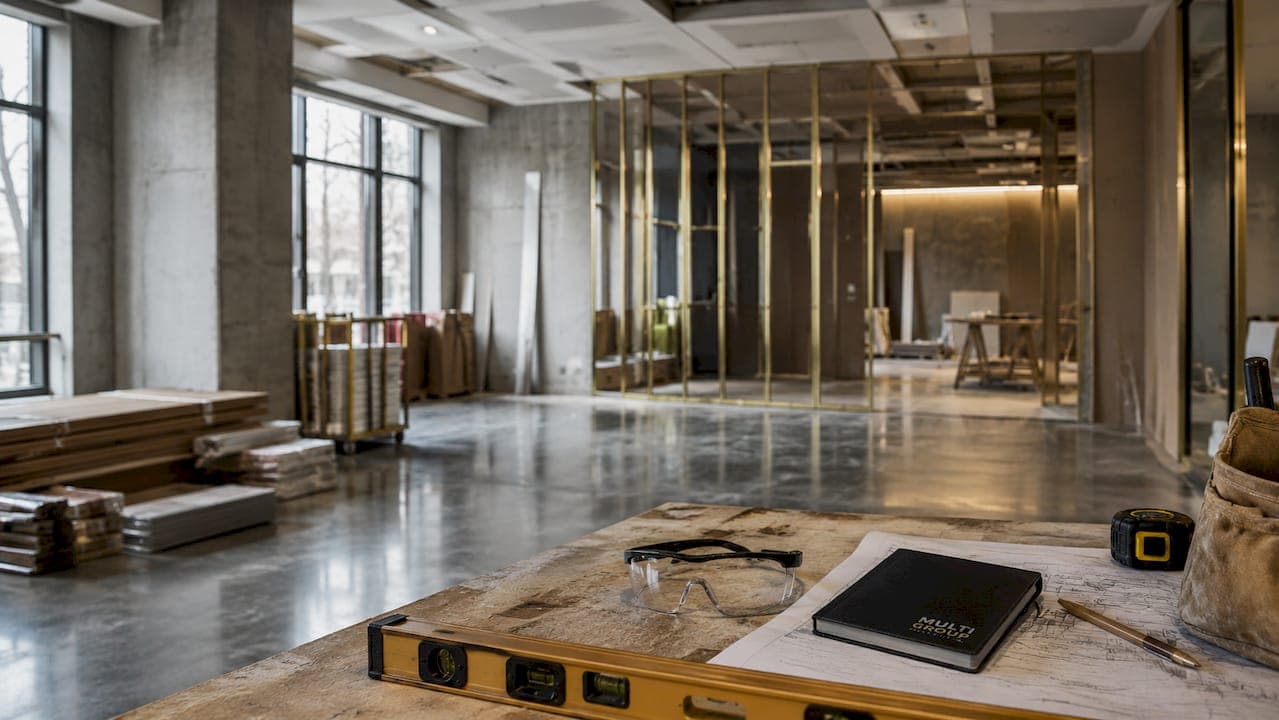
True flexibility in commercial interiors goes beyond moveable furniture. It requires modular infrastructure built into the structure of the space from the start.
The most effective flexible commercial interiors share several characteristics:
- Modular partitions that can be repositioned without major construction, allowing teams to reconfigure zones within weeks rather than months
- Raised access flooring that routes power, data, and HVAC beneath the surface, making layout changes non-destructive
- Mobile and stackable furniture specified for multiple configurations, from open collaboration to private focus
- Demountable wall systems that meet BC Building Code requirements and can be relocated without losing their permit status
Consumer behaviour confirms the direction. Searches for "moveable kitchen island" rose more than ninefold, signalling that flexibility is a mainstream priority, not a niche one. The same instinct drives commercial clients who want spaces that can grow or contract with their business.
For leasing purposes, flexible interiors reduce tenant improvement costs at turnover. A landlord who builds in modular infrastructure from the outset attracts a wider range of tenants and shortens vacancy periods. For business owners, the ability to reconfigure without a full renovation protects capital.
Pro Tip: When planning a commercial fitout, specify conduit pathways and junction boxes beyond your current technology needs. Adding data and power capacity during construction costs a fraction of what it costs to retrofit later.
The step-by-step office buildout process that Multigroup follows in Metro Vancouver projects always accounts for future reconfiguration. Infrastructure decisions made at framing stage determine how adaptable a space will be for the next decade.
How does technology integration work in human-centred commercial spaces?
Technology in commercial interiors works best when it disappears into the architecture. Visible cable management, exposed server racks, and prominent hardware all signal poor planning. The goal is a space where technology enables work without dominating the environment.
AI-assisted design tools are now the competitive default in commercial design workflows. Lighting simulations, material rendering, and client presentations that once took days now take hours. Designers who have not adopted these tools are losing ground on project timelines and client expectations.
The investor case for technology integration is equally clear. 93% of investors agree that technology-enabled commercial properties deliver superior performance and returns. That consensus shapes capital allocation and directly influences which properties attract premium tenants.
A counter-trend is emerging alongside the push for digital integration. Analog spaces that prioritise tactile, human-centric environments are gaining traction as a deliberate response to screen fatigue. These are zones within commercial spaces designed for face-to-face interaction, handwriting, and physical materials. The most well-designed commercial interiors in 2026 balance both.
Practical technology integration in commercial spaces includes:
- Wireless charging surfaces built into millwork and reception desks
- Occupancy sensors embedded in ceilings to monitor space utilisation without visible hardware
- Integrated AV systems with flush-mounted screens and concealed speaker arrays
- Smart lighting controls that adjust colour temperature and intensity based on time of day and occupancy
"The spaces that perform best are the ones where you cannot see the technology but you feel its effect immediately."
What role does biophilic and sensory design play in commercial interiors?
Biophilic design is the practice of connecting interior environments to natural systems through materials, light, plants, and spatial form. In commercial settings, it directly affects employee wellbeing, client perception, and brand identity.
Sensory layering as a design method
Sensory layering addresses sight, sound, smell, and touch as distinct design inputs. Most commercial fitouts address sight and ignore the rest. The result is spaces that look good in photographs but feel uncomfortable to work in for eight hours. Effective sensory design considers acoustic comfort, material texture, and even scent as part of the specification.
Acoustic comfort must be designed into the building from the early planning stages, through partitions, ceilings, glazing, and airflow. Decorative acoustic panels added after construction are a partial fix. They address surface reflection but do not control sound transmission between zones. The partition specification, ceiling plenum design, and glazing selection all need to account for acoustics before a single wall goes up.
Material combinations that define commercial space aesthetics
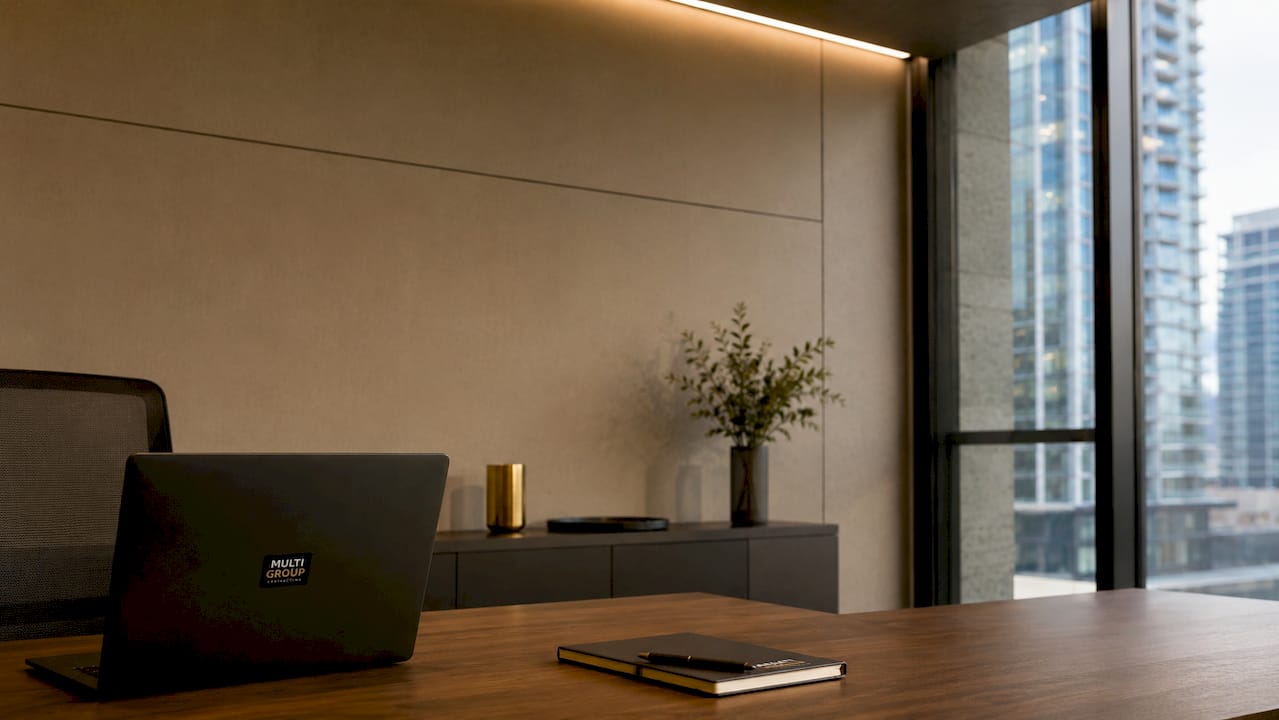
Raw concrete, warm timber, brushed brass, and statement lighting are the industry-preferred material combinations for 2026 commercial interiors. Each material serves a dual purpose: functional performance and brand expression.
| Material | Functional role | Brand signal |
|---|---|---|
| Raw concrete | Durable, low maintenance | Industrial credibility |
| Warm timber | Acoustic absorption, warmth | Approachability, craft |
| Brushed brass | Durable hardware finish | Quality, permanence |
| Statement lighting | Wayfinding, mood control | Design confidence |
People-centred design practices map employee routines and noise profiles to position collaboration zones and quiet focus areas strategically. This approach produces floorplans that function well rather than simply photograph well.
Pro Tip: Specify acoustic performance targets in your fitout brief before selecting partition systems. A target of STC 45 between offices and STC 35 between open-plan zones gives your contractor clear criteria to meet rather than leaving it to interpretation.
What sustainable materials meet modern commercial design standards?
Sustainability in commercial interiors is now a hard requirement, not a differentiator. Verified recycled materials, low-VOC finishes, and energy-efficient lighting are expected by clients and increasingly mandated by building codes and lease agreements.
In Metro Vancouver, BC Building Code compliance intersects with municipal sustainability requirements on most commercial projects. Specifying materials that meet both sets of requirements from the outset avoids costly substitutions during permit review.
The most practical sustainable material choices for commercial fitouts include:
- Low-VOC paints and adhesives that meet LEED v4 indoor air quality credits and protect occupant health
- Reclaimed timber millwork that provides character, reduces embodied carbon, and qualifies for green building credits
- Recycled content carpet tiles with modular replacement capability, reducing waste when sections wear out
- LED lighting systems with daylight harvesting controls that reduce energy consumption and meet BC Energy Step Code requirements
Fitouts optimised for long-term use focus on maintenance-friendly materials, coordinated service access, and local code compliance. A space that costs less to maintain over ten years delivers better total value than one with lower upfront costs but high replacement frequency.
For Metro Vancouver commercial projects, typical tenant improvement budgets range from $80 to $200 CAD per square foot depending on finish level, mechanical complexity, and the extent of structural work. Retail buildouts with custom millwork and brand-specific finishes sit toward the upper end of that range. Warehouse conversions with open-plan office components typically fall in the middle.
The commercial construction best practices that apply in Metro Vancouver require material documentation for permit submission. Specifying sustainable materials early in the design process means the documentation is ready when the permit application goes in, not assembled under deadline pressure.
Key takeaways
Modern commercial interiors that perform well in 2026 combine modular infrastructure, integrated technology, biophilic materials, and verified sustainable finishes from the planning stage forward.
| Point | Details |
|---|---|
| Flexibility requires infrastructure | Modular partitions and raised flooring enable reconfiguration without full renovation. |
| Technology should be invisible | Embedded sensors, wireless charging, and concealed AV systems outperform visible hardware. |
| Biophilic design is baseline | Natural materials, daylight, and plants are now standard expectations, not premium additions. |
| Acoustics must be planned early | Partition, ceiling, and glazing specifications determine acoustic performance before walls go up. |
| Sustainability is a hard requirement | Low-VOC finishes, recycled materials, and energy-efficient lighting meet both client and code demands. |
What I have learned building commercial spaces in Metro Vancouver
The biggest mistake I see on commercial fitout projects is treating flexibility as a furniture decision. Clients choose mobile desks and stackable chairs, then discover two years later that their power and data infrastructure locks every workstation in place. Real adaptability is an infrastructure decision made at the framing stage, not a procurement decision made at the end.
The same pattern applies to acoustics. Every project where acoustic design was deferred to the finishing stage required remediation. Remediation costs more and delivers less. The partition specification, the ceiling plenum height, and the glazing selection all need acoustic criteria attached before construction begins. This is not a design preference. It is a functional requirement that affects how people work every day.
Technology integration in Vancouver commercial projects is accelerating. Clients who would not have considered occupancy sensors or integrated building management systems three years ago are now requesting them as standard. The investor data supports this: technology-enabled properties attract better tenants and command stronger returns. The design and construction team needs to plan for this infrastructure from day one.
What I find most interesting in 2026 is the deliberate push back toward analog spaces within otherwise digital environments. The most thoughtful commercial interiors I have seen recently include dedicated zones with no screens, natural materials, and acoustic separation from the open floor. These spaces get used constantly. People are actively seeking environments that feel different from their devices. That is a design opportunity that most fitouts are still missing.
Working with a licensed contractor who understands BC Building Code requirements and Metro Vancouver permit processes removes a significant layer of risk from any commercial renovation. Code compliance is not optional, and permit delays are expensive. Getting both right from the start is the most cost-effective approach.
— MultigroupTeam
Multigroup's approach to commercial design and construction in Metro Vancouver
Multigroup is a licensed Vancouver general contractor with direct experience in the tenant improvements, retail buildouts, and office renovations that these design trends require. Every project Multigroup delivers covers permit handling, BC Building Code compliance, scheduling, and full project management from design coordination through to occupancy.
Whether you are planning a tenant improvement that needs modular infrastructure and acoustic planning, or a retail buildout in Vancouver with brand-specific finishes and sustainable materials, Multigroup has the trade relationships and project management systems to deliver on time and within budget. Multigroup serves Metro Vancouver including Burnaby, Richmond, Surrey, Coquitlam, North Vancouver, and New Westminster. Contact Multigroup to discuss your commercial renovation project.
FAQ
What is biophilic design in commercial interiors?
Biophilic design connects interior spaces to natural systems through plants, natural materials, and maximised daylight. It is now a baseline expectation in modern commercial interiors because of its direct impact on occupant wellbeing and productivity.
How much does a commercial tenant improvement cost in Vancouver?
Tenant improvement costs in Metro Vancouver typically range from $80 to $200 CAD per square foot, depending on finish level, mechanical complexity, and structural scope. Retail buildouts with custom millwork and brand finishes sit toward the upper end of that range.
Why does acoustic design need to happen early in a fitout?
Acoustic performance depends on partition specifications, ceiling plenum design, and glazing selection, all of which are determined before walls are built. Adding acoustic panels after construction addresses surface reflection but does not control sound transmission between zones.
What sustainable materials are required in commercial fitouts?
Verified recycled materials, low-VOC paints and adhesives, and energy-efficient LED lighting are now standard requirements in commercial interiors. In Metro Vancouver, these choices also support BC Building Code compliance and LEED credit eligibility.
How does modular infrastructure support flexible commercial spaces?
Modular partition systems, raised access flooring, and demountable wall systems allow commercial spaces to be reconfigured within months rather than requiring full renovation. JLL research confirms these systems are designed for reconfiguration timelines spanning 3 months to 30 years.