

TL;DR:
- Upgrading building systems improves energy efficiency, reduces costs, and increases asset value through coordinated, data-driven efforts. Deep retrofits and retro-commissioning extend asset life and cut emissions without full replacement, offering significant long-term savings. Sustainable upgrades attract tenants, support higher lease rates, and ensure compliance with regional requirements.
Upgrading building systems is the process of modernising existing HVAC, electrical, and building automation infrastructure to improve performance, reduce operating costs, and lower carbon emissions without full replacement. For property owners and business operators in Metro Vancouver, this is one of the highest-return investments available. Modern HVAC upgrades reduce energy use by 20–40%, and deep retrofits can push those savings past 50%. Technologies like building automation systems (BAS), IoT sensors, and retro-commissioning make it possible to extract far more value from existing infrastructure than most owners realise.
What are the measurable benefits of upgrading building systems?
The financial case for upgrading building infrastructure is direct and well-documented. Energy costs drop, maintenance bills shrink, and asset value rises. These are not marginal gains.
Key measurable benefits include:
- Energy savings of 20–40% from HVAC and electrical upgrades, with deep retrofits exceeding 50% in well-coordinated projects
- Carbon emission reductions up to 80% by reusing and modernising existing structures rather than demolishing and rebuilding
- Maintenance cost reductions from proactive system management, replacing reactive repairs with scheduled, lower-cost servicing
- Payback periods of 1–5 years, with retro-commissioning paying back in 1–3 years and equipment upgrades typically within 2–5 years
- Improved occupant comfort through stable indoor air quality, consistent temperatures, and fewer system failures
Each of these outcomes compounds over time. A building that costs less to run, produces fewer emissions, and keeps occupants comfortable commands stronger lease rates and retains tenants longer. That combination directly increases net operating income and asset valuation.
Pro Tip: Track your current energy and maintenance spend for 12 months before planning upgrades. That baseline data makes it far easier to quantify ROI and justify capital expenditure to stakeholders or lenders.
How do modernisation and retro-commissioning differ from full replacement?
Property owners often assume that fixing a failing system means replacing it entirely. That assumption is expensive and usually wrong. Modernisation extends asset life by up to 30 years while avoiding the downtime and capital outlay of full replacement.
| Approach | Cost vs. replacement | Downtime | Asset life extension | Best suited for |
|---|---|---|---|---|
| Full replacement | Baseline (100%) | High | Full new lifecycle | End-of-life, failed systems |
| Modernisation | Up to 40% lower | Low to moderate | Up to 30 years | Ageing but functional systems |
| Retro-commissioning | Lowest upfront | Minimal | Restores original performance | Systems with performance drift |
Retro-commissioning is particularly underused. Building systems degrade over time due to manual overrides, sensor ageing, and shifting usage patterns. Retro-commissioning restores original design intent, reducing energy use by 10–20% and resolving chronic comfort complaints that tenants have often stopped reporting because they assume nothing will change.
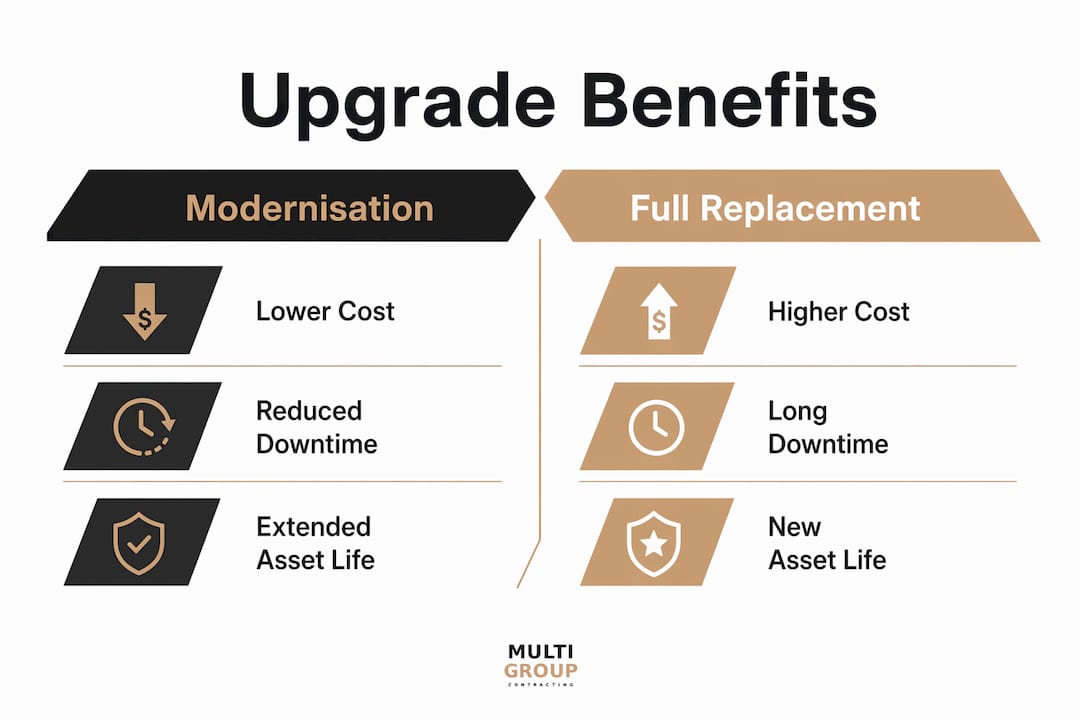
Modernisation, by contrast, upgrades specific components while keeping the broader system intact. It saves up to 40% in costs versus full replacement and cuts CO2 emissions by up to 80% by reusing the existing structure. The environmental benefit alone makes this approach worth serious consideration under BC's evolving emissions regulations.
Pro Tip: Before approving a full system replacement, request a retro-commissioning assessment. Many systems that appear to need replacement simply need recalibration, control updates, and sensor replacements at a fraction of the cost.
What are deep energy retrofits and why do they matter?
A deep energy retrofit treats the building as one integrated system rather than a collection of independent components. The goal is to coordinate envelope improvements, mechanical upgrades, controls, and electrification so that each change supports the others. Deep retrofits reduce whole-life carbon emissions by 50–75% compared to new construction by avoiding the energy-intensive manufacturing of new materials.
The sequence of work matters enormously. Improving the building envelope first, through better insulation, air sealing, and window upgrades, reduces the heating and cooling load. That reduced load then allows right-sizing of the HVAC system, which means smaller, less expensive equipment that runs more efficiently. Skipping the envelope step and simply installing a new HVAC system embeds future inefficiency into the building.
A well-executed deep retrofit delivers:
- Reduced heat loss and air infiltration through an upgraded building envelope
- Right-sized HVAC equipment matched to the actual thermal load
- Integrated controls and BAS monitoring to maintain performance over time
- Electrification of heating and hot water systems to reduce fossil fuel dependence
- Improved indoor air quality through better ventilation design
The long-term operational benefits are equally significant. Fewer comfort complaints, simplified maintenance, and a more predictable operating budget all follow from a coordinated approach. For commercial properties in Metro Vancouver, where energy costs and tenant expectations are both rising, deep retrofits are a practical path to long-term competitiveness. You can read more about the financial outcomes in this overview of commercial retrofit costs and results.
How does upgrading building systems improve asset competitiveness?
High-performance buildings command premium rents in ESG-driven markets. That is not a future trend. It is the current reality in Metro Vancouver's commercial real estate market, where institutional tenants and national retailers increasingly require buildings to meet energy and sustainability benchmarks before signing leases.
ESG criteria now directly influence commercial real estate valuations. Lenders, investors, and major tenants all apply environmental performance metrics when assessing properties. A building with outdated HVAC, poor air quality controls, and high energy intensity is a liability in that environment. An upgraded building with BAS monitoring, modern electrical infrastructure, and documented energy performance is an asset.
Specific advantages for property owners include:
- Higher lease rates from tenants who value stable operating costs and healthy indoor environments
- Lower vacancy risk because upgraded buildings attract and retain quality tenants
- Stronger asset valuation supported by documented energy performance and lower operating expenses
- BC Building Code compliance maintained through permitted upgrades managed by a licensed contractor
- Tenant improvement integration that combines system upgrades with interior buildouts to maximise value per project
For business operators, upgraded systems also reduce the risk of operational disruptions from equipment failures. A retail tenant or medical clinic operator cannot afford HVAC downtime during business hours. Reliable, modernised systems protect revenue as directly as they protect the building. Explore how Metro Vancouver renovation strategies connect system upgrades to tenant attraction.
What practical strategies maximise value from system upgrades?
The most common mistake property owners make is upgrading systems in isolation, one piece at a time, without a coordinated plan. Piecemeal replacements lock in inefficiencies and miss the cost savings that come from aligning work across systems and maintenance cycles.
Coordinating upgrades with major maintenance milestones is the single most effective way to reduce costs and disruption. When a roof reaches end-of-life, that is the right time to add insulation and address air sealing. When an HVAC unit fails, that is the moment to assess whether the whole system needs retro-commissioning before installing new equipment.
Practical strategies that deliver results:
- Use BAS data as your starting point. Visibility into building system performance enables evidence-based decisions rather than reactive fixes. Buildings without BAS monitoring are essentially flying blind.
- Phase upgrades to minimise downtime. A phased approach keeps operations running and spreads capital expenditure across budget cycles.
- Right-size equipment after envelope improvements. Installing oversized HVAC before addressing insulation wastes capital and creates long-term inefficiency.
- Align with BC Building Code requirements. Permitted upgrades protect asset value and avoid compliance issues during future sales or refinancing.
- Engage a licensed general contractor early. Early contractor involvement in planning prevents costly scope changes and keeps projects on schedule.
Upgrading is about orchestrating system interactions through data-driven retrofits, not just swapping hardware. That distinction separates property owners who capture the full value of their investment from those who spend money without seeing proportional returns.
Pro Tip: Ask your contractor to model energy savings before committing to a scope of work. A qualified Vancouver general contractor can run a preliminary assessment that shows projected payback periods for different upgrade scenarios, giving you a clear basis for decision-making.
Key takeaways
Upgrading building systems delivers measurable energy savings, lower maintenance costs, and stronger asset value when upgrades are coordinated, data-driven, and aligned with BC Building Code compliance.
| Point | Details |
|---|---|
| Energy savings are significant | Modern HVAC and electrical upgrades reduce energy use by 20–40%, with deep retrofits exceeding 50%. |
| Modernisation beats replacement | Upgrading existing systems costs up to 40% less than full replacement and extends asset life by up to 30 years. |
| Sequence matters in deep retrofits | Improve the building envelope before right-sizing HVAC to avoid overspending on oversized equipment. |
| ESG drives asset value | High-performance buildings attract premium tenants and command higher lease rates in Metro Vancouver's market. |
| Coordinate with maintenance cycles | Aligning upgrades with roof or HVAC end-of-life reduces disruption and locks in long-term efficiency gains. |
From the field: what Vancouver projects have taught us about building upgrades
After working on commercial renovations and tenant improvements across Metro Vancouver, Burnaby, Richmond, and Surrey, one pattern stands out clearly. Property owners who treat system upgrades as a coordinated investment consistently outperform those who respond only to failures.
The most revealing projects are the ones where a client comes to us after years of piecemeal repairs. The HVAC has been patched repeatedly. The lighting controls are outdated. The building envelope has never been assessed. Each individual repair seemed reasonable at the time, but the cumulative result is a building that costs far more to operate than it should, and one that struggles to attract quality tenants.
What I have found works is starting with a clear picture of where the building stands today. BAS data, energy audits, and a frank assessment of system age give you the information needed to prioritise. From there, aligning upgrade scope with BC Building Code requirements and permit processes is not optional. It protects the asset and protects the owner.
The buildings that perform best in Metro Vancouver's competitive leasing market are not always the newest. They are the ones where the owner made deliberate, coordinated investments in systems, envelope, and tenant improvements over time. That approach builds equity, attracts tenants, and reduces the operational headaches that drain property management resources.
Proactive facility management, backed by real data and executed by a licensed contractor who understands both the technical and regulatory environment, is the most reliable path to long-term building performance.
— MultigroupTeam
Multigroup's approach to building system upgrades in Metro Vancouver
Multigroup is a licensed general contractor serving Metro Vancouver, with direct experience in tenant improvements, commercial renovations, and building system upgrades across Burnaby, Richmond, Surrey, Coquitlam, and North Vancouver.

Property owners working with Multigroup get full project management from permit handling through to construction completion. Every upgrade is planned in compliance with the BC Building Code, with scheduling designed to minimise disruption to ongoing operations. Whether the scope involves HVAC coordination, electrical upgrades, or integrated tenant improvement work, Multigroup manages the process so owners can focus on their business. Contact Multigroup to discuss your building's upgrade priorities and get a clear plan for improving performance and asset value.
FAQ
What does upgrading building systems actually involve?
Upgrading building systems involves modernising HVAC, electrical, lighting, controls, and building automation infrastructure to improve energy performance and reliability. It ranges from retro-commissioning existing equipment to phased deep retrofits coordinating envelope and mechanical improvements.
How much can I save on energy costs by upgrading?
Modern HVAC and electrical upgrades reduce energy use by 20–40% on average, with deep retrofits exceeding 50% savings. Retro-commissioning alone typically pays back within 1–3 years through reduced operating and maintenance costs.
What is retro-commissioning and how is it different from replacement?
Retro-commissioning is a process that restores a building's systems to their original design performance by fixing sensor drift, manual overrides, and control issues. It costs significantly less than replacement and typically reduces energy use by 10–20%.
Do building system upgrades require permits in BC?
Yes. Most mechanical, electrical, and structural upgrades in BC require permits under the BC Building Code. Working with a licensed contractor ensures permits are obtained correctly and upgrades meet current code requirements.
How do upgraded systems affect tenant satisfaction and lease rates?
High-performance buildings with upgraded systems command premium rents and attract quality tenants by delivering stable indoor air quality, reliable comfort, and lower operating costs. ESG criteria increasingly influence tenant decisions in Metro Vancouver's commercial market.