

TL;DR:
- Keeping building code compliance current reduces injury risk, limits legal liability, and protects asset value. Non-compliance can lead to legal fines, insurance exclusions, and marketability issues. Updating codes in response to triggers ensures safety and legal adherence without unnecessary renovations.
Keeping building code compliance current reduces injury risk, limits legal liability, and protects the financial value of your property. Those three outcomes are the core reasons any building owner, contractor, or risk manager in Canada should treat code updates as an ongoing obligation rather than a one-time event. Codes Canada, under the National Research Council (NRC), develops the National Model Codes that provinces and territories then adopt into local law — the BC Building Code and Ontario Building Code being the most prominent examples.
- Safety: Updated codes reflect current knowledge about structural performance, fire protection, and occupant health. Non-compliant buildings carry measurable risk of injury.
- Legal and insurance exposure: Courts use codes as a benchmark for "reasonable safety." Non-compliance raises the likelihood of a successful negligence claim and can trigger insurance exclusions.
- Asset and market value: Lenders, buyers, and tenants increasingly require code-compliant buildings. Gaps discovered at sale or refinancing create costly delays.
Table of Contents
- How building codes are developed and adopted across Canada
- 8 reasons to keep your building code compliance current
- Legal and insurance consequences of falling behind on compliance
- When does a code update actually require physical work?
- A practical compliance checklist for owners, contractors, and risk managers
- Typical cost and timeline ranges for compliance upgrades in Canada
- Where to monitor code changes in Canada
- How Multigroup manages code updates during tenant improvements in Metro Vancouver
- New builds versus existing buildings: different compliance obligations
- Indigenous building standards and Canadian codes
- Key takeaways
- Planned compliance costs less than reactive compliance
- Multigroup's compliance-ready renovation services in Metro Vancouver
- Useful sources
- FAQ
How building codes are developed and adopted across Canada
Building codes are minimum performance standards covering structure, materials, plumbing, fire protection, occupant loads, and mechanical systems. They are not suggestions. Once a province or territory adopts a model code, its requirements become enforceable law.
Codes Canada develops the National Building, Fire, Plumbing, and Energy Codes through volunteer technical committees and public review cycles. The resulting model codes set the national baseline. Provinces then adopt or adapt them, sometimes with amendments, and set their own effective dates. The BC Building Code 2024, for instance, came into force for permits applied after its effective date, meaning the trigger for compliance is the permit application date—not the construction start date.
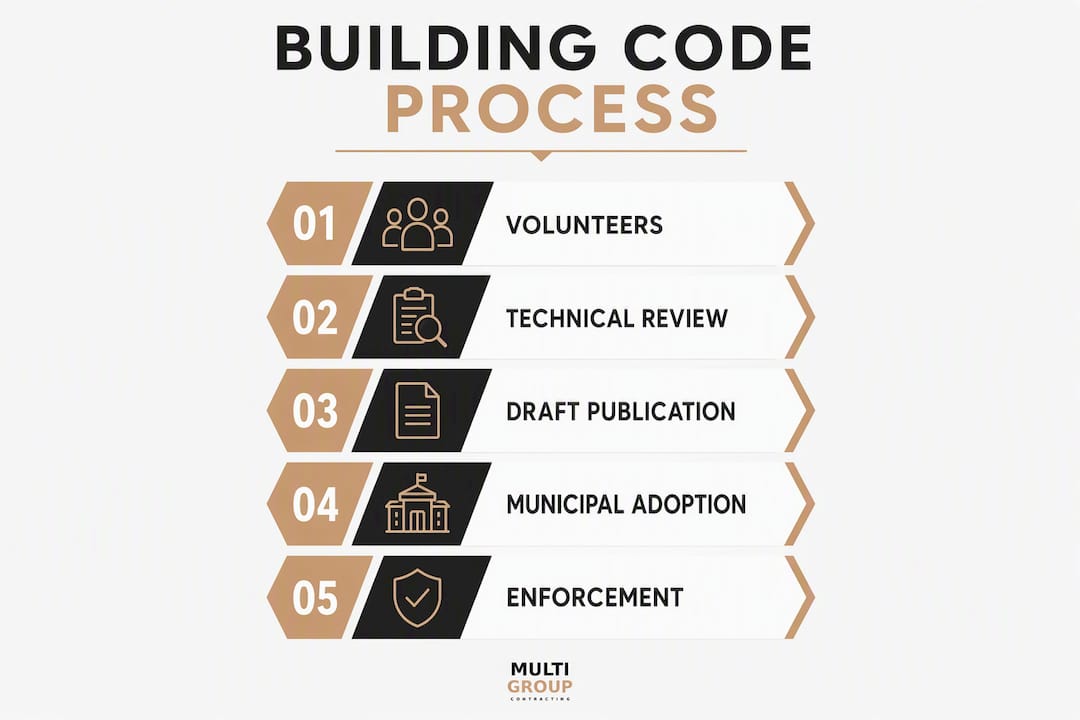
Municipal building departments enforce the adopted provincial code through permit review and site inspections. BC jurisprudence confirms that municipalities can owe duties of care around inspections when they choose to regulate construction via bylaws, which means the enforcement chain runs from NRC model codes all the way to your local permit counter. For official adoption notices, check provincial code compendia and your municipality's building bylaw directly.
8 reasons to keep your building code compliance current
Code compliance is not just about avoiding fines. Each update addresses a real-world risk that directly affects your building's performance, your legal standing, and your bottom line.
-
Occupant safety. Updated codes incorporate lessons from fires, structural failures, and public health events. The minimum standards for fire protection, structural integrity, and ventilation exist because past non-compliance caused injuries and deaths. Staying current closes those gaps.
-
Reduced legal liability. Courts in BC and across Canada regularly use building codes as comparative evidence when assessing whether premises were "reasonably safe." Non-compliance — even in older buildings — can significantly increase liability exposure in negligence claims and may result in large damage awards.
-
Insurance coverage integrity. Standard property policies often exclude or cap costs for bylaw and code upgrades during reconstruction. Bylaw/code upgrade coverage is available but carries separate limits. Owners who skip it face large out-of-pocket costs when rebuilding to current standards after a loss.
-
Energy efficiency and operating costs. The 2025 National Model Codes introduce mandatory energy-efficiency requirements that now apply to alterations of existing buildings. Compliance with these provisions typically reduces utility costs over time, making upgrades a financial investment as much as a regulatory obligation.
-
Climate resilience. The codes also incorporate long-term climate projections and passive radon stack requirements. Buildings designed or retrofitted to these standards are better positioned to withstand extreme weather events, which is a growing concern for Metro Vancouver properties. For a deeper look at energy and climate retrofit strategies, the Canadian builder's guide to energy efficiency covers practical retrofit approaches.
-
Accessibility and market reach. Accessibility objectives in the updated national codes expand the legal and commercial obligation to accommodate people with disabilities. Non-compliant buildings face both human rights exposure and a narrower tenant pool.
-
Resale and refinancing. Lenders and buyers conduct code compliance reviews. Gaps discovered during due diligence can reduce sale price, delay closing, or cause financing to fall through entirely. Proactive compliance keeps your asset financeable.
-
Marketability and tenant attraction. Commercial tenants, particularly medical clinics, retail franchisees, and food-service operators, often require landlords to confirm code compliance before signing a lease. A tenant improvement contractor who understands current BC Building Code requirements can confirm compliance status before lease negotiations begin.
Legal and insurance consequences of falling behind on compliance
Non-compliance is not a theoretical risk. It has concrete legal and financial consequences that risk managers can quantify.
Courts in BC and elsewhere commonly use building codes as comparative evidence when determining whether premises were "reasonably safe," increasing liability exposure for non-compliant owners — even when the non-compliance predates the current owner's tenure.
The Occupier's Liability Act in BC places a duty of care on occupiers to keep premises reasonably safe for visitors. When an injury occurs and codes were not met, the code gap becomes direct evidence of a breach of that duty. The practical effect: a plaintiff's lawyer does not need to prove the owner knew about the deficiency. The deficiency itself, measured against the code, can establish negligence.
On the insurance side, many standard policies exclude or strictly cap the cost of bringing a rebuilt structure up to current codes after a covered loss. Without specific bylaw/code upgrade coverage, an owner may receive enough to rebuild to the pre-loss standard but face a significant shortfall for the mandatory upgrades the municipality now requires. That gap comes out of pocket.
Annual inspection records for fire alarms and emergency lighting are often the first line of defence in both insurance claims and liability cases. Absence of those records severely weakens any defence, regardless of whether the systems were actually functioning.
When does a code update actually require physical work?
Publishing a new code does not automatically force every building owner to renovate. Specific triggers convert a paper update into a mandatory project.
The most common triggers in Canada are:
- Change of occupancy. Changing a building's use can require seismic, fire, or accessibility upgrades even without new construction. Owners frequently underestimate these costs when leasing or purchasing commercial space.
- Substantial alteration or renovation. When the scope of work crosses a threshold defined by the authority having jurisdiction (AHJ), the entire affected area may need to meet current code.
- Building permit for new work. The permit application date triggers the applicable code edition. Under the BC Building Code 2024, permits applied after the effective date are subject to the new requirements.
- Orders from the AHJ. A municipal inspector or fire marshal can issue an order requiring upgrades regardless of renovation plans.
- Insurance-driven rebuilds after a loss. Reconstruction after fire or flood must meet current codes, which often exceed the pre-loss standard.
- Mandatory certification schedules. Annual fire alarm certification and emergency lighting inspections are required by code for most commercial buildings, independent of any renovation trigger.
The NRC's work on alterations to existing buildings confirms that the guiding principle is voluntary owner action: when you choose to alter, upgrade, or change the function of a building, additional requirements apply. The extent of those requirements scales with the scope of the alteration.
Pro Tip: Before signing a commercial lease or purchase agreement, commission a code gap analysis. Change-of-occupancy upgrades for seismic, fire, and accessibility can run into six figures in Metro Vancouver, and they are the tenant's or buyer's responsibility once the deal closes.
A practical compliance checklist for owners, contractors, and risk managers
Compliance is a shared responsibility. Assigning tasks by role prevents gaps.
Building owners:
- Confirm the current edition of the BC Building Code applies to your property and note its effective date for permits.
- Maintain a compliance file: building permits, inspection certificates, occupancy permits, and annual fire alarm and emergency lighting logs.
- Review lease agreements to confirm which party is responsible for code upgrades triggered by tenant fit-outs.
- Obtain bylaw/code upgrade coverage as a separate endorsement on your property policy.
Contractors and design professionals:
- Conduct a pre-construction code review for every permit application, including BC Building Code edition confirmation.
- Engage a registered design professional or engineer of record when the scope triggers Part 3 or structural requirements.
- Document all phased inspections and obtain sign-off from the AHJ at each stage.
- Deliver a compliance record package to the owner at project close, including as-built drawings, inspection certificates, and permit close-out documents.
Risk managers:
- Schedule annual inspections for fire alarms, emergency lighting, and suppression systems and file the certificates immediately.
- Review insurance policy language annually for bylaw/code upgrade limits and adjust coverage as the building's replacement cost changes.
- Track provincial code adoption announcements and flag any changes that affect the building's occupancy classification or systems.
Pro Tip: Keep digital copies of all inspection certificates and permits in a cloud-based folder organised by year. Paper records are frequently lost in the same events — floods, fires — that trigger insurance claims, and their absence can delay or reduce a payout.
Typical cost and timeline ranges for compliance upgrades in Canada
Cost and timeline depend on scope, jurisdiction, building condition, and whether concealed conditions are present. The table below provides working estimates for Metro Vancouver; costs in other Canadian markets will vary.
| Upgrade category | Typical CAD cost range | Typical timeline |
|---|---|---|
| Annual fire alarm certification (commercial) | — | 1 day |
| Emergency lighting inspection and repair | — | 1–3 days |
| Accessible washroom retrofit | — | 2–4 weeks |
| Accessible building entry (ramp, door, hardware) | — | 1–3 weeks |
| Fire suppression system upgrade or extension | — | 3–8 weeks |
| Energy-efficiency retrofit (envelope/mechanical) | — | 4 weeks |
| Seismic bracing for vulnerable elements | — | 4–6 weeks |
| Change-of-occupancy code work (full review) | — | 6 weeks |
| Tenant improvement with full code compliance | — | 6–8 weeks |
Metro Vancouver adds a permit lead-time premium. Depending on the municipality and project complexity, permit review can add 4–12 weeks to a schedule. Heritage constraints and concealed conditions — common in older Burnaby and New Westminster commercial stock — can push costs well above the ranges above.
Reducing commercial building energy costs through code-compliant HVAC and envelope upgrades often qualifies for provincial or utility incentive programmes, which can partially offset retrofit costs. Owners who plan upgrades proactively, rather than reactively after a loss or order, can stage the work to spread costs across fiscal years.
Where to monitor code changes in Canada
Rely on Codes Canada and NRC as the primary federal source, then layer in provincial compendia and municipal bulletins.
- Codes Canada / NRC: The authoritative source for National Model Code editions, amendments, and public review notices. Subscribe to NRC announcements directly.
- CBHCC announcements: The Canadian Board for Harmonized Construction Codes publishes release notices for new model code editions, including the 2025 National Model Codes.
- BC Building Code page (Province of BC): Lists the current edition, effective dates, and any provincial amendments. Check this page when any permit application is being prepared.
- Ontario Building Code resources (ontario.ca): Equivalent provincial resource for Ontario projects, including adoption notices and amendment bulletins.
- Municipal building department notices: Many Metro Vancouver municipalities (City of Vancouver, Burnaby, Surrey, Richmond) publish permit bulletins and bylaw amendment notices. Sign up for email alerts where available.
- Provincial builders' associations: BC Construction Association and the Canadian Home Builders' Association distribute code-change summaries to members.
- Commercial fire door regulations: Annual certification requirements for fire doors are a frequently overlooked compliance item; this resource covers current standards for building managers.
Set a monitoring cadence: check provincial code pages at least once per quarter and review municipal bulletins before every permit application.
How Multigroup manages code updates during tenant improvements in Metro Vancouver
Multigroup integrates a code review into the kickoff of every tenant improvement and commercial renovation project, treating compliance as a project management input rather than an afterthought.
The process follows a consistent sequence. At project kickoff, the team conducts an initial code scan against the current BC Building Code edition, confirming the applicable version based on the permit application date. When the scope triggers Part 3 requirements, structural work, or fire suppression changes, Multigroup engages a registered design professional or engineer of record before permit submission. This avoids the common problem of a permit being returned for design revisions, which adds weeks to a Metro Vancouver schedule.
Permit submission is coordinated with the relevant municipal building department, with documentation prepared to address anticipated reviewer comments. Phased inspections are scheduled in advance and tracked against the construction schedule. At project close, Multigroup delivers a compliance record package to the owner: as-built drawings, inspection sign-offs, permit close-out documents, and annual certification records where applicable.
Proactive code review at project kickoff is the single most effective way to prevent permit delays and budget overruns on tenant improvement projects in Metro Vancouver. Concealed conditions discovered mid-construction are far more expensive to address than gaps identified during the design phase.
New builds versus existing buildings: different compliance obligations
New construction must meet the current edition of the applicable provincial building code in full, without exception. Every system, every assembly, and every clearance is reviewed against current requirements at permit application and verified through inspections.
Existing buildings operate under a different framework. The NRC's research on alterations to existing buildings confirms that requiring all existing buildings to meet current code in full is not a realistic goal — the cost in materials, labour, and compliance would be prohibitive and could deter owners from improving their buildings at all. Instead, the principle is to close the performance gap as much as possible where it is logical, cost-effective, and does not impose an undue burden.
In practice, this means existing buildings are generally grandfathered under the code edition in force when they were built, unless a trigger event occurs. When a trigger does occur — renovation, change of occupancy, permit application — the affected scope must meet current requirements. The unaltered portions of the building are typically not required to be upgraded, though the AHJ retains discretion to order upgrades for unsafe conditions.
This distinction matters for budget planning. A tenant improvement in an older Burnaby warehouse may trigger fire separation, accessibility, and energy upgrades in the renovated area without requiring a full building retrofit. Understanding exactly which portions of the building fall within scope is a critical early step in any commercial renovation.
Indigenous building standards and Canadian codes
Indigenous communities in Canada have a distinct relationship with building codes. Many First Nations communities on reserve lands are not subject to provincial building codes, which apply only to lands under provincial jurisdiction. Instead, building standards on reserve may be governed by band council resolutions, federal programs, or agreements negotiated under self-government arrangements.
The National Model Codes developed by Codes Canada are available for adoption by any jurisdiction, including Indigenous governments, and some First Nations have chosen to adopt provincial or national model codes as their own standard. Others have developed community-specific standards that reflect local climate conditions, traditional building practices, and available materials.
Federal programs administered through Indigenous Services Canada provide funding and technical support for housing and community infrastructure on reserve, often with their own technical standards and inspection requirements. For contractors working on projects in Indigenous communities, confirming the applicable standard before design and permit work begins is not optional. The standard may differ materially from the BC Building Code, and the enforcement authority will be the band council or a designated inspector rather than a municipal building department.
Key takeaways
Keeping building code compliance current is the most cost-effective way to protect occupant safety, limit legal liability, and preserve asset value in Canada.
| Point | Details |
|---|---|
| Safety and liability are linked | Courts use codes as evidence of reasonable safety; non-compliance raises negligence exposure under BC's Occupier's Liability Act. |
| Insurance gaps are common | Standard policies often exclude bylaw/code upgrade costs; obtain separate endorsement coverage before a loss event occurs. |
| Triggers drive mandatory work | Change of occupancy, substantial renovation, and permit applications are the most common events that convert code updates into required physical upgrades. |
| TI projects require code review | Tenant improvements commonly trigger mandatory fire, accessibility, and energy compliance reviews; budget for these before signing a lease. |
| Multigroup for Metro Vancouver | Multigroup conducts code scans at project kickoff and manages permit coordination for TI and commercial renovation projects across Metro Vancouver. |
Planned compliance costs less than reactive compliance
The conventional wisdom in construction is that code compliance is a cost centre. From where Multigroup sits, working on tenant improvements and commercial renovations across Metro Vancouver, that framing gets it backwards. Planned compliance is a cost-control tool. When a code gap is identified during the design phase, it is a line item. When it surfaces during construction, it is a change order, a schedule delay, and often a strained client relationship.
Metro Vancouver permit timelines are not forgiving. A permit returned for code deficiencies can add 6–10 weeks to a project schedule, and municipal inspectors here are thorough. Owners who invest in a code gap analysis before committing to a lease or a renovation scope consistently see faster approvals, fewer surprises, and cleaner project closes. The records delivered at project completion also strengthen their position in any future insurance claim or liability defence. That is not a theoretical benefit — it is a practical one that shows up in real project outcomes.
Multigroup's compliance-ready renovation services in Metro Vancouver
Multigroup is a licensed BC general contractor serving Metro Vancouver — Burnaby, Richmond, Surrey, Coquitlam, North Vancouver, West Vancouver, New Westminster, Langley, and Delta — with a core focus on tenant improvements, retail buildouts, office renovations, and permit management.

For owners and managers who need to close a code gap or plan a compliant renovation, Multigroup offers three compliance-ready services:
- Code scan and gap report: A pre-construction review of the applicable BC Building Code edition against your building's current condition, identifying mandatory upgrades before design begins. Starting from $1,500–$3,500 CAD depending on building size and complexity.
- Permit application and municipal coordination: Full preparation and submission of permit documents, including coordination with municipal reviewers and response to deficiency notices. Included in project management scope on all Multigroup contracts.
- Compliance-focused construction and record handover: Construction managed to phased inspection milestones, with a complete compliance record package delivered at project close.
To discuss a tenant improvement project or request a code scan for your Metro Vancouver property, contact Multigroup directly through multigroup.ca.
Useful sources
Official government and primary sources should be your first stop for code compliance questions. Provincial code compendia and municipal bulletins are more current than any third-party summary.
- Codes Canada / NRC: National Model Code editions, FAQ, and public review notices.
- NRC: Alterations to Existing Buildings: The framework governing when existing buildings must be upgraded.
- CBHCC / Energy Manager: 2025 National Model Codes: Release summary for the latest model code edition, including energy and climate provisions.
- Young Anderson: Building Regulation and Inspection: BC legal context on municipal duties and liability.
- Holness & Small LLP: Building Code Deficiency Liability: Plain-language explanation of how code gaps create negligence exposure.
- Mondaq: Bylaw and Code Upgrade Coverage: Insurance implications of reconstruction to current codes.
- RC-PM: Commercial Property Maintenance: Record-keeping requirements for BC commercial landlords.
- City of Kamloops: Change of Occupancy Bulletin: Municipal guidance on change-of-occupancy upgrade triggers.
- Multigroup blog: BC Building Code contractor guide, energy efficiency in construction, and tenant improvement guide for Vancouver.
FAQ
What is the main purpose of a building code in Canada?
Building codes set minimum performance standards for structure, fire protection, plumbing, mechanical systems, and occupant safety. Provinces and territories adopt the National Model Codes developed by Codes Canada and enforce them through municipal permit and inspection regimes.
When was the BC Building Code last updated?
The BC Building Code 2024 is the current edition. It came into effect for permit applications submitted after its effective date, meaning the applicable code edition is determined by when you apply for a permit, not when construction begins.
What is the most common building code violation in commercial buildings?
Fire and life safety deficiencies — including missing or expired fire alarm certifications, non-compliant exit lighting, and blocked egress paths — are among the most frequently cited violations in commercial buildings. Annual certification of fire alarm and emergency lighting systems is a code requirement for most commercial occupancies.
How do you ensure compliance with local building codes and regulations?
Conduct a code gap analysis before any renovation or change of occupancy, engage a registered design professional when the scope requires it, apply for permits before starting work, and maintain annual inspection records for fire alarms and emergency lighting. In Metro Vancouver, Multigroup manages this process from initial code scan through permit close-out.
Does a code update automatically require me to renovate my existing building?
No. Publishing a new code edition does not force immediate upgrades on existing buildings. Mandatory work is triggered by specific events: a renovation permit application, a change of occupancy, an order from the authority having jurisdiction, or a rebuild after an insured loss. Proactive upgrades are best practice but are generally not legally required until a trigger event occurs.