
TL;DR:
- Commercial retrofitting is a cost-effective way to reduce operating expenses, meet sustainability goals, and preserve asset value without disrupting tenants. Deep, integrated upgrades can achieve up to 60% energy savings and deliver short payback periods when properly planned and monitored. Phased, occupancy-friendly approaches enable retrofits to proceed with minimal operational disruption while maximizing long-term financial and environmental benefits.
Most property owners and business operators assume that to retrofit commercial space means months of construction chaos, displaced tenants, and a budget that spirals before the first wall comes down. That assumption is wrong, and it's costing them money. Commercial retrofitting is one of the most cost-effective tools available for reducing operating expenses, meeting sustainability targets, and preserving long-term asset value. This article breaks down exactly what retrofitting involves, what it delivers financially and environmentally, and how experienced contractors complete upgrades with tenants still in the building.
Table of Contents
- Key takeaways
- What commercial retrofitting actually involves
- The financial and environmental case for retrofitting
- Retrofitting without disrupting operations
- Challenges to plan for before you commit
- My take on why retrofit decisions get delayed too long
- Ready to upgrade your commercial space?
- FAQ
Key takeaways
| Point | Details |
|---|---|
| Deep retrofits cut energy use significantly | Integrated upgrade packages can achieve 50% reductions in building energy use intensity. |
| Occupied retrofits are achievable | With phased planning and tenant coordination, full-building retrofits can proceed without requiring vacancy. |
| Financial returns are measurable | Projects like the ESRT portfolio show payback periods as short as 6.5 years on major investments. |
| Commissioning protects your ROI | Without rigorous post-retrofit monitoring, buildings often realize only 60-75% of projected savings. |
| Retrofitting preserves asset value | Upgrading rather than rebuilding maintains property value while meeting modern performance and compliance standards. |
What commercial retrofitting actually involves
Commercial retrofitting refers to upgrading an existing building's systems, envelope, or both to improve performance without demolishing and rebuilding. The scope can range from targeted fixes to full system overhauls, and understanding the difference matters for planning both budget and timeline.
Shallow retrofits focus on individual systems in isolation: swapping fluorescent tubes for LED fixtures, upgrading thermostats, or resealing windows. These measures typically achieve 10 to 20% reductions in energy use intensity. They are fast and low-cost, but they leave significant performance on the table.
Deep retrofits take an integrated approach. When systems are upgraded together, the results compound. The key systems involved include:
- Building envelope: Insulation upgrades, window glazing improvements, air sealing, and exterior cladding to reduce heat loss and solar gain
- HVAC electrification: Replacing gas-fired heating and cooling with electric heat pumps and modern air handling units
- Lighting and controls: LED upgrades paired with occupancy sensors and daylight harvesting to reduce plug loads
- Building automation: Smart controls that connect HVAC, lighting, and ventilation into a single managed system
When these elements are addressed together rather than piecemeal, deep retrofit packages consistently achieve 40 to 60% reductions in energy use intensity. That is not a marginal improvement. It fundamentally changes the operating economics of a building.
Pro Tip: Start with a building energy audit before committing to any scope. An audit identifies the highest-impact systems in your specific building rather than applying a generic upgrade list.
The financial and environmental case for retrofitting
The strongest argument for retrofitting is not environmental. It is financial. And the environmental returns are substantial on top of that.
Empire State Realty Trust invested $140 million over 15 years to retrofit its 10.1 million square foot commercial portfolio. The result: 46% reduction in energy consumption and 50,000 tonnes less carbon emissions per year, with a payback period of approximately 6.5 years. Every upgrade was completed while the buildings remained fully occupied. That is the benchmark for what serious, phased commercial retrofitting looks like.
On the environmental side, the World Business Council for Sustainable Development estimates that retrofitting commercial portfolios can unlock 5 to 6% reductions in Scope 1 and Scope 2 emissions for companies working toward net-zero targets. This makes retrofitting a direct line item in corporate climate transition plans, not just a building operations decision.
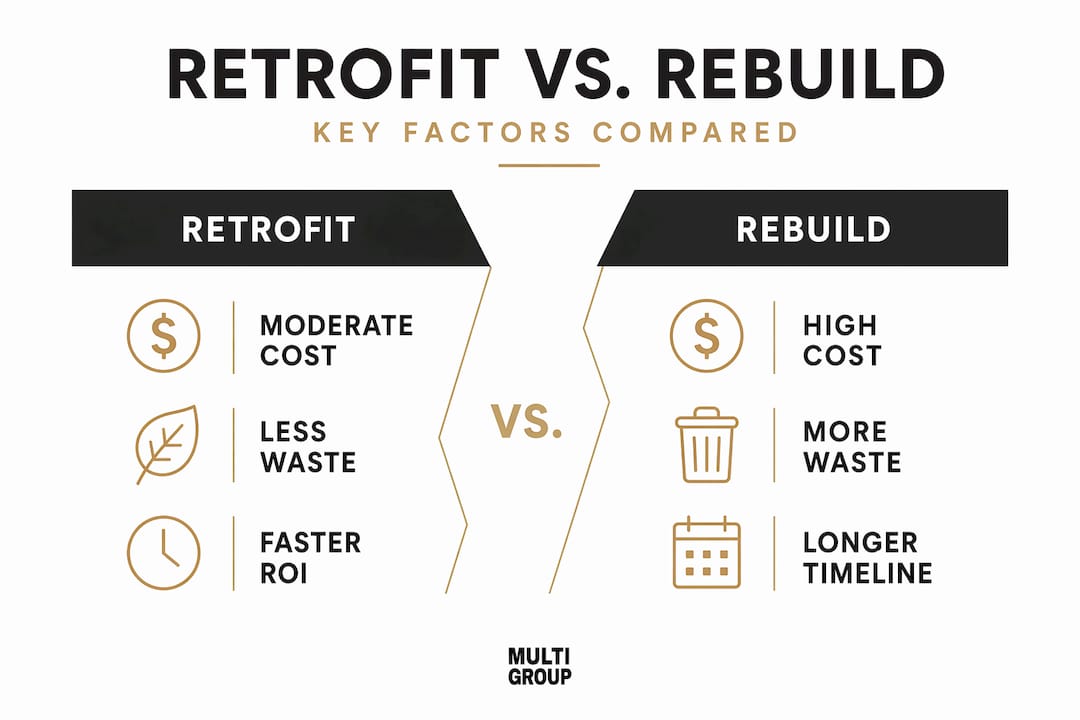
The financial picture extends beyond energy savings. Consider the following comparison:
| Factor | Retrofit | Demolish and Rebuild |
|---|---|---|
| Upfront cost | Moderate, scalable by phase | Very high, fixed commitment |
| Operational disruption | Manageable with phased approach | Full vacancy required |
| Asset value impact | Preserved and enhanced | Dependent on market timing |
| Carbon footprint | Reduces operational emissions | High embodied carbon from new construction |
| Timeline to ROI | 5 to 10 years for deep retrofits | 15 to 20+ years |
| Regulatory compliance | Addresses existing gaps incrementally | Compliant from day one but at full rebuild cost |
Retrofitting also improves your competitive position in the leasing market. Sustainability in commercial spaces has moved from a selling point to a tenant expectation in many markets. Green-certified or high-performing buildings attract quality tenants, retain them longer, and command better lease terms.
Pro Tip: Track renovation ROI across multiple channels: energy use intensity, carbon emissions, tenant satisfaction scores, and rental income. A single metric gives you an incomplete picture. Read more about smart value strategies that Vancouver property owners use to maximize returns on commercial upgrades.
Retrofitting without disrupting operations
The most common reason property owners delay retrofitting is the fear of disrupting tenants and losing rental income. This concern is legitimate but manageable. The key is in how the project is planned and sequenced.
The most effective approach uses a phased retrofit strategy, where upgrades are staged over time to minimize overlap and allow continuous occupancy. A well-executed phased plan typically looks like this:
- Phase one: No-regret measures. Begin with lighting upgrades, HVAC optimization, and building controls. These deliver immediate savings, require minimal construction, and cause the least disruption to tenants. They also fund subsequent phases through the savings generated.
- Phase two: Mechanical system upgrades. Replace aging HVAC equipment with electrified alternatives during low-occupancy periods or floor-by-floor. Coordinate scheduling with tenant lease renewals when possible.
- Phase three: Envelope improvements. Address insulation, window glazing, and exterior air sealing last, as these require the most coordination and have the longest payback periods.
"Deep retrofits can be completed while fully occupied with careful planning and tenant engagement." — ESRT Retrofit Program Study
The Empire State Building case study demonstrates this directly. ESRT's phased retrofit approach prioritized less intrusive work first, preserving tenant operations throughout. Modern technologies also help reduce physical disruption. Prefabricated panel systems for exterior insulation, for example, can be installed from the outside with minimal interior impact. Digital twins allow contractors to model and test system changes virtually before any physical work begins.
For property owners managing occupied buildings in Burnaby, Richmond, or Surrey, this phased approach is exactly how a well-run retrofit project should be structured. You can find detailed planning guidance in this commercial renovation guide for Richmond that covers how to stage work to protect tenant operations.

Challenges to plan for before you commit
Retrofitting delivers real results, but it is not without complications. Understanding these trade-offs upfront helps you avoid budget surprises and unrealized savings.
The performance gap. Deep retrofits often deliver only 60 to 75% of predicted savings unless rigorous commissioning and continuous monitoring are built into the project scope. The gap arises from occupant behavior, poor system calibration after installation, and inadequate handoff from contractor to facilities management. NYSERDA's evaluation of commercial energy management retrofits shows realization rates around 62% on electricity savings without ongoing performance tracking. That number improves significantly when post-occupancy evaluation is built into the plan from day one.
Embodied carbon. Not all retrofits are carbon-neutral in the near term. Embodied carbon in retrofit materials can represent 50% or more of lifecycle emissions when you factor in manufacturing and transportation. For a retrofit to deliver a genuine carbon benefit, the operational savings must outpace the embodied carbon within a reasonable timeframe. Lighter intervention, like controls upgrades and HVAC optimization, tends to have a faster carbon payback than heavy envelope work.
- Choose materials with Environmental Product Declarations (EPDs) to verify embodied carbon figures before specifying
- Prioritize reuse of existing structural and envelope elements where performance allows
- Sequence measures so operational savings begin generating carbon payback as early as possible
Split-incentive problems. In multi-tenant buildings, landlords pay for upgrades while tenants pay the utility bills and receive the savings. This misalignment discourages landlord investment. The solution is to structure lease agreements that allow for green lease clauses, where energy savings are shared between owner and tenant, or to factor retrofit costs into lease renewals at improved rates tied to verified performance improvements.
Financial and labor barriers. The upfront cost of retrofitting remains the primary obstacle for many owners. The most effective path forward is to combine available government incentives with phased project delivery so capital outlay is spread across multiple budget cycles rather than committed all at once.
My take on why retrofit decisions get delayed too long
I've watched property owners in Metro Vancouver sit on retrofit decisions for years, convinced that the disruption and upfront cost outweigh the return. In almost every case, when the numbers are finally run with a qualified contractor and an energy model behind them, the delay itself turns out to be the most expensive decision.
What I've found is that the fear of disruption is real but disconnected from reality when a project is planned properly. The buildings that struggle are the ones where retrofits are treated as one-time events rather than a phased program. You don't need to do everything at once. Starting with lighting controls and HVAC optimization in a single floor or zone costs relatively little, generates savings almost immediately, and builds the internal case for the next phase.
The other thing most owners underestimate is the asset value dimension. A commercial building with aging mechanical systems, high energy costs, and no green credentials is increasingly hard to lease in competitive markets like Vancouver, Portland, and Seattle. Tenants are screening buildings on operating costs and sustainability performance, not just location and floor plate. That trend is not reversing.
My advice: treat retrofitting as long-term asset management, not as a renovation project. Engage a contractor who understands the sequencing, has experience managing occupied buildings, and can coordinate across trades. The projects I've seen go wrong almost always come down to poor planning, not the retrofit concept itself.
— Momo
Ready to upgrade your commercial space?
Multigroup has worked with property owners and business operators across Metro Vancouver on commercial building improvements that protect tenant operations and deliver measurable returns. From warehouse upgrades in Burnaby to retail buildouts in Coquitlam and office tenant improvements in North Vancouver, the team manages every phase of the project: permits, scheduling, trades coordination, and communication with occupants throughout construction.

Whether you are evaluating a phased retrofit program or planning a full commercial renovation, Multigroup brings licensed, insured expertise to every project. The focus is always on completing work on time, within budget, and with minimal disruption to your tenants and operations. For property owners in Surrey, Richmond, and across the Metro Vancouver region, professional retrofit planning starts with a conversation.
Contact Multigroup Contracting today: Phone: 778-819-5933 Email: info@multigroup.ca Website: multigroup.ca
FAQ
What does it mean to retrofit a commercial space?
Commercial retrofitting means upgrading an existing building's systems, including HVAC, lighting, insulation, and controls, to improve energy performance, functionality, or both without demolishing and rebuilding. Retrofits range from targeted fixes to deep, integrated upgrades.
How much does commercial retrofitting cost?
Costs vary widely based on scope and building size. Shallow retrofits like lighting and controls upgrades cost far less than deep envelope and HVAC work. A major portfolio retrofit, like the ESRT program, ran at roughly $14 per square foot with a 6.5 year payback, but smaller projects can deliver returns much faster.
Can a commercial building be retrofitted while tenants are still in it?
Yes. With a phased approach that sequences less intrusive work first and schedules disruptive tasks during off-hours or floor rotations, occupied retrofits are entirely achievable. The Empire State Building retrofit proceeded without requiring tenant relocation.
How much energy can a commercial retrofit save?
Shallow retrofits typically achieve 10 to 20% reductions in energy use intensity. Deep, integrated retrofits addressing envelope, HVAC, lighting, and controls together can reach 40 to 60% reductions in energy use intensity.
Why do some retrofits underperform their projected savings?
The most common cause is inadequate commissioning after installation and no ongoing performance monitoring. Buildings often realize only 60 to 75% of predicted savings without these steps. Building in a commissioning and monitoring plan from the start closes that gap and protects your return on investment.