

TL;DR:
- Most property owners overlook pre-construction planning, risking costly rework that can amount to 19% of total project costs.
- Thorough early planning, including BIM coordination and stakeholder alignment, reduces rework, delays, and disputes significantly.
- Implementing disciplined preconstruction processes leads to predictable schedules, budgets, and higher client satisfaction.
Most property owners and developers treat pre-construction planning as an administrative formality rather than the most financially consequential phase of any build. That assumption is expensive. Research shows that rework alone costs up to 19% of total project cost, and a significant portion of that rework traces back to skipped or rushed planning before a single worker sets foot on site. Understanding why pre-construction planning matters is not just an academic exercise. For property owners, developers, and business operators in Metro Vancouver and beyond, it is the difference between a project that delivers on schedule and on budget and one that bleeds money from start to finish.
Table of Contents
- Key takeaways
- Why pre-construction planning is the most overlooked phase
- The financial case for thorough planning
- Common challenges and misconceptions
- How to implement pre-construction planning effectively
- Planning vs. minimal planning: the real trade-offs
- My take on what most owners get wrong
- How Multigroup approaches preconstruction for Metro Vancouver projects
- FAQ
Key takeaways
| Point | Details |
|---|---|
| Rework is the real cost driver | Skipping thorough planning leads to rework that can consume up to 19% of total project cost. |
| Fix errors early or pay more later | Correcting a design error during preconstruction costs roughly one-tenth of fixing it in the field. |
| Only 30% follow a consistent process | Most contractors lack a repeatable preconstruction process, creating predictability gaps. |
| BIM dramatically reduces rework | Building Information Modeling can cut rework-related time losses by 70% to 85% on complex projects. |
| Locked assumptions prevent disputes | Undefined scope assumptions at the start are the leading cause of costly change orders and contractor disputes. |
Why pre-construction planning is the most overlooked phase
In the construction industry, the term most professionals use is preconstruction or the preconstruction phase, sometimes called the pre-build or project planning phase. Whatever you call it, the activities within this phase set the foundation for everything that follows.
Preconstruction typically includes:
- Design reviews and value engineering: Identifying constructability issues, material substitutions, and scope refinements before drawings go to permit.
- Budgeting and cost estimating: Developing detailed quantity takeoffs, subcontractor pricing, and contingency planning based on current market rates.
- Scheduling: Building a preliminary project schedule that accounts for permit lead times, long-lead material procurement, trade sequencing, and inspections.
- Risk assessment: Identifying site-specific risks, utility conflicts, structural unknowns, and regulatory requirements specific to jurisdictions like Burnaby, Richmond, or Coquitlam.
- Permitting strategy: Mapping out the permit application sequence to avoid gaps that stall mobilization.
In Metro Vancouver, preconstruction is particularly important because of layered municipal requirements. A commercial tenant improvement in Surrey may face different occupancy classification rules than a similar project in North Vancouver. Getting those details right before construction begins is not optional.
The financial case for thorough planning
The numbers behind preconstruction are hard to argue with. According to research from the Construction Industry Institute, fixing a design error during preconstruction costs roughly one-tenth of what the same fix costs once work has reached the field. Multiply that ratio across a medium-sized retail buildout or warehouse renovation, and the savings potential becomes significant.
Here is how the financial impact breaks down across different project scenarios:
| Scenario | Without strong preconstruction | With strong preconstruction |
|---|---|---|
| Design errors discovered | During construction, at full cost | During review, at roughly 10% of the cost |
| Rework as % of total project cost | Up to 19% of total budget | Substantially reduced through coordination |
| Schedule delays | Common, compounding daily costs | Reduced through permit and procurement planning |
| Change order disputes | High frequency due to undefined scope | Low frequency with locked assumptions |
| Client satisfaction | Lower, tied to cost and schedule overruns | Higher, tied to predictable delivery |
The relationship between strong preconstruction and client satisfaction is well documented. Procore's 2026 State of Global Preconstruction Report found that organizations with above-average preconstruction processes consistently report higher profitability, less rework, and fewer project delays.

Technology amplifies these gains. A 2026 study published in Scientific Reports found that using BIM on bridge projects reduced rework-related time losses by 70% to 85% and delivered cost savings of 65% to 75% compared to projects without BIM. While bridge construction differs from commercial renovations, the underlying principle transfers directly. Clash detection, 3D coordination, and model-based quantity takeoffs during preconstruction catch problems that would otherwise materialize as expensive field changes.
Pro Tip: If your preconstruction process does not include at least one BIM-based coordination review for projects with multiple trades, you are likely carrying preventable risk into your construction phase.
Common challenges and misconceptions
One of the most persistent misconceptions about preconstruction is that it adds unnecessary time and cost to a project. Owners under schedule pressure often push to start construction before planning is complete, reasoning that work in the field is visible progress. In reality, accelerated schedules compress preconstruction windows and open what industry analysts call the "preconstruction gap," leading to coordination chaos and cost overruns downstream.
The organizational factors behind this gap are structural. Only about 30% of general and specialty contractors consistently follow an agreed-upon preconstruction process, which means the industry default is inconsistency. When contractors do not follow a repeatable process, owners bear the consequences in the form of schedule surprises and scope disputes.
Here is a practical sequence for improving preconstruction collaboration and reducing these risks:
- Align stakeholders early. Bring your general contractor, key subcontractors, and design team into the process before drawings are finalized. Early contractor involvement catches constructability issues at the lowest possible cost.
- Document every assumption. Many expensive change orders and schedule impacts originate from unconfirmed assumptions rather than actual scope changes. Write them down and get sign-off.
- Use structured review cycles. Effective preconstruction processes involve clear modeling standards and regular team alignment to distribute quality assurance rather than leaving it to a single reviewer.
- Build contingency with data. Generic 10% contingencies are not planning. Use historical cost data from comparable Metro Vancouver projects to set realistic contingencies by trade.
"Strong preconstruction is less about estimation and more about deeply managing project risk and schedule to achieve predictable outcomes." — Procore, 2026 State of Global Preconstruction Report
How to implement pre-construction planning effectively
For property owners and developers in Metro Vancouver, the practical steps for solid preconstruction are straightforward, but they require discipline and the right team.
Start by locking your project assumptions before engaging subcontractors for pricing. Undefined scope at the pricing stage produces bid spreads that are impossible to reconcile and nearly guarantee change orders later. California's SB 440 legislation, which requires written responses to change orders within 30 days on large private projects, illustrates how regulators are responding to the downstream consequences of poor preconstruction. While BC operates under different rules, the underlying problem, which is disputed scope from unresolved early assumptions, is identical.
The following preconstruction practices are particularly relevant for commercial projects in Metro Vancouver:
- Long-lead procurement planning: Identify mechanical equipment, custom millwork, and specialty materials early. In the current supply environment, lead times of 12 to 20 weeks for HVAC units or electrical switchgear can stall a project if not ordered during preconstruction.
- Permit sequencing: Work with your contractor to map the full permit pathway before construction begins. In Burnaby and Surrey, building permit timelines can vary significantly by project type, and knowing the sequence prevents mobilization delays.
- BIM coordination: Use 3D models to run clash detection between structural, mechanical, and electrical systems before those systems are installed. The cost of a model update is a fraction of the cost of relocated ductwork in the field.
- Scheduling certainty: Preconstruction scheduling and procurement certainty arise from planning long-lead items, permit sequencing, and inspections before mobilization. Build a detailed schedule with your contractor and lock it before groundbreaking.
Pro Tip: Engage your general contractor during the design development phase, not just at the tender stage. Early contractor involvement on projects in Richmond or Coquitlam often reveals local subcontractor capacity issues and material pricing conditions that directly affect your budget and schedule.
Learning more about commercial construction best practices specific to Metro Vancouver can help you frame your preconstruction expectations before meeting with a contractor.
Planning vs. minimal planning: the real trade-offs
Some developers, particularly those running fast-track or developer-driven projects, choose to compress or bypass preconstruction. The trade-offs are predictable and well-documented.
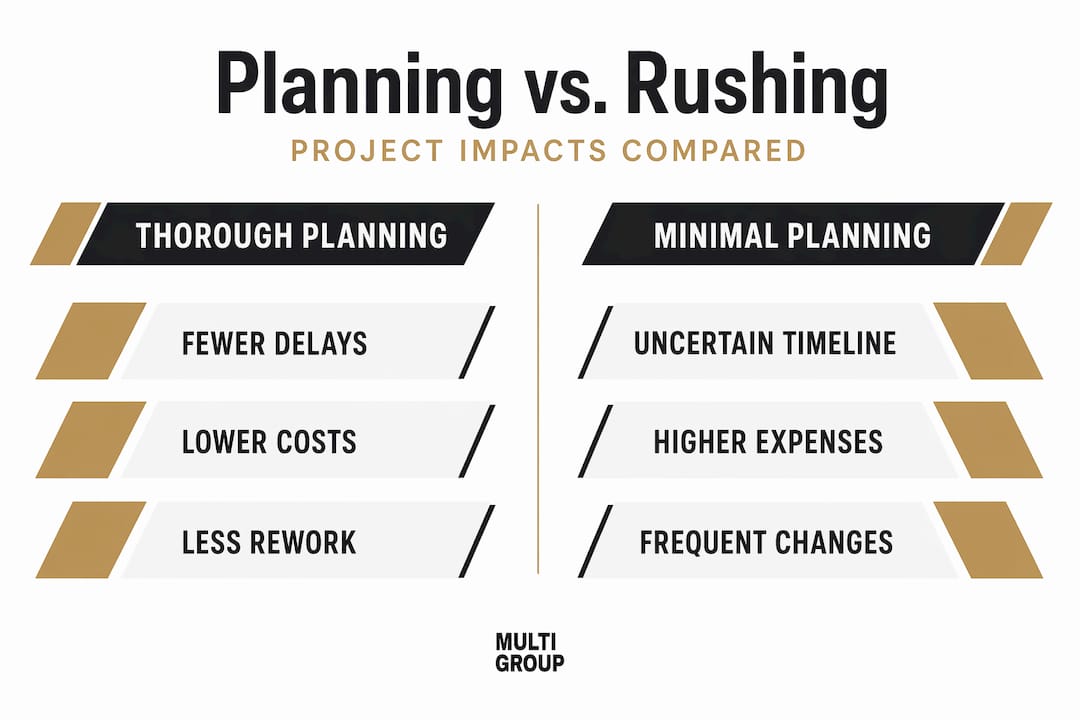
Without structured preconstruction, subcontractor bids are based on incomplete drawings. Gaps in scope get filled by assumptions, and those assumptions become change orders. For projects using Guaranteed Maximum Price contracts, the risk is even more concentrated. GMP contracts succeed only when preconstruction estimates and scope exclusions are clearly and progressively refined. A GMP set against a poorly defined scope is essentially a fiction that will unravel during construction.
The comparison is direct:
| Approach | Schedule predictability | Budget control | Dispute risk |
|---|---|---|---|
| Structured preconstruction | High | Strong, with data-backed contingencies | Low |
| Minimal planning, fast-track | Low to moderate | Weak, reliant on assumptions | High |
| No formal preconstruction | Unpredictable | Highly vulnerable to overruns | Very high |
Closing the preconstruction gap requires shifting coordination work earlier in the project timeline. That is not a philosophical position. It is a financial one. Projects that invest in preconstruction consistently outperform those that do not, and the margin of outperformance grows with project complexity.
My take on what most owners get wrong
I have watched a lot of projects get into trouble, and the pattern is almost always the same. The owner pushed to start construction before the plans were ready, assumed the contractor would figure out the details in the field, and then spent the back half of the project managing disputes and approving change orders.
What conventional wisdom misses is that preconstruction is not a cost. It is insurance with a guaranteed payout. In my experience, every dollar spent on thorough planning returns several times over in avoided rework, schedule recovery time, and professional fees spent on dispute resolution.
The projects I have seen run smoothest share one trait: the owner and contractor were aligned on scope, schedule, and assumptions before a permit was applied for. That alignment does not happen by accident. It is the product of a deliberate preconstruction process where decisions get made at the right time, by the right people, with the right information.
The trend I watch most closely now is the integration of digital coordination tools into earlier and earlier stages of preconstruction. BIM is no longer just a design tool. It is a risk management tool, and the contractors using it that way are delivering noticeably better outcomes for their clients.
— Momo
How Multigroup approaches preconstruction for Metro Vancouver projects

At Multigroup Contracting, preconstruction is built into every project from day one. Whether you are planning a tenant improvement in Burnaby, a retail buildout in Richmond, a warehouse renovation in Surrey, or a coffee shop renovation in North Vancouver, the team at Multigroup brings the same structured planning approach to every engagement.
Multigroup handles permit coordination, scheduling, subcontractor procurement, and budget management as integrated preconstruction services, not add-ons. The company is fully licensed and insured in BC, with direct experience across commercial construction projects throughout Metro Vancouver.
If you want your next project to start with a plan that holds, contact Multigroup Contracting at 778-819-5933, info@multigroup.ca, or visit multigroup.ca for a consultation.
FAQ
What is pre-construction planning in construction?
Pre-construction planning, known in the industry as the preconstruction phase, covers all project preparation before construction begins. It includes design reviews, budgeting, scheduling, risk assessment, and permitting strategy.
Why is construction planning necessary before breaking ground?
Starting construction without thorough planning leads to coordination gaps, costly rework, and change order disputes. Research shows rework can represent up to 19% of total project cost when preconstruction is weak.
How does pre-construction reduce project costs?
Fixing a design error during preconstruction costs roughly one-tenth of the same fix made during active construction, making early investment in planning one of the highest-return activities in any build.
What are the main benefits of construction planning for developers?
Structured preconstruction delivers stronger budget control, more predictable schedules, fewer disputes, and higher client satisfaction compared to projects where planning is rushed or skipped.
When should pre-construction planning begin?
Pre-construction planning should begin during design development, not at the tender stage. Engaging your general contractor early, before drawings are finalized, produces the most complete cost and schedule data.