

TL;DR:
- Design-build delivers projects up to 102% faster with better cost predictability than traditional methods.
- It streamlines communication by handling design and construction under one team, reducing delays and risks.
- Best suited for commercial, urgent, or fixed-budget projects, but may limit owner control in detailed design decisions.
Most property owners assume that splitting design and construction into separate contracts gives them more control and better pricing. The data tells a different story. Design-build delivers projects up to 102% faster than traditional methods, with stronger cost predictability and fewer surprises along the way. For Metro Vancouver property owners and business operators working in one of Canada's most competitive real estate markets, that kind of efficiency is not a minor perk. It can be the difference between opening on time or losing months of revenue to delays.
Table of Contents
- What is design-build? The basics explained
- How design-build saves you time and money
- Why Metro Vancouver is moving toward design-build
- When design-build might not be the right fit
- A fresh perspective on design-build's promise (and limits)
- Ready to see if design-build is right for your Vancouver project?
- Frequently asked questions
Key Takeaways
| Point | Details |
|---|---|
| Unified workflow | Design-build streamlines construction with one contract team, reducing miscommunication and delays. |
| Faster project delivery | Empirical studies show design-build can complete projects up to twice as fast as traditional methods. |
| Greater cost certainty | Owners see fewer budget surprises and as much as 6% lower costs with design-build. |
| Best for complex builds | Design-build excels with complex or urgent projects needing rapid decision-making and coordination. |
| Consider owner goals | If you want maximum design control or the lowest bid competition, another method may suit you better. |
What is design-build? The basics explained
Design-build is a project delivery method where a single entity handles both design and construction under one contract. Instead of hiring an architect separately and then putting the project out to bid for a general contractor, you work with one team from concept to completion. That team coordinates everything internally, which eliminates the communication gaps that often cause delays and cost overruns in traditional projects.
The traditional alternative is called design-bid-build. In that model, you hire a designer, wait for complete drawings, then solicit bids from contractors, then award a separate construction contract. Each handoff between parties creates an opportunity for miscommunication, scope disputes, and scheduling conflicts. The DBIA's 2025 Design-Build Data Sourcebook confirms that design-build enables overlapping of design and construction phases, which is the core reason it outperforms traditional delivery on speed.
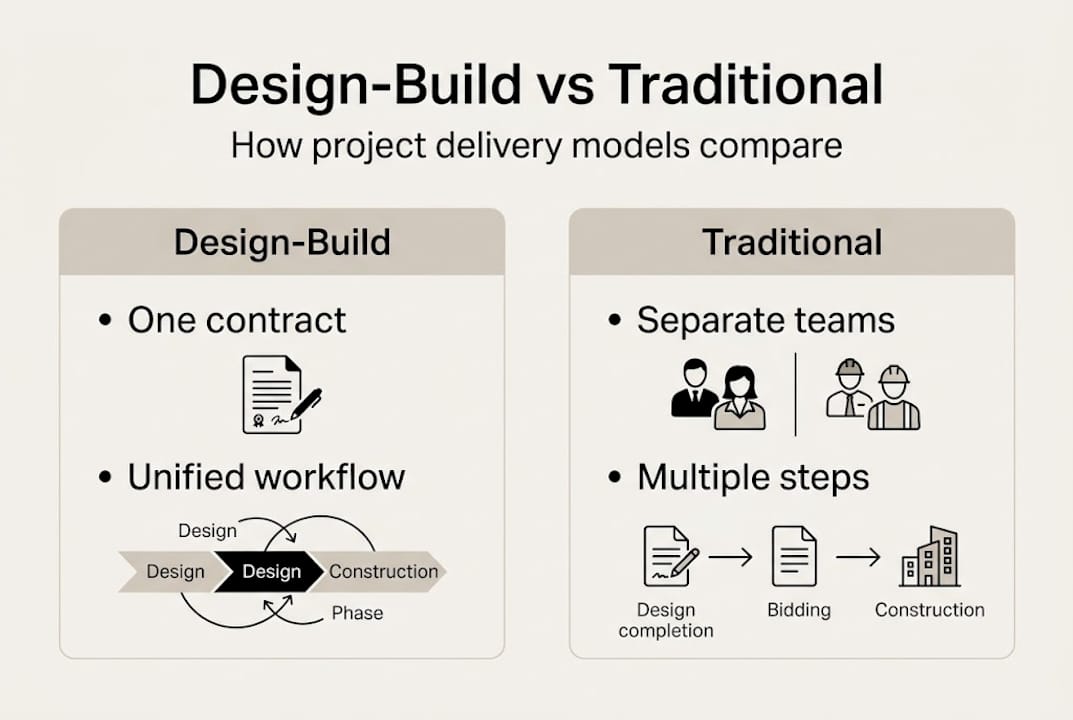
Here is a direct comparison of the two methods:
| Feature | Design-build | Design-bid-build |
|---|---|---|
| Contracts | Single contract | Multiple contracts |
| Team coordination | Unified team | Separate parties |
| Phase overlap | Yes | No |
| Cost certainty | Higher | Lower |
| Owner involvement | Outcome-focused | Detail-focused |
| Risk distribution | Shared with design-builder | Spread across parties |
Design-build works best for:
- Commercial renovations and tenant improvements (fit-outs for retail, office, or restaurant spaces)
- New builds where speed to market matters
- Projects with fixed budgets and firm deadlines
- Owners who want accountability from one source
For property owners managing project management in Vancouver, the single-point-of-responsibility model reduces the time spent coordinating between multiple parties and keeps your project moving forward without gaps.
How design-build saves you time and money
The numbers behind design-build are compelling. Design-build projects finish 33 to 102% faster and cost up to 6% less than projects delivered through traditional methods. For a business operator in Metro Vancouver, a faster project completion means earlier revenue generation and lower carrying costs on financing.
Here is how those savings break down in practice:
| Metric | Design-build | Traditional |
|---|---|---|
| Delivery speed | Up to 102% faster | Baseline |
| Cost growth | Lower variance | Higher variance |
| Schedule growth | Significantly reduced | More common |
| Unit cost | Up to 6% lower | Baseline |
Why does this matter so much in Vancouver specifically? The local construction market moves fast. Permit timelines, subcontractor availability, and material costs all fluctuate. When your design and construction teams operate as one unit, they can respond to those changes in real time rather than waiting for approvals between separate contracts. Staying current on Vancouver construction trends confirms that early project completion in this market translates directly to competitive advantage.
To realize these benefits, follow these steps:
- Define your project goals and budget clearly before engaging any firm
- Select a design-build firm with proven local experience
- Establish communication expectations and milestone checkpoints early
- Trust the process while staying engaged on key decisions
- Review progress against the agreed schedule at regular intervals
Pro Tip: Ask your design-build contractor to show you a sample project schedule from a similar past project. This gives you a realistic picture of timelines and helps you plan your business operations around the build.
Why Metro Vancouver is moving toward design-build
Vancouver's construction landscape is shifting. Owners and developers are increasingly choosing delivery models that prioritize speed, accountability, and budget control. This is not a coincidence. The pressures of rising construction costs, tight labor markets, and competitive real estate timelines are pushing the industry toward more efficient approaches.
Locally, design-build is showing up across a wide range of project types:
- Commercial towers and mixed-use developments where phased construction requires tight coordination between design and trades
- Urgent municipal and institutional projects where fixed deadlines are non-negotiable
- High-end residential renovations where clients want a single point of contact and a predictable outcome
- Retail and hospitality buildouts where business operators need fast turnaround to minimize lost revenue
This shift mirrors a broader North American trend. Nearly 50% of US non-residential projects will be design-build by 2028 due to its proven efficiency advantages. Canada, and Metro Vancouver in particular, is tracking closely behind that curve.
"The design-build model reduces the risk of finger-pointing between designers and contractors. When one team owns both phases, accountability is built into the structure."
The future of commercial construction in Vancouver points toward integrated delivery models as the standard, not the exception. Property owners who understand this now are better positioned to make informed decisions on their next project. Keeping up with renovation trends in the region shows that demand for efficient, accountable delivery is only growing.
When design-build might not be the right fit
Design-build is a strong model, but it is not the right fit for every project or every owner. Understanding its limitations helps you make a smarter decision before signing any contract.
According to a detailed design-build vs. design-bid-build guide, design-build may reduce owner control and shift more risk to the design-builder. For owners who want to be deeply involved in every design decision, review multiple design iterations, or have very specific aesthetic requirements, this can feel limiting.
Here are situations where design-build may not be the best choice:
- Highly customized design projects where the owner has a detailed vision and wants full control over every specification
- Public sector projects that legally require competitive low-bid procurement
- Projects with incomplete program requirements where the scope is still being defined
- Owners who prefer to manage separate design and construction contracts for internal governance reasons
The model works best when you come to the table with clear goals, a realistic budget, and a willingness to collaborate. If you are still exploring scope or comparing detailed renovation costs Vancouver across multiple options, spend time getting clarity before committing to any delivery method.
For a broader overview of all available options, reviewing the full range of project delivery methods helps you understand where design-build fits relative to alternatives like construction management at risk or integrated project delivery.
Pro Tip: If you are unsure whether design-build is right for your project, ask a contractor to walk you through both delivery models using your specific project as the example. The comparison will make the decision much clearer.
A fresh perspective on design-build's promise (and limits)
Here is something most articles on design-build skip: the model does not automatically produce better results. The delivery method creates the conditions for success, but the outcome still depends on the quality of the team and the clarity of the owner's input.
We have seen projects where owners chose design-build expecting it to handle everything, then disengaged from the process entirely. That is where problems start. Design-build reduces administrative complexity, but it does not eliminate the need for clear communication. Owners who define their goals precisely, establish budget boundaries early, and stay engaged at key milestones get dramatically better results.
The biggest risk in design-build is not the model itself. It is vague expectations. When an owner says "make it look modern" without defining materials, finishes, or functional requirements, the design-builder has to make assumptions. Those assumptions may not match what the owner had in mind.
Choosing the right firm matters just as much as choosing the right delivery method. A strong track record in commercial construction in Vancouver tells you more about likely outcomes than any contract structure alone. Vet your team carefully, ask for references from similar project types, and make sure their communication style matches yours before you start.
Ready to see if design-build is right for your Vancouver project?
Design-build simplifies the construction process for Metro Vancouver property owners and business operators who want faster delivery, stronger cost control, and a single accountable team. Whether you are planning a commercial renovation, a tenant improvement, or a ground-up build, the right delivery model can save you significant time and money.
Multigroup Contracting works with property owners and businesses across Metro Vancouver to plan and deliver projects efficiently. If you are weighing your options and want to understand how design-build applies to your specific situation, connecting with experienced design-build contractors in Vancouver is the most direct next step. Reach out to discuss your project goals and get a clear picture of what the process looks like from start to finish.
Frequently asked questions
How is design-build different from traditional construction methods?
Design-build uses a single contract for both design and construction, while traditional methods separate these phases with multiple contracts. This unified structure allows overlapping phases for faster delivery and reduces gaps between the design and construction teams.
Is design-build really faster and more cost-effective?
Yes. Studies show design-build is up to 102% faster and up to 6% less expensive than traditional approaches, making it a strong option for owners who need predictable timelines and budgets.
Does design-build reduce owner control over the project?
Design-build may reduce owner design control during the design phase, but it increases speed and accountability overall. It works best for owners who have clear goals and prefer outcome-focused involvement over detail-by-detail oversight.
What projects benefit most from design-build?
Design-build is ideal for complex, urgent, or large-scale projects where collaboration and fast delivery are priorities. According to a review of construction project delivery methods, it performs best when the owner's scope and budget are well defined from the start.
Recommended
- Top residential construction trends in Greater Vancouver for 2026
- Construction project management: delivering success in Metro Vancouver
- Multigroup Contracting | Vancouver General Contractor – Commercial & Residential Construction
- Multigroup Contracting | Vancouver General Contractor – Commercial & Residential Construction