
TL;DR:
- A custom home build involves homeowners controlling every design and material decision to create a property that fits their unique needs. It offers superior quality, energy efficiency, and adaptability, although it requires higher initial costs and active involvement throughout the process. Long-term benefits include increased resale value, lower energy expenses, and a home tailored to current and future lifestyles.
A custom home build is defined as a residential construction project where the homeowner directs every design and material decision from the ground up, rather than purchasing a pre-built or speculative home. This level of control is the core reason why choose custom home builds consistently ranks as the right answer for Metro Vancouver homeowners who want a property that fits their life precisely. Unlike buying an existing home, a custom build means your floor plan, materials, energy systems, and lot orientation all serve your specific needs. Working with a licensed BC contractor under the BC Building Code adds accountability and compliance to that creative freedom.
Why choose custom home builds over buying existing homes?
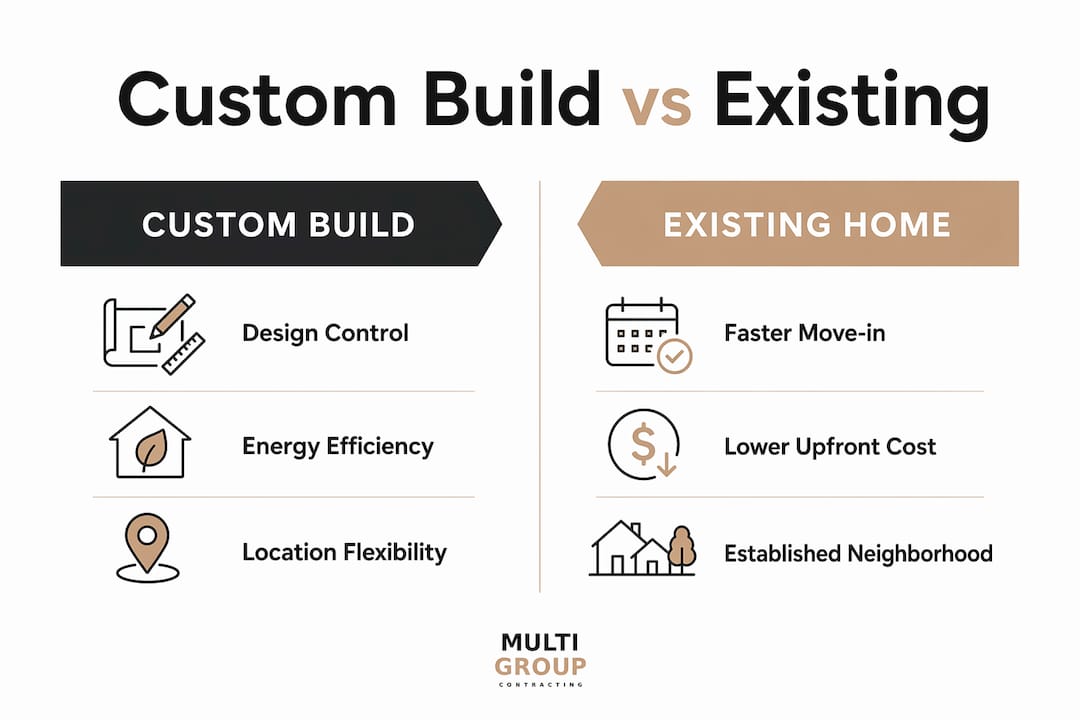
Custom builds and existing homes represent two fundamentally different approaches to housing. Buying an existing home means accepting someone else's layout, structural decisions, and material choices. Building custom means you define all of those from day one.
The differences go well beyond aesthetics. Custom building replaces the reactive search for housing adequacy with proactive utility design. That shift matters because most existing homes require costly compromises: walls in the wrong place, inadequate storage, outdated wiring, or poor sun orientation.
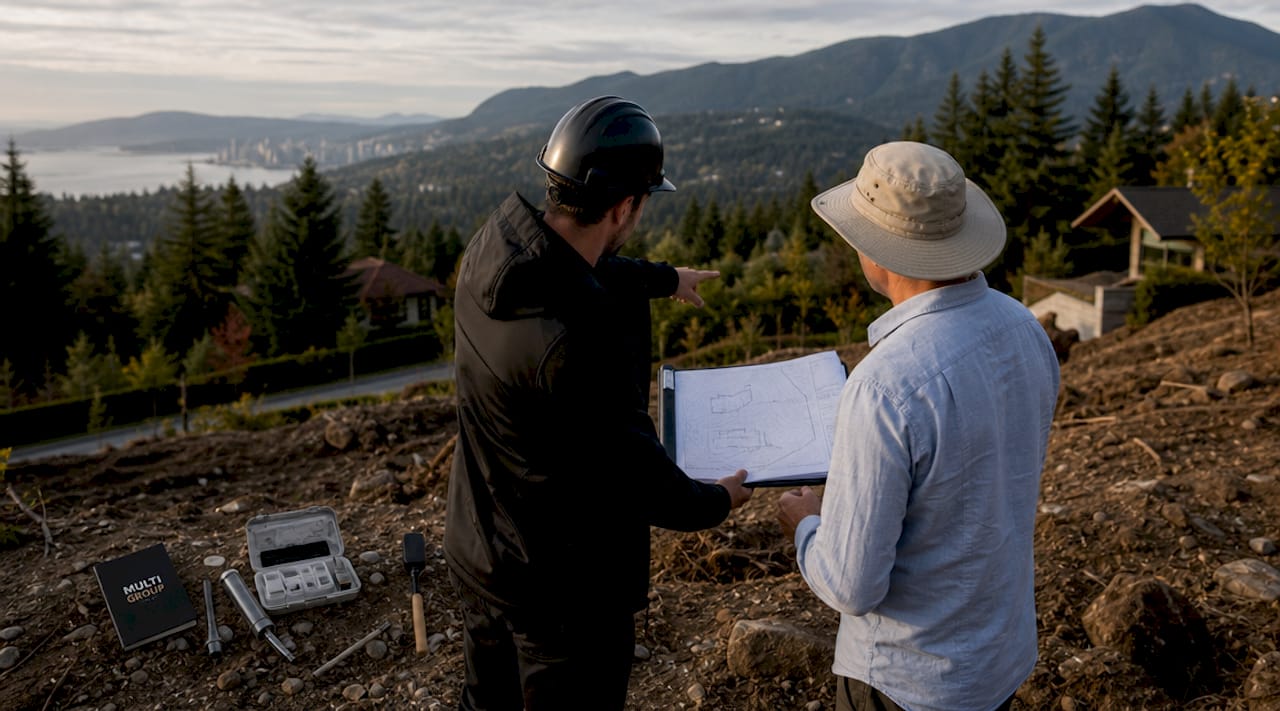
Custom builds also offer location freedom, letting you tailor architecture to your lot's specific topography and sun exposure. Maximising natural light or passive solar gain is simply not possible when you are constrained by an existing structure.
The table below compares the three most common paths to homeownership:
| Factor | Custom Build | Spec/New Build | Existing Home |
|---|---|---|---|
| Design control | Full | Limited | None |
| Material quality | Owner-specified | Builder-standard | Unknown |
| Energy performance | High | Moderate | Variable |
| Timeline | 12–24 months | 6–12 months | 30–90 days |
| Upfront cost | Higher | Moderate | Lower |
| Long-term value | Highest | Moderate | Depends on condition |
The timeline for a custom build is longer, but that time is spent making decisions that serve you for decades. A spec home delivers speed at the cost of personalisation. An existing home delivers speed at the cost of both.
How does custom building deliver superior quality and efficiency?
The quality gap between a custom home and a standard production build is structural, not cosmetic. True value in custom construction lies in engineered floor systems, commercial-grade waterproofing, and premium framing. These are elements hidden inside the walls that most buyers never think to ask about until something fails.
Custom homes built today can be 40%–50% more energy-efficient than those built 15 years ago. That gap comes from high-performance windows, advanced insulation, and solar-ready or geothermal-ready mechanical systems that exceed current BC Energy Step Code requirements. For a Metro Vancouver homeowner, that translates directly into lower BC Hydro bills and reduced carbon tax exposure year over year.
Key quality advantages in a custom build include:
- Engineered floor systems that eliminate squeaking and flex underfoot
- Commercial-grade waterproofing at foundations and wet areas, reducing moisture risk in BC's wet climate
- High-performance building envelopes with continuous insulation and air sealing that reduce heating and cooling loads significantly
- Owner-specified mechanical systems including heat recovery ventilators (HRVs), in-floor radiant heat, and EV-ready electrical panels
- Builder accountability through open-book pricing and owner involvement at every stage
Builder accountability is not a soft benefit. Transparency and open-book pricing are the primary tools for preventing cost overruns and maintaining trust through construction. A licensed BC contractor who involves you in decisions at each phase is structurally less likely to cut corners than a production builder working to a fixed margin.
Pro Tip: Ask your contractor to walk you through the building envelope specification before framing begins. Insulation type, air barrier details, and window performance ratings are decisions that cannot be corrected cheaply after the walls are closed.
Can a custom home adapt to your family's changing needs?
The most underrated benefit of custom home design is adaptability. A home built to your current life can also be planned for the life you expect to have in 10, 20, or 30 years. Homeowners are shifting from architectural compromise to proactive utility by building layouts that serve remote work, hosting, and aging in place simultaneously.
Planning for adaptability at the design stage costs far less than retrofitting later. Consider these four decisions that pay off over time:
- Wider doorways and hallways. Building to accessibility standards from the start costs roughly $500–$1,500 CAD extra. Retrofitting later can cost $10,000 or more.
- A main-floor bedroom or flex suite. This serves aging parents, adult children returning home, or short-term rental income without structural changes.
- Conduit runs for future technology. Pre-installed conduit for smart home wiring, solar panels, or EV charging adds minimal cost during framing and eliminates major disruption later.
- Structural rough-ins for future additions. A beam sized for a future deck or a foundation designed for a secondary suite keeps options open without committing budget now.
A generational mindset in design leads to material and system choices that age gracefully and remain serviceable over decades. This is the difference between building a home and building an asset. For Metro Vancouver homeowners, where property values are high and land is limited, a home that adapts without major reconstruction is a significant financial advantage.
Reviewing residential design tips specific to 2026 construction trends can help you identify which adaptability features are most relevant for your lot and lifestyle before you finalise your plans.
Pro Tip: Discuss "future-proofing" items with your contractor during the pre-design phase, not after drawings are complete. Changes on paper cost almost nothing. Changes during framing cost significantly more.
What are the financial implications of a custom home build?
Custom builds carry a higher upfront cost than buying an existing home. In Metro Vancouver, a fully custom residential build typically ranges from $350 to $600+ CAD per square foot depending on finishes, site conditions, and mechanical complexity. That number is real and should not be minimised.
The financial case for custom builds rests on long-term asset performance, not short-term savings. Custom homes command higher resale values due to premium materials and superior structural integrity. Buyers in the resale market pay a premium for homes with documented build quality, modern energy systems, and layouts that do not require immediate renovation.
| Cost Category | Custom Build | Existing Home Purchase |
|---|---|---|
| Purchase/build price | Higher upfront | Lower upfront |
| Immediate renovation needs | None | Often $50,000–$200,000+ CAD |
| Annual energy costs | Lower | Higher |
| Maintenance in first 10 years | Minimal | Moderate to high |
| Resale premium | Significant | Depends on condition |
The comparison shifts when you account for the renovation costs that almost always follow an existing home purchase in Metro Vancouver. A dated kitchen, outdated electrical panel, and poor insulation in a 1980s Surrey or Burnaby home can easily add $100,000–$150,000 CAD in immediate work. A custom build starts with none of those liabilities.
Owner involvement at every project stage, supported by experienced licensed contractors, also protects the financial investment. When you understand what is being built and why, you make better decisions and avoid costly changes mid-construction.
Pro Tip: Request a detailed line-item budget from your contractor before signing a construction agreement. Knowing exactly where your money goes, from permits and site prep to millwork and mechanical, gives you real control over the final number.
Key takeaways
Custom home builds deliver the highest long-term value for Metro Vancouver homeowners who prioritise design control, build quality, and a property that adapts to their life over decades.
| Point | Details |
|---|---|
| Design control is total | Every layout, material, and system decision serves your needs, not a builder's standard template. |
| Quality is structural, not cosmetic | Engineered floors, commercial waterproofing, and high-performance envelopes outperform standard builds. |
| Energy efficiency is measurable | Custom homes today can be 40%–50% more efficient than homes built 15 years ago. |
| Adaptability reduces future costs | Planning for accessibility, technology, and expansions at build time costs far less than retrofitting. |
| Long-term value exceeds upfront cost | Higher build cost is offset by lower maintenance, energy savings, and stronger resale performance. |
The part most homeowners learn too late
After working on residential builds across Metro Vancouver, from North Vancouver to Surrey and Coquitlam, one pattern stands out clearly. Homeowners who struggle with custom builds almost always made the same mistake: they treated the design phase as a formality and saved their real engagement for construction.
By the time framing starts, the decisions that matter most are already locked in. The building envelope, the structural system, the mechanical rough-ins. These are not finish selections. They are the foundation of every performance and cost outcome you will experience for the next 30 years. A homeowner who is deeply involved in pre-construction planning consistently ends up with a better home at a more predictable cost.
The other thing worth saying directly: the BC Building Code is a minimum standard, not a target. The best custom builds in this region exceed code on insulation, air sealing, and structural detailing because the licensed contractors running those projects know that meeting the minimum is not the same as building well. If your contractor cannot explain why their specification exceeds code in at least two or three areas, that is a conversation worth having before you sign anything.
Custom building is not the right path for everyone. It requires time, decisions, and active participation. But for homeowners who want a property that genuinely fits their life and holds its value in one of Canada's most competitive real estate markets, it is the most direct route available.
— MultigroupTeam
Build your custom home with Multigroup in metro vancouver
Multigroup is a licensed Vancouver general contractor with direct experience in residential custom builds across Metro Vancouver, including Burnaby, Richmond, North Vancouver, Surrey, and Coquitlam. Every project is managed with full BC Building Code compliance, permit handling, and transparent project scheduling from design through to occupancy.

If you are weighing the benefits of custom homes and want to understand what a build on your specific lot would involve, Multigroup offers detailed consultations that cover site assessment, budget framing, and construction timelines. Explore Multigroup's residential build services to see completed projects and connect with the team. You can also review the Metro Vancouver build planning guide for a practical overview of what to expect at each stage.
FAQ
What is a custom home build?
A custom home build is a residential construction project where the homeowner controls all design, material, and layout decisions from the ground up. Unlike spec or production homes, no two custom builds are identical.
Is a custom home worth the higher upfront cost?
Yes, for most Metro Vancouver homeowners. Higher build costs are offset by lower maintenance, reduced energy expenses, and stronger resale value compared to purchasing and renovating an existing home.
How long does a custom home build take in BC?
A typical custom build in Metro Vancouver takes 12–24 months from design to occupancy. Timeline depends on permit processing, site conditions, and the complexity of the design.
What makes custom homes more energy-efficient?
Custom homes use high-performance windows, continuous insulation, air sealing, and modern mechanical systems that exceed BC Energy Step Code standards. This can result in 40%–50% better energy performance than homes built 15 years ago.
Do i need a licensed contractor for a custom home build in BC?
Yes. BC law requires a licensed general contractor for new residential construction. A licensed contractor manages permits, ensures BC Building Code compliance, and carries the liability coverage that protects your investment throughout the build.