

TL;DR:
- Effective project scheduling organizes tasks, resources, and timelines to ensure successful completion within set deadlines. Regular updates, collaborative planning, and techniques like CPM and pull-planning significantly improve on-time project delivery. Consistently treating schedules as dynamic tools helps prevent delays, control costs, and manage construction risks effectively.
Project scheduling is the process of organising all project tasks, resources, and timelines into a structured, time-based plan that guides a project from start to finish. In construction, this process is the difference between a tenant improvement delivered on time and a renovation that bleeds weeks and budget. A schedule converts outline plans into visual workflow models, allowing teams to forecast the impact of any disruption before it becomes a crisis. Techniques like the Critical Path Method (CPM), Earned Value Management (EVM), and pull-planning are the industry's primary tools for building schedules that hold. Whether you are a project manager overseeing a warehouse renovation in Burnaby or a homeowner planning a custom build in North Vancouver, understanding how scheduling works is the foundation of every successful project.

What is project scheduling and why does it matter?
Project scheduling is a formal project management discipline that sequences activities, assigns resources, and sets deadlines to achieve a defined scope within a fixed timeframe. The term is often used interchangeably with "project timeline," but a true schedule goes further. It captures task dependencies, resource constraints, and critical milestones in a single model.
The stakes in Canadian construction are significant. Ineffective schedule management causes 71% of Canadian construction projects to finish late by an average of 4.7 months, costing the industry $5.2 billion annually. That figure means poor scheduling is not a minor inconvenience. It is a systemic financial risk affecting every stakeholder from the property owner to the general contractor.
A schedule also functions as a vital communication tool that visualises work flow and helps predict the impacts of disruptions in real time. When a subcontractor falls behind on framing, a well-built schedule shows immediately which downstream trades are affected and by how much. That visibility is what separates reactive project management from controlled delivery.
What are the main steps in creating a project schedule?
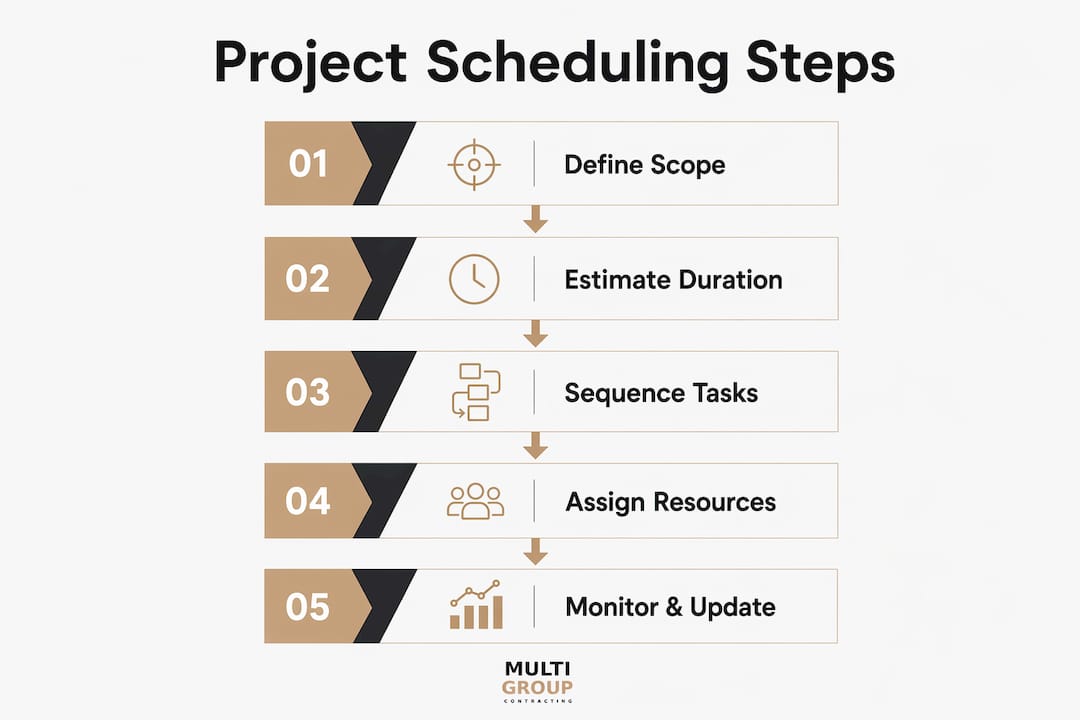
Building a reliable project schedule follows a clear sequence. Skipping any step compounds errors downstream, which is why experienced contractors treat each phase as non-negotiable.
- Define the project scope. Identify every deliverable and boundary of the work. For a retail buildout in Richmond, this means confirming the full list of trades, finishes, and permit requirements before a single date is set.
- Create a Work Breakdown Structure (WBS). Decompose the scope into individual work packages. A warehouse renovation in Surrey, for example, breaks into demolition, structural work, mechanical, electrical, and finishing phases.
- Identify task dependencies. Determine which activities must finish before others can start. Concrete cannot be poured before formwork is complete. Electrical rough-in must precede drywall.
- Estimate durations. Assign realistic time estimates to each task based on crew size, material lead times, and BC Building Code inspection windows. Optimistic estimates are the single most common cause of schedule failure.
- Sequence and link activities. Connect tasks using dependency relationships to build the network logic. This step produces the critical path, the longest chain of dependent tasks that determines the project's minimum duration.
- Assign resources. Load labour, equipment, and materials onto each task. Resource conflicts surface here, before they cause delays on site.
- Baseline the schedule. Lock the approved schedule as the performance benchmark. All future progress is measured against this baseline.
- Update continuously. A schedule that is not updated weekly is a historical document, not a management tool. Schedules must be treated as dynamic, living documents updated with actual progress.
Pro Tip: When estimating durations for permit-dependent activities in Metro Vancouver, add a buffer for BC Building Code inspection queues. Municipal inspection timelines vary significantly across Burnaby, Coquitlam, and the City of Vancouver, and ignoring this is one of the most common causes of schedule slippage on residential and commercial projects alike.
Which techniques improve project scheduling accuracy?
Traditional scheduling methods produce inconsistent results. Static Gantt charts, the most widely used format, carry only 40–50% accuracy on complex projects. Modern techniques push that figure to 80–85%. That gap represents the difference between a project that finishes on time and one that does not.
Critical Path Method (CPM)
CPM identifies the sequence of tasks that directly controls the project end date. Any delay on the critical path delays the entire project. CPM is the baseline technique for commercial renovation projects, tenant improvements, and new builds across Metro Vancouver.
Pull-planning and the Last Planner System
Pull-planning involves trades working backwards from key milestones to negotiate handoffs and commitments. Collaborative pull-planning raises schedule commitment reliability from the 54% industry average to 85%, reducing delays by up to 65%. The shift from top-down scheduling to collaborative commitment is one of the most impactful changes a construction team can make.
Rolling wave planning
Rolling wave planning provides detailed scheduling for near-term work while progressively elaborating future activities as more information becomes available. This approach suits projects where full scope details are not known at the outset, such as phased office renovations or multi-stage residential builds.
Look-ahead planning
Look-ahead planning over a 4–6 week window removes constraints before they become delays. It turns reactive site management into proactive preparation by identifying material shortages, inspection bookings, and subcontractor availability well in advance.
4D BIM integration
4D BIM links a 3D building model to the project schedule, creating a visual simulation of construction sequencing. 4D BIM integration boosts on-time delivery rates by 20–30% through early conflict identification. When updated weekly, it resolves logistical clashes before construction begins, which is particularly valuable on complex commercial projects in dense urban sites like downtown Vancouver.
Here is a quick comparison of scheduling methods by use case:
| Method | Best suited for | Key benefit |
|---|---|---|
| Critical Path Method (CPM) | Commercial builds, TI projects | Identifies schedule-controlling tasks |
| Pull-planning | Multi-trade construction | Raises commitment reliability to 85% |
| Rolling wave planning | Phased or evolving projects | Balances detail with flexibility |
| Look-ahead planning | Active construction sites | Removes constraints 4–6 weeks out |
| 4D BIM | Complex commercial projects | Visual conflict detection before build |
Pro Tip: For construction workflow management, digital tools that integrate scheduling with daily site communications reduce the gap between planned and actual progress. The best results come from teams that update the schedule and the site log simultaneously.
Why does effective scheduling matter and what goes wrong?
Quality planning reduces risk, minimises rework, and aligns procurement with construction sequencing. The importance of project scheduling is not theoretical. It is the mechanism that keeps a coffee shop renovation in Kitsilano from running three months over and costing the owner $40,000 in lost revenue.
Poor scheduling failures share three root causes: unrealistic timelines set without trade input, resource constraints that are identified too late, and a lack of collaborative planning at the project outset. Addressing all three before construction starts is the only reliable way to protect the schedule.
The most common scheduling challenges in construction include:
- Optimistic duration estimates. Planners routinely underestimate task durations, particularly for permit inspections, custom material fabrication, and millwork installation.
- Unresolved resource conflicts. Assigning the same crew or equipment to overlapping tasks creates bottlenecks that cascade through the schedule.
- Scope changes without schedule updates. Every approved change order must trigger a schedule review. Failing to do so disconnects the plan from reality within weeks.
- Insufficient stakeholder input. Schedules built without input from subcontractors, suppliers, and the client miss critical constraints that only those parties know.
- Treating the schedule as a one-time document. A schedule that is not updated regularly loses its value as a management tool and becomes a source of conflict rather than clarity.
How is project scheduling applied in construction and homeowner projects?
Practical scheduling in construction looks different depending on project type, but the core principles apply across a warehouse renovation in Delta, a leasehold improvement in Coquitlam, or a custom residential build in West Vancouver.
Project schedulers align engineering, procurement, and contracting teams with timelines and contractual goals. On a tenant improvement project, this means coordinating the base building landlord's work, the permit timeline, and the fit-out trades in a single integrated schedule. Missing any one of those threads delays occupancy.
Key practices for construction and homeowner projects:
- Coordinate permit timelines early. BC Building Code compliance requires permits for structural, mechanical, and electrical work. In Metro Vancouver, permit approval timelines range from two weeks to several months depending on project complexity and municipality. Build this into the schedule from day one.
- Communicate the schedule to all subcontractors. Every trade on site should have access to the current schedule and understand their start dates, durations, and handoff obligations. A construction scheduling checklist helps formalise this communication.
- Track progress weekly. Compare actual completion percentages against the baseline. Identify slippage early and adjust the schedule before delays compound.
- Use look-ahead schedules for active sites. A 4–6 week look-ahead, shared in weekly site meetings, keeps all trades aligned and surfaces material or inspection constraints before they stop work.
- Plan for weather and site access. Exterior work in Metro Vancouver is subject to significant rainfall from october through march. Scheduling exterior envelope work outside the wet season reduces weather-related delays.
For homeowners managing a renovation, the residential project workflow follows the same logic at a smaller scale. Knowing when your contractor needs decisions from you, when materials must be ordered, and when inspections are booked keeps the project moving without surprises.
Pre-construction planning is the single highest-return activity in any project. Decisions made before construction begins cost a fraction of changes made during construction. A well-developed schedule is the primary output of that planning phase.
Key takeaways
Effective project scheduling is the single most reliable predictor of on-time, on-budget project delivery in construction, requiring CPM logic, collaborative planning, and continuous schedule updates to succeed.
| Point | Details |
|---|---|
| Define scope before scheduling | A complete Work Breakdown Structure prevents missed tasks and unrealistic timelines. |
| Use CPM to control the critical path | Identify the task chain that controls your end date and protect it from delays. |
| Adopt pull-planning for multi-trade projects | Collaborative scheduling raises commitment reliability from 54% to 85%. |
| Update the schedule weekly | A static schedule loses accuracy within weeks; treat it as a live document. |
| Plan permits into the timeline | BC Building Code inspections and permit approvals must be scheduled, not assumed. |
Scheduling is a discipline, not a document
After years of working on commercial renovations and residential builds across Metro Vancouver, the pattern is consistent. The projects that finish on time are not the ones with the most detailed initial schedule. They are the ones where the schedule is treated as a working tool, updated every week, shared with every trade, and revised every time scope changes.
The biggest misconception I see is that scheduling is a one-time task completed during pre-construction. In practice, a schedule that is not actively maintained becomes a liability. It creates false confidence and masks the real state of the project until the delay is too large to recover.
The second misconception is that technology alone solves scheduling problems. 4D BIM and pull-planning software are genuinely powerful, but they require disciplined input and consistent team engagement to deliver results. A poorly maintained digital schedule is no better than a poorly maintained paper one.
What actually works is combining a sound CPM baseline with weekly look-ahead planning, collaborative trade input, and a project manager who treats schedule updates as a non-negotiable part of the job. That combination, not any single tool or technique, is what separates projects that deliver from projects that disappoint.
— MultigroupTeam
Multigroup's approach to project scheduling in Vancouver
Multigroup is a licensed general contractor serving Metro Vancouver, including Burnaby, Richmond, Surrey, Coquitlam, North Vancouver, and West Vancouver. Every commercial renovation project Multigroup delivers, from tenant improvements and retail buildouts to warehouse renovations and office fit-outs, is managed with a structured project schedule from pre-construction through occupancy.

Multigroup handles permit coordination, BC Building Code compliance, subcontractor scheduling, and client communication as part of every project scope. Property managers, business owners, and developers across Metro Vancouver rely on Multigroup's scheduling discipline to protect their timelines and budgets. Contact Multigroup to discuss your next commercial or residential project and get a schedule-backed plan from day one.
FAQ
What is project scheduling in simple terms?
Project scheduling is the process of listing all project tasks, estimating how long each takes, and arranging them in the order they must be completed. The result is a time-based plan that guides the entire project team.
What is the difference between a project schedule and a project timeline?
A project timeline shows key dates and milestones in sequence. A project schedule goes further by including task dependencies, resource assignments, and critical path logic, making it a management tool rather than just a visual summary.
Which project scheduling technique is most reliable for construction?
The Critical Path Method (CPM) combined with pull-planning produces the most reliable results in construction. Pull-planning raises schedule commitment reliability to 85% compared to the 54% industry average, significantly reducing delays.
How often should a construction schedule be updated?
A construction schedule should be updated at minimum once per week. Schedules treated as static documents lose accuracy quickly and fail to reflect real site conditions, which is a leading cause of unmanaged delays.
How does BC Building Code compliance affect a project schedule?
BC Building Code compliance requires permits and inspections at multiple project stages, including structural, mechanical, and electrical work. In Metro Vancouver, permit timelines vary by municipality and must be built into the schedule from the start to avoid delays.