

TL;DR:
- Effective construction cost management involves actively tracking on a live budget to prevent overruns. Regular reviews and advanced ERP tools enable early detection of variances, safeguarding profit margins. Ownership by project managers and disciplined change ordering are essential for successful cost control.
Cost control in construction is defined as the active management of project expenditures to keep spending within an approved budget and protect profit margins throughout every phase of a build. The industry term for this practice is construction cost management, and it covers budgeting, tracking, forecasting, and corrective action taken before overruns occur. General contractors commonly operate on thin profit margins of 3–8%, meaning a 5% budget overrun can eliminate a project's profit entirely. For construction managers and project stakeholders in Metro Vancouver, understanding how to control costs in construction is not optional. It is the difference between a profitable project and a financial loss.
What is cost control in construction and why does it matter?
Cost control in construction is a proactive process, not a reactive one. It differs from cost accounting, which records what has already been spent. Construction budget control requires comparing actual costs against a baseline budget in real time, then acting on the gap before it widens.
The primary cause of cost overruns is a lack of integrated responsibility. Project managers must own budget tracking and forecasting beyond isolated accounting. When that ownership is absent, costs drift without anyone catching the variance until it is too late.
For commercial renovation projects in Metro Vancouver, this matters even more. BC Building Code compliance, permit fees, and subcontractor scopes add layers of cost that shift throughout a project. A licensed contractor without a live cost management system is flying blind.
What are the core components of a construction cost control system?
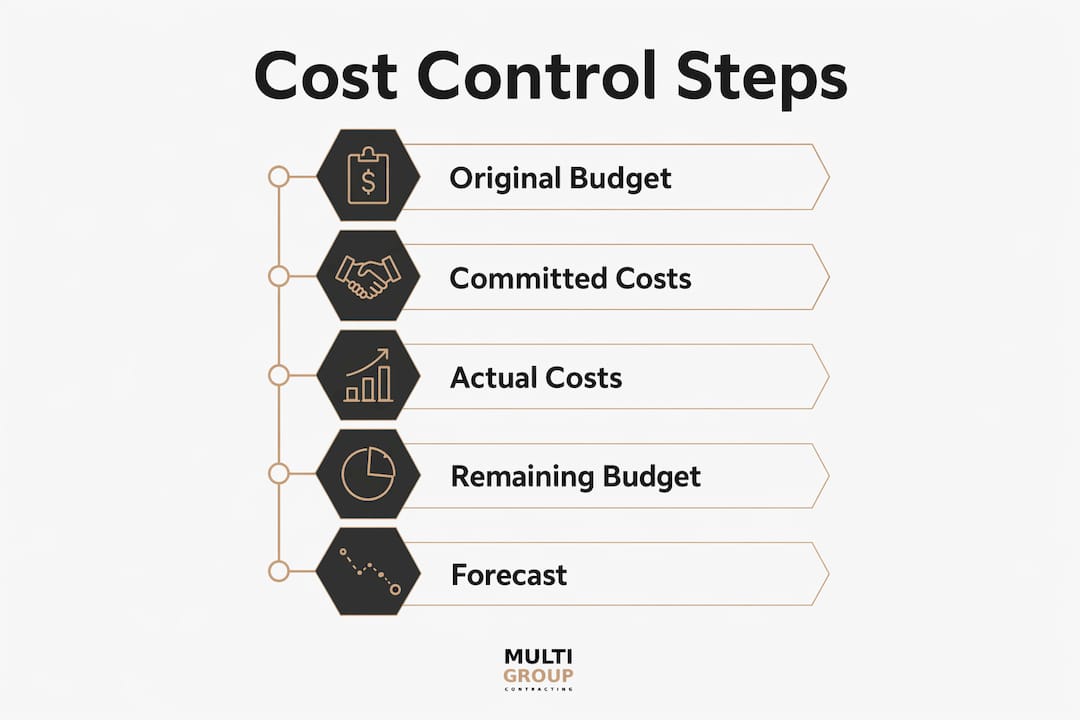
Best-in-class cost control systems track five components: the original budget, committed costs, actual costs, remaining budget, and forecasted final cost. Each component serves a distinct function in keeping a project financially on track.
Here is how each component works in practice:
- Original budget: The approved baseline established before work begins. This figure does not change once set.
- Committed costs: Contracts and purchase orders that have been signed but not yet invoiced. These represent financial obligations already made.
- Actual costs: Invoices paid, labour hours logged, and materials received. This is the real spending to date.
- Remaining budget: The difference between the original budget and committed plus actual costs combined.
- Forecasted final cost: A forward-looking projection of total spend at project completion, updated continuously.
The relationship between these five components tells a project manager whether the project is trending on budget, over budget, or recovering. A forecasted final cost that exceeds the original budget is an early warning signal, not a post-project finding.
| Component | What it measures | When it changes |
|---|---|---|
| Original budget | Approved baseline spend | Set once at project start |
| Committed costs | Signed contracts and POs | Updated as agreements are executed |
| Actual costs | Invoices, labour, materials paid | Updated continuously |
| Remaining budget | Available funds left | Recalculated at every review |
| Forecasted final cost | Projected total at completion | Revised at every financial review |
Effective construction cost control requires a regular financial review cadence. The standard is monthly joint reviews between project managers and finance teams, increasing to bi-weekly for complex or high-value projects. That frequency keeps the forecasted final cost accurate and gives teams time to act.

Pro Tip: Set your bi-weekly review as a fixed calendar event from day one of the project. Teams that schedule reviews reactively miss the window to correct variances before they compound.
How do modern tools improve construction cost control?
Spreadsheet-based reporting was the industry standard for decades. It is no longer sufficient for projects where costs move daily across multiple subcontractors, material suppliers, and labour crews.
Leading firms now use integrated ERP platforms for automated, real-time cost control. These platforms connect field data directly to financial reporting, eliminating the lag between a cost event and its appearance in the budget. That lag is where overruns hide.
The shift from manual monthly reporting to real-time ERP systems helps catch cost variances early and supports proactive cost management. A variance caught in week two of a four-week billing cycle is correctable. A variance caught at month-end invoice review often is not.
Key capabilities that modern construction cost management platforms provide include:
- Real-time field cost capture: Labour hours, material deliveries, and equipment usage logged on-site and synced immediately.
- Automated work-in-progress (WIP) reporting: Continuous calculation of costs incurred versus costs billed, giving a live picture of project financial health.
- Variance alerts: Automated flags when actual costs exceed committed costs or when a cost code is trending over budget.
- AI-powered forecasting: Pattern recognition across historical project data to predict cost risks before they materialise.
- Integrated change order tracking: All approved, submitted, and pending changes captured in one system, linked directly to the budget.
Live cost visibility changes how project managers make decisions. When a subcontractor's invoice arrives 15% above the purchase order, an integrated system flags it immediately. Without that system, the discrepancy may not surface until the next monthly report.
Pro Tip: When evaluating construction management platforms, prioritise those that integrate directly with your accounting software. Platforms that require manual data exports between systems reintroduce the same lag you are trying to eliminate.
What are the most common cost control failures in construction?
Most budget overruns on construction projects trace back to a small set of repeatable mistakes. Recognising them is the first step to preventing them.
-
Treating the initial estimate as a static document. Failing to maintain estimates as living budgets that integrate every purchase, labour hour, and change order erodes cost control from the start. The estimate must evolve with the project, not sit frozen in a pre-construction spreadsheet.
-
Poor timesheet discipline. Project managers who do not enforce timesheet discipline cause indirect costs to inflate general and administrative expenses, obscuring project profitability. Labour hours not logged against specific job codes inflate overhead and distort true project costs.
-
Lump-sum invoice entry. Invoices entered without itemising costs against estimate line items lose budget control and make variance analysis unreliable. Every invoice must reconcile to a specific budget line, not a general cost category.
-
Incomplete change order tracking. Change order management must distinguish approved changes, submitted but unapproved changes, and pending changes. Costs incurred before formal contract updates are a major source of budget erosion. A project manager who approves verbal scope changes without a formal change order is spending money that has no budget home.
-
Absent project manager ownership. Budget tracking delegated entirely to an accounting team, without active project manager involvement, breaks the link between field reality and financial reporting. The project manager is the only person who knows what is happening on-site and what it will cost to finish.
Pro Tip: Create a change order log as a live document, not a monthly summary. Every scope discussion, even informal ones, should generate a written record. This protects your budget and your client relationship.
How to implement cost control in Metro Vancouver construction projects
Applying financial planning in construction to a Metro Vancouver commercial renovation or tenant improvement project requires adapting general principles to local conditions. BC Building Code compliance, municipal permit timelines, and the region's subcontractor market all affect how costs move.
A practical implementation follows these steps:
- Establish a dynamic cost baseline before permits are pulled. Include permit fees, BC Building Code compliance costs, and contingency allowances in the original budget. For commercial renovations in Metro Vancouver, permit timelines vary by municipality and can affect labour scheduling costs.
- Use CAD pricing estimates for all budget line items. Budgeting in Canadian dollars with current Metro Vancouver material and labour rates prevents the gap between estimate and actual that appears when generic pricing is used.
- Schedule joint financial reviews from project kickoff. Monthly reviews are the minimum standard. For tenant improvements, warehouse renovations, or retail buildouts with active subcontractor scopes, bi-weekly reviews are the correct cadence.
- Monitor subcontractor scopes against committed costs weekly. Each subcontractor's purchase order is a committed cost. Any scope deviation must trigger a formal change order before work proceeds.
- Maintain a live change order register. Categorise every change as approved, submitted, or pending. Do not allow costs to be incurred against pending changes without written authorisation.
The table below shows a simplified cost control structure for a typical Metro Vancouver commercial renovation:
| Cost category | Budget line example | Review frequency |
|---|---|---|
| Permits and compliance | BC Building Code, municipal fees | At permit issuance and close |
| Labour | Framing, electrical, millwork crews | Bi-weekly via timesheet review |
| Materials | Drywall, flooring, fixtures | Weekly against purchase orders |
| Subcontractors | HVAC, plumbing, glazing | Bi-weekly against PO and invoice |
| Change orders | Scope additions, design revisions | Continuous, live register |
For construction project management in Metro Vancouver, the combination of a live cost baseline, disciplined change order tracking, and regular joint reviews is the foundation of budget control. Technology supports that foundation, but the process must be in place first.
Pro Tip: Build your contingency line as a separate budget item, not a hidden buffer inside other line items. A visible contingency is managed. A hidden buffer gets spent without anyone noticing.
Key takeaways
Effective construction cost management requires five tracked components, a regular review cadence, and project manager ownership to prevent budget overruns and protect margins.
| Point | Details |
|---|---|
| Five-component tracking | Track original budget, committed costs, actual costs, remaining budget, and forecasted final cost on every project. |
| Review cadence matters | Monthly reviews are the minimum standard; bi-weekly reviews are required for complex or high-value projects. |
| Project manager ownership | Budget tracking must be owned by the project manager, not delegated solely to accounting teams. |
| Change orders need categories | Distinguish approved, submitted, and pending changes to prevent unbudgeted costs from eroding margins. |
| Technology accelerates control | Real-time ERP platforms catch variances faster than monthly spreadsheet reporting and support proactive decisions. |
Cost control in construction: what I have learned managing Metro Vancouver projects
The most persistent myth in construction cost management is that a detailed pre-construction estimate is enough. It is not. An estimate is a starting point. A working budget is a living document that absorbs every change, every invoice, and every labour hour logged against the project. The gap between those two things is where most overruns live.
What I have seen repeatedly in Metro Vancouver commercial renovation projects is that the teams with the tightest margins are not always the ones with the best estimates. They are the ones with the most disciplined review processes. A project manager who sits in a bi-weekly cost review and can explain every variance by line item is worth more to a project's profitability than any software platform.
Technology matters, and the shift to integrated ERP platforms is real and necessary. But technology without process discipline produces accurate reports of a budget that is already out of control. The sequence is process first, then technology to support it.
The future of cost control in construction will be shaped by AI-powered forecasting that identifies risk patterns before they become overruns. For Metro Vancouver contractors competing in a market with high labour costs and complex permit environments, that capability will separate competitive firms from the rest. The contractors who invest in both the process and the tools now will be the ones who protect their margins when project complexity increases.
— MultigroupTeam
Multigroup's approach to budget-controlled commercial renovations
Multigroup is a licensed Vancouver general contractor with direct experience managing commercial renovation projects across Metro Vancouver, including tenant improvements, retail buildouts, warehouse renovations, and office renovations. Every project Multigroup delivers includes active cost management: a dynamic budget baseline, regular financial reviews, and formal change order tracking from day one.

For property managers, business owners, and developers who need a contractor that treats budget discipline as a core deliverable, Multigroup brings the project management structure to back it up. From permit handling in Burnaby and Richmond to subcontractor coordination in Surrey and Coquitlam, the team keeps costs visible and decisions informed. Contact Multigroup to discuss your next commercial renovation with a contractor who manages budgets as carefully as the build itself.
FAQ
What is cost control in construction?
Cost control in construction is the active process of tracking, forecasting, and managing project expenditures to keep spending within an approved budget. It differs from cost accounting by focusing on prevention rather than recording.
Why do construction projects go over budget?
The primary cause of cost overruns is a lack of integrated responsibility, where project managers do not actively own budget tracking and forecasting alongside the accounting team. Poor change order management and lump-sum invoice entry are also major contributors.
How often should construction cost reviews happen?
Monthly joint reviews between project managers and finance teams are the standard minimum. For complex or high-value projects, bi-weekly reviews are the recommended cadence to catch variances before they compound.
What are the five components of a cost control report?
A complete cost control report tracks the original budget, committed costs, actual costs, remaining budget, and forecasted final cost. Together, these five components give a real-time picture of project financial health.
How does change order management affect construction budgets?
Untracked change orders are one of the most common sources of budget erosion. Costs incurred before formal contract updates are approved create spending with no budget line, which is why every change must be categorised as approved, submitted, or pending before work proceeds.