
TL;DR:
- Construction quality control involves inspecting, testing, and documenting work to meet design and code standards. It is essential for protecting margins, ensuring regulatory compliance, and delivering defect-free projects in BC and Metro Vancouver.
Construction quality control is defined as the systematic, reactive process of inspecting, testing, and documenting construction work to verify it meets design specifications, applicable codes, and client expectations. Every phase of a build carries risk. Rework costs alone account for 2% to 20% of project budgets, with avoidable errors averaging around 5%. For construction professionals in BC and Metro Vancouver, understanding what is construction quality control is not optional. It is the operational foundation that protects margins, satisfies regulators, and keeps projects on schedule.
What is construction quality control and what does it aim to achieve?

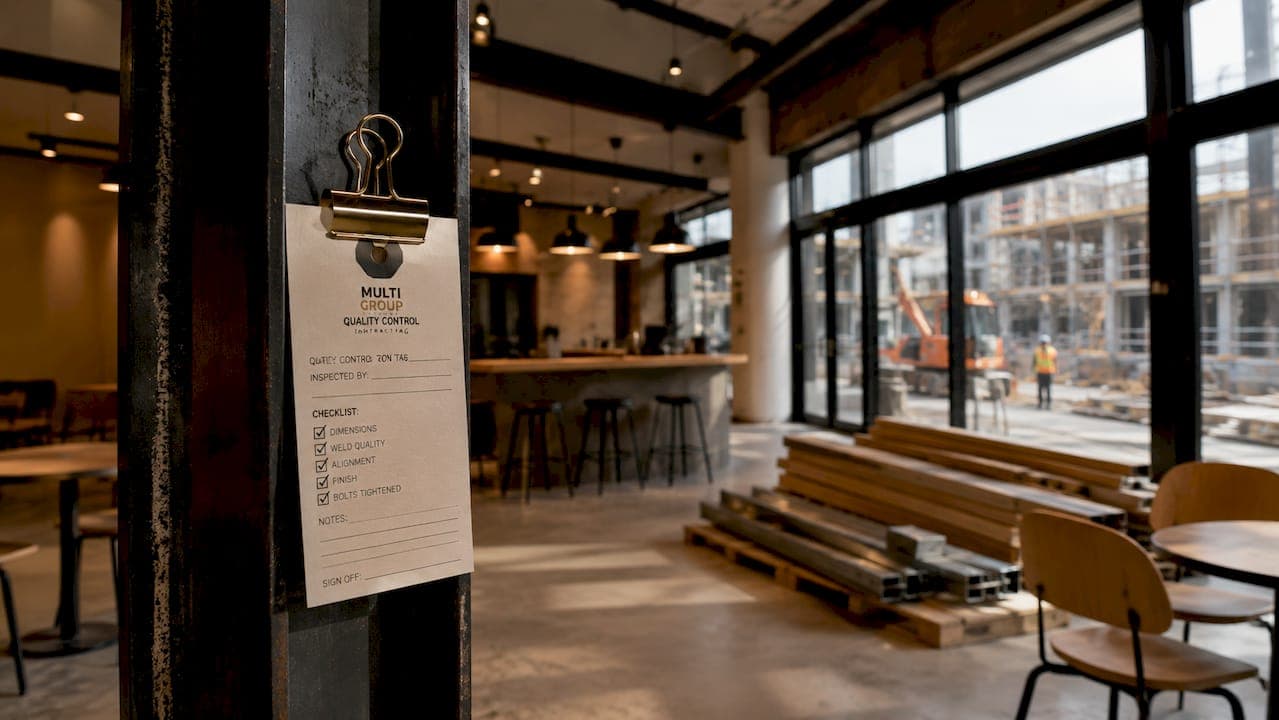
Construction quality control, formally known as QC within a quality management system (QMS), is the reactive verification process that confirms completed work meets pre-defined acceptance criteria. It operates during execution phases, not before them. QC is the hands-on layer of construction quality management practices: the site inspector checking concrete slump, the supervisor signing off on framing before drywall closes the wall, the technician documenting weld test results.
The core objectives of QC are straightforward:
- Verify conformance: Confirm that materials, workmanship, and installations meet design drawings, specifications, and the BC Building Code.
- Detect defects early: Identify non-conformances at the point of work, before they are buried by subsequent trades.
- Enforce first-time quality: Gatekeeping inspections prevent trades from proceeding past a checkpoint until work is confirmed acceptable.
- Maintain accountability: Assign clear responsibility for each inspection activity to a named individual or role.
- Create a documented record: Produce an audit trail that supports permit sign-offs, warranty claims, and regulatory compliance.
The distinction between detecting a defect at framing stage versus discovering it after finishes are installed is the difference between a one-hour fix and a multi-day rework event. QC exists to catch problems at the cheapest possible moment.
How does construction quality control differ from quality assurance?
Quality assurance (QA) is proactive. Quality control is reactive. QA designs the systems, standards, and processes that should produce good work. QC verifies whether that work actually met the standard. Failing to distinguish the two is one of the most common causes of quality failures on construction projects.
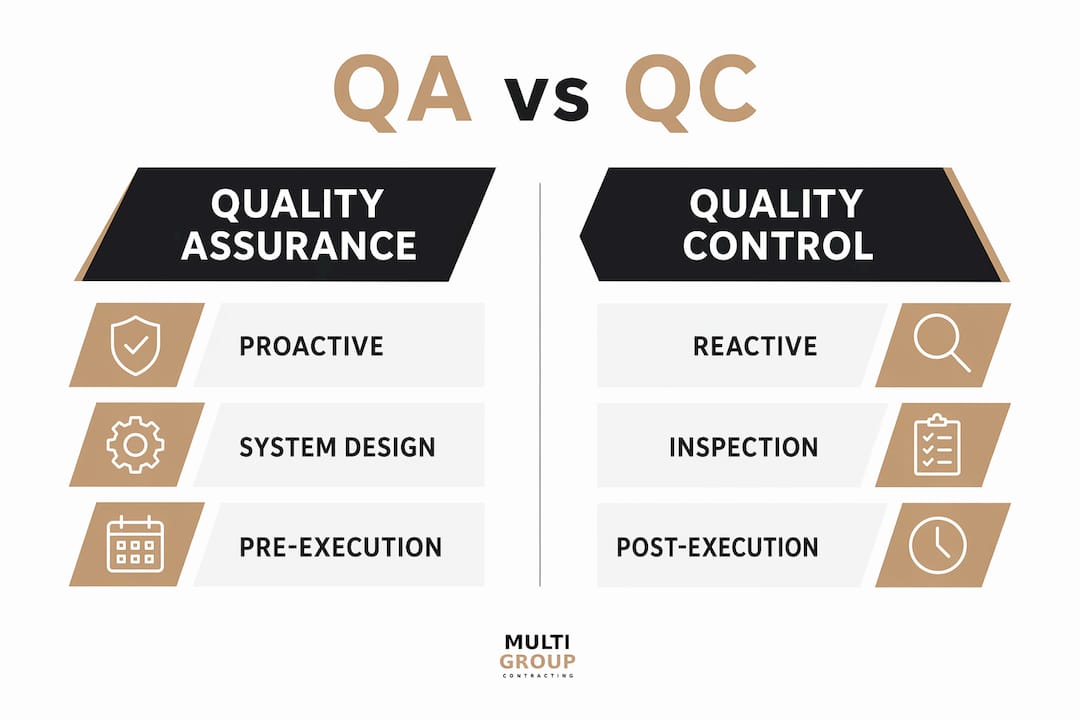
| Dimension | Quality Assurance (QA) | Quality Control (QC) |
|---|---|---|
| Timing | Before and during execution | During and after execution |
| Focus | Process design and prevention | Defect detection and correction |
| Activities | Training, procedure writing, audits | Inspections, testing, documentation |
| Responsibility | Management and QA coordinators | Site supervisors, inspectors, trades |
| Standard reference | ISO 9001 framework | Acceptance criteria, BC Building Code |
ISO 9001 is the most widely recognised international framework for construction quality management as of 2026. It requires organisations to operate both QA and QC as integrated components of a single QMS. Neither works well in isolation. A contractor who writes excellent QA procedures but skips site inspections will still produce defective work. A contractor who inspects constantly but has no documented procedures cannot demonstrate compliance to a building authority or client.
Pro Tip: Build your QC inspection checklist directly from your QA procedures. If a procedure says "install vapour barrier lapped 150mm at seams," your QC checklist should have a line item confirming exactly that measurement. The two documents should mirror each other.
QA and QC practiced together form the only reliable defence against costly late-stage rework. For Metro Vancouver projects subject to BC Building Code inspections and municipal permit requirements, this integration is not a best practice. It is a compliance necessity.
What are the essential quality control processes in construction?
Effective quality control processes in construction follow a defined sequence. Skipping steps does not save time. It transfers the cost of non-conformance to a later, more expensive stage.
- Define acceptance criteria. Before work begins, document exactly what "acceptable" looks like for every scope item. Reference specifications, drawings, and applicable codes. Acceptance criteria must be written, not assumed.
- Develop an Inspection and Test Plan (ITP). An ITP maps every critical activity to a specific inspection type. Hold points require work to stop until an inspector approves. Witness points require an inspector to observe but do not halt progress.
- Assign accountable personnel. Name the individual responsible for each inspection. Unnamed responsibility is no responsibility.
- Conduct daily inspections. Site supervisors verify work against acceptance criteria before trades move to the next phase. Findings are recorded in real time, not reconstructed at day's end.
- Test materials and installations. Concrete cylinder tests, soil compaction reports, air barrier continuity checks, and fire-stop inspections are examples of testing activities that produce objective evidence of conformance.
- Document non-conformances. When work fails an inspection, issue a Non-Conformance Report (NCR). Track root cause, corrective action, and re-inspection outcome.
- Maintain a digital audit trail. Digital compliance records are increasingly a legal requirement. In BC, permit authorities and building officials expect documented evidence of inspections at key stages.
| QC Document | Purpose | When Created |
|---|---|---|
| Inspection and Test Plan | Maps inspections to project activities | Pre-construction |
| Daily Inspection Report | Records site conformance findings | Daily during construction |
| Non-Conformance Report | Documents defects and corrective actions | At point of defect detection |
| Material Test Report | Confirms material properties meet spec | At delivery or installation |
| QC Completion Certificate | Confirms all QC activities are closed | Project closeout |
Pro Tip: Tie your construction scheduling checklist directly to your ITP hold points. When a hold point is not cleared, the schedule should reflect that the next activity cannot start. This makes QC a scheduling tool, not just a paperwork exercise.
Good pre-construction planning is where QC plans are built. Projects that define acceptance criteria and ITPs before mobilisation consistently outperform those that develop QC documents reactively on site.
What are the benefits and challenges of construction quality control?
The importance of quality control in construction is most visible when it is absent. Rework costs extend beyond materials to labour diversion, schedule delays, and client trust erosion. A single missed waterproofing inspection on a Metro Vancouver commercial renovation can result in tens of thousands of dollars in remediation costs, plus the reputational damage of a dissatisfied client.
The measurable benefits of effective QC include:
- Margin protection: Catching defects early eliminates the compounding cost of rework at later project stages.
- Schedule adherence: Fewer defects mean fewer disruptions. Trades complete their scope and move on without being called back.
- Regulatory compliance: BC Building Code inspections, municipal permit sign-offs, and occupancy certificates all depend on documented QC evidence.
- Client satisfaction: Clients who receive a complete, defect-free handover are far more likely to return and refer.
- Legal protection: A thorough QC record is the contractor's primary defence in any dispute over workmanship or code compliance.
"Quality control is often misunderstood as an optional expense. Top contractors view it as a profit strategy that protects margins." — Industry consensus on QC value
The challenges are real. Gatekeeping inspections slow trades who want to proceed. Documentation takes time. Site teams under schedule pressure resist hold points. The solution is not to remove QC friction. It is to build QC activities into the schedule from the start so they are expected, not resented. Construction quality matters most when it prevents a problem that would have cost far more to fix after the fact.
How to implement construction quality control in BC and Metro Vancouver projects
Implementing best practices for construction quality control in BC requires aligning your QC plan with local regulatory frameworks from day one. Metro Vancouver municipalities, including Burnaby, Richmond, Surrey, and Coquitlam, each have permit and inspection requirements that sit on top of the BC Building Code. Your QC plan must account for both layers.
Practical implementation steps for BC projects:
- Align your ITP with permit milestones. BC Building Code inspections at framing, insulation, and occupancy stages are mandatory hold points. Build them into your ITP so they are never missed.
- Assign a named QC lead. On tenant improvement and commercial renovation projects, this is typically the site superintendent. On larger builds, a dedicated QC coordinator is warranted.
- Use digital record-keeping from day one. Legal requirements increasingly mandate digital QC records. Cloud-based field documentation tools create a timestamped, searchable audit trail that satisfies both clients and building officials.
- Integrate QC into subcontract agreements. Require each trade to submit their own inspection records before payment is released. This distributes QC responsibility across the project team.
- Conduct regular QC audits. Weekly QC reviews with the site team identify systemic issues before they become patterns. Root-cause analysis on NCRs prevents repeat defects.
- Close out QC documentation at project completion. A complete QC record at handover supports post-construction service obligations and protects against future warranty claims.
For tenant improvement projects in Metro Vancouver, QC plans must also address base building interface requirements. Landlord approval processes, existing condition surveys, and building system tie-in inspections all require documented QC evidence. Skipping this documentation creates liability for both the contractor and the tenant.
Key takeaways
Construction quality control is the systematic verification process that protects project margins, satisfies BC Building Code compliance, and delivers defect-free handovers to clients.
| Point | Details |
|---|---|
| QC is reactive verification | QC confirms completed work meets acceptance criteria; it operates during and after execution phases. |
| QA and QC must work together | Integrated QA and QC within a QMS is the only reliable way to prevent costly rework and meet ISO 9001 standards. |
| Define acceptance criteria first | Written acceptance criteria defined before work begins are the foundation of every effective QC plan. |
| Digital records are now mandatory | BC and Metro Vancouver projects require documented, timestamped QC evidence for permit sign-offs and legal compliance. |
| Early detection protects margins | Catching defects at the point of work costs a fraction of what rework costs after subsequent trades have proceeded. |
Why QC is the operating system of every successful build
Construction quality control is not a department. It is an operating system that runs underneath every trade, every phase, and every decision on a project. I have seen this distinction matter enormously in practice. Teams that treat QC as a separate function, something the "QC person" handles, consistently produce more defects than teams where every supervisor owns their own inspection records.
The most damaging mindset on a construction site is "we'll fix it later." Later is always more expensive. Later means the drywall is up, the ceiling is closed, or the client is already occupying the space. The cost of fixing a defect multiplies with every trade that works over it.
What I have found works is treating every hold point as a non-negotiable gate. Not a suggestion. Not a courtesy check. A gate that does not open until the work is confirmed acceptable. This requires buy-in from project management, not just site staff. When a project manager pushes a superintendent to proceed past a hold point to protect schedule, the QC system collapses. Schedule pressure is the single biggest threat to quality on any project.
Digital QC tools have changed the game for documentation. Timestamped photos, cloud-stored inspection records, and real-time NCR tracking make it impossible to claim an inspection was done when it was not. That accountability is good for the project and good for the contractor. The contractors who resist digital QC are usually the ones with the most to hide.
— MultigroupTeam
Multigroup's approach to quality-controlled construction in Metro Vancouver
Multigroup is a licensed general contractor in BC, delivering tenant improvements and commercial renovations across Metro Vancouver with quality control embedded at every project stage.
From permit handling and scheduling to trade coordination and final inspection, Multigroup manages the full QC process on behalf of property managers, business owners, and developers. Every project aligns with BC Building Code requirements and municipal permit milestones. Multigroup's site superintendents maintain daily inspection records and digital audit trails throughout construction. Whether the scope is a retail buildout in Vancouver, an office renovation in Burnaby, or a warehouse fit-out in Surrey, quality control is not an add-on. It is built into how Multigroup works. Contact Multigroup to discuss your next project.
FAQ
What is construction quality control in simple terms?
Construction quality control is the process of inspecting, testing, and documenting construction work to confirm it meets design specifications and applicable codes. It operates during construction to catch and correct defects before they escalate.
What is the difference between QA and QC in construction?
Quality assurance designs the systems and procedures that should produce good work. Quality control verifies whether the completed work actually met those standards. Both are required components of an effective quality management system.
Why is quality control important in construction projects?
Rework costs account for 2% to 20% of project budgets, with avoidable errors averaging around 5%. Effective QC catches defects early, protects margins, supports regulatory compliance, and preserves client trust.
What documents are part of a construction QC process?
Core QC documents include the Inspection and Test Plan, daily inspection reports, Non-Conformance Reports, material test reports, and a QC completion certificate issued at project closeout.
Does BC Building Code require quality control documentation?
BC Building Code inspections at key project milestones are mandatory, and permit authorities expect documented evidence of conformance. Digital QC records are increasingly required to satisfy both building officials and legal compliance standards.