

TL;DR:
- Construction budgeting involves continuously planning, managing, and controlling all project costs within approved funding limits. Proper budgets include all categories, size contingency appropriately, and are regularly updated to prevent overruns and ensure project success. Effective discipline in managing the budget process is essential for consistent, on-budget project completion.
Construction budgeting is the process of planning, allocating, and controlling all costs required to complete a construction project within its approved funding limits. Known formally as construction cost management, it covers everything from materials and labor to permits and contingency reserves. Unlike a rough estimate, a construction budget is a living financial document that evolves with your project from feasibility through final closeout. Property owners and developers who treat budgeting as a one-time task rather than an ongoing discipline are the ones most likely to face costly surprises. This guide breaks down what construction budgeting involves, how it works in practice, and how you can use it to keep your project on track financially.
What are the main components of a construction budget?
A construction budget is built from several distinct cost categories, and missing even one of them is a primary reason projects run over budget. Nearly 90% of construction projects experience cost overruns, and the leading cause is incomplete budgets that omit entire cost categories before work begins. Understanding what belongs in a budget is the first step toward building one that holds.
The major components of any construction budget include:
- Hard costs: Materials, labor, and equipment. These typically represent 65 to 80% of the total budget and are the most visible costs on any project.
- Soft costs: Design fees, permits, engineering, inspections, and legal fees. These usually account for 3 to 15% of the total, depending on project complexity.
- Site work and utilities: Grading, drainage, utility connections, and landscaping. These are frequently underestimated on new builds and major renovations.
- General conditions: Dumpsters, site cleanup, temporary power, site fencing, and portable toilets. General conditions should be budgeted at 5 to 8% of hard costs. Trades rarely include these in their quotes, so owners who do not budget for them separately face shortfalls.
- Allowances: Placeholder amounts for items not yet selected, such as flooring, fixtures, or millwork. Allowances must be tracked carefully and resolved before construction begins.
- Contingency reserve: A buffer for unforeseen costs. Industry best practice recommends 5 to 10% of the total budget, with higher amounts for renovation projects or older buildings.
- Overhead and profit: The general contractor's markup, typically 10 to 20% of construction costs depending on project type and market conditions.
| Cost Category | Typical Budget Share |
|---|---|
| Hard costs (labor, materials, equipment) | 65–80% |
| Soft costs (permits, design, legal) | 3–15% |
| General conditions | 5–8% of hard costs |
| Contingency reserve | 5–10% of total budget |
| Overhead and profit | 10–20% of construction costs |
Pro Tip: When reviewing a contractor's quote, check whether general conditions are included or listed separately. A quote that omits them is not cheaper. It is incomplete.

How does construction budgeting differ from cost estimating and cost planning?
These three terms are used interchangeably in casual conversation, but they describe distinct tools with different purposes. Confusing them leads to poor financial decisions, especially early in a project.
A cost estimate is a snapshot. It is a point-in-time calculation of what a project might cost, based on available information. Estimates are produced at multiple stages, from a rough order-of-magnitude figure at project inception to a detailed bid estimate before construction starts. They are useful for feasibility analysis but are not designed to control spending.
A cost plan is an evolving financial framework used during the design phase. Cost plans support early feasibility and design alignment, helping owners and designers make scope decisions that stay within financial targets. Cost plans are updated as design progresses and are typically managed by a quantity surveyor or cost consultant.
A construction budget is the approved financial control document. A budget is a managed financial operating system that governs all project spending once scope and funding are fixed. It incorporates change orders, tracks actual costs against approved amounts, and connects directly to cash flow planning and procurement decisions.
| Tool | Purpose | When used | Who manages it |
|---|---|---|---|
| Cost estimate | Predict likely cost | Feasibility through bidding | Estimator or contractor |
| Cost plan | Align design with budget | Design development | Cost consultant or QS |
| Construction budget | Control all spending | Construction through closeout | Owner, PM, or GC |
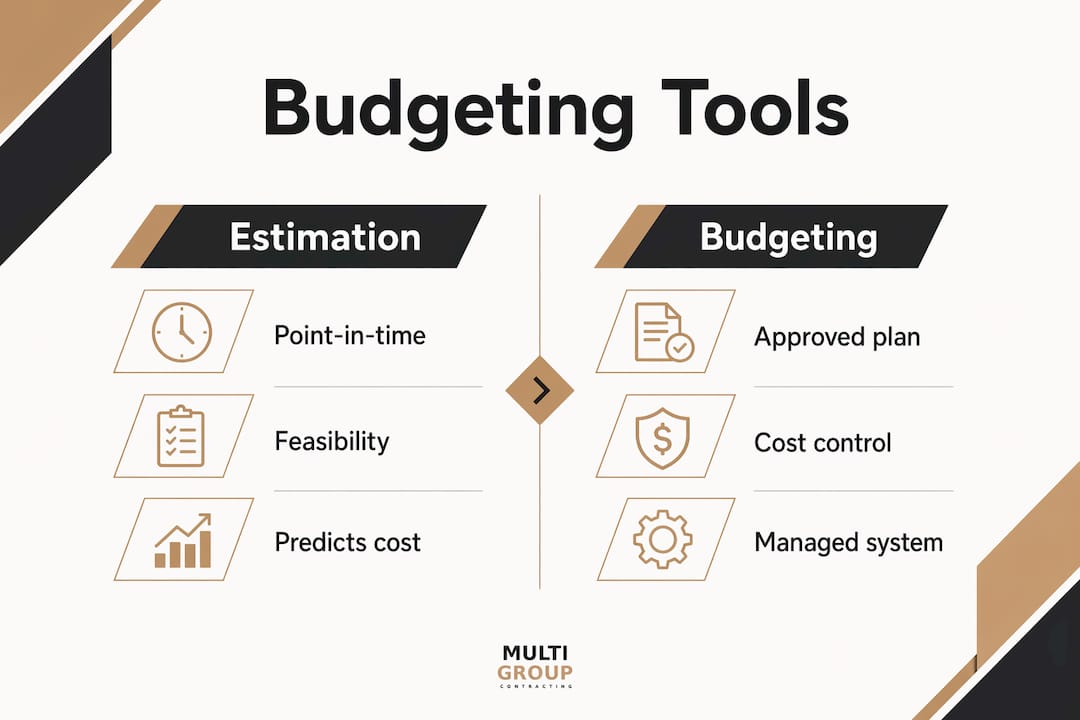
The practical implication: you need all three at different stages. Skipping the cost plan phase and jumping straight to a budget without proper design development is one of the most common causes of scope creep and financial surprises on Metro Vancouver projects.
What are the key steps to create and manage an effective construction budget?
Budget planning in construction follows a layered process that builds in detail as the project matures. Here is a practical framework that property owners and developers can follow:
-
Define the scope baseline. Before any numbers are assigned, document exactly what the project includes. Scope gaps at this stage become change orders later. For a commercial tenant improvement in Burnaby or a warehouse renovation in Surrey, this means floor plans, finish schedules, and a clear list of inclusions and exclusions.
-
Build the budget in stages. Start with a feasibility-level budget based on cost-per-square-foot benchmarks. Typical U.S. construction costs range from $150 to $350 per square foot for residential and $200 to $400 per square foot for commercial, excluding land. As design develops, replace benchmarks with line-item detail sourced from subcontractor quotes and supplier pricing.
-
Allocate contingency based on risk. New construction with complete drawings warrants a 5% contingency. Renovations of older buildings in North Vancouver or Coquitlam, where hidden conditions like asbestos or outdated wiring are common, may require 15% or more. Size the contingency to the actual risk profile of your project.
-
Assign cost codes to every line item. Cost codes connect budget line items to actual invoices and pay applications. Without them, tracking whether you are over or under budget in any given category becomes guesswork.
-
Track against pay applications and change orders. Every approved change order must be added to the budget immediately. Every pay application must be reconciled against the corresponding budget line. This is where most owners fall behind, and where budget drift begins.
-
Set firm allowance deadlines. Allowances without selection deadlines cause schedule delays and budget overruns because unresolved selections become costly change orders mid-construction. Set deadlines for every allowance item at the time the budget is issued.
-
Update the budget regularly. A construction budget is not a static document. It incorporates scope changes, change orders, and cash flow updates throughout the project lifecycle. Review and update it at every major milestone.
Pro Tip: Use construction management software like Procore or Buildertrend to link your budget directly to change orders and pay applications. Manual spreadsheets work for small projects, but they break down fast on anything with more than 20 line items.
What common mistakes cause construction budget overruns and how can they be avoided?
Budget overruns are not random. They follow predictable patterns, and most of them are preventable with proper planning.
- Omitting entire cost categories. The most common mistake is a budget that covers trade costs but ignores soft costs, general conditions, or contingency. A budget missing these categories is not conservative. It is wrong.
- Using generic benchmarks without market adjustments. A $250 per square foot benchmark from a national database does not reflect current labor and material costs in Metro Vancouver, Richmond, or the broader BC market. Always validate benchmarks against recent local project data or subcontractor quotes.
- Treating contingency as a slush fund. Contingency is a controlled reserve for unforeseen costs, not a buffer for poor planning or scope additions. Every draw from contingency should require documentation and approval.
- Ignoring general conditions. Site cleanup, temporary power, and dumpsters are real costs that add up quickly on a commercial buildout or retail renovation. Budget them explicitly at 5 to 8% of hard costs rather than assuming they are included in trade quotes.
- Failing to update the budget after change orders. A change order that is approved but not added to the budget creates a phantom gap. By the time the project closes, the numbers no longer reconcile.
"A budget that is not updated is not a budget. It is a historical document."
Pro Tip: Review your budget against actual costs at every draw cycle, not just at the end of the project. Early detection of overruns gives you options. Late detection gives you problems.
How can property owners use construction budgets to improve project outcomes?
A well-managed budget does more than track spending. A professional construction budget connects every line item to cash flow and financial decisions, enabling profitable project closeout. For property owners and developers, this translates into several concrete advantages.
- Real-time financial visibility. A current, detailed budget tells you at any point whether you are on track, ahead, or behind. This visibility supports better decisions about scope, timing, and procurement.
- Cash flow planning. Knowing when costs will hit allows you to time draws, financing, and payments to subcontractors and suppliers. This is especially relevant for phased projects in Burnaby, Richmond, or Surrey where construction timelines span multiple months.
- Scope control. When every design decision is evaluated against the budget, scope creep is caught early. Owners who align design decisions with budget limits avoid the painful value-engineering exercises that happen when a project is already over budget.
- Risk management. A budget with properly sized contingency and documented allowances gives you a financial buffer and a clear process for managing the unexpected.
- Stronger contractor relationships. A detailed, well-organized budget signals to contractors and subcontractors that you are a prepared, professional client. That reputation often translates into more competitive pricing and better service.
Pro Tip: Share a summary version of your budget with your general contractor at project kickoff. When the GC understands your financial targets, they are better positioned to flag risks before they become change orders.
Key takeaways
Construction budgeting is a continuous financial management discipline that requires complete cost categories, properly sized contingency, and regular updates throughout the project lifecycle to prevent overruns.
| Point | Details |
|---|---|
| Budget vs. estimate | A budget controls spending; an estimate predicts cost. Treat them as different tools. |
| Include all cost categories | Hard costs, soft costs, general conditions, and contingency must all be present. |
| Size contingency to risk | Use 5–10% for new builds and up to 15%+ for older renovations with hidden conditions. |
| Update after every change order | An outdated budget creates financial blind spots that compound through closeout. |
| Set allowance deadlines | Unresolved allowances cause schedule delays and mid-construction cost increases. |
Why budgeting is the most underrated skill in construction
From Multigroup's experience working on tenant improvements, warehouse renovations, and retail buildouts across Metro Vancouver, the single biggest difference between projects that close on budget and those that do not is not the size of the contingency. It is the discipline of the budget process itself.
Most owners come to us with a number in mind. What they rarely have is a structured breakdown of how that number was derived. When we dig in, we consistently find the same gaps: general conditions missing, soft costs underestimated, allowances left open-ended, and contingency sized at a flat 5% regardless of project risk. These are not random errors. They are the predictable result of treating budgeting as a one-time task rather than a continuous management discipline.
The owners who get the best outcomes are the ones who treat the budget as a working document. They review it at every draw cycle. They approve change orders against it in real time. They ask hard questions when a line item starts trending over. That discipline, more than any single cost-saving decision, is what keeps projects on track.
For renovation projects specifically, we always recommend starting with a higher contingency than feels comfortable. Older buildings in North Vancouver, Coquitlam, and similar markets have a way of revealing surprises once walls open up. A 10% contingency that felt generous at the start can disappear quickly when you find knob-and-tube wiring or unexpected structural issues. Budget for the building you have, not the one you hope it is.
— MultigroupTeam
Work with Multigroup on your next construction project

Multigroup Contracting is a licensed and insured general contractor serving Metro Vancouver, including Burnaby, Richmond, Surrey, Coquitlam, and North Vancouver, as well as Seattle, WA and Portland, OR. Whether you are planning a commercial tenant improvement, a warehouse renovation, a retail buildout, or a residential project, Multigroup brings structured cost management and transparent budgeting to every job. Our team handles permit coordination, scheduling, and full project management so your project stays on time and within budget. Contact Multigroup today to discuss your project and get a detailed, accurate budget from the start.
Phone: 778-819-5933 Email: info@multigroup.ca Website: multigroup.ca
FAQ
What is construction budgeting in simple terms?
Construction budgeting is the process of planning and controlling all costs for a construction project from start to finish. It covers materials, labor, permits, contingency, and every other expense needed to complete the work within an approved funding limit.
How much contingency should a construction budget include?
Industry best practice recommends 5 to 10% of the total budget for contingency. Renovation projects, especially in older buildings, may require 15% or more due to the risk of hidden conditions.
What is the difference between a construction budget and an estimate?
An estimate is a point-in-time cost prediction used for feasibility or bidding. A construction budget is an approved, actively managed financial document that controls all spending and is updated throughout the project lifecycle.
What costs are most often missing from construction budgets?
General conditions such as dumpsters, temporary power, and site cleanup are the most frequently omitted costs. Soft costs like permits and design fees are also commonly underestimated or left out entirely.
How often should a construction budget be updated?
A construction budget should be updated after every approved change order and reviewed at every draw cycle. Treating it as a static document after project kickoff is one of the leading causes of budget overruns at closeout.