
TL;DR:
- Build-to-suit is a commercial real estate approach where developers build custom spaces for tenants before lease signing. It minimizes vacancy risk, allows full design control, and suits businesses with specific operational needs. However, it requires long-term commitment and careful planning to avoid costly changes and delays.
Build-to-suit is defined as a commercial real estate development strategy where a developer constructs a facility built precisely to a tenant's operational specifications, secured from the outset by a long-term lease agreement. Unlike purchasing an existing building or signing a standard office lease, this approach gives property owners, developers, and business operators direct control over every structural and mechanical detail of the space. Lease terms commonly span 10–20 years, giving the developer time to recover construction and land costs while the tenant benefits from a purpose-built facility. For businesses with highly specific spatial, technical, or brand requirements, build-to-suit is often the only path to a facility that truly fits.
How does the build-to-suit process work?
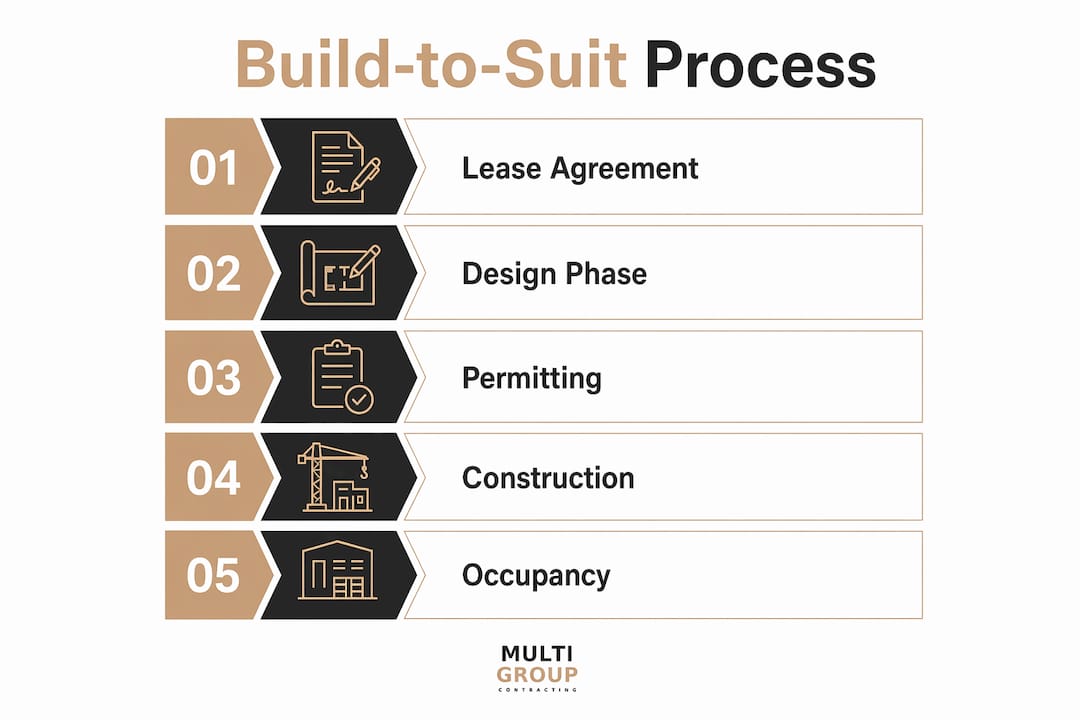
Build-to-suit construction follows a defined sequence, and understanding each phase helps developers and tenants avoid costly surprises. The process begins well before a shovel touches the ground.
-
Tenant commitment. The tenant signs a lease before construction begins. Construction only starts after tenant commitment, which eliminates the vacancy risk that plagues speculative developments. This is the single most important structural difference between build-to-suit and spec construction.
-
Site selection and land acquisition. The developer identifies and acquires a suitable site based on the tenant's location requirements, zoning needs, and logistics. In Metro Vancouver, this step must account for municipal zoning bylaws and Metro Vancouver Regional District land use policies.
-
Collaborative design phase. The tenant, developer, architect, and engineers work together to produce detailed drawings and specifications. Aligning design to technical needs at this stage prevents costly inefficiencies after occupancy. This phase is where the project either succeeds or sets itself up for problems.
-
Permitting and approvals. The developer applies for building permits under the BC Building Code. In Metro Vancouver, this includes municipal review, fire safety compliance, and in some cases, environmental assessments. Permit timelines vary by municipality and project complexity.
-
Construction and project management. A licensed general contractor manages trades, scheduling, and quality control through the build. Coordination between structural, mechanical, electrical, and technology systems is critical at this stage.
-
Occupancy and lease commencement. Once the certificate of occupancy is issued, the tenant takes possession and the lease term begins. Rent payments typically start at this point, covering the developer's amortised construction and financing costs.
Pro Tip: Finalise your technical specifications before the design phase closes. Accurate technical specifications early in a build-to-suit project are the single most effective way to avoid expensive change orders and schedule delays.
What are the advantages and trade-offs of build-to-suit?
Build-to-suit arrangements offer genuine benefits for both tenants and developers, but they also carry obligations that standard leases do not. A clear-eyed view of both sides helps you decide whether this structure fits your situation.
Benefits for tenants
- Capital preservation. Developers cover construction and land costs, so tenants avoid large upfront capital expenditures. That capital stays available for operations, equipment, or growth.
- Operational customisation. Tenants control mechanical systems, technology infrastructure, and sustainability features. Customisation includes mechanical, tech, and sustainability controls, enabling a facility that matches workflow precisely.
- Brand alignment. Retail franchises, medical clinics, and food service operators can build spaces that reflect brand standards from the foundation up, something a standard spec building rarely accommodates.
- Long-term cost predictability. Fixed rent terms over a 10–20 year lease make financial planning more reliable than navigating a volatile commercial leasing market.
Benefits for developers
- Reduced vacancy risk. A signed lease before construction means the developer has a committed tenant before spending on land or materials.
- Stable long-term income. Extended lease terms provide predictable cash flow, which supports financing and investor returns.
Trade-offs to weigh
| Factor | Tenant impact | Developer impact |
|---|---|---|
| Rent level | Higher base rent than comparable spec space | Justified by financing and customisation costs |
| Lease flexibility | Stricter exit clauses, limited early termination | Protects investment in a specialised asset |
| Credit requirements | Strong credit profile typically required | Reduces re-leasing risk on a custom property |
| Timeline | Longer lead time before occupancy | Requires patient capital and project management |
BTS leases carry stricter termination clauses because re-leasing a highly customised building to a new tenant is genuinely difficult. Tenants need to enter these agreements with a clear long-term operational plan.
Pro Tip: If your business model may shift significantly within five years, build-to-suit leasing may not be the right fit. The structure rewards businesses with stable, long-term space requirements.
What design and construction factors determine BTS success?
The design and construction phase is where build-to-suit projects either deliver their full value or fall short. Getting the technical details right from the start is non-negotiable.
Technical specifications that matter most
Successful build-to-suit projects require precise decisions on the following before design drawings are finalised:
- Floor load capacity. Industrial and warehouse tenants often require reinforced concrete slabs rated for heavy equipment or racking systems.
- Power supply and electrical infrastructure. Data centres, medical facilities, and food processing operations have power demands that standard commercial buildings cannot meet.
- Mechanical and HVAC systems. Clean rooms, commercial kitchens, and medical clinics require specialised ventilation and temperature control systems.
- Technology and communications infrastructure. Conduit routing, server room placement, and fibre entry points must be planned before walls are framed.
- Accessibility and code compliance. BC Building Code requirements for accessible design, fire egress, and occupancy classification must be incorporated from the earliest design stage.
How BTS differs from tenant improvements and spec builds
A tenant improvement modifies an existing space to suit a tenant's needs, working within the constraints of an existing structure. A speculative build constructs a generic space and hopes to attract tenants after completion. Build-to-suit sits in a different category entirely. The building is designed from the ground up around the tenant's requirements, with no pre-existing structural compromises to work around. That distinction matters most for businesses with technical or operational requirements that a standard commercial shell simply cannot accommodate.
Licensed general contractors with experience in commercial construction best practices play a central role in coordinating the trades, managing permit submissions, and keeping the project on schedule. In Metro Vancouver, that means working within the BC Building Code and navigating municipal permit offices in Burnaby, Richmond, Surrey, and other jurisdictions across the region.
How does build-to-suit apply in Vancouver and Canadian markets?
Metro Vancouver presents a specific set of conditions that make build-to-suit arrangements particularly relevant for property owners and business operators. Industrial vacancy rates in the region have remained tight, and purpose-built commercial space for specialised uses is in short supply. Businesses that need a facility configured for their exact operations often cannot find a suitable existing property.
Build-to-suit applies across diverse sectors including federal agencies, specialised retail, and medical facilities. In the Vancouver context, this translates to practical applications such as:
- Retail franchise buildouts where brand standards require specific storefront dimensions, fixture layouts, and mechanical configurations.
- Medical and dental clinics that need plumbing, gas lines, and ventilation systems that standard office space cannot support.
- Warehouse and distribution facilities in Burnaby, Delta, or Langley requiring specific clear heights, dock doors, and floor load ratings.
- Office headquarters for technology or professional services firms that need custom server infrastructure, open-plan layouts, and specific acoustic treatments.
From a budgeting perspective, build-to-suit projects in Metro Vancouver typically carry higher per-square-foot costs than tenant improvements or standard leases, reflecting land values, construction costs, and the developer's financing overhead. Tenants should budget for higher monthly rents relative to comparable spec space, and factor in the full lease term when modelling total occupancy costs. Working with a licensed contractor familiar with Metro Vancouver commercial buildouts helps ensure that cost estimates are grounded in current local market conditions.
Permit timelines in Metro Vancouver vary by municipality. Surrey and Langley tend to process commercial permits faster than the City of Vancouver for larger industrial projects. Building in permit timeline assumptions of three to six months for complex BTS projects is a reasonable starting point, though this varies by project scope and municipality.
Key takeaways
Build-to-suit is the most effective commercial real estate structure for businesses with precise operational requirements that standard spec buildings cannot meet.
| Point | Details |
|---|---|
| Lease commitment comes first | Tenants sign before construction begins, reducing developer vacancy risk from day one. |
| Capital stays with the tenant | Developers fund land and construction; tenants pay higher rent to compensate over a 10–20 year term. |
| Design phase is critical | Finalising technical specs early prevents costly change orders and schedule overruns. |
| Lease terms are strict | Exit clauses are tighter than standard leases due to the specialised nature of the building. |
| BTS suits diverse sectors | Retail, medical, industrial, and government users all use build-to-suit for specialised facility needs. |
The case for treating BTS as a long-term business decision
Working on commercial construction projects across Metro Vancouver, I have seen build-to-suit arrangements succeed and struggle, and the difference almost always comes down to preparation, not the structure itself.
The most common mistake I see is treating the design phase as a formality. Tenants arrive with a general idea of what they need and assume the details can be sorted out during construction. They cannot. Change orders on a build-to-suit project are expensive, and they erode the capital preservation advantage that made the arrangement attractive in the first place. The businesses that get the most from build-to-suit are the ones that invest serious time in specifying their requirements before the architect starts drawing.
The second pattern I have observed is underestimating the commitment involved. A 15-year lease on a custom building is not a lease. It is closer to a real estate investment. Tenants need to be confident in their long-term operational model before signing. That said, for businesses with stable, well-defined space requirements, build-to-suit delivers something that no other commercial real estate structure can: a facility built entirely around how you work, not how a developer imagined a generic tenant might work.
My recommendation is to engage a licensed contractor with direct experience in BC Building Code compliance and Metro Vancouver permitting early in the process. The design and permit phase sets the cost and timeline for everything that follows.
— MultigroupTeam
Multigroup's role in build-to-suit and tenant improvement projects
Multigroup is a licensed Vancouver general contractor with direct experience in tenant improvements, retail buildouts, and warehouse renovations across Metro Vancouver. Whether you are working through a full build-to-suit development or fitting out a newly constructed shell, Multigroup manages permits, scheduling, and trade coordination under BC Building Code requirements.
Multigroup's tenant improvement services cover the full scope of commercial interior work, from mechanical and electrical rough-ins to millwork, flooring, and final finishes. For industrial and distribution projects, Multigroup's warehouse renovation expertise applies directly to build-to-suit shells requiring specialised fit-out. Contact Multigroup to discuss your project requirements and get a realistic assessment of scope, timeline, and budget for your Metro Vancouver build.
FAQ
What is build-to-suit in commercial real estate?
Build-to-suit is a development arrangement where a developer constructs a facility to a tenant's exact specifications, secured by a long-term lease signed before construction begins. The tenant gets a custom-built space without the upfront capital cost of purchasing land and constructing a building.
How long is a typical build-to-suit lease?
Build-to-suit lease terms typically span 10–20 years to allow the developer to recover construction and financing costs through rent. Shorter terms are uncommon because the developer carries significant upfront risk on a specialised asset.
What is the difference between build-to-suit and speculative construction?
Speculative construction builds a generic commercial space before securing a tenant, while build-to-suit begins only after a tenant commits to a lease. This distinction means build-to-suit carries far less vacancy risk for the developer and far more customisation for the tenant.
Who uses build-to-suit arrangements?
Build-to-suit is used by retail franchises, medical and dental clinics, federal agencies, warehouse and distribution operators, and technology firms. Any business with technical or operational requirements that standard commercial buildings cannot meet is a candidate for this structure.
Are build-to-suit leases more expensive than standard leases?
Yes. BTS leases cost more than traditional leasing because the developer's financing, customisation, and development risk are amortised into the base rent. Tenants pay a premium for a purpose-built facility and avoid the upfront capital cost of ownership.