

TL;DR:
- A construction gallery is a curated digital portfolio showcasing completed projects with detailed images and project data, serving as a trust-building and lead-generation tool. It differs from a proposal by documenting past work rather than outlining future plans, helping contractors attract clients and improve SEO. Regular updates, high-quality visuals, and strategic organisation maximize its impact across marketing, bid support, and internal quality control.
A construction gallery is a structured digital portfolio that showcases a company's completed projects through high-quality images, descriptive captions, and project-specific data, functioning as a primary trust-building and lead-generation asset. Unlike a generic photo folder or a formal project proposal, a construction gallery is purpose-built to communicate expertise, quality, and range at a glance. Visuals are processed 60,000 times faster than text, which means a well-organised gallery communicates your capabilities before a prospective client reads a single word. For property managers, business owners, and developers in Metro Vancouver, understanding what a construction gallery is and how to use it effectively can directly influence which contractor wins the bid.
What is a construction gallery and how does it differ from a photo folder?
A construction gallery is a curated, strategically organised digital collection of project documentation, not simply a folder of job-site photos. The distinction matters because galleries act as silent salespeople that educate prospects and filter unqualified leads, while a photo folder is passive storage with no sales function.
A well-built construction gallery includes metadata for each project: location, scope, materials used, challenges encountered, and solutions delivered. This level of detail transforms individual images into proof points. A retail buildout in Burnaby, for example, becomes far more persuasive when the gallery entry notes the square footage, the BC Building Code compliance requirements met, the permit timeline, and the before-and-after transformation achieved within budget.
A formal project proposal, by contrast, is a forward-looking document outlining how future work will be executed. Proposals describe timelines, costs, and methodologies for a project that has not yet begun. A gallery documents what has already been accomplished. Both serve distinct purposes, and confusing the two leads contractors to underinvest in their gallery as a marketing asset.
The table below clarifies the structural and strategic differences between the two:
| Feature | Construction gallery | Project proposal |
|---|---|---|
| Purpose | Showcase completed work and build trust | Outline scope and cost for future work |
| Audience | Prospective clients browsing options | Specific client reviewing a bid |
| Content | Photos, captions, metadata, project data | Timelines, pricing, methodology |
| Sales function | Passive lead qualification | Active bid submission |
| SEO value | High, through image metadata and project pages | None |
Pro Tip: Add a "challenges and solutions" field to every gallery entry. Clients searching for a contractor who has handled complex structural issues or tight permit timelines will self-qualify immediately when they see that your team has solved problems identical to theirs.
How to create an effective construction gallery
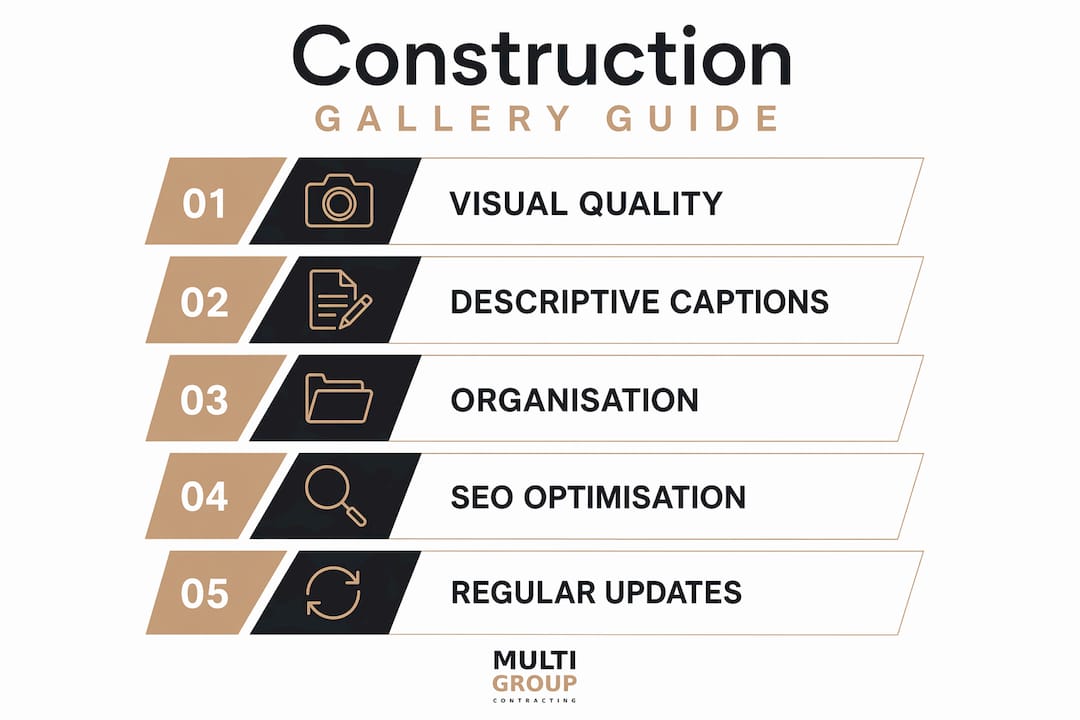
Creating an effective construction gallery requires deliberate planning across four areas: visual quality, descriptive content, site organisation, and technical optimisation. Each area compounds the impact of the others.
Visual quality and documentation
High-resolution photography is non-negotiable. Images should be captured at multiple stages: pre-construction site conditions, framing and structural work, mechanical and electrical rough-ins, and the finished space. Progress documentation is particularly persuasive for commercial renovation clients in Metro Vancouver because it demonstrates project management discipline, not just a polished final result. Video walkthroughs of completed tenant improvements or warehouse renovations add another layer of credibility that static images cannot replicate.
Descriptive captions and project data
Every image or project entry needs a clear caption that includes the project type, location, approximate scope, and one specific detail that sets the work apart. "Office renovation, North Vancouver, 4,200 sq ft, completed in 11 weeks including permit approval" communicates far more than "office renovation." Variety in project types and metadata sustains visitor attention and communicates the full range of a contractor's capabilities, which is critical for winning bids across different sectors.
Organisation and filtering
A construction photo collection becomes genuinely useful when visitors can filter by project type, location, or complexity. Allowing prospects to filter projects by type helps them self-qualify as leads, which improves conversion rates and reduces time spent on enquiries that are not a good fit. Categories might include tenant improvements, retail buildouts, coffee shop renovations, warehouse renovations, and residential custom builds.
Technical and SEO optimisation
Each gallery page should carry descriptive file names, alt text, and page titles that reflect the project type and location. A page titled "Burnaby warehouse renovation, 8,000 sq ft mezzanine addition" targets a specific search query while also informing the visitor. Compressing images for fast loading is equally important. Poor quality or slow-loading galleries damage brand reputation and drive visitors away before they reach the call-to-action.
Pro Tip: Treat your gallery as a living document, not a static archive. Add new projects within two weeks of completion, retire outdated entries that no longer reflect your current quality standards, and update captions when project outcomes include measurable client results.
What are the benefits of a construction gallery for your business?
Construction galleries serve at least four distinct business functions: marketing, search engine optimisation, bid support, and internal operations. Most contractors focus only on the first and leave significant value on the table.
-
Marketing and client trust. Visual proof of completed work builds client confidence faster than any written service description. A prospective restaurant operator in Richmond reviewing a coffee shop renovation gallery can assess millwork quality, spatial planning, and finish standards before making a single phone call. This pre-qualification reduces the sales cycle considerably.
-
SEO performance. Optimised project galleries reduce bounce rates and increase the time visitors spend on a website compared to standard service pages. Longer visits and lower bounce rates signal relevance to search engines, which improves rankings for location-specific queries like "tenant improvement contractor Coquitlam" or "retail buildout Vancouver." For licensed contractors in BC competing in Metro Vancouver's dense market, this organic visibility is a measurable competitive advantage.
-
Bid support and proposals. Gallery content pulled into formal bid proposals gives decision-makers visual evidence of comparable completed work. A property manager reviewing bids for a Surrey office renovation is more likely to shortlist a contractor whose proposal includes a linked gallery of similar office projects than one who submits text descriptions alone. Gallery content integrated into bid proposals extends the gallery's value well beyond the website.
-
Internal training and quality control. Visual project logs support team training, quality benchmarking, and dispute resolution. A site supervisor reviewing finish standards for a new retail buildout in Langley can reference documented examples of previous projects to align expectations across the crew. This internal use of gallery content is underutilised by most contractors but directly supports consistent output quality.
Local focus in galleries also helps smaller Metro Vancouver contractors compete against national firms by demonstrating relevant regional experience, familiarity with local permit processes, and community-specific project types.
Common pitfalls to avoid when building a construction gallery in 2026
Even experienced contractors make avoidable mistakes when building or maintaining their construction project showcase. The following issues are the most common and the most damaging:
- Low-resolution or poorly lit photography. Blurry or dark images suggest low standards regardless of the actual quality of the work. Hire a professional photographer for at least your flagship projects, and use a good smartphone with proper lighting for documentation shots on smaller jobs.
- No mobile optimisation. A significant portion of construction gallery traffic comes from mobile devices. If images load slowly or the layout breaks on a phone screen, visitors leave. Test every gallery page on both iOS and Android before publishing.
- Missing calls-to-action. A gallery without a call-to-action is a dead-end page. Every project entry should include a prompt to request a quote, view related services, or contact the team directly. The gallery's job is to convert inspiration into an enquiry.
- Outdated or inconsistent entries. A gallery that mixes high-quality recent work with grainy photos from five years ago undermines credibility. Audit your gallery annually and remove entries that no longer represent your current standards.
- No before-and-after documentation. Before-and-after photo pairs are among the most persuasive formats in construction marketing. They make the transformation concrete and give prospective clients a clear sense of what is possible in a space similar to their own.
Pro Tip: Pair each gallery entry with a brief client testimonial when possible. A two-sentence quote from the property manager or business owner who commissioned the project adds social proof that images alone cannot provide.
For contractors working on Vancouver commercial construction projects, galleries that document BC Building Code compliance steps and permit milestones also serve as evidence of professional project management, which is a differentiator in competitive bid situations.
Key takeaways
A construction gallery is the single most effective digital asset a contractor can maintain for simultaneous marketing, SEO, bid support, and internal quality management.
| Point | Details |
|---|---|
| Definition and purpose | A construction gallery is a curated digital portfolio with project data, not a simple photo folder. |
| Gallery vs. proposal | Galleries document completed work for lead generation; proposals outline future project execution. |
| SEO and engagement | Optimised galleries reduce bounce rates and improve search rankings over standard service pages. |
| Internal value | Visual project logs support team training, quality control, and dispute resolution. |
| Ongoing maintenance | Galleries must be updated regularly to reflect current quality standards and recent project completions. |
Why construction galleries matter more than most contractors realise
From Multigroup's experience working across Metro Vancouver on tenant improvements, warehouse renovations, and retail buildouts, the contractors who invest seriously in their project galleries win more bids and spend less time on unqualified enquiries. That is not an opinion. It is a pattern we observe consistently.
What surprises most clients is how much a gallery communicates before any conversation takes place. A property manager in Burnaby reviewing options for a leasehold improvement will often arrive at a first meeting already convinced of fit, simply because the gallery showed a comparable project completed on time and within budget. The gallery did the qualifying work before the phone rang.
The other underappreciated function is local specificity. In Metro Vancouver, clients want to see that a contractor understands the regional permit process, the BC Building Code requirements for commercial spaces, and the practical realities of working in dense urban environments. A gallery that documents renovation permits in Vancouver and shows permit-compliant work at every stage signals a level of professional rigour that generic portfolio sites simply cannot match.
The contractors who treat their gallery as a living sales asset, updating it after every significant project and integrating it into proposals and presentations, consistently outperform those who treat it as a static archive. The investment in photography, captions, and organisation pays back in shorter sales cycles and higher-quality client relationships.
— MultigroupTeam
See Multigroup's construction gallery in action
Multigroup is a licensed Vancouver general contractor with a project gallery that documents completed work across tenant improvements, retail buildouts, warehouse renovations, coffee shop renovations, and high-end residential interiors throughout Metro Vancouver.

Every entry in Multigroup's construction project showcase includes project type, location, scope, and key details, giving property managers, developers, and business owners the visual evidence they need to make a confident decision. From tenant improvement services in Burnaby to commercial renovations in Richmond and Surrey, Multigroup's gallery reflects the quality and project management discipline that clients across the region rely on. Contact Multigroup to discuss your next project and explore completed work that matches your needs.
FAQ
What is a construction gallery?
A construction gallery is a structured digital portfolio of completed construction projects, including high-quality images, project descriptions, metadata, and client outcomes. It functions as both a marketing asset and a lead-qualification tool for contractors.
How does a construction gallery differ from a project proposal?
A construction gallery documents completed work to build trust with prospective clients, while a project proposal outlines the scope, cost, and timeline for a future project. The two serve distinct purposes and are not interchangeable.
What should a construction gallery include?
An effective construction gallery includes high-resolution photos, before-and-after documentation, project type and location, scope details, BC Building Code compliance notes where relevant, and a clear call-to-action on every entry.
How do construction galleries improve SEO?
Optimised project galleries reduce bounce rates and increase time-on-site compared to standard service pages, signalling relevance to search engines and improving rankings for location-specific queries like "commercial renovation Vancouver."
How often should a construction gallery be updated?
A construction gallery should be updated within two weeks of each project completion. Outdated entries that no longer reflect current quality standards should be removed during an annual audit to maintain credibility with prospective clients.