

TL;DR:
- Proper planning and adherence to local codes are crucial for successful warehouse upgrades.
- Reconfigure racking for minor adjustments, replace for heavy loads or automation needs.
- Phased, customized renovations ensure compliance, control costs, and improve operational efficiency.
Choosing the right upgrades for a Metro Vancouver warehouse is one of the most consequential decisions a business operator can make. With local building codes tightening, seismic requirements evolving, and operating costs rising, the wrong renovation plan can drain your budget and stall your operations for months. The right plan, on the other hand, directly improves throughput, reduces energy bills, and positions your facility to scale. This article gives you a practical, decision-focused framework to evaluate, compare, and prioritize warehouse renovation ideas so you can move forward with confidence.
Table of Contents
- Setting renovation priorities: What matters most
- Racking systems: Reconfigure vs. replace for adaptability and safety
- Smart HVAC and lighting upgrades: Cut energy costs and improve comfort
- Layout optimization: Maximize storage and speed up picking
- Permitting and compliance: Navigating regulations in Metro Vancouver
- Why one-size-fits-all warehouse renovations don't work
- Your next step: Get expert help for your Metro Vancouver warehouse renovation
- Frequently asked questions
Key Takeaways
| Point | Details |
|---|---|
| Set clear goals | Define your needs and priorities before starting any warehouse renovation. |
| Mind local regulations | Always check city-specific permit and safety requirements for Metro Vancouver warehouses. |
| Invest for efficiency | Smart upgrades like heat pumps or layout optimization can quickly deliver big cost savings. |
| Customize your approach | Every warehouse has unique needs—don’t copy others’ solutions without a site-specific plan. |
| Get expert help early | Engaging professionals upfront helps avoid costly mistakes and compliance delays. |
Setting renovation priorities: What matters most
Before you schedule a single contractor visit, you need a clear picture of what you're trying to fix. Warehouse renovation decisions driven by vague goals like "we need more space" often result in expensive changes that don't move the needle. Setting specific, measurable objectives tied to your actual business pain points keeps the project on track and on budget.
For Metro Vancouver facilities, the list of decision factors is longer than most operators expect. Here are the key ones to work through:
- Operational efficiency: Are pick times too slow? Are workers covering too much ground? Efficiency gaps are usually the highest-ROI area to tackle first.
- Safety compliance: BC Building Code seismic requirements and fire codes are not optional, and non-compliance can result in work stoppages or liability exposure.
- Energy costs: Heating and lighting in large warehouse spaces represent a significant and controllable expense. Upgrading these systems pays back over time.
- Regulatory compliance: Different municipalities in Metro Vancouver have different requirements. Surrey, Burnaby, and Vancouver each have their own permit processes and checklist requirements.
- Budget and phasing: Knowing which upgrades can wait and which are urgent helps you sequence projects without shutting down operations.
The City of Vancouver provides checklists for building and renovation permits, energy requirements, and compliance bulletins for industrial properties. Reviewing these before planning saves weeks of back-and-forth with building departments later.
Pro Tip: Download your municipality's permit checklist before you finalize your renovation scope. Catching a permit requirement early is far less disruptive than discovering it mid-construction. This also applies to understanding warehouse construction permits before you commit to a contractor.
Racking systems: Reconfigure vs. replace for adaptability and safety
With your priorities set, let's look at one of the most pivotal upgrades: your racking system. Racking directly controls how much inventory you can store, how safely workers move through aisles, and whether your facility meets current code. The core decision most operators face is whether to reconfigure existing racking or invest in full replacement.
"Always inspect existing racking before deciding—full replacement is best for automation or heavy loads."
When reconfiguring is enough:
- Racking is structurally sound with no visible damage, rust, or deformation
- You only need to adjust bay widths or add additional beam levels
- Load requirements remain similar to the original installation
- The change does not push rack height above 2.5 meters (which triggers permit requirements in many municipalities)
When full replacement makes more sense:
- Existing racking has sustained impact damage or significant corrosion
- You're introducing automated storage and retrieval systems (ASRS) or new handling equipment
- Load requirements have increased substantially
- You need a fundamentally different rack type (for example, switching from selective to drive-in or push-back racking)
Here's a side-by-side comparison to help you evaluate both paths:
| Factor | Reconfigure existing racking | Replace with new system |
|---|---|---|
| Upfront cost | Lower | Higher |
| Time to complete | Faster (days to weeks) | Longer (weeks to months) |
| Disruption to operations | Minimal | Significant |
| Compliance risk | Moderate (existing may not meet 2024 code) | Low (new systems built to current standards) |
| Flexibility for future changes | Limited | High |
| Suitable for automation | Rarely | Yes |
One critical compliance factor in Metro Vancouver: racking over 2.5m requires a permit in Surrey and must be seismically restrained, comply with NFPA 13 sprinkler code, and have slab load confirmation from a registered professional. This applies whether you're reconfiguring or installing new systems.
Additionally, the BCBC 2024 seismic code became fully effective in March 2025, with a transition period for pre-2024 designs running until 2027. If your racking was installed before 2024, a seismic compliance review is a smart step before any significant reconfiguration. For more on how these seismic code updates 2026 affect commercial facilities, a review of the latest provincial bulletins is worth your time.
Smart HVAC and lighting upgrades: Cut energy costs and improve comfort
Racking is only one part. Let's talk about another lever for comfort and cost savings: HVAC and lighting. These two systems are often overlooked in warehouse renovations, but they consistently deliver some of the strongest returns on investment, especially in facilities that operate year-round or run multiple shifts.
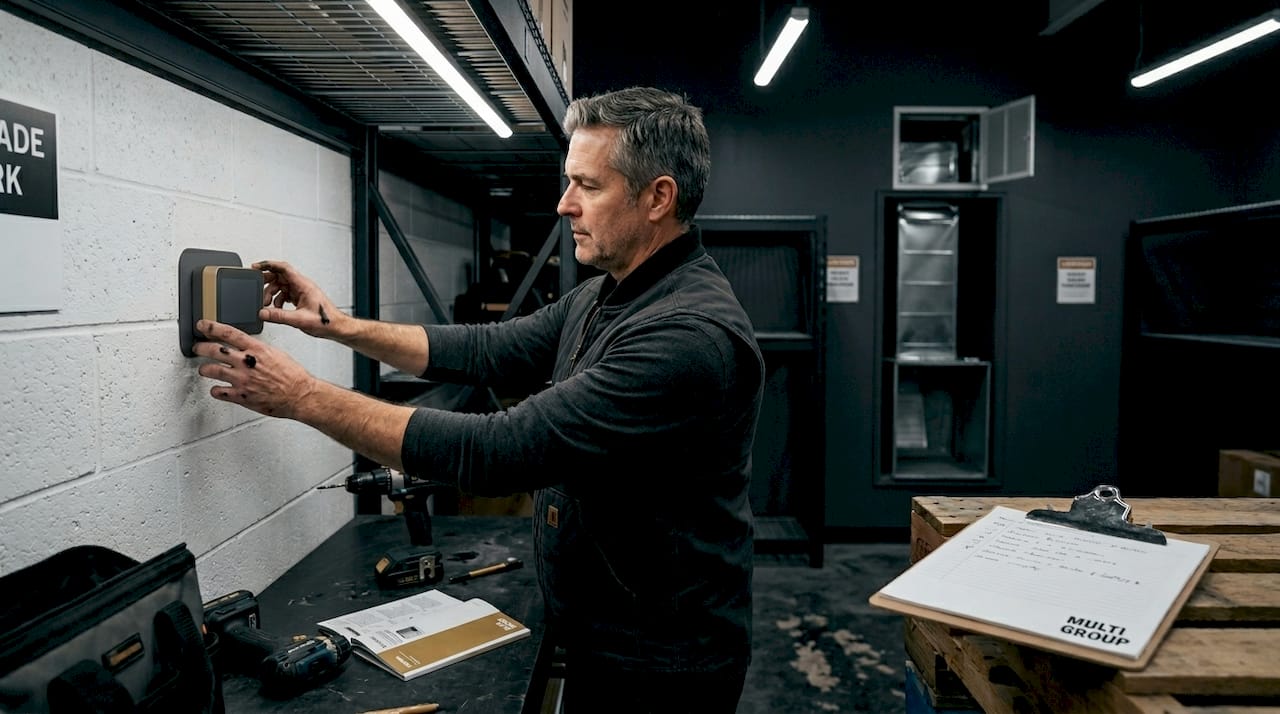
HVAC systems in older warehouses are frequently oversized for some zones and undersized for others, leading to uneven temperatures, excess energy consumption, and worker discomfort that quietly reduces productivity. Modern upgrades address all of this directly. Heat pump upgrades can cut energy bills by up to 50% and often qualify for BC utility subsidies that offset installation costs.
Top HVAC and lighting renovation options for Metro Vancouver warehouses:
- Smart zoning systems: Divide your warehouse into temperature zones based on occupancy and use. Loading dock areas need different conditioning than office spaces or cold storage zones.
- Heat pump replacement: Replacing gas-fired rooftop units with heat pumps dramatically reduces energy consumption and positions your facility for provincial clean energy incentives.
- LED high-bay retrofit: Swapping out older metal halide or fluorescent high-bays for LED fixtures cuts lighting energy use by 40 to 60 percent and reduces maintenance calls.
- Occupancy-based lighting controls: Sensors that dim or switch off lights in unoccupied aisles add another layer of savings on top of the LED retrofit.
- System recalibration: Even without replacing equipment, recalibrating an existing HVAC system to match current occupancy patterns and seasonal loads can recover significant efficiency.
These top energy-saving renovations are increasingly standard in Metro Vancouver commercial builds because the utility savings are real and the payback periods have shortened as equipment costs have fallen.
Pro Tip: If your renovation includes a mezzanine, use open-grid decking rather than solid steel plate. Solid decking blocks airflow between levels, forcing your HVAC system to work harder and creating uncomfortable temperature gradients for workers on the upper level. Open-grid decking solves this without adding significant cost.
Layout optimization: Maximize storage and speed up picking
After improving systems and comfort, let's ensure your layout actually maximizes productivity. A well-designed layout is not just about fitting more shelves in. It's about reducing the time and steps required to move product through your facility, from receiving to put-away to picking to shipping.
Here's a practical, step-by-step approach to layout optimization:
- Map your current flow. Document where product enters, where it's stored, and how it moves to shipping. Identify where workers travel the most and where bottlenecks form.
- Classify your inventory by velocity. Separate fast-moving (A) items from moderate (B) and slow (C) items. This is called ABC slotting and it's the most reliable method for reducing pick travel.
- Place A items closest to shipping. High-velocity products should be in the lowest, most accessible rack positions nearest to the outbound staging area.
- Zone your floor by function. Create clearly defined areas for receiving, bulk storage, active picking, staging, and shipping. Mixed-use areas create confusion and slow everything down.
- Streamline pick paths. Design aisle layouts that allow workers to complete pick routes without backtracking. U-shaped and I-shaped flow patterns each have strengths depending on your order profile.
- Evaluate vertical space. Many warehouses underutilize height. Adding rack levels or a mezzanine can expand usable storage without touching your footprint.
The data on layout optimization is compelling. ABC slotting and layout redesign consistently reduce pick travel by 20 to 35 percent, and well-designed warehouses achieve usable storage in 40 to 50 percent of total floor area.
Here's what that looks like in practice:
| Metric | Before optimization | After optimization |
|---|---|---|
| Average pick travel per order | 180 meters | 120 meters |
| Picks per hour | 65 | 88 |
| Usable storage area | 32% of floor space | 46% of floor space |
| Aisle congestion incidents per week | 14 | 3 |
These numbers represent realistic outcomes from facilities that applied systematic layout changes, not exotic technology. Understanding these gains also connects directly to your racking and equipment investment decisions, since layout efficiency only works when your storage systems are configured to match your product flow. For context on where future commercial construction trends are heading, smart layout planning is increasingly integrated with digital inventory tools and automation-ready infrastructure.
Permitting and compliance: Navigating regulations in Metro Vancouver
All great ideas rely on getting approval. The final step before breaking ground is confirming legal compliance. This is the area where well-intentioned renovations most often run into trouble, not because operators are careless, but because Metro Vancouver's regulatory environment is genuinely complex.
"A missed permit can halt renovations for weeks—always verify first."
Here are the permit essentials every warehouse operator in Metro Vancouver needs to understand:
- Building permits are required for structural changes, mezzanine additions, new partitions, and any modification to mechanical or electrical systems.
- Racking permits are triggered when rack height exceeds 2.5 meters. Seismic restraint and NFPA 13 sprinkler compliance are mandatory in most jurisdictions.
- Fire suppression reviews are often required when you change storage heights, switch product types, or modify rack configurations, because these changes affect sprinkler head placement and water supply calculations.
- Slab load confirmation from a registered professional engineer is required in many municipalities when adding heavy racking, mezzanines, or equipment.
- Energy compliance documentation is increasingly required for mechanical system upgrades under BC's Step Code and local energy bylaws.
The City of Vancouver's permit checklists are an essential starting point for any Vancouver facility. Each municipality in Metro Vancouver (Surrey, Burnaby, Richmond, Coquitlam, and others) has its own process, so confirm requirements with the local building department before finalizing your plans.
Working with licensed contractors in Vancouver who manage permit handling as part of their project scope eliminates much of this complexity, since experienced contractors already know the local requirements and maintain working relationships with building departments.
Why one-size-fits-all warehouse renovations don't work
Planning compliance brings us to a final, crucial insight: why template solutions often miss the mark.
There is a persistent assumption in warehouse renovation planning that what worked in one facility will naturally translate to another. Operators read case studies, see impressive numbers, and attempt to replicate the same layout changes or the same racking system in a completely different environment. The results are often disappointing, and sometimes costly.
Every warehouse has its own combination of variables: slab thickness, ceiling height, column spacing, fire suppression layout, product mix, order profile, and workforce practices. A layout optimization that reduced pick travel by 30 percent in a high-velocity e-commerce facility may actually hurt productivity in a bulk distribution operation with different picking patterns.
The same logic applies to compliance. A racking permit that sailed through approval in one Surrey location may face additional seismic review requirements in another, depending on the building's age and original construction documents.
The most effective warehouse renovations we see in Metro Vancouver are phased and custom-scoped. Rather than trying to overhaul everything at once, operators who stage their upgrades reduce operational risk, control spending, and have the flexibility to adjust course when the first phase reveals something unexpected. Phasing also makes compliance easier to manage, since smaller scopes involve fewer intersecting permit requirements.
Pro Tip: Before committing to a renovation plan, consult a general contractor who specializes in commercial warehouse spaces and ask them to produce a written scope with phasing built in. This document becomes the anchor for permit applications, contractor scheduling, and budget control. Following a clear step-by-step buildout planning process is what separates successful projects from ones that stall out mid-construction.
Copying "industry best practices" without tailoring them to your specific facility is not a strategy. It's a shortcut that tends to create compliance headaches, budget overruns, and layouts that don't quite fit how your business actually runs.
Your next step: Get expert help for your Metro Vancouver warehouse renovation
If you're ready to start or would like expert input customized to your facility, here's your next step.
Even modest warehouse renovations can deliver significant financial and operational impact when they're planned correctly. A racking reconfiguration that improves storage utilization by 15 percent, combined with a targeted LED retrofit, can meaningfully reduce operating costs within the first year. The key is matching the right upgrades to your specific facility, workforce, and compliance requirements.

Multigroup Contracting works with Metro Vancouver business owners and operators to plan, permit, and execute warehouse renovations from start to finish. From initial scope development to permit handling, scheduling, and construction management, the team brings the expertise and local knowledge to get your project done right, on time, and within budget. Reach out today to discuss your facility's needs and get a renovation plan tailored to your operation.
Frequently asked questions
What permits are needed to renovate a warehouse in Metro Vancouver?
Permits depend on your renovation scope but are required for most structural, mechanical, or layout changes including racking, HVAC, and mezzanines. The City of Vancouver's permit checklists are a reliable starting point, and each Metro Vancouver municipality has its own specific requirements.
How can I reduce energy costs during warehouse renovation?
Upgrading to smart HVAC systems with heat pumps and efficient zoning can reduce energy costs by up to 50% and may qualify your facility for BC utility subsidies. LED lighting retrofits and occupancy-based controls add further savings on top of HVAC improvements.
What is the advantage of ABC slotting for warehouse layout?
ABC slotting places your fastest-moving products closest to shipping, which reduces pick travel by 20 to 35% and helps maximize usable storage space for faster, more consistent operations.
When should I replace versus reconfigure warehouse racking?
Replace racking if it is damaged, needs to support automation, or must carry significantly heavier loads. Reconfiguration is appropriate for minor adjustments after a safety inspection, provided the existing system still meets current seismic and sprinkler code requirements for your municipality.