

TL;DR:
- Client testimonials guide property owners in assessing contractor reliability and project success.
- They complement online reviews by providing detailed, trust-building narratives for high-stakes projects.
- Evaluating recent, specific testimonials helps owners make informed hiring decisions and reduce risk.
Client testimonials in contracting are defined as curated, first-person endorsements from past clients that validate a contractor's quality, reliability, and communication before a new project begins. For property owners and business operators facing construction investments that routinely exceed $50,000 CAD, this third-party validation is not optional. 98% of consumers read online reviews before choosing a local service, and contractors with 40 or more reviews generate 12 times more leads than those without. The role of testimonials in contracting extends beyond marketing. They are decision data, risk filters, and trust signals that directly influence which contractor gets hired and which does not.
What is the difference between reviews and testimonials in contracting?
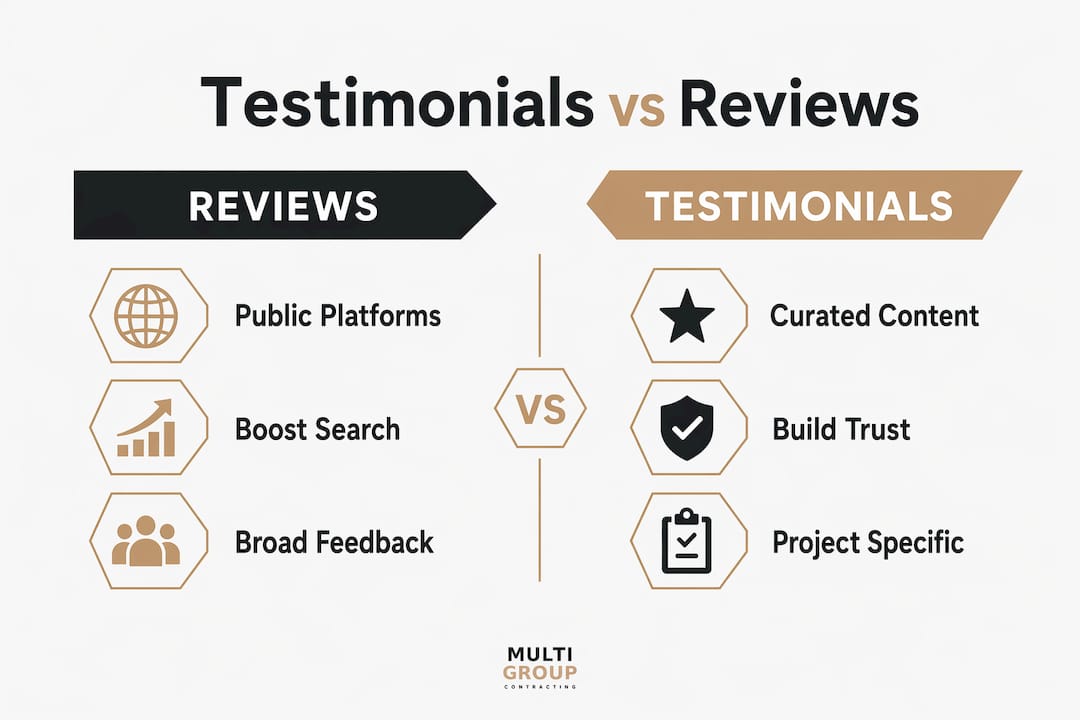
Reviews and testimonials serve different functions, and confusing them costs both contractors and clients. Reviews appear publicly on platforms like Google, Houzz, or the Better Business Bureau. Testimonials are curated endorsements selected by the contractor and displayed on their website, proposals, or marketing materials. Both matter, but they work differently.
Reviews drive local search ranking and lead generation. Google Reviews account for 20% of local search ranking and drive 44% of local search clicks. That means a contractor without a strong Google review profile is effectively invisible to a large share of property owners searching online. Testimonials, by contrast, work at the conversion stage. Once a prospect lands on a contractor's website or receives a proposal, testimonials are what turn interest into a signed contract.
Here is how the two formats compare:
| Feature | Google Reviews | Client Testimonials |
|---|---|---|
| Location | Public platforms (Google, Houzz) | Contractor website, proposals, social media |
| Control | Unfiltered, public | Curated and selected by contractor |
| Primary function | Local SEO and lead generation | Website conversion and trust-building |
| Format | Short, often unstructured | Detailed, story-driven accounts |
| Verification | Platform-verified user | Client permission required |
Testimonials carry a distinct advantage for high-stakes projects. A Google review might say "great work, highly recommend." A well-collected testimonial describes how a contractor managed a permit delay on a Surrey warehouse renovation, stayed on budget, and communicated weekly throughout. That level of detail addresses the specific concerns a property owner has before committing to a $200,000 build.
Contractors who collect both formats build a complete trust profile. Reviews bring prospects to the door. Testimonials close the deal.
How do testimonials reduce risk for large construction projects?

Construction projects carry significant financial and operational risk. A tenant improvement for a retail space in Burnaby might run $80,000 to $150,000 CAD. A warehouse renovation in Richmond can exceed $300,000. At those figures, a client cannot afford to guess at a contractor's reliability.
Testimonials reduce perceived risk by providing social proof from clients who faced the same uncertainty. Contractors with 200 or more reviews and a 4.5-star average convert leads at 2.4 times higher rates than those with thinner profiles. That conversion lift reflects a real psychological shift: when prospects read detailed accounts of successful projects similar to their own, their confidence increases and their hesitation decreases.
The most effective testimonials address three specific concerns:
- Quality of workmanship: Does the finished product meet or exceed expectations? Testimonials that describe specific finishes, materials, or design outcomes are far more persuasive than vague praise.
- Timeline adherence: Did the contractor finish on schedule? For business operators, delays mean lost revenue. A testimonial confirming on-time delivery of a coffee shop renovation in Vancouver carries real weight.
- Communication throughout the project: Did the contractor keep the client informed? Testimonials that describe weekly updates, responsive project managers, and clear permit handling address one of the most common client fears.
76% of users searching local services visit a business within 24 hours of their search. For contractors, that means a prospect who reads a compelling testimonial today may be calling for a quote tomorrow. Recency matters. A testimonial from 2019 about a residential build does not reassure a 2026 client looking for a licensed commercial renovation contractor in Metro Vancouver.
Pro Tip: Ask past clients to mention the specific project type, location, and one challenge the contractor solved. That specificity makes the testimonial far more useful to prospects with similar projects.
Responding to negative feedback is equally important. Responding professionally to negative reviews builds more trust than a spotless profile with no responses at all. A contractor who acknowledges a complaint and explains how they resolved it demonstrates accountability. That is a stronger signal of reliability than five stars and silence.
What are the best practices for collecting and displaying testimonials?
Collecting strong testimonials requires a deliberate process, not a casual request. The timing, format, and organisation of testimonials all affect their persuasive value.
-
Request immediately after the final walkthrough. Optimal testimonial timing is post-walkthrough, when the client's satisfaction is highest and the project details are fresh. Waiting weeks reduces response rates and the quality of detail in the feedback.
-
Separate the request from the project manager. When satisfaction surveys come from someone other than the project manager, clients give more honest and candid responses. This separation removes the social pressure to be polite and yields more useful feedback.
-
Collect video testimonials alongside written ones. Video testimonials carry greater emotional impact than text. A client describing their new office renovation in North Vancouver on camera conveys authenticity that a written quote cannot fully replicate.
-
Categorise testimonials by project type, concern, and geography. Organising testimonials by project type and location improves relevance for prospects. A property manager in Coquitlam looking for a tenant improvement contractor wants to read about similar projects in Metro Vancouver, not a residential build in another province.
-
Obtain explicit written permission before publishing. Using a client's name, photo, or company without consent creates legal and trust problems. A simple email confirmation is sufficient and protects both parties.
-
Use a three-touch request approach. A three-touch system combining an in-person ask, an SMS follow-up, and an email link maximises review volume and quality. Most clients intend to leave a review but need a direct prompt to follow through.
Pro Tip: Create a short, specific prompt for clients: "Can you describe the project, one challenge we solved, and whether you would hire us again?" This structure produces testimonials that answer the exact questions future clients are asking.
For property owners evaluating contractors, understanding how a contractor collects and displays testimonials tells you something about their professionalism. A contractor with a disorganised or outdated testimonial page likely applies the same approach to project documentation and client communication.
How should property owners evaluate testimonials when choosing a contractor?
Testimonials are most useful when you read them critically, not passively. The goal is to find evidence that a contractor can handle your specific project, not just that they have satisfied clients in general.
When reviewing a contractor's testimonials and public reviews, focus on these factors:
- Project type alignment: Look for testimonials from clients with projects similar to yours. If you are planning a retail buildout in Vancouver, a testimonial about a warehouse renovation in Delta is less relevant than one describing a similar commercial fit-out.
- Recency and volume: A contractor with 15 testimonials from 2021 and nothing since raises questions about their current activity and client satisfaction. Active contractors collect feedback consistently. Strong review profiles triple local search citations compared to those with fewer than 50 reviews.
- Specificity of detail: Vague praise ("they did a great job") is less reliable than specific accounts ("they completed our 4,000 sq ft office renovation in New Westminster two weeks ahead of schedule and managed all BC Building Code permits").
- Contractor responses to negative feedback: Check Google and other public platforms for how the contractor handles criticism. Thoughtful responses to negative reviews demonstrate accountability and client care that goes beyond the project itself.
- Credentials alongside testimonials: Testimonials confirm client experience. They do not replace verification of a contractor's licence, insurance, and compliance with the BC Building Code. Use testimonials as one layer of a broader assessment.
The table below outlines what to look for and why it matters:
| Evaluation Factor | What It Tells You |
|---|---|
| Project type match | Confirms relevant experience for your specific build |
| Testimonial recency | Indicates active reputation management and current client satisfaction |
| Specificity of detail | Signals authentic, uncoached client feedback |
| Response to negative reviews | Demonstrates professionalism and accountability |
| Volume of reviews | Reflects consistent delivery across multiple projects |
Pairing testimonial research with direct questions during the hiring process produces the clearest picture. Reviewing questions to ask contractors before signing any agreement helps you verify what testimonials suggest. Testimonials set expectations. Direct conversations confirm them.
Key takeaways
Client testimonials in contracting are the most reliable form of social proof available to property owners, and evaluating them critically is the single most effective step in reducing hiring risk.
| Point | Details |
|---|---|
| Testimonials differ from reviews | Reviews drive search visibility; testimonials convert prospects into signed contracts. |
| Specificity signals authenticity | Testimonials naming project type, location, and resolved challenges are far more credible than vague praise. |
| Recency and volume matter | Active contractors collect feedback consistently; outdated or sparse testimonials indicate risk. |
| Negative review responses build trust | A professional response to criticism signals accountability more clearly than a perfect rating with no engagement. |
| Testimonials complement formal vetting | Use testimonials alongside licence verification, BC Building Code compliance checks, and direct client references. |
Why testimonials deserve more weight than most owners give them
From our experience working on commercial renovations and tenant improvements across Metro Vancouver, we have seen property owners make two consistent mistakes with testimonials. The first is ignoring them entirely and relying solely on price comparisons. The second is reading them too passively, treating every positive comment as equally meaningful.
Testimonials are not marketing decoration. They are the closest thing to a reference check that most clients will conduct before signing a contract. When a past client describes how a contractor handled a permit complication on a Richmond retail buildout, that account contains more useful information than any brochure or sales conversation.
We also believe that client satisfaction surveys used proactively, not just at project end, are an underused tool. Contractors who check in at project milestones catch problems before they become complaints. That habit shows up in testimonials as consistent praise for communication, and it is a reliable indicator of how a contractor will manage your project.
The contractors we respect most are not the ones with perfect five-star profiles. They are the ones who respond thoughtfully when something goes wrong, collect feedback systematically, and display testimonials that reflect the full range of their work. That combination reflects the same discipline that produces quality construction. When you are evaluating contractors for a project worth tens of thousands of dollars, that discipline is exactly what you are paying for.
Understanding why experienced builders invest in reputation management helps explain why their testimonial profiles look different from newer or less organised competitors.
— MultigroupTeam
See how multigroup's clients describe their experience

Multigroup is a licensed general contractor serving Metro Vancouver, with a track record of completed tenant improvements, retail buildouts, warehouse renovations, and office fit-outs across Burnaby, Richmond, Surrey, Coquitlam, and beyond. Every project is managed in full compliance with the BC Building Code, including permit handling, scheduling, and client communication from start to finish. Client testimonials on the Multigroup website reflect real projects, specific outcomes, and honest accounts of the construction process. If you are planning a commercial renovation or tenant improvement in Metro Vancouver, reviewing Multigroup's testimonial portfolio is a practical first step toward confident contractor selection. Contact Multigroup directly to discuss your project scope and timeline.
FAQ
What is the role of testimonials in contracting?
Testimonials in contracting serve as curated, first-person endorsements that validate a contractor's quality, reliability, and communication. They reduce perceived risk for property owners and business operators facing high-cost construction decisions.
How do testimonials differ from google reviews?
Google Reviews appear publicly and influence local search ranking, while testimonials are selected by the contractor and used on websites and proposals to convert prospects. Both formats support contractor selection but at different stages of the decision process.
How many reviews should a contractor have before i trust them?
Contractors with 40 or more reviews generate significantly more leads, and those with 200 or more reviews and a 4.5-star average convert leads at 2.4 times higher rates. Volume and rating together indicate consistent performance across multiple projects.
Should i be concerned if a contractor has negative reviews?
Negative reviews are less concerning than how a contractor responds to them. Professional responses to criticism demonstrate accountability and often build more trust than a profile with no negative feedback and no engagement at all.
What should i look for in a contractor's testimonials?
Look for testimonials that match your project type, describe specific outcomes, and were collected recently. Testimonials that name the project location, scope, and a challenge the contractor resolved are the most reliable indicators of what your experience will be.