

TL;DR:
- The project manager role involves strategic planning, leadership, risk management, and stakeholder communication across various industries. Effective project management relies on structured tools like RACI charts, work breakdown structures, and comprehensive documentation to ensure project success. The best managers are self-aware leaders who foster trust and psychological safety, regardless of technical expertise.
The role of project manager is one of the most misunderstood positions in any organization. Most people picture someone tracking tasks on a spreadsheet and running weekly status meetings. The reality is far more demanding. A project manager is equal parts strategist, communicator, risk assessor, and team leader. Whether you are considering this career path or trying to understand what effective project management actually looks like, this guide breaks down the real responsibilities, the skills that matter most, and how the role plays out across industries, including the fast-paced world of construction in Metro Vancouver.
Table of Contents
- Key takeaways
- The role of project manager: core responsibilities
- Skills every project manager must develop
- How the role changes across industries
- Tools and frameworks that support the role
- My take on what actually makes a great project manager
- Multigroup's construction project management expertise
- FAQ
Key takeaways
| Point | Details |
|---|---|
| Beyond task tracking | The project manager role spans planning, leadership, risk management, and stakeholder communication. |
| Leadership is central | Technical skills alone are not enough. Leadership is what binds every other competency together. |
| Industry context shapes the role | Construction PMs face unique daily challenges that differ from IT or marketing, but core principles stay consistent. |
| Tools create structure | Frameworks like RACI and Work Breakdown Structure reduce ambiguity and keep projects accountable. |
| Soft skills drive outcomes | Emotional intelligence and conflict resolution often determine project success more than methodology. |
The role of project manager: core responsibilities
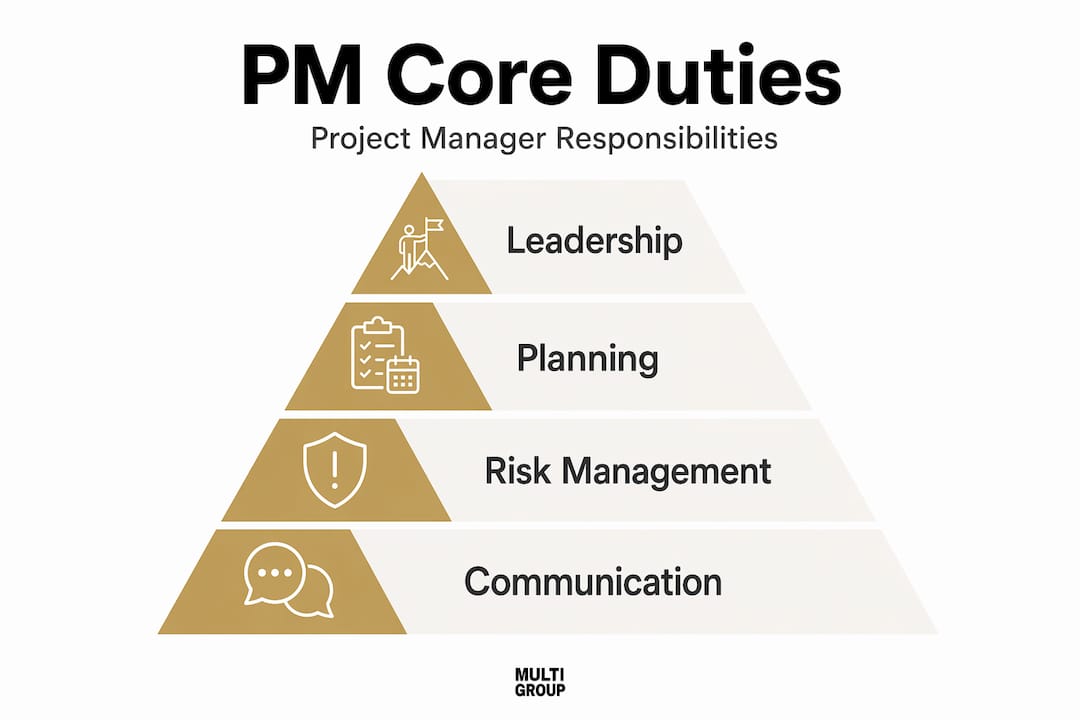
Most professionals would agree that a project manager keeps projects on time and on budget. That description is accurate but incomplete. The core project management responsibilities actually span five distinct areas: planning and scope definition, team leadership, progress tracking, stakeholder communication, and risk and change management.
Here is what each responsibility looks like in practice:
- Planning and scope definition. The PM sets the boundaries of a project before a single task begins. This means documenting objectives, defining deliverables, and creating a timeline that the entire team can work from.
- Team leadership. A project manager coordinates people who often report to different departments or companies. Keeping that group aligned and motivated requires daily attention.
- Progress tracking. Regular check-ins, milestone reviews, and performance reports tell the PM whether the project is on course or starting to drift.
- Stakeholder communication. Clients, executives, regulatory bodies, and end users all need different information at different times. The PM manages all of those communication streams simultaneously.
- Risk and change management. Projects rarely go exactly as planned. A skilled PM identifies risks early, prepares contingency plans, and manages scope changes without derailing the schedule or budget.
The importance of project managers becomes clear when you consider what happens without them. Teams lose direction, budgets overrun, and stakeholders receive conflicting information. The PM role is the connective tissue that holds a project together.
Pro Tip: Document your risk log from day one of any project. Most PMs only start tracking risks after problems surface. Starting earlier gives you time to act rather than react.
Skills every project manager must develop
Understanding what a project manager does is one thing. Knowing what skills are required to do it well is another. Balancing technical and interpersonal skills is not optional. Both are necessary for competent project management.
Here is a practical progression for building the skill set:
- Learn scheduling and budgeting fundamentals. Before managing people, a PM must be comfortable creating realistic timelines, allocating budgets, and tracking variances. These are the mechanics of the role.
- Study risk assessment methods. Risk management is not guesswork. It involves identifying potential problems, estimating their likelihood and impact, and preparing responses before those problems occur.
- Build communication skills deliberately. Most project failures are communication failures. Practice writing clear project briefs, running efficient meetings, and delivering difficult updates to stakeholders.
- Develop emotional intelligence. Project management is fundamentally human-centric, requiring emotional intelligence and conflict resolution as much as methodology. Understanding what motivates your team members, recognizing tension before it becomes conflict, and knowing when to listen rather than direct are all learnable skills.
- Strengthen leadership capabilities. Leadership binds technical and strategic skills in effective project management. It is what gives a PM the authority to resolve disputes, realign priorities, and keep a team focused under pressure.
IT project managers offer a clear example of how these skills combine in practice. They blend technical expertise with adaptive leadership and emotional intelligence to keep projects on track even as business needs shift mid-project. Construction PMs face the same demand, just in a different context.
Pro Tip: Effective PMs recognize that domain mastery matters less than empathy, influence, and communication for project success. You do not need to be the best engineer on a construction site to manage one effectively. You need to earn the team's trust.
How the role changes across industries
The skills of a project manager carry over from one industry to the next, but the daily environment looks very different depending on where you work. The table below compares how the PM role operates in three common sectors.
| Dimension | Construction | Information Technology | Marketing |
|---|---|---|---|
| Primary output | Physical structure or renovation | Software, system, or infrastructure | Campaign, brand asset, or content |
| Key stakeholders | Owner, architect, subcontractors, inspectors | Executives, developers, end users | Client, creative team, media buyers |
| Top daily challenge | Site safety, sequencing, weather | Scope creep, shifting requirements | Approval cycles, budget changes |
| Risk profile | High. Physical safety and regulatory compliance | Medium. Data security and integration failures | Lower. Primarily financial and reputational |
| Communication style | On-site briefings, written RFIs, inspection reports | Digital tools, sprint reviews, status dashboards | Creative briefs, presentations, campaign reports |
Construction project management deserves particular attention because it combines nearly every challenge found in other industries simultaneously. A construction PM spends mornings on-site to preempt safety and sequencing issues, then shifts to coordination calls and administrative tasks in the afternoon. That balance of field presence and office work is unique to the construction environment.
In Metro Vancouver, where Multigroup operates, construction PMs also handle municipal permit timelines, coordinate with multiple trade subcontractors across Burnaby, Richmond, Surrey, and Coquitlam, and manage owner expectations on projects ranging from warehouse renovations to retail buildouts. Understanding construction project management in Metro Vancouver means understanding that no two days are the same and that adaptability is not a soft skill. It is a survival skill.
Aspiring PMs in any industry benefit from studying construction management. The stakes are high, the variables are many, and the feedback is immediate. If you can manage a commercial tenant improvement on schedule and within budget, you can manage almost anything.
Tools and frameworks that support the role
Good project managers do not rely on memory and instinct alone. They use structured tools to reduce ambiguity and create accountability across the team. Three frameworks stand out as particularly effective.
The Responsibility Assignment Matrix, commonly called a RACI chart, maps every task to a person who is Responsible, Accountable, Consulted, or Informed. Built at the work package level, it eliminates the "I thought someone else was handling that" problem that derails many projects.
The Work Breakdown Structure (WBS) divides the total project scope into smaller, manageable components. Each component can be scheduled, budgeted, and assigned independently, which makes large projects far easier to track and report on.
Risk management frameworks formalize the process of identifying threats and preparing responses. A simple risk register that lists each identified risk, its probability, its potential impact, and the planned response gives the entire team a shared view of what to watch for.
Effective documentation ties all of these tools together. Meeting notes, change orders, decision logs, and status reports create a paper trail that protects both the PM and the client when disputes arise. This is especially true in construction project management where formal documentation is often required for permits and inspections.
The tools are only as useful as the discipline behind them. A RACI chart that nobody updates, or a risk register that nobody reviews, provides no real protection. Consistent use of these frameworks is what separates organized teams from reactive ones.
My take on what actually makes a great project manager
I have worked alongside project managers across construction, technology, and commercial development. The pattern I keep seeing is that the best ones are not the most technically skilled people in the room. They are the most self-aware.
Technical skill gets you the job. Leadership keeps the project together when things go sideways. And things always go sideways. A structural issue surfaces on day 14 of a 90-day renovation. A key subcontractor misses a delivery. A permit approval runs three weeks late. In those moments, the PM's job is not to know every answer. It is to stay calm, communicate clearly, and help the team find a path forward.
Project managers serve as a link between strategy and execution, focusing on removing obstacles and aligning teams during uncertainty. That description resonates with me because it captures something most job descriptions miss: the PM's authority is rarely formal. It is earned through trust, consistency, and the ability to make people feel that the project is in capable hands.
What I have found is that psychological safety within a team often predicts project success more reliably than the quality of the project plan. When team members feel safe to flag problems early, you can solve them before they become crises. Creating that environment is a leadership choice, not a process outcome.
— Momo
Multigroup's construction project management expertise
Understanding the role of project manager on paper is useful. Seeing it executed on an active construction site is another level of clarity entirely. Multigroup Contracting brings that execution to commercial and residential projects across Metro Vancouver, including tenant improvements, warehouse renovations, retail buildouts, and coffee shop renovations in Burnaby, Richmond, Surrey, Coquitlam, and North Vancouver.
Every Multigroup project is managed with clear scope documentation, direct stakeholder communication, and a consistent focus on schedule and budget. Multigroup is licensed and insured in BC, and handles everything from permit coordination to final inspections. If you are a property owner, developer, or business owner looking for a contractor who treats project management in Metro Vancouver as a core competency rather than an afterthought, reach out directly.
Call 778-819-5933, email info@multigroup.ca, or visit multigroup.ca to discuss your next project.
FAQ
What does a project manager do on a daily basis?
A project manager plans tasks, coordinates team members, monitors project progress, communicates with stakeholders, and addresses risks or issues as they arise. In construction, this often includes on-site inspections in the morning and administrative coordination in the afternoon.
What are the most important skills of a project manager?
The most critical skills include scheduling, budgeting, risk assessment, communication, and leadership. Research shows that leadership unifies technical and strategic competencies and is what gives a PM the authority to resolve conflicts and keep projects on track.
Why are project managers important to a team?
Project managers provide structure, accountability, and direction. Without a PM, teams often lack clear priorities, communication breaks down, and projects run over time and budget.
How does the project manager role differ in construction?
Construction PMs manage physical site safety, subcontractor coordination, permit timelines, and sequencing challenges that do not exist in office-based industries. The role requires both field presence and strong administrative discipline.
What qualifications do most organizations require for project managers?
Most organizations expect 3 to 5 years of experience along with a relevant bachelor's degree and familiarity with governance frameworks. Certifications like PMP are increasingly common and can significantly improve earning potential.