

TL;DR:
- Subcontractors are independently protected by legal rights, lien rights, and holdback protections in BC.
- The Prompt Payment Act requires timely payments within 35 days, with specific invoice and notice procedures.
- Owners should verify subcontractor credentials, retain holdbacks, and manage relationships proactively to avoid legal issues.
Most property owners and developers in Metro Vancouver walk into a construction project thinking the general contractor handles everything. The reality is more layered. Subcontractors, the licensed trade professionals who do the actual specialized work, carry their own legal rights, payment timelines, and lien protections that exist independently of the general contractor relationship. Misunderstanding this can expose you to unexpected financial liability, project delays, and legal disputes. This guide breaks down who subcontractors are, what BC law says about their rights, how new payment legislation affects your obligations, and what steps you can take to protect your project from the start.
Table of Contents
- What is a subcontractor, and how do they fit in Vancouver projects?
- Legal protections: Lien rights, holdbacks, and recent court decisions
- Payment rules: How BC's Prompt Payment Act shapes subcontractor cash flow
- Pros, risks, and pitfalls: What property owners need to know about working with subcontractors
- Why 'set-it-and-forget-it' fails: Lessons for Vancouver owners from real projects
- Ready to navigate your next project with expert support?
- Frequently asked questions
Key Takeaways
| Point | Details |
|---|---|
| Critical role clarified | Subcontractors provide specialized skills essential to Vancouver construction, often working under a contractor on key project tasks. |
| Robust legal protections | BC law gives subcontractors strong lien and payment rights, including dual protections through holdbacks and recent court decisions. |
| Tight payment timelines | Prompt Payment Act requires strict deadlines for payment to subcontractors, making administrative compliance vital. |
| Owner action required | Property owners must withhold proper holdbacks, vet subs, and maintain strong contracts to avoid disputes or excess liability. |
What is a subcontractor, and how do they fit in Vancouver projects?
To understand risks and opportunities, you first need clarity on what subcontractors actually are and where they fit. A subcontractor is a specialized trade professional hired by the general contractor, not directly by the property owner, to perform a defined scope of work on a construction project. They are experts in a specific discipline and are brought in precisely because that expertise is needed.
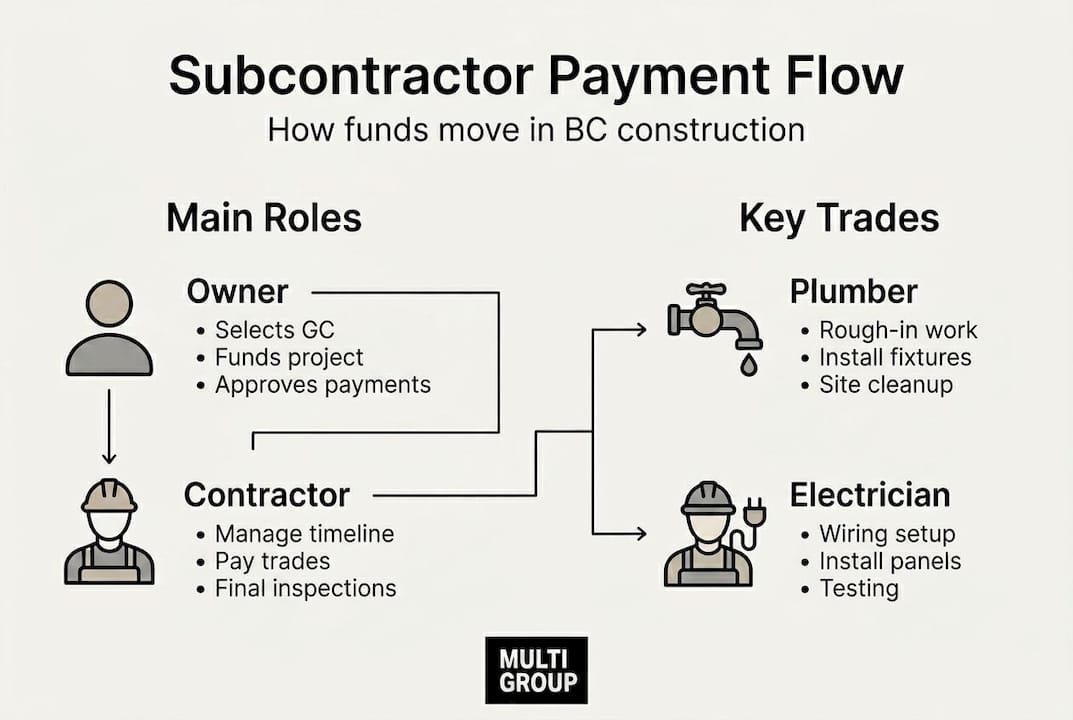
The typical project structure follows a clear chain: the owner contracts with a general contractor, and the general contractor then hires multiple subcontractors to complete specific portions of the work. That separation matters legally and financially.
On most Metro Vancouver builds, the following trades are commonly handled by separate subcontractors:
- Electrical (wiring, panels, lighting installation)
- Plumbing (supply lines, drainage, fixtures)
- HVAC (heating, ventilation, and air conditioning systems)
- Framing and structural carpentry
- Drywall and insulation
- Flooring and finishing
- Fire suppression and safety systems
A mid-sized commercial or residential build in Vancouver typically relies on five or more subcontractor trades working in sequence. Coordination between them is what a skilled general contractor manages. Working with licensed contractors ensures each sub on your project meets BC licensing and insurance requirements.
What many owners overlook is that subcontractors have their own legal standing. As the BC Court of Appeal confirmed, subcontractors retain holdback rights against holdback funds separate from any lien registered against land. That's not a technicality. It's a legal protection that can affect your cash obligations as an owner, even if you never spoke directly to a single subcontractor on site.
Legal protections: Lien rights, holdbacks, and recent court decisions
Once you know how subcontractors operate, it's important to understand the unique legal protections that shape their role in every project. BC operates under a dual lien framework. Subcontractors can register a lien against the land itself, and separately, they hold rights against the holdback fund that owners are legally required to retain.
The holdback is 10% of each progress payment, withheld by the owner specifically to protect subcontractors and suppliers. If a general contractor fails to pay a sub, that holdback fund exists as a source of compensation.

A landmark 2025 BC Court of Appeal decision in the Kingdom Langley case made this crystal clear. The court confirmed that posting security for a land lien does not cancel a subcontractor's right to pursue the holdback. In other words, securing a lien bond to remove a land lien does not wipe out a subcontractor's separate claim against holdback funds.
| Protection type | Who benefits | Owner obligation |
|---|---|---|
| Land lien | Subcontractors and suppliers | Cannot sell or refinance with active lien |
| Holdback fund lien | Subcontractors | Must retain 10% of each progress payment |
| Holdback release | General contractor | Triggered after lien period expires |
Key point: In the Wah Fai edge case, failing to retain the holdback exposed owners to subcontractor claims that exceeded the 10% threshold because no fund existed for lien attachment. Holdback non-compliance can cost owners significantly more than simply retaining the funds from the start.
Owners who skip or shortchange the holdback process do not eliminate liability. They increase it. Understanding contractor liability in BC's legal framework is not optional knowledge for developers managing active projects.
Payment rules: How BC's Prompt Payment Act shapes subcontractor cash flow
Legal rights mean little without effective payment. Here's how recent legislation has reshaped subcontractor compensation in BC. Bill 20, BC's Construction Prompt Payment Act, introduced structured payment timelines that apply across most construction contracts in the province.
The framework works on a cascading schedule:
- The subcontractor submits a proper invoice (a standardized invoice meeting statutory requirements) to the general contractor on a monthly basis.
- The owner must pay the general contractor within 28 days of receiving a proper invoice.
- The general contractor must pay the subcontractor within 7 days of receiving payment from the owner.
- The total maximum timeline from invoice to sub payment is 35 days from when the owner receives the invoice.
- If the owner or contractor disputes payment, they must issue a notice of non-payment within specific windows or lose the right to withhold.
The BC Prompt Payment Act timelines are enforceable, and failure to comply can trigger adjudication, a faster dispute resolution process designed specifically for construction payment disagreements.
| Party | Obligation | Deadline |
|---|---|---|
| Owner | Pay contractor after proper invoice | 28 days |
| Contractor | Pay subcontractor after receiving payment | 7 days |
| Combined maximum | Sub receives payment | 35 days from owner's receipt |
| Notice of non-payment | Must be issued to contest | Per statutory window |
This legislation improves cash flow for construction payments across the industry, particularly for smaller trade contractors who previously had no recourse against delayed payment chains. Owners and general contractors should review future payment frameworks to stay ahead of how these rules continue to evolve. Staying current on renovation compliance trends in 2026 is equally important for project planning.
Pro Tip: Set up an invoice tracking system at the start of every project. Know when each proper invoice arrives and calendar the 28-day and 35-day deadlines immediately. Missing these windows, even accidentally, can result in enforceable adjudication claims.
Pros, risks, and pitfalls: What property owners need to know about working with subcontractors
Understanding obligations is only step one. Here's exactly how these rules and relationships play out on Metro Vancouver job sites. Working with subcontractors through a general contractor offers real advantages. Specialized expertise means each phase of work is handled by a professional who does that task every day. Cost efficiency comes from the general contractor's ability to source competitive sub bids. Speed improves because multiple trades can sequence their work without the owner managing each one directly.
But the risks are real. Here's what commonly goes wrong:
- Credential gaps: Owners or GCs fail to verify that subcontractors hold valid BC licenses and appropriate insurance coverage.
- Coordination failures: Scheduling conflicts between trades create delays. One late sub can push back every trade that follows.
- Payment misunderstandings: Verbal agreements on payment terms create disputes when prompt payment deadlines arrive.
- Ignored holdback obligations: Owners release progress payments in full, forgetting to retain the required 10%, then face lien claims with no fund to draw from.
- Unclear contract scope: Ambiguous scopes of work lead to change order disputes and cost overruns.
The BC Prompt Payment Act does accelerate cash flow for subcontractors, but it adds administrative load for owners and general contractors. Tracking invoice receipt dates, issuing notices of non-payment on time, and managing adjudication risk all require organized project administration.
For a practical breakdown of how these relationships work in commercial settings, the commercial buildout guide is a useful starting point.
Pro Tip: Request a lien waiver from each subcontractor before releasing their final payment. A lien waiver is a signed document confirming the sub has been paid in full and waives their right to register a lien. It's one of the simplest protections available to owners.
Why 'set-it-and-forget-it' fails: Lessons for Vancouver owners from real projects
Stepping back from rules and risks, here's what real-world experience in Vancouver's building scene consistently teaches about subcontractor management. The common instinct for many owners is to focus attention on the general contractor relationship and assume everything below that level is the GC's problem. That instinct is understandable. It's also where avoidable losses tend to originate.
A smaller electrical or insulation subcontractor might represent 5% of your total project budget. But if that sub goes unpaid by the GC and registers a holdback lien, your project can stall, your financing can be disrupted, and resolving the claim takes time and legal cost that no owner planned for.
Seasoned Metro Vancouver developers ask for a list of all subcontractors before work begins. They confirm holdback is being tracked. They request statutory declarations, which are formal sworn statements from the GC confirming subs have been paid, before releasing holdback at project completion.
Working with teams who already understand these obligations makes this process significantly less burdensome. Peace of mind with licensed contractors is not just about quality of work. It's about knowing the administrative and legal foundations are in place from day one. Passive oversight is not a strategy. It's a risk that Metro Vancouver's legal and payment landscape no longer accommodates.
Ready to navigate your next project with expert support?
If you're ready to apply these lessons and want peace of mind for your next build, professional support makes all the difference. Managing subcontractor relationships, holdback compliance, and prompt payment timelines is complex work. Getting it right from the start prevents costly disputes and keeps your project on schedule.

Multigroup Contracting brings the experience, systems, and trade relationships needed to manage every layer of your Metro Vancouver project. From permit handling to subcontractor coordination and payment administration, the team ensures your build moves forward cleanly and compliantly. Whether you're planning a new commercial build, a tenant improvement, or a residential renovation, connecting with an experienced local contractor is the most direct path to a smooth, well-managed project. Reach out to discuss your project and request an estimate today.
Frequently asked questions
What's the legal difference between contractors and subcontractors in Vancouver projects?
Contractors are hired directly by the owner to manage the build; subcontractors are specialists hired by the contractor for specific tasks and hold separate legal and payment rights under BC law, including independent lien protections.
What are 'holdback funds' and how do they protect owners and subcontractors?
Holdback funds are 10% of each progress payment withheld by owners to ensure subcontractors can be compensated if the general contractor fails to pay. Non-compliance with holdback rules can expose owners to subcontractor claims that exceed the withheld amount.
How quickly must subcontractors be paid under BC's Prompt Payment Act?
Subcontractors must be paid within 7 days of the contractor receiving payment from the owner, with a maximum total window of 35 days from when the owner receives the proper invoice under BC's Act.
What compliance steps should owners and developers take to avoid payment disputes?
Owners should retain the 10% holdback on every progress payment, verify subcontractor credentials, document all invoice receipt dates, and follow Bill 20's payment timelines to stay compliant with BC construction law.
Recommended
- Licensed contractors in Vancouver: liability, quality, peace of mind
- Multigroup Contracting | Vancouver General Contractor – Commercial & Residential Construction
- Multigroup Contracting | Vancouver General Contractor – Commercial & Residential Construction
- Multigroup Contracting | Vancouver General Contractor – Commercial & Residential Construction