

TL;DR:
- Portland commercial renovations face predictable delays due to permitting, seismic, and compliance requirements.
- Effective team assembly, including local contractors with BDS experience, is essential for budget and schedule success.
- Prioritizing sustainability and understanding local regulations enhance project value and long-term performance.
Commercial renovation in Portland sounds straightforward until you hit your first permitting delay, discover outdated seismic requirements buried in a building's history, or realize your contractor has never navigated a Bureau of Development Services review cycle. These are not rare occurrences. They are predictable obstacles that catch unprepared business owners and developers off guard, stalling timelines and inflating budgets before a single wall goes up. This guide walks you through every major phase of a Portland commercial renovation, from regulatory groundwork to final inspections, so you can move forward with confidence and clarity.
Table of Contents
- Pre-renovation essentials: Permits, budgeting, and compliance
- Strategic planning: Setting goals and assembling your team
- Sustainability and codes: Meeting Portland's green building standards
- Execution phase: Overseeing construction and staying on track
- Final checks: Inspections, verification, and project handoff
- Why most Portland commercial renovations go over budget—and how local expertise changes everything
- Bring your Portland commercial renovation vision to life with the right partner
- Frequently asked questions
Key Takeaways
| Point | Details |
|---|---|
| Understand permitting up front | Accurate cost and documentation planning avoids delays with Portland BDS. |
| Build the right project team | Choosing experienced, local professionals streamlines renovation and mitigates risk. |
| Prioritize sustainability | Pursuing adaptive reuse and incentive programs reduces operating costs and environmental impact. |
| Oversee execution actively | Regular site meetings and clear documentation prevent overruns and missed deadlines. |
| Verify before handoff | Thorough inspections and closeout ensure a successful, compliant transition to occupancy. |
Pre-renovation essentials: Permits, budgeting, and compliance
With a clear picture of what awaits before you even break ground, you can avoid costly mistakes during project initiation.
The Portland Bureau of Development Services (BDS) manages all commercial building permits in the city. Understanding how their process works is the first real task for any project. Permit fees are tied to project valuation, starting at a minimum of $153 for commercial work and scaling with cost. For example, the first $100,000 of project value carries a base fee of approximately $272, with an additional $1.50 charged per $1,000 above that threshold. On a $500,000 renovation, that adds up quickly, and this fee is just one component of your total permit cost.
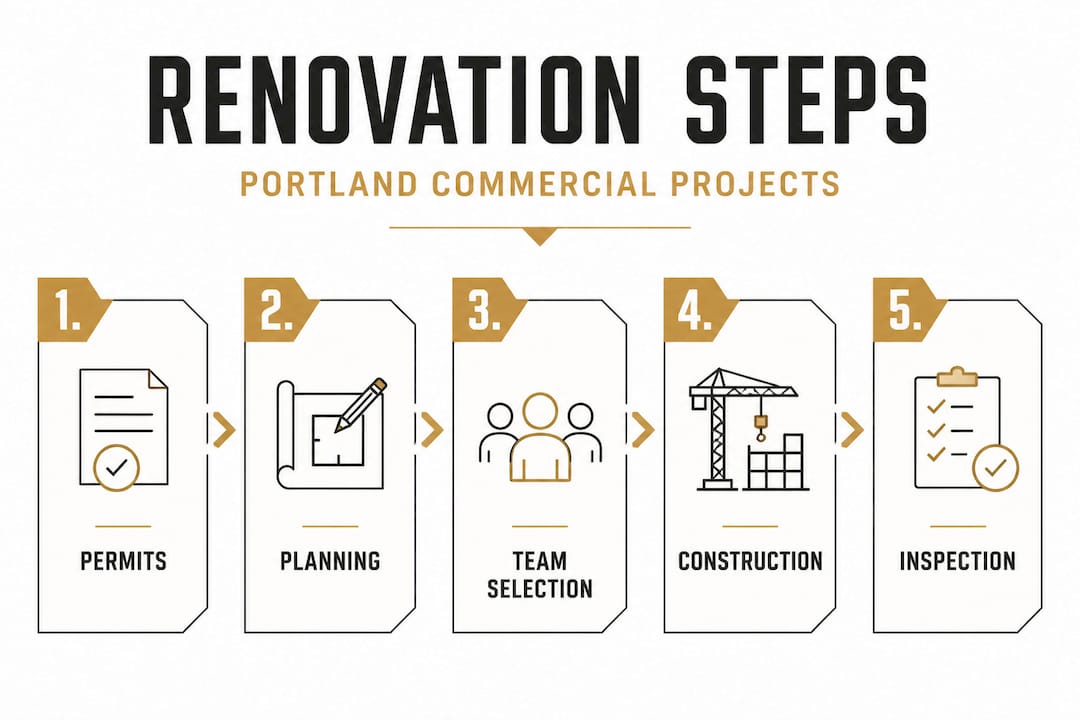
Beyond fees, timing matters. Commercial permit reviews in Portland can take anywhere from 4 to 12 weeks for standard projects, and significantly longer if your building triggers environmental, historic, or zoning review. Engaging BDS early through a pre-design conference is one of the most effective ways to avoid surprises. These meetings let you present your concept, hear concerns in advance, and adjust your plans before they become costly revisions.
Understanding commercial construction processes in detail helps you anticipate what documentation BDS will require, including structural drawings, mechanical plans, and energy code compliance documents.
Common compliance areas that affect Portland commercial renovations:
- Seismic requirements: Many older Portland buildings require upgrades to meet current Oregon Structural Specialty Code standards before renovation can proceed.
- Fire and life safety: Sprinkler systems, egress width, and rated assemblies are closely reviewed, especially in mixed-use and multi-story buildings.
- Zoning and land use: Confirm that your intended use aligns with the base zone. Changes in use often trigger additional land use review.
- Accessibility: ADA and Oregon accessibility code compliance is checked at every new permit, even in partial renovations.
| Compliance area | Typical impact on timeline | Estimated cost range |
|---|---|---|
| Seismic retrofit | 4 to 16 weeks additional | $50,000 to $500,000+ |
| Fire suppression upgrade | 2 to 8 weeks | $8,000 to $50,000 |
| Land use review | 6 to 20 weeks | $2,000 to $20,000 in fees |
| ADA compliance | 1 to 4 weeks | $5,000 to $40,000 |
Pro Tip: Schedule your BDS pre-design meeting as soon as you have a rough concept. This single step can save weeks of back-and-forth and gives you a documented record of early regulatory guidance that protects your project.
Strategic planning: Setting goals and assembling your team
Now that you understand the pre-renovation landscape, it is time to strategically assemble the right team for your vision.
The first planning decision is defining your project scope. Are you doing a targeted tenant improvement, a full adaptive reuse of an underutilized property, or a ground-up build? Each path carries different regulatory obligations, costs, and timelines. Adaptive reuse, for example, converts an existing structure to a new purpose without full demolition. This approach preserves embodied carbon, reduces construction waste, and often costs less than new construction when the existing structure is sound.
The future of Portland commercial renovation increasingly favors adaptive reuse, especially as sustainability mandates tighten and available lots shrink in core neighborhoods.
Comparing delivery methods:
| Delivery method | How it works | Best for |
|---|---|---|
| Design-build | One firm handles design and construction under a single contract | Speed, cost certainty, complex projects |
| Design-bid-build | Owner hires designer separately, then bids construction | When design must be finalized before pricing |
| Construction manager at risk | CM joins early as advisor, then holds the construction risk | Large, phased, or institutional projects |
The design-build approach tends to reduce miscommunication and compresses schedule because the designer and contractor work together from day one. Design-bid-build gives you more control over design before committing to a builder, but requires more owner management during the transition.
Team assembly checklist:
- Licensed architect with Oregon commercial experience
- Structural engineer familiar with Portland's seismic zone requirements
- MEP engineer for mechanical, electrical, and plumbing coordination
- General contractor with demonstrated Portland permit history
- Geotechnical consultant if the site involves soil concerns or basement work
- Sustainability consultant if targeting LEED, Earth Advantage, or BPS compliance
Reviewing Portland and Vancouver construction companies gives useful context for evaluating contractor qualifications across the Pacific Northwest. For a sense of scale, the top Portland general contractors as listed by the Portland Business Journal in 2025 include firms like Skanska, which handled a $64.7 million PSU project, alongside regional specialists like DF Construction, active in the market since 2006.
Pro Tip: Involve your general contractor before design is finalized. Contractors who participate in design review often catch constructability issues early, reduce change orders, and provide accurate cost input that keeps your budget realistic from the start.
Sustainability and codes: Meeting Portland's green building standards
With your team in place, you can unlock additional value by understanding Portland's sustainability landscape.
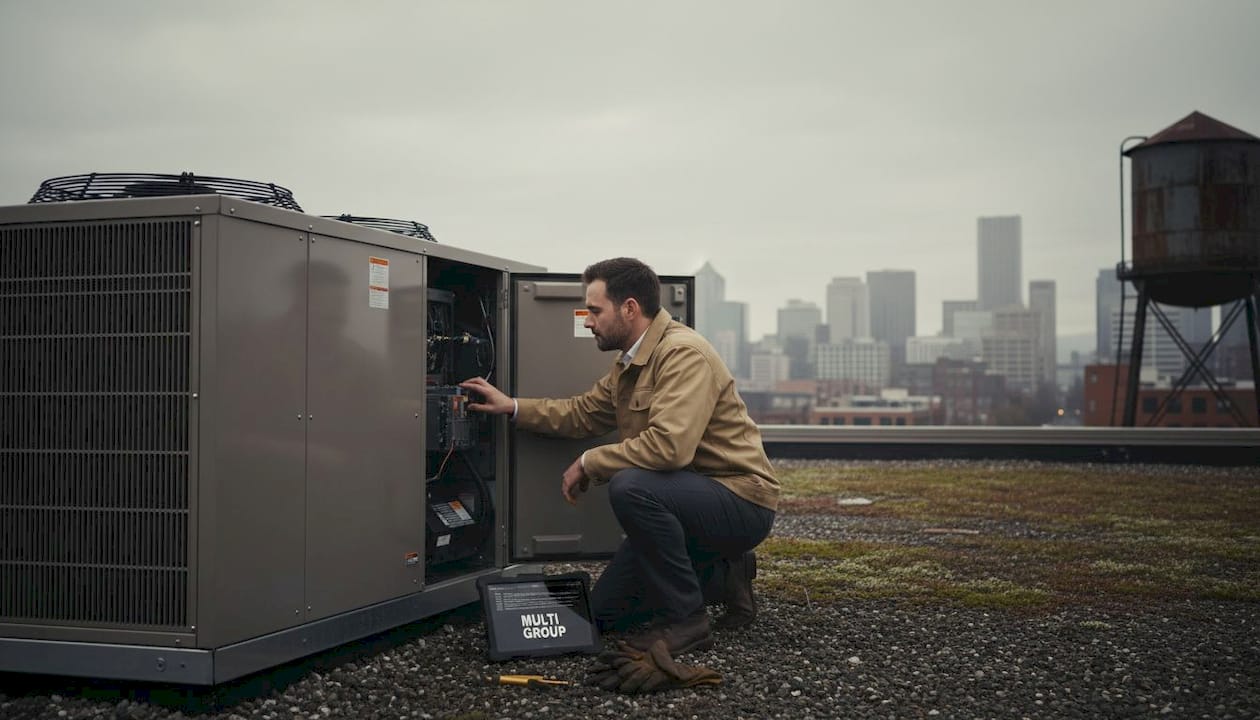
Portland has some of the most aggressive building performance requirements in the Pacific Northwest. Oregon's Building Performance Standard (BPS) requires benchmarking for large commercial buildings, specifically those above 20,000 square feet, with targets focused on energy use intensity (EUI) reductions. For owners who act proactively, Energy Trust of Oregon offers financial incentives that help offset the cost of qualifying upgrades.
Adaptive reuse projects have demonstrated measurable sustainability gains. A Portland State University project that transformed a Brutalist-era building achieved 66% embodied carbon reduction compared to equivalent new construction, a benchmark that demonstrates the environmental and financial logic of preserving existing structures where feasible.
"The most cost-effective sustainability strategy is often the simplest one: keep what's already there. Renovating an existing structure rather than demolishing and rebuilding eliminates enormous amounts of embodied carbon before a single upgrade is made."
Portland-specific green building requirements and resources:
- Oregon BPS benchmarking applies to buildings over 20,000 square feet beginning with certain compliance windows
- Portland's green construction strategies align well with LEED, Earth Advantage, and Passive House frameworks
- Energy Trust of Oregon offers prescriptive and custom incentive tracks for HVAC, lighting, insulation, and envelope upgrades
- Portland's Commercial Energy Efficiency Loan program provides low-interest financing for qualifying improvements
- The city's Clean Energy Fund grants are available for projects serving income-qualified populations or community facilities
Integrating sustainability from the planning stage rather than retrofitting it late is always more cost-effective. Systems like building automation, high-efficiency HVAC, and enhanced envelope insulation perform better and cost less when designed in from the beginning. Owners who treat BPS compliance as a checkbox exercise typically spend more than those who treat it as a design principle.
Execution phase: Overseeing construction and staying on track
After strong planning and sustainability groundwork, the construction phase is where your vision comes to life, but vigilance is crucial.
Step-by-step construction sequence for a Portland commercial renovation:
- Pre-construction coordination: Finalize subcontractor scopes, confirm long-lead material orders, and verify permits are in hand before mobilizing.
- Site protection and temporary measures: Establish hoarding, dust barriers, and utility disconnects as required. In occupied buildings, this step protects tenants and customers.
- Selective demolition or deconstruction: Remove materials systematically. For older structures, salvage valuable components like old-growth timber, brick, or architectural millwork.
- Structural and seismic retrofits: Address any structural work early. This is often the most unpredictable phase in older Portland buildings, where hidden conditions can emerge.
- Rough mechanical, electrical, and plumbing: Install MEP systems before walls are closed. Coordinate inspections at each rough-in stage.
- Insulation and envelope upgrades: Complete air sealing and insulation before finishing, especially important for BPS-compliant projects.
- Finish work and buildout: Millwork, flooring, ceilings, fixtures, and storefronts are installed during this phase.
- Final inspections and commissioning: Request all required city inspections. Commission mechanical and electrical systems before occupancy.
Historic and older structures in Portland require additional attention during the execution phase. Seismic retrofits and material salvage are common requirements, but they also open doors to high-performance outcomes. Projects that incorporate solar photovoltaic systems and envelope upgrades into historic renovations have achieved LEED Gold and net-zero designations, outcomes that add long-term value and tenant appeal.
Staying on schedule requires more than a good Gantt chart. Weekly site meetings with your contractor and subcontractors keep issues visible before they become delays. Change orders are the most common source of budget overruns. Documenting every scope change in writing, with cost and schedule impact acknowledged by all parties, is a non-negotiable practice.
"A missed inspection or an undocumented change order doesn't just cost money at the time. It can create liability issues at project handoff and complicate future transactions involving the property."
Pro Tip: Keep a daily construction log and photograph all rough-in work before it is covered. This documentation protects you during disputes and provides evidence of code compliance long after the project closes.
The 2026 commercial renovation trends in the Pacific Northwest indicate that owners who invest in thorough documentation and proactive communication during construction consistently report better outcomes, fewer disputes, and faster occupancy approvals.
Final checks: Inspections, verification, and project handoff
Your build is almost complete. Now comes the final and crucial step of verifying compliance and wrapping up the project.
Final inspections in Portland are conducted by BDS for building, fire, mechanical, electrical, and plumbing systems. Each trade typically requires its own final sign-off. Common issues that delay final approval include incomplete fire stopping, missing accessible hardware on doors and restrooms, or MEP systems that were not commissioned before inspection.
Comparison of typical final inspection requirements by building type:
| Building type | Key inspection categories | Common deficiency areas |
|---|---|---|
| Retail buildout | Building, electrical, mechanical, accessibility | Exit signage, ADA hardware, HVAC balancing |
| Office tenant improvement | Building, electrical, mechanical, fire | Fire stopping, egress path, data/electrical panel |
| Warehouse renovation | Building, mechanical, fire suppression | Sprinkler coverage, seismic bracing, dock compliance |
| Restaurant or cafe | Building, electrical, mechanical, plumbing, health | Grease interceptor, ventilation, hand wash stations |
The punch list process is a structured review of all incomplete or deficient items before the owner accepts the project. Best practice is to conduct a formal walk-through with your contractor and design team, document every item with photos and descriptions, and set firm resolution deadlines.
Best practices for project closeout:
- Collect all warranties from subcontractors and equipment suppliers before final payment
- Receive and organize all operation and maintenance manuals for installed systems
- Obtain the Certificate of Occupancy from BDS before scheduling tenant move-in
- Confirm that all lien waivers are signed by all contractors and suppliers
Portland's approach to renovation also increasingly emphasizes material stewardship at project close. The deconstruction program expanding to commercial settings signals that future projects may face additional salvage and recycling requirements. Understanding how adaptive reuse and careful deconstruction contrast with outright demolition, such as what occurred at Lloyd Center, helps property owners position their projects for long-term regulatory alignment.
For commercial tenant improvements specifically, the handoff process should also include a walkthrough with incoming tenants to ensure they understand how systems operate, where shutoffs are located, and who to contact for warranty service.
Why most Portland commercial renovations go over budget—and how local expertise changes everything
Every process milestone described in this guide matters. But process alone does not determine whether a Portland renovation succeeds. What separates well-run projects from expensive failures is usually a single factor: local expertise applied at the right moments.
Out-of-town contractors regularly underestimate Portland-specific variables. They miss the seismic overlay requirements that apply in certain zones. They underestimate BDS review timelines, pricing their bids based on jurisdictions with faster permitting. They overlook Energy Trust incentive opportunities because they are not embedded in local utility relationships. These are not small errors. A missed seismic upgrade requirement can halt a project mid-construction. An incorrect zoning assumption can invalidate months of design work.
Lessons from real Portland projects consistently reinforce the same point. Adaptive reuse projects that succeed do so because the team understood the building's condition before committing to scope. Projects that avoid budget disasters typically have contractors who have an established working relationship with BDS reviewers, who know which plan examiners specialize in which project types, and who can anticipate feedback before comments are issued.
The future of Portland construction will reward owners who choose partners with local roots, not just impressive portfolios from other markets. Relationships with city officials, knowledge of active code amendments, and familiarity with local subcontractor networks are assets that no checklist can replicate.
Pro Tip: Never underestimate the value of a contractor who has a direct working relationship with BDS staff. That relationship translates into faster responses, clearer plan review comments, and more predictable timelines for your project.
Bring your Portland commercial renovation vision to life with the right partner
Choosing the right contractor does more than simplify your project. It gives you a single point of accountability for permits, scheduling, subcontractor coordination, and quality control. That kind of integrated expertise is what keeps Portland commercial renovations on budget and on time, especially when unexpected conditions surface in older buildings or sustainability targets require creative problem-solving.
The experienced commercial renovation specialists at Multigroup Contracting bring proven project management discipline and a commitment to quality craftsmanship to every commercial buildout. Whether you are planning a retail buildout, office improvement, or adaptive reuse project, the team is ready to guide you from initial planning through final occupancy. Reach out today to schedule an onsite assessment and start your renovation with a clear, well-structured plan built for Portland's unique regulatory environment.
Frequently asked questions
What is the typical cost range for commercial renovation permits in Portland?
Permit fees start at $153 for commercial projects and scale with project valuation, with additional charges of approximately $1.50 per $1,000 of value above the base tier. Total permit costs vary significantly based on project complexity, required trade permits, and any land use review.
How can I reduce the environmental impact of my renovation?
Adaptive reuse strategies preserve the existing structure and can reduce embodied carbon by up to 66% compared to equivalent new construction. Enrolling in Energy Trust incentive programs further reduces the cost and impact of energy efficiency upgrades.
What incentives are available for energy upgrades in Portland commercial buildings?
Energy Trust of Oregon and city programs offer financial incentives for commercial buildings pursuing BPS compliance, particularly those over 20,000 square feet targeting measurable energy use intensity reductions. Both prescriptive and custom incentive tracks are available.
Are there unique requirements for renovating historic commercial buildings in Portland?
Yes. Historic renovations often trigger requirements for seismic retrofits and material salvage planning, along with opportunities to pursue LEED Gold or net-zero designations through solar integration and envelope improvements.
How long does a typical commercial renovation take in Portland?
Most standard commercial renovations take 6 to 12 months from permit approval to occupancy, with variation based on project scope, permit review timelines, and whether structural or seismic work is required.