

TL;DR:
- A construction scope of work is a legally binding document that defines tasks, deliverables, materials, and boundaries for a project. It helps prevent scope creep and cost overruns by clearly stating exclusions, assumptions, and change procedures. Properly drafting and updating the SOW before and during construction ensures project success and dispute avoidance.
A construction scope of work (SOW) is a formal, legally binding document that defines exactly what tasks, deliverables, materials, and work boundaries apply to a given project. For property owners, developers, and contractors in Metro Vancouver, understanding what is scope of work in construction is not optional. It is the single document that separates a well-run project from one that ends in disputes, delays, and budget overruns. A strong SOW aligns every party before a single nail is driven, and it holds that alignment through to project completion.
What is scope of work in construction?
A construction SOW typically includes 8–10 core sections: project overview, detailed work descriptions, inclusions and exclusions, materials specifications, timelines, roles and responsibilities, quality standards, and a change order process. Each section serves a specific function. The project overview sets context. The work descriptions define deliverables. The inclusions and exclusions draw the boundary lines. Together, these sections create a document that every party can reference when questions arise.

The Construction Industry Institute identifies vague SOWs as a root cause of litigation and budget issues on construction projects. That finding is significant. It means that most disputes on job sites are not caused by bad contractors or difficult clients. They are caused by documents that left too much open to interpretation. A precise SOW closes those gaps before work begins.
The SOW is distinct from the construction contract, though the two documents work together. The contract governs the legal relationship. The SOW defines the technical and operational scope. Both are necessary, and neither replaces the other. Contractors in BC should treat the SOW as the technical backbone of every project agreement.
What are the essential components of a construction scope of work?
A complete SOW covers six areas that, when written clearly, leave no room for misunderstanding.
Project overview and objectives state what the project is, where it is located, and what the finished result should achieve. For a tenant improvement in Burnaby or a retail buildout in Richmond, this section anchors every decision that follows.
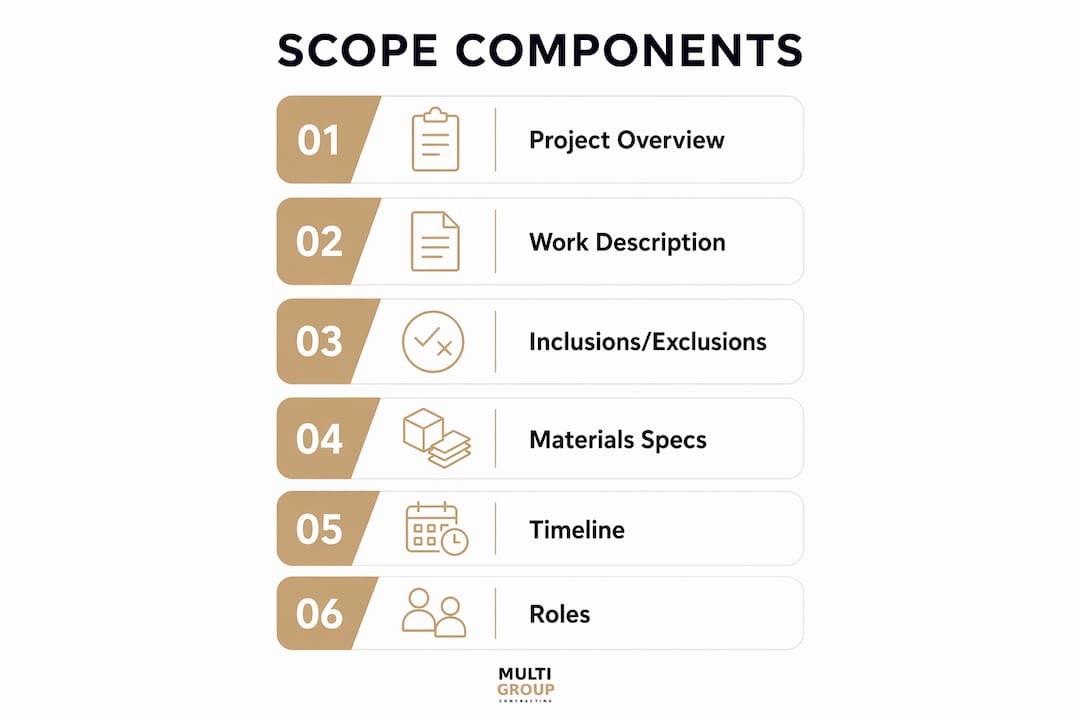
Detailed work descriptions list every task the contractor will perform. Vague language like "general carpentry" creates risk. Specific language like "supply and install 12mm birch plywood millwork panels to the east wall of the reception area" removes it.
Inclusions and exclusions are the most underused protection in any SOW. Explicit exclusions prevent scope creep and reduce change order arguments. If electrical rough-in is not in scope, the SOW must say so. If the owner is supplying fixtures, that must be stated too.
Materials and equipment specifications name the exact products, grades, and standards required. Referencing BC Building Code standards here connects the SOW directly to permit and inspection requirements.
Timeline and milestones define when each phase of work is due. Hold points, which require formal sign-offs before the next phase begins, increase communication and reduce rework later in the project.
Roles and responsibilities assign ownership of every task. Who coordinates inspections? Who manages subcontractors? Who approves substitutions? Answering these questions in the SOW prevents the blame-shifting that derails projects.
| Component | Included in scope | Excluded from scope |
|---|---|---|
| Framing and drywall | Yes | Painting (separate contract) |
| Electrical rough-in | Yes | Fixture supply (owner-furnished) |
| Flooring installation | Yes | Flooring material (owner-furnished) |
| Permit applications | Yes | Engineering drawings (separate consultant) |
| Final cleaning | Yes | Furniture installation (owner-arranged) |
Pro Tip: Always include acceptance criteria in your SOW. These criteria define what "done" looks like, whether that means a system passing a pressure test or a surface meeting a specific finish grade. Without them, project completion becomes a matter of opinion, and opinions lead to disputes.
How does a construction scope of work prevent scope creep and cost overruns?
Scope creep is the gradual expansion of project work beyond what was originally agreed, usually without a corresponding increase in budget or timeline. It is the most common cause of cost overruns on construction projects, and it almost always starts with a vague SOW.
Poorly managed projects with unclear scopes can see costs double relative to the original budget. That outcome is avoidable. A detailed SOW controls scope creep through three mechanisms:
- Explicit exclusions tell every party what is not included, removing the assumption that "the contractor will handle it."
- Written assumptions protect contractors from absorbing costs due to unforeseen site conditions. If the SOW states that the work assumes no asbestos is present, and asbestos is found, a change order is triggered automatically.
- Change order procedures define how new work gets approved and priced. Without this process in writing, owners and contractors argue about whether extra work was authorised.
Consider a common scenario in Metro Vancouver commercial renovation. An owner hires a contractor for an office renovation in Coquitlam. The SOW does not mention ceiling tile replacement. Midway through the project, the owner assumes it is included. The contractor assumes it is not. Without a clear exclusion in the SOW, this dispute costs time and money to resolve. With one sentence in the exclusions section, it never happens.
A well-drafted SOW also improves coordination among general contractors, subcontractors, and owners. When every party is working from the same document, construction scheduling becomes more predictable and inspections proceed without delays.
Common pitfalls when writing a construction scope of work
Most SOW problems come from the same handful of mistakes. Knowing them in advance is the most efficient way to avoid them.
-
Confusing scope with specifications. Scope defines what will be delivered. Specifications define how it will be built. A SOW that mixes the two becomes difficult to enforce. Keep them in separate sections or separate documents.
-
Omitting owner-furnished items. Defining owner-furnished items in the SOW assigns responsibility clearly. If the owner supplies cabinetry and it arrives damaged or late, the contractor is not liable for the resulting delay, provided the SOW states this explicitly.
-
Skipping assumptions. Explicit assumptions protect contractors from absorbing costs for conditions they could not have anticipated. Common assumptions include existing structural capacity, soil conditions, and the absence of hazardous materials.
-
Treating the SOW as a static document. A SOW should function as a living document, updated through formal change orders as the project evolves. Contractors who lock the document at signing and never revisit it create risk for themselves and their clients.
-
Leaving out acceptance criteria. Acceptance criteria define project completion and are consistently underutilised. Without them, a contractor may consider the work done while the owner expects additional steps.
-
Using vague language. Words like "as required," "to the owner's satisfaction," or "best practices" are unenforceable. Replace them with measurable standards tied to BC Building Code requirements or named product specifications.
Pro Tip: Write your SOW in plain language. Legal clarity does not require legal language. A document that a property owner, a site supervisor, and a subcontractor can all read and understand the same way is far more effective than one that requires a lawyer to interpret.
How does a construction SOW fit into real project management workflows?
The SOW is not a standalone document. It connects directly to every other element of the project management process, from permitting to final inspection.
- Contract documentation: In BC, the SOW forms part of the contract package alongside drawings, specifications, and the general conditions. Courts and arbitrators refer to the SOW when resolving disputes, so its language must be precise.
- Permit applications: BC Building Code compliance requirements belong in the SOW. When the document references specific code sections, permit reviewers and inspectors have a clear basis for their approvals.
- Milestone tracking: Each SOW milestone should align with a scheduled inspection or sign-off. This connection between the SOW and the project management workflow keeps the project on schedule and on budget.
- Change order management: Every change to the scope must be documented through a formal change order that references the original SOW. This creates an auditable record of every decision made during the project.
- Subcontractor coordination: General contractors use the SOW to assign work packages to subcontractors. Each subcontractor's agreement should reference the master SOW so that responsibilities are consistent across the entire project team.
Pre-construction planning is the best time to draft and refine the SOW. Changes made on paper cost a fraction of changes made on site. For Metro Vancouver projects, where permit timelines and BC Building Code requirements add complexity, a complete SOW before permit submission prevents costly revisions mid-project.
Key takeaways
A construction scope of work is the most important document on any project. Without it, every decision becomes a negotiation.
| Point | Details |
|---|---|
| SOW is legally binding | It forms part of the contract and is referenced in disputes and arbitration. |
| Exclusions prevent scope creep | Stating what is not included is as important as stating what is. |
| Assumptions protect contractors | Written assumptions trigger change orders when unforeseen conditions arise. |
| SOW is a living document | Update it formally through change orders as the project evolves. |
| Acceptance criteria define completion | Without them, project finish is open to interpretation and dispute. |
Why the SOW conversation should happen before the first site visit
After working on commercial renovations, tenant improvements, and residential builds across Metro Vancouver, the pattern is consistent. The projects that run smoothly are the ones where the SOW was drafted carefully before any work began. The projects that run into trouble almost always have one thing in common: a scope that was written quickly, reviewed lightly, or not updated when conditions changed.
The most common mistake I see is treating the SOW as a formality rather than a working tool. Owners sign it, contractors file it, and nobody looks at it again until something goes wrong. By then, the document is being used as a weapon rather than a guide. That is the wrong way to use it.
The second mistake is under-defining exclusions because contractors worry about discouraging clients. I understand that instinct. But a client who is surprised by an exclusion mid-project is far more difficult to work with than one who understood the boundaries from the start. Clear exclusions build trust. They show the client that you have thought through the project carefully and that you are not hiding anything.
For property owners and developers in BC, my advice is straightforward. Before you sign any construction contract, read the SOW section by section. Ask what is excluded. Ask what assumptions the contractor is making. Ask how changes will be handled. A contractor who cannot answer those questions clearly is a contractor whose SOW will cause you problems. A contractor who answers them confidently, with specific language in the document, is one worth working with.
— MultigroupTeam
Multigroup's approach to scope and project delivery in Vancouver
Multigroup brings the same rigour to scope development that it applies to construction itself. Every project, whether a commercial renovation in Vancouver or a tenant improvement in Burnaby, begins with a detailed SOW that covers inclusions, exclusions, materials, milestones, and BC Building Code compliance requirements.

Multigroup's project managers work directly with property owners, developers, and business operators across Metro Vancouver to build scopes that reflect real site conditions and realistic timelines. For tenant improvements in particular, where lease agreements and landlord requirements add complexity, a precise SOW is the difference between a smooth handover and a costly dispute. Contact Multigroup to discuss your project scope before construction begins.
FAQ
What is a construction scope of work?
A construction scope of work is a formal, legally binding document that outlines the tasks, deliverables, materials, timelines, and responsibilities for a construction project. It defines what work is included and, critically, what is excluded.
What should be included in a construction scope of work?
A complete SOW includes a project overview, detailed work descriptions, inclusions and exclusions, materials specifications, a timeline with milestones, roles and responsibilities, quality standards, and a change order process. Acceptance criteria defining project completion should also be included.
How does a scope of work prevent cost overruns?
A detailed SOW prevents cost overruns by explicitly stating what is and is not included, documenting assumptions that trigger change orders, and establishing a formal process for approving additional work. Vague scopes are the primary driver of budget issues on construction projects.
What is the difference between a scope of work and specifications?
Scope defines what will be delivered on a project. Specifications define how the work will be built, including technical methods and material standards. Distinguishing between the two prevents confusion and makes both documents easier to enforce.
Can a scope of work be changed after a project starts?
A SOW can be updated after a project starts, but only through a formal change order process. Treating the SOW as a living document with documented changes protects both the contractor and the owner throughout the project lifecycle.