

TL;DR:
- Retail space optimization is an ongoing, data-driven strategy focused on maximizing revenue and customer flow within a store. It involves aligning layout, fixture placement, and product positioning based on real traffic, dwell time, and sales data, rather than intuition or static plans. Regular review, cross-team collaboration, and flexible fixtures are essential to sustaining improved performance and adapting to changing consumer behaviors.
Every square foot of your retail store either earns money or costs you money. Retail space optimization explained properly goes well beyond a one-time floor rearrangement. It is a continuous, data-driven discipline that directly affects sales per square foot, customer flow, and how efficiently your team operates day to day. Most store owners treat layout as a setup task. The ones consistently outperforming their competition treat it as an ongoing revenue strategy. This guide breaks down the fundamentals, the tools, the organizational habits, and the practical steps you need to make every corner of your store perform.
Table of Contents
- Key takeaways
- Retail space optimization explained: the fundamentals
- Using data and technology to drive layout decisions
- Aligning teams around space planning
- Practical steps to optimize your retail space
- My take on what actually works
- How Multigroup can support your retail space goals
- FAQ
Key takeaways
| Point | Details |
|---|---|
| Space is a revenue asset | Every zone in your store should be tracked with sales per square foot KPIs, not treated as passive square footage. |
| Data beats guesswork | Heatmaps, people counters, and dwell time analytics reveal what intuition misses about customer behavior. |
| Silos kill optimization | Merchandising, operations, and finance must share metrics and coordinate planning or space decisions stay misaligned. |
| Flexibility beats fixed layouts | Modular fixtures and movable shelving let you adapt to seasonal shifts instead of locking in one static configuration. |
| Continuous review wins | Monthly or quarterly layout audits using real performance data outperform annual resets by a wide margin. |
Retail space optimization explained: the fundamentals
Retail space optimization is the process of aligning your store's physical layout, fixture placement, and shelf allocation to maximize both customer engagement and revenue output. The goal is not to cram more product into a space. It is to make sure the right products are in the right locations, at the right time, based on real data.
At the macro level, you are making decisions about overall store layout. Which sections do customers visit first? Where are the natural traffic lanes? How does your floor plan guide a shopper from entry to checkout? These questions shape the bones of your design. At the micro level, you are looking at individual shelf bays, product facings, and planogram compliance. A product sitting in the wrong shelf position in a high-traffic zone can underperform by a significant margin even when foot traffic is strong.
The key performance indicators that matter most include:
- Sales per square foot: The primary measure of how efficiently your floor space generates revenue.
- Conversion rate: The percentage of store visitors who complete a purchase, shaped directly by layout and product visibility.
- Dwell time: How long customers spend in specific zones. High dwell time in a category signals effective merchandising and genuine category appeal.
- Planogram compliance: The degree to which your actual shelf execution matches the intended plan.
- Dead zone identification: Tracking areas of the store that receive little traffic or generate disproportionately low sales relative to the space they occupy.
Dead zones silently reduce revenue across your entire store. A back corner that nobody visits is not neutral. It is square footage that generates zero return while occupying prime real estate in your lease. Treating every zone as a revenue asset, and auditing performance regularly, is what separates stores that grow from stores that plateau.
Using data and technology to drive layout decisions
Improving retail layout used to rely on manager intuition and periodic store walks. In 2026, the tools available to retail operators have fundamentally changed what good space planning looks like.

People counters and heatmap technology give you a clear picture of where customers go and, more critically, where they stop. Heatmaps and sensor data identify dead zones that managers often overlook and allow you to reallocate those areas to higher-performing categories. The difference between measuring foot traffic and measuring dwell time is significant. A busy aisle that nobody pauses in suggests a navigation problem, not a demand problem. An aisle with moderate traffic but long dwell times is a strong candidate for your highest-margin products.
Real-time analytics go further. When you can see peak traffic windows as they happen, you adjust staffing to match customer density, reduce wait times, and improve the overall experience. That same data informs inventory positioning, so fast-moving items stay accessible during high-demand periods.
AI and image recognition tools are now being applied directly to planogram compliance. AI image recognition identifies shelf deviations and enables corrective action while store reps are still on the floor, not after they have left. That timing matters. A misplaced or out-of-stock product during peak hours represents a direct, quantifiable revenue loss.
Pro Tip: Start with a 30-day heatmap baseline before making any layout changes. You need to know what your store actually looks like from a traffic perspective, not what you assume it looks like.
Combining macro navigation heatmaps with micro-level shelf execution checks generates the highest yield in layout performance. Linking where customers walk with what they actually interact with at the shelf level closes the loop between behavior and placement.
Aligning teams around space planning
One of the most persistent and damaging failures in retail space planning is treating it as a single department's responsibility. Retail space planning fails when merchandising, operations, and finance operate independently, because each team's decisions affect the others in ways that compound over time.
Merchandising may select product assortments that look strong on paper, but if operations cannot restock efficiently within the layout, shrink and out-of-stock rates climb. Finance may push for high-margin product prioritization, but if those products are placed in low-traffic zones, the margin improvement never materializes. Getting these teams to share a common set of space performance metrics is not optional. It is a prerequisite for effective planning.
Here is a practical sequence for building cross-functional alignment:
- Establish shared KPIs. Agree on metrics like sales per square foot, conversion rate, and planogram compliance that all three departments can track and be held accountable for.
- Schedule joint planning reviews. Monthly or quarterly sessions where merchandising, operations, and finance review space performance data together prevent decisions being made in isolation.
- Map operational constraints early. Before finalizing any layout change, operations should sign off on restocking access, traffic flow for staff, and inventory logistics.
- Build in modular flexibility. Modular and movable fixtures allow layouts to adapt to seasonal demand without requiring a full store remodel. Static shelving locks you into one configuration regardless of what the data shows.
- Document and distribute decisions. Every layout change should be recorded with a rationale tied to data, so future decisions are informed rather than reactive.
Pro Tip: If your store has not had a cross-functional space review in the past 90 days, schedule one before your next layout change. Decisions made without operational input are the most expensive kind.
Practical steps to optimize your retail space
Knowing the principles is one thing. Applying them inside a real store, with real constraints, requires a structured approach.
Start with accurate spatial records
Before analyzing performance, confirm that your floor plan is current and accurate. Digital twins and standardized checklists prevent costly surprises during remodels and speed up space planning significantly. Remote validation tools allow teams to identify discrepancies without requiring full on-site visits for every audit cycle.
Capture and analyze customer flow data
Deploy people counters and heatmap sensors for at least four weeks before drawing conclusions. Traffic patterns shift by day of week and season. A single week of data produces misleading baselines. Once you have reliable data, segment it by zone and time window to identify where customers engage and where they do not.
Reallocate dead space strategically
Rather than guessing which products to move into underperforming zones, use your sales per square foot data to identify categories that are currently over-spaced relative to their revenue contribution. Shift that allocation to categories that are under-spaced and outperforming their footprint.
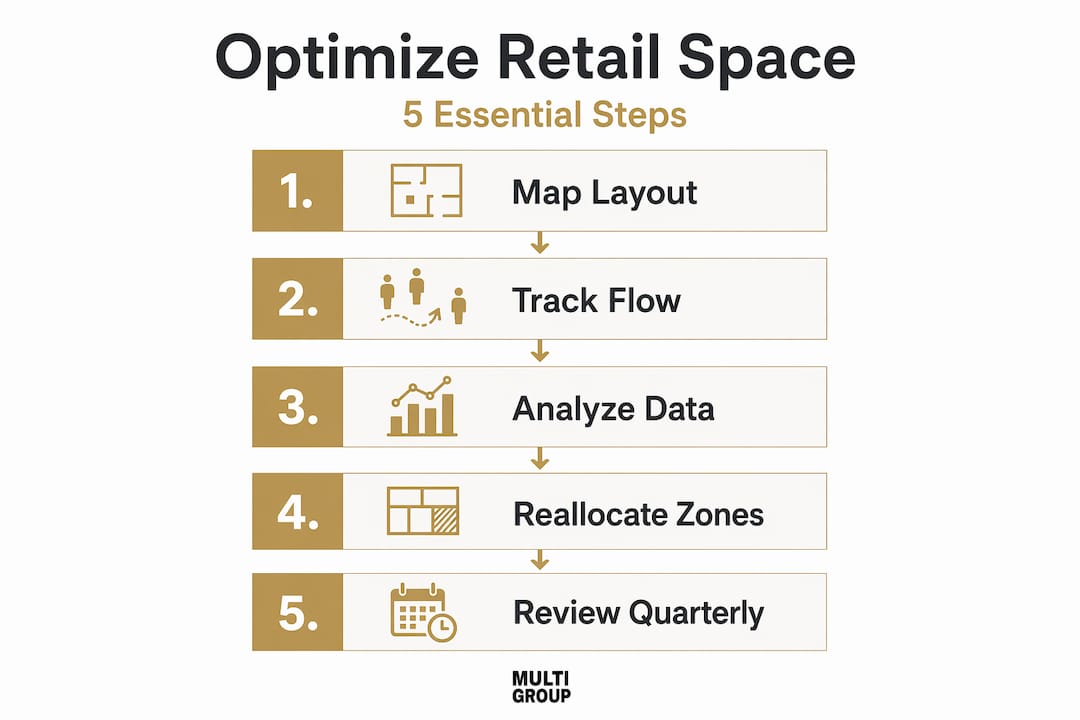
The following table compares common retail space planning approaches:
| Approach | Best for | Key limitation |
|---|---|---|
| Annual layout resets | New stores or major category shifts | Too infrequent to respond to real-time data |
| Quarterly data reviews | Established stores with traffic analytics | Requires consistent data collection infrastructure |
| Continuous planogram updates | High-SKU environments like grocery or pharmacy | Demands real-time compliance tools to be effective |
| Modular fixture rotation | Seasonal retailers or trend-driven categories | Higher upfront cost for flexible fixture systems |
Maintain planogram compliance
Planogram compliance at the SKU level during store visits reduces revenue leaks by enabling immediate corrective action. Build a clear resolution process so that shelf deviations identified during visits are corrected before the visit ends, not logged for a follow-up that may take days.
When planning a physical retail buildout or remodel, construction decisions directly shape your optimization options afterward. Reviewing retail buildout examples from stores in Vancouver and surrounding markets gives you concrete reference points for how construction choices translate into layout flexibility.
My take on what actually works
I've worked alongside retail operators and contractors on enough commercial buildout projects to say with confidence that the most common failure point in retail space optimization is not a lack of data. It is a lack of follow-through. Retailers invest in heatmap technology or hire consultants for a layout redesign and then treat the result as finished. Eighteen months later, the store looks the same even though consumer behavior has shifted and sales data has been quietly signaling problems for quarters.
What I've seen work consistently is pairing good construction planning with a genuine commitment to reviewing performance on a schedule. Stores that build in flexibility from day one, meaning modular shelving, accessible power for digital signage, and clear traffic sightlines, have a structural advantage when it comes time to adapt. The stores that struggle are the ones that locked in a static layout during their buildout and never considered what it would cost to change it later.
I've also observed that the human judgment piece is irreplaceable. Technology tells you where customers go. It takes experienced operators to understand why and to make decisions that technology cannot. The best results come from teams that use data to inform decisions, not to replace them. If you are exploring a renovation or new retail build, planning your retail buildout with optimization in mind from the start saves significant rework later.
— Momo
How Multigroup can support your retail space goals
If your retail space is underperforming and you are ready to make structural changes that actually support better layout and customer flow, Multigroup can help. Multigroup is a licensed and insured general contractor serving Metro Vancouver including Burnaby, Richmond, Surrey, Coquitlam, and North Vancouver, as well as markets in Seattle and Portland.

Multigroup specializes in retail buildouts and tenant improvements built around real operational requirements. Whether you are reconfiguring an existing store to improve traffic flow, installing modular fixture systems, or starting a new retail build from the ground up, the team at Multigroup brings the project management, permitting expertise, and construction precision needed to bring your space vision to life on time and on budget.
Contact Multigroup today at 778-819-5933, info@multigroup.ca, or visit multigroup.ca to discuss your retail renovation or buildout project.
FAQ
What is retail space optimization?
Retail space optimization is the ongoing process of configuring your store's layout, fixtures, and shelf space to maximize revenue per square foot and improve the customer experience. It is a continuous practice, not a one-time redesign.
What metrics should I track to measure retail space efficiency?
The most important metrics are sales per square foot, conversion rate, dwell time by zone, and planogram compliance. Tracking these together gives you a complete picture of how well your space performs.
How do heatmaps help with improving retail layout?
Heatmaps show you exactly where customers walk, stop, and engage inside your store. This data identifies dead zones, high-traffic areas, and placement opportunities for high-margin products that intuition alone would miss.
How often should I review and adjust my store layout?
Quarterly reviews using real traffic and sales data produce far better outcomes than annual resets. For high-SKU stores in categories like grocery or pharmacy, monthly planogram compliance checks are worth the operational investment.
Do I need to remodel my store to optimize its space?
Not always. Many optimizations happen through fixture repositioning, product reallocation, and planogram updates. However, if your current layout has structural constraints limiting flow or flexibility, a targeted renovation built with modular systems can significantly expand your optimization options long term.