

TL;DR:
- Correct understanding of construction terms like vanilla shell and warm shell is vital to avoid costly delays.
- Retail spaces in Vancouver must meet stricter fire, egress, and finish standards due to occupancy classifications.
- Mastering terminology and working with local experts ensures projects stay on schedule and within budget.
Misunderstanding a single construction term can cost a Metro Vancouver developer tens of thousands of dollars. When a landlord says "vanilla shell" and a tenant hears "move-in ready," the resulting disagreement delays openings, inflates budgets, and strains business relationships before a single customer walks through the door. This guide is written specifically for property developers and business owners in Metro Vancouver who want to negotiate confidently, ask sharper questions, and avoid the miscommunications that derail retail and commercial projects. By the time you finish reading, core terms like TI allowance, warm shell, MEP systems, and fast track will be completely clear.
Table of Contents
- Core retail construction terms: start with the basics
- How retail occupancies differ from other commercial spaces
- Understanding TI allowances, turnkey, and what goes wrong
- More advanced retail construction concepts decoded
- Why mastering terminology gives you an edge in Metro Vancouver retail
- Need more guidance? Talk to Vancouver retail construction specialists
- Frequently asked questions
Key Takeaways
| Point | Details |
|---|---|
| Master essential terms | Understanding terms like TI, vanilla shell, and allowance protects you from costly mistakes. |
| Retail rules differ | Retail status in Metro Vancouver means stricter finishes and fire codes than other commercial spaces. |
| TI structure matters | Whether you choose turnkey or allowance, clarify scope and ownership before signing any deals. |
| Nuanced concepts count | Advanced terms like BIM and fast track can significantly impact speed, cost, and compliance. |
| Expert help pays off | Partnering with local specialists makes project delivery and regulatory navigation much smoother. |
Core retail construction terms: start with the basics
Now that the stakes are clear, let's break down the most common terms you'll encounter negotiating a retail construction project. These are the words that appear in every lease, every scope of work, and every contractor conversation. Missing their exact meaning puts you at a disadvantage from the first meeting.
Tenant Improvement (TI) refers to any construction work done to customize a leased space for a specific tenant's use. This can range from installing flooring and lighting to full interior buildouts. As defined by commercial construction standards, a vanilla shell delivers a basic, unfinished interior: bare concrete floors, unpainted drywall, and limited utility rough-ins. A warm shell goes a step further, adding functional HVAC, restrooms, and basic electrical. Understanding Vancouver buildout phases helps you map which shell type aligns with your project timeline and budget.
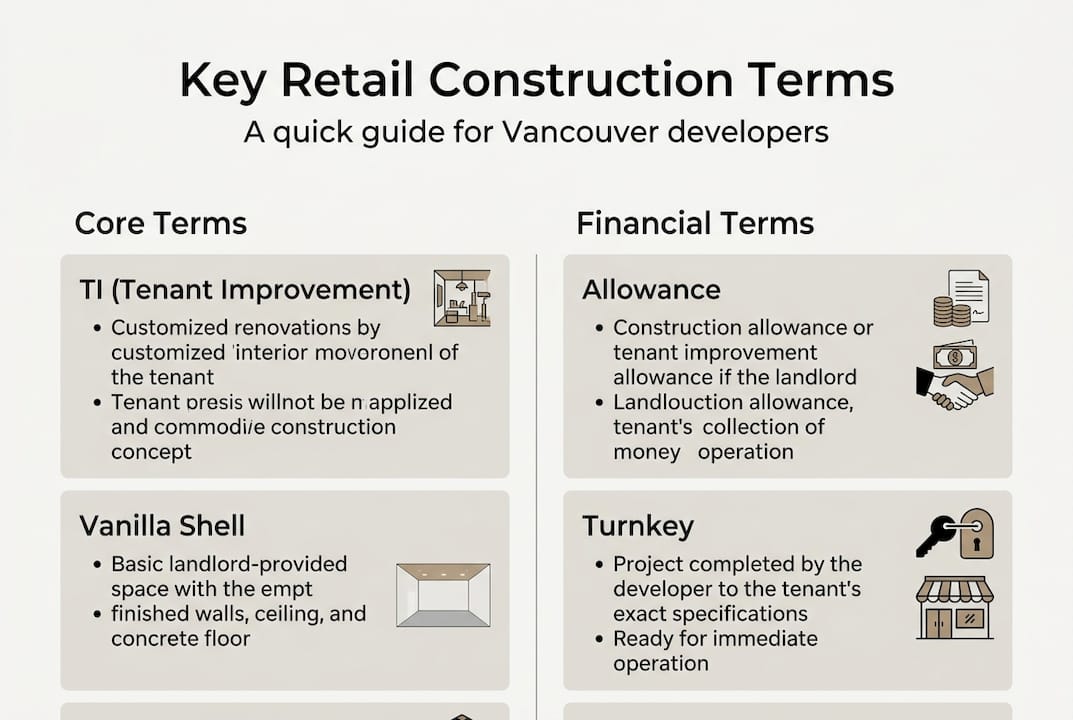
Here is a quick reference for the most fundamental terms:
| Term | What it means | Who typically provides it |
|---|---|---|
| Core & shell | Structural frame, exterior, common areas | Landlord |
| Vanilla shell | Minimal interior finishes, no MEP | Landlord |
| Warm shell | Basic MEP (HVAC, plumbing, electrical) | Landlord |
| TI (tenant improvement) | Custom interior work for tenant use | Tenant or landlord-funded |
| MEP systems | Mechanical, electrical, and plumbing | Contractor |
The distinction between turnkey and allowance structures is equally important. In a turnkey arrangement, the landlord completes improvements to a specified standard and delivers a finished space. In an allowance model, the landlord provides a set dollar amount per square foot and the tenant manages the construction. Each model shifts risk differently.
- Turnkey: Landlord controls construction, tenant has less flexibility
- Allowance model: Tenant controls scope, but bears cost overruns
- Hybrid: A combination, common in Metro Vancouver mixed-use projects
In a typical Vancouver lease discussion, a landlord might offer a "$50 per square foot TI allowance on a 2,000 square foot space." That sounds generous until you realize high-end retail finishes in Vancouver often run $150 to $200 per square foot.
Pro Tip: Before signing any lease, ask for a written breakdown of exactly what the "shell" includes. Confirm whether HVAC, sprinklers, and electrical panels are already in place or if they come out of your TI budget.
How retail occupancies differ from other commercial spaces
After understanding basic terms, it is critical to recognize how retail differs from other spaces you may have worked with. Retail construction operates under specific regulatory requirements that directly shape design decisions, finish choices, and construction costs.
Retail spaces are classified under IBC Group M, which designates spaces where merchandise is displayed and sold. This classification carries stricter requirements for fire protection, egress width, and occupant load calculations compared to Group B (business/office) or Group S (storage/industrial) spaces. For Metro Vancouver developers, this is not a technicality. It directly affects your permit applications and your contractor's scope.
Here is how occupancy classes compare for practical construction decisions:
| Factor | Group M (retail) | Group B (office) | Group S (industrial) |
|---|---|---|---|
| Egress requirements | High: wider aisles, more exits | Moderate | Lower |
| Finish durability | High: foot traffic resistance | Moderate | Low |
| Fire suppression | Sprinklers often required | Conditional | Conditional |
| Storefront visibility | Typically required by code | Not applicable | Not applicable |
"Retail construction classifications directly affect fire egress design, finish material selection, and layout planning in ways that office or industrial projects simply do not."
In Vancouver, additional local requirements apply. High-visibility storefront glazing, accessible egress paths under the BC Building Code, and mandatory sprinklers in spaces above a certain occupant load are all standard considerations. For Vancouver commercial construction projects in mixed-use buildings, the classification can overlap, adding complexity to permit applications.
Here is a step-by-step view of how occupancy class shapes TI strategy:
- Confirm the occupancy classification with your architect before budgeting
- Identify sprinkler and egress requirements specific to your space size
- Factor finish durability standards into your material selections
- Check whether the landlord's shell already meets Group M fire protection thresholds
- Review Vancouver's local amendments to the BC Building Code with your contractor
Missing any of these steps creates re-work, permit delays, and budget pressure that could have been avoided with upfront clarity.
Understanding TI allowances, turnkey, and what goes wrong
With occupancy class clear, developers and tenants must next grasp how improvements are actually paid for and who carries what risk. This is where many retail projects run into trouble.

A TI Allowance is a fixed dollar amount a landlord contributes toward tenant improvements, typically expressed per square foot. A turnkey deal means the landlord delivers a finished space to an agreed standard. In an allowance model, the tenant takes the money and manages their own build. The practical difference is significant.
Key risks in each approach:
- TI Allowance model: Cost overruns fall on the tenant, and any permanent improvements such as built-in millwork or plumbing typically revert to the landlord when the lease expires
- Turnkey: Tenants have less control over finish quality and contractor selection
- Ambiguous upgrades: When scope is not detailed in writing, disputes arise over what is "standard" versus what is a tenant-requested upgrade
Understanding the retail TI process before finalizing your lease terms helps you negotiate a scope that matches your actual needs. In Metro Vancouver, where construction costs are among the highest in Canada, the gap between a TI allowance and actual build costs can be substantial.
Negotiation strategies that protect your position:
- Request a detailed scope of work attached to the lease, not just a dollar figure
- Clarify who owns improvements at lease expiry, particularly millwork, flooring, and MEP upgrades
- Ask for a landlord approval process for contractor selection if you control the build
- Include a holdback provision so funds are released against verified completed work
Pro Tip: Always get improvement ownership and scope confirmed in writing before construction begins. Verbal agreements about what the landlord "will cover" rarely hold up when disputes arise after the build.
More advanced retail construction concepts decoded
Basic and financial terms are only part of the picture. Advanced concepts are increasingly critical for retail delivery in Vancouver, particularly as projects grow more complex and timelines tighten.
BIM (Building Information Modeling) is a digital 3D modeling process that creates a shared, data-rich model of the project. For retail, this means designers, engineers, and contractors all work from the same coordinated model, reducing conflicts between MEP systems and structural elements before construction begins.
Fast Track is a delivery method where design and construction phases overlap. Rather than completing all drawings before breaking ground, construction starts on completed portions while design continues on others. This speeds up delivery in competitive leasing markets.
Constructibility Review is a formal process where the construction team evaluates drawings for practical build issues before work begins. It catches problems that look fine on paper but create field complications, saving time and cost.
CCD (Construction Change Directive) is a directive issued by the owner or architect to proceed with a change before a formal change order is agreed upon. In fast-moving retail projects, CCDs prevent work stoppage but require careful tracking to avoid cost disputes.
Key points at a glance:
- BIM: Reduces coordination errors; increasingly standard in Vancouver commercial projects
- Fast Track: Saves time but requires experienced project management to avoid scope gaps
- Constructibility Review: Prevents expensive field re-work; highly recommended for complex TI scopes
- CCD: Keeps projects moving but must be reconciled financially in writing
Vancouver adds another layer of complexity. Seismic requirements and permitting timelines in Metro Vancouver are more demanding than in many other Canadian cities. BIM and constructibility reviews are not extras here. They are risk management tools. Choosing design-build for retail and working with a team experienced in Vancouver construction management can make these advanced processes far easier to manage.
Why mastering terminology gives you an edge in Metro Vancouver retail
Here is an insight most guides skip: Vancouver's regulatory environment makes precise language more consequential than it is in almost any other Canadian market. The BC Building Code, local amendments, seismic requirements, and Metro Vancouver's development bylaws create a layered approval environment where a single misused term in a permit application can trigger a revision cycle that delays your opening by weeks.
We have seen projects stall because a scope of work described work as "cosmetic renovations" when the actual scope triggered a full building permit requirement. That kind of ambiguity is costly. It is also entirely avoidable.
Contrary to common assumption, experienced general contractors genuinely value clients who use terminology correctly. It signals that you understand your own project, that you will hold scope boundaries clearly, and that communication will be efficient. A client who asks "is this a warm shell or vanilla shell?" before signing a lease saves everyone time.
Prioritizing project delivery success starts with language. When you speak clearly, your contractor, landlord, and architect respond in kind. That alignment is what keeps retail projects on schedule and on budget in one of Canada's most demanding construction markets.
Need more guidance? Talk to Vancouver retail construction specialists
Having a reliable expert in your corner can turn complex terminology into straightforward project success. Understanding the difference between a vanilla shell and a warm shell, or knowing when to push back on a TI allowance structure, is easier when you have experienced professionals guiding the conversation.

At Multigroup Contracting, we work directly with Metro Vancouver property developers and business owners on retail buildouts, tenant improvements, and commercial renovations. We handle permit coordination, scope definition, and project management so that terminology confusion never becomes a budget problem for you. Whether you are negotiating your first lease or managing a multi-site retail rollout, our team brings the local knowledge and hands-on experience your project needs. Connect with Metro Vancouver construction experts to discuss your next retail project.
Frequently asked questions
What is a TI allowance in retail construction?
A TI Allowance is a set amount a landlord provides per square foot for tenant improvements. Per standard lease structures, tenants cover any cost overruns, and permanent improvements typically revert to the landlord when the lease ends.
How does a vanilla shell differ from a warm shell?
A vanilla shell provides only minimal interior finishes with no MEP systems included, while a warm shell includes essential utilities like HVAC, basic lighting, and restrooms already in place.
Why does occupancy classification matter for retail projects?
IBC Group M classification affects fire protection, egress requirements, and finish standards in ways that office or industrial classifications do not, directly shaping your permit scope and construction costs.
What does fast track mean in construction?
Fast Track is a method overlapping design and construction phases to accelerate delivery, commonly used when retail lease timelines are tight in competitive Metro Vancouver markets.