
TL;DR:
- A residential project workflow is a structured process that guides each phase of home construction or renovation, ensuring timely inspections, approvals, and documentation. Proper management of permits, inspections, and subcontractor coordination is vital to avoid delays and cost overruns, with digital tools and BIM supporting effective collaboration. Enforcing clear phase gates and proactive planning, especially during pre-construction and closeout, is essential for project success in Metro Vancouver.
A residential project workflow is the structured process that coordinates every phase of a home construction or renovation project, from pre-construction planning through final handover, keeping scheduling, inspections, subcontractors, and documentation aligned. Without this structure, even well-funded projects in Metro Vancouver regularly run over budget and behind schedule. Tools like Asana, Trello, and Procore give homeowners and property managers real-time visibility into their building project timeline. The core insight is simple: a defined workflow with formal phase gates and clear role assignments is what separates projects that finish on time from those that don't.
What is a residential project workflow and why does it matter?
A residential project workflow is the industry term for what construction professionals also call a construction management process or phase-gate system. It defines who does what, when, and in what order, across every stage of a home build or renovation. The workflow covers scheduling, permit management, subcontractor coordination, inspection hold points, procurement, and documentation. Without it, decisions get made reactively, trades show up out of sequence, and inspections fail because no one confirmed readiness in advance.
Managing the workflow as a series of connected milestones with go/no-go decision points allows clear progress tracking and unified team commitment. For homeowners managing a kitchen renovation in Burnaby or a custom build in North Vancouver, this structure is the difference between a six-month project and a twelve-month one. The financial stakes are equally real: cost overruns on residential projects almost always trace back to poor sequencing, missed inspections, or late procurement decisions.
What are the key phases and phase gates in a residential construction workflow?
Phase gates aligned to inspection hold points control project progression and prevent any phase from closing before mandatory inspections and conditions are met. This is the backbone of an efficient home construction workflow.
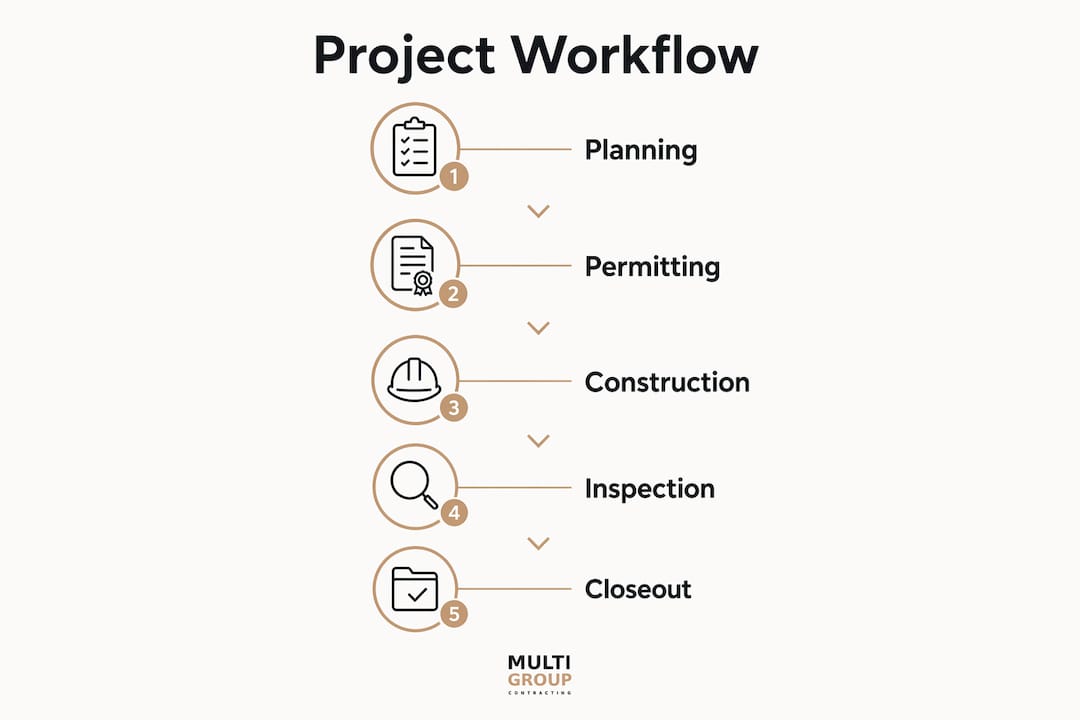
The standard phases in a residential development process run in this order:
- Pre-construction: Permits secured, long-lead items ordered, contracts signed, and site logistics confirmed. This phase does not close until all permits are in hand.
- Foundation: Excavation, formwork, concrete pour, and waterproofing. The phase closes only after the foundation inspection is signed off by the authority having jurisdiction.
- Framing: Structural framing, roof sheathing, and window rough-ins. Framing inspection and trade coordination sign-off are required before moving forward.
- Rough-in: Mechanical, electrical, and plumbing rough-ins installed before walls close. Each discipline has its own inspection hold point.
- Finishes: Insulation, drywall, flooring, cabinetry, and fixtures. This phase is the most trade-intensive and requires tight sequencing.
- Commissioning: Systems testing, deficiency corrections, and pre-occupancy checks.
- Closeout: Punch list resolution, final inspections, Certificate of Occupancy, and document handover.
The table below shows how phase gates connect to budget and procurement milestones:
| Phase | Inspection hold point | Budget/procurement trigger |
|---|---|---|
| Pre-construction | Permit issuance | Long-lead item orders placed |
| Foundation | Foundation inspection | Structural steel or lumber order confirmed |
| Framing | Framing inspection | Window and door delivery scheduled |
| Rough-in | MEP inspections | Fixture and equipment procurement |
| Closeout | Final/occupancy inspection | Retainage release authorized |
Pro Tip: Treat each phase gate as a formal go/no-go meeting, even on small renovations. A five-minute readiness check before calling for an inspection prevents failed inspections that reset the schedule clock for that entire trade discipline.
How to organize permits, inspections, and approvals efficiently
A home renovation workflow uses clear permit packaging, decision logging, and role clarity, with a typical timeline of 6 to 8 weeks including scheduled inspections and site meetings. That timeline assumes permits are filed early and tracked actively, not reactively.
Practical steps for managing this part of the process:
- List every required permit at project start. In Metro Vancouver, this typically includes a building permit, electrical permit, plumbing permit, and gas permit. Surrey and Coquitlam may have additional requirements for secondary suites or heritage properties.
- Assign one person to own permit tracking. On projects managed by a general contractor, this is the GC's responsibility. On owner-managed projects, the homeowner must designate someone.
- Build inspection scheduling into the master schedule. Do not treat inspections as events that happen when the work is done. Schedule them as deliverables with specific dates.
- Add buffer for reinspection. A failed inspection resets the schedule for that discipline. Budget at least three to five business days of buffer per inspection phase.
- Use a decision log. Record every approval, change order, and material substitution in writing. This protects all parties and prevents disputes at closeout.
- Use digital tools for tracking. Platforms like Buildertrend or CoConstruct centralize permit status, inspection dates, and approval documents in one place accessible to the whole team.
Pro Tip: Conduct a pre-inspection walk with your contractor the day before any scheduled inspection. Internal readiness checks before the inspector arrives significantly reduce the chance of a failed inspection.
How does BIM improve a residential construction workflow?
Building Information Modeling, or BIM, is a digital process where architects, engineers, and contractors work from a shared three-dimensional model of the building rather than separate two-dimensional drawings. A BIM Execution Plan (BEP) defines ownership, software, versioning, and modeling detail levels across project stages, facilitating coordination and clash detection. On residential projects, BIM is most valuable during design coordination and rough-in phases, where conflicts between structural, mechanical, and electrical systems are caught digitally before they become expensive field problems.
BIM supports the residential development process across these stages:
- Conceptual design (LOD 200): Massing, spatial relationships, and early cost modeling.
- Construction documentation (LOD 300): Detailed drawings for permit submission and trade coordination.
- Pre-construction planning (LOD 400): Prefabrication details and component-level coordination.
- As-built modeling: Final model updated to reflect actual construction, delivered to the homeowner at closeout.
Software like Autodesk Revit and ArchiCAD are the standard tools for residential BIM work. For homeowners working with an architect or design-build firm, asking for architectural drawings produced in a BIM environment gives you a more accurate permit package and a more reliable construction document set. The as-built model delivered at project end also becomes a permanent record of your home's systems, which is useful for future renovations or insurance claims.
BIM workflows succeed when BEP rules are locked down early, preventing versioning chaos and ensuring smooth coordination across teams. This is why Multigroup recommends confirming BIM protocols with your design team before construction documents begin.
Best practices for subcontractor coordination and schedule management
The biggest schedule failure in residential construction is lack of early communication with subcontractors. Shared schedules with adequate lead time are the single most effective fix.
Follow this sequence to keep trades coordinated and on schedule:
- Share a master schedule with all subcontractors at project start. Every trade needs to see the full building project timeline, not just their own scope.
- Issue 1 to 2 week look-ahead schedules weekly. Look-ahead schedules shared with subcontractors need at least one to two weeks' notice to enable proactive planning and avoid last-minute schedule failures.
- Define scope clearly in writing before mobilization. Scope gaps between trades are a primary cause of delays and disputes. Define who supplies materials, who installs, and who cleans up.
- Hold pre-installation meetings for every major trade. Pre-installation meetings and rehearsed sequencing protect design intent and prevent costly on-site delays by ensuring trade crews arrive prepared and aligned on expectations.
- Assign a single point of contact per trade. Communication routed through multiple people creates confusion. One contact per trade, one contact on the GC side.
- Run weekly site meetings. Even a 20-minute weekly check-in catches schedule drift before it compounds. Document decisions and distribute notes the same day.
Pro Tip: Never keep the schedule only in your head or the general contractor's head. Keeping schedules inaccessible to subcontractors leads to poor responsiveness and delays. Use a shared digital portal, even something as simple as a Google Sheet, so every trade can see upcoming milestones.
How to manage project closeout and final handover documents
The closeout phase is where many residential projects stall. A comprehensive closeout routine treats punch lists, documentation, retainage, and final approvals as workflow deliverables, not afterthoughts, enabling smooth contract closure and occupancy.
Key closeout tasks include:
- Punch list completion: Walk the site with your contractor and document every deficiency. Assign each item a responsible trade and a completion date.
- Final inspections: All trade disciplines must pass their final inspections before the Certificate of Occupancy is issued.
- Retainage release: Retainage funds of 5 to 10% are typically held until punch list items are resolved and final approvals are secured.
- Document compilation: Collect warranties, operations and maintenance manuals, as-built drawings, and commissioning reports. Schedule this compilation as a task in the project schedule, not a last-minute scramble.
- Digital handover package: Deliver all documents in a single organized folder, either cloud-based or on a USB drive, so the homeowner has a permanent record.
| Closeout document | Who provides it | Why it matters |
|---|---|---|
| As-built drawings | General contractor or architect | Records actual construction for future reference |
| Warranties | Each trade or supplier | Defines coverage and claim procedures |
| O&M manuals | Equipment suppliers | Required for system maintenance and service |
| Commissioning reports | Mechanical/electrical contractor | Confirms systems operate to specification |
| Certificate of Occupancy | Municipal authority | Legal authorization to occupy the building |
Learning more about post-construction service helps homeowners understand what to expect after the keys are handed over.
Key takeaways
A well-executed residential project workflow requires phase gates, proactive inspection management, clear subcontractor communication, and organized closeout documentation to deliver on time and on budget.
| Point | Details |
|---|---|
| Phase gates control progress | Each phase closes only after inspections are signed off and entry criteria for the next phase are met. |
| Permits need active tracking | Assign one owner to permit and inspection management, and build reinspection buffer into the schedule. |
| BIM reduces field conflicts | A BIM Execution Plan locks down software, versioning, and detail levels early to prevent coordination failures. |
| Subcontractor lead time is critical | Share look-ahead schedules at least one to two weeks in advance to prevent last-minute delays. |
| Closeout is a workflow, not a wrap-up | Treat punch lists, document compilation, and retainage release as scheduled deliverables from day one. |
What we've learned from managing residential workflows in Metro Vancouver
After managing residential projects across Burnaby, Richmond, Surrey, and Coquitlam, the pattern is consistent: projects that struggle share one common trait. They treat the workflow as something that happens naturally rather than something that must be designed and enforced.
The advice from Fine Homebuilding's Douglas Cameron resonates with our experience: rehearsed sequencing and hands-on presence at key milestones are what separate projects that run smoothly from those that don't. We've seen framing inspections fail because no one walked the site the day before. We've seen closeout drag on for months because no one started compiling warranties until after the final inspection. These are not complex problems. They are sequencing problems.
BIM and digital project management tools are genuinely useful, but they are not magic. A BIM model only helps if the BEP is agreed upon before design begins. A project management platform only helps if every trade actually uses it. The technology amplifies good process. It does not replace it.
The most underrated practice in residential construction is the pre-installation trade meeting. Spending 30 minutes with a plumbing crew before they mobilize, confirming sequencing, access, and completion expectations, prevents two days of delays and one difficult conversation later. We recommend this on every project, regardless of size.
If you are managing a renovation or custom build, invest time in pre-construction planning before a single shovel hits the ground. The decisions made in that phase determine whether the rest of the project runs on your schedule or the contractor's.
— MultigroupTeam
How Multigroup supports your residential project in Metro Vancouver
Multigroup Contracting manages residential and commercial construction projects across Metro Vancouver, including Burnaby, Richmond, Surrey, Coquitlam, and North Vancouver. Whether you are planning a full custom build, a high-end interior renovation, or a suite addition, Multigroup handles permit coordination, subcontractor scheduling, inspection management, and closeout documentation from start to finish.
Every project Multigroup delivers is backed by licensed and insured tradespeople, a defined project management process, and direct communication with a dedicated project lead. If you want a residential construction checklist tailored to Vancouver's permitting environment, or you are ready to discuss your project, contact Multigroup today. Call 778-819-5933, email info@multigroup.ca, or visit multigroup.ca to get started.
FAQ
What is a residential project workflow?
A residential project workflow is the structured sequence of phases, approvals, and coordination steps that guides a home construction or renovation from pre-construction planning through final occupancy. It includes scheduling, permit management, inspection hold points, subcontractor coordination, and document handover.
How long does a typical home renovation workflow take?
A home renovation workflow typically runs 6 to 8 weeks for mid-size projects when permits are filed early and inspections are scheduled in advance. Larger custom builds follow a multi-phase timeline that can extend 12 to 24 months depending on scope and permit complexity.
What are phase gates in residential construction?
Phase gates are formal go/no-go checkpoints that prevent a project from advancing until mandatory inspections are signed off and entry criteria for the next phase are confirmed. For example, the foundation phase does not close until the foundation inspection is approved by the municipal authority.
How do I avoid failed inspections on my renovation?
Conduct an internal pre-walk with your contractor the day before every scheduled inspection. Treating inspections as scheduled deliverables with readiness checklists, rather than events to hope will pass, significantly reduces failed inspections and schedule resets.
What documents should I receive at project closeout?
At closeout, you should receive as-built drawings, warranties for all installed systems and materials, operations and maintenance manuals, commissioning reports, and the Certificate of Occupancy. Scheduling document compilation as a project task prevents missing items from delaying final payments and retainage release.