

TL;DR:
- Vancouver renovation rules require energy upgrades based on project cost tiers.
- Proper planning, permits, and local expertise are essential to avoid costly mistakes.
- Final inspections confirm that energy and safety upgrades meet city requirements.
Renovating a home in Metro Vancouver is one of the most rewarding investments you can make, but it comes with layers of complexity that can catch unprepared homeowners off guard. From navigating the City of Vancouver's energy efficiency requirements to securing the right permits and managing contractor schedules, the process demands careful planning at every turn. Without a clear roadmap, even well-intentioned projects can run over budget, miss inspections, or require costly retrofits. This guide walks you through each phase of a successful renovation, from the earliest preparation steps through final verification, with practical advice grounded in local expertise.
Table of Contents
- What you need before starting your renovation
- Step-by-step process: Planning your property renovation
- Execution: Managing your renovation for success
- Final walkthrough and verification
- Why experience and local expertise matter in Metro Vancouver renovations
- Next steps: Partner with Vancouver renovation experts
- Frequently asked questions
Key Takeaways
| Point | Details |
|---|---|
| Know your regulatory tier | Your renovation budget determines which city energy requirements and permits apply. |
| Plan in clear steps | A structured approach from planning to verification minimizes delays and surprises. |
| Expert input is invaluable | Working with professionals in Metro Vancouver avoids pitfalls and maximizes the long-term value of your project. |
| Check upgrades before inspection | Ensuring all mandatory requirements are met boosts your chances of first-time inspection approval. |
What you need before starting your renovation
With those initial challenges in mind, let's explore the groundwork homeowners should lay before demolition begins. Skipping this stage is one of the most common and expensive mistakes renovators make. Getting organized upfront saves you time, money, and significant stress throughout the project.
Understand Vancouver's energy requirements first
One of the most important things to know is that Vancouver requires specific energy-efficient upgrades based on project cost brackets. This means the total cost of your renovation directly affects what the city will require you to install or upgrade. If your project crosses certain cost thresholds, you may be legally obligated to add insulation, upgrade your hot water system, or have an energy audit conducted. Many homeowners do not realize this until they are already mid-project, which can derail timelines and budgets significantly.
The three primary cost brackets that trigger different obligations are under $150,000, between $150,000 and $250,000, and over $250,000. Each tier carries distinct requirements, and understanding which tier your project falls into before you start is essential.
Essential documents to gather before you begin
Before any work begins, assemble the following:
- Building permit applications relevant to your scope of work
- Energy efficiency compliance plan if your budget exceeds $150,000
- Site drawings or existing floor plans for structural context
- Proof of property ownership or strata approval if applicable
- Contractor license and insurance documentation
- Quotes from at least three licensed contractors for accurate budget projection
Understanding renovation permits in Vancouver is critical because unpermitted work can result in fines, required demolition, or complications when you sell the property. Permits are not just a bureaucratic formality. They protect you legally and ensure your home is safe and up to code.
A quick look at cost bracket obligations
| Project cost range | Energy efficiency requirement |
|---|---|
| Under $150,000 | Minimal; basic code compliance |
| $150,000 to $250,000 | Select upgrades (e.g., hot water, insulation) |
| Over $250,000 | EnerGuide evaluation plus two or more upgrades, electric heat conversion |
Knowing your renovation costs before you start also helps you plan for contingency. Industry professionals recommend setting aside 10 to 15 percent of your total budget for unexpected expenses, particularly in older Vancouver homes where hidden issues like outdated wiring or moisture damage are common.
Pro Tip: Get a preliminary energy assessment before finalizing your renovation budget. This gives you a clearer picture of what upgrades may be mandatory and lets you incorporate them into your original quote rather than treating them as surprises later.
Step-by-step process: Planning your property renovation
Once your prerequisites are set, mapping out each phase ensures a smooth, compliant project. Many Vancouver homeowners underestimate how much planning goes into a renovation before a single wall is touched. A structured approach eliminates guesswork and keeps everyone on the same page.
The renovation planning sequence
- Assess your space and define goals. Walk through your home and identify what is not working. Is it the layout, the materials, the systems, or all three? Write down specific functional goals for each area.
- Set a realistic budget. Include the cost of permits, professional fees, materials, labor, and a contingency buffer. Be honest about what you can spend without financial strain.
- Determine permit requirements. Based on your scope, apply for the necessary permits early. Permit processing times in Metro Vancouver can range from a few weeks to several months for complex projects.
- Hire a qualified designer or architect. For major renovations, especially those above $150,000, professional design services ensure your plans meet code and maximize your space effectively.
- Select your general contractor. Look for a licensed, insured contractor with demonstrable local experience. Ask for references from past Vancouver clients specifically.
- Finalize construction drawings and specifications. These documents form the legal backbone of your contract and protect both parties if disputes arise.
- Sign a detailed contract. Include timelines, payment schedules, scope of work, and a clear change order process.
- Begin construction. Coordinate start dates with your contractor and prepare your household for the disruption ahead.
- Schedule city inspections. Depending on your project, multiple inspections may be required at different stages of the build.
Paying attention to construction trends in Vancouver also helps homeowners make choices that will hold their value over time. Designs that align with current building science and livability standards tend to perform better both functionally and in resale value.
Energy upgrade requirements by budget tier
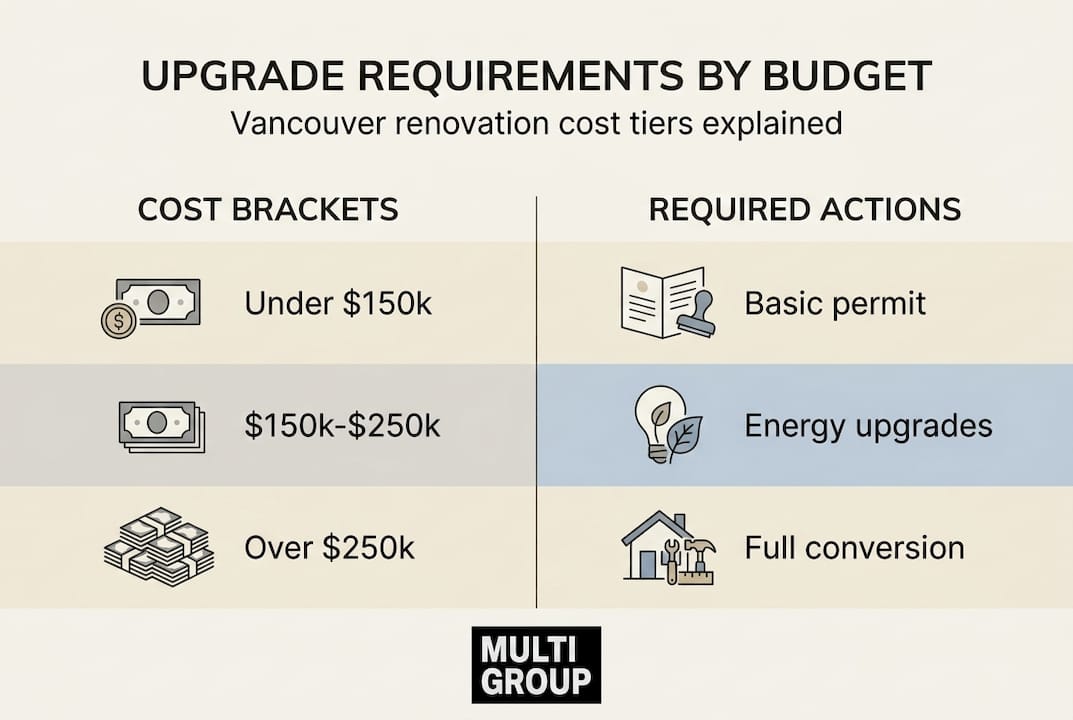
For projects over $150,000 and up to $250,000, the city may require you to complete select energy upgrades such as hot water system improvements or added insulation. For projects over $250,000, renovations require EnerGuide evaluation and electric heating system upgrades, in addition to at least two other specified improvements. This makes it critical to understand your obligations before your contractor begins work.
| Budget tier | Planning actions required |
|---|---|
| Under $150,000 | Basic permit, standard design documents |
| $150,000 to $250,000 | Permit plus select energy upgrade planning |
| Over $250,000 | EnerGuide audit, energy upgrade plan, electric heat conversion |
Understanding the benefits of investing in renovation helps put these extra requirements in perspective. Energy upgrades required by the city often pay for themselves over time through reduced utility bills and increased property value.
Pro Tip: If your project is hovering near the $150,000 or $250,000 thresholds, work with your contractor to understand the cost implications of crossing those lines. Sometimes a small scope adjustment saves significant regulatory burden, and sometimes the upgrade is worth it for the long-term benefit.
Execution: Managing your renovation for success
With plans in place, it's time to turn strategy into real-world progress while staying agile. The execution phase is where preparation either pays off or falls apart. Clear communication, proactive scheduling, and a good handle on your obligations keep things moving smoothly.
Communicate clearly and consistently
The most successful renovations share one common trait: the homeowner and contractor maintain open, consistent communication throughout the build. Set a regular check-in schedule, whether daily or weekly, depending on the project's pace. Document every conversation that involves a change in scope, cost, or timeline. A quick email summary after a verbal discussion prevents misunderstandings from becoming disputes.
Key communication habits to build into your routine:
- Maintain a shared project log. Note daily progress, materials delivered, and any concerns raised.
- Request photos from your contractor. If you cannot be on-site daily, photo updates are an effective substitute.
- Address issues immediately. Small problems left unaddressed tend to grow. If something looks wrong, raise it the same day.
- Confirm inspection dates in writing. City inspectors have schedules, and missing an appointment can delay your entire project by weeks.
"A renovation is only as good as the coordination behind it. Clear expectations, written agreements, and proactive communication between homeowners, contractors, and city inspectors are what separate a smooth project from a stressful one."
Managing mandatory upgrades during the build
For projects between $150,000 and $250,000, select upgrades like efficient hot water may be required as part of your permit obligations. Your contractor should schedule these upgrades in alignment with the rest of the project timeline. For example, a hot water system upgrade is best completed before interior finishing begins, so walls do not need to be reopened after the fact.
Staying current on latest renovation trends can also inform how you approach upgrades. Heat pump water heaters, for instance, are increasingly popular because they satisfy both the city's energy requirements and long-term household efficiency goals.
Minimizing disruption during the build
Living in or near an active renovation is challenging. A few practical strategies help reduce the impact on daily life. Establish designated work zones and set clear boundaries about which areas of the home remain livable. Coordinate noisy or dusty work for days when you can be away from the property. If the renovation is extensive, temporary relocation may be the most practical option. Factor this cost into your overall budget from the start.
Pro Tip: Ask your contractor to provide a two-week rolling schedule at the start of each week. This lets you plan your household routine around major disruptions like concrete pours, flooring installation, or electrical panel work.
Final walkthrough and verification
As your space nears completion, verifying results guarantees lasting satisfaction and compliance. The final phase of any renovation is just as important as the first. A thorough walkthrough and proper documentation protect your investment and close the project cleanly.
Your final walkthrough checklist
Use this numbered sequence to guide your review:
- Inspect all energy upgrades. Confirm that every city-required improvement has been installed and is functioning correctly. This includes hot water systems, insulation, ventilation, and any electric heating components.
- Review all finishes and millwork. Check cabinetry, trim, tile, and flooring for any gaps, chips, or misalignments. These are far easier to address before deficiencies are signed off.
- Test all fixtures and systems. Run every faucet, check all light switches, test HVAC controls, and confirm that appliances are operational.
- Verify safety compliance. Confirm that smoke detectors, carbon monoxide detectors, and any required fire separations are in place and tested.
- Walk through with your contractor. Go room by room and create a formal deficiency list. Set a written deadline for corrections.
- Request all documentation. Collect warranties for materials and equipment, as-built drawings, inspection sign-offs, and your final permit closure from the city.
City inspections and compliance verification
The final city inspection ensures all required upgrades based on cost brackets have been completed correctly. Failing a final inspection is more common than most homeowners expect. Industry estimates suggest that a significant portion of residential renovation projects in Metro Vancouver require at least one follow-up inspection to resolve deficiencies. Common reasons for failure include incomplete energy upgrade installations, missing permits for scope additions made mid-project, and incorrect placement of safety devices.
If your project does not pass the first inspection, your contractor is typically responsible for correcting deficiencies outlined in the inspector's report. Get the correction list in writing and confirm that all items are addressed before requesting a re-inspection. Keep copies of all inspection reports as part of your permanent home records.
Warranties and ongoing documentation
Once your renovation passes final inspection, collect all warranty documentation for products and labor. Major components like roofing, windows, HVAC equipment, and appliances carry manufacturer warranties that require proof of installation. Your contractor should also provide a workmanship warranty. In British Columbia, the BC New Home Warranty Program (2-5-10) applies to major structural work, and it is worth confirming whether any portion of your renovation qualifies for this coverage.
Store all documentation, including permits, inspection reports, warranties, and as-built drawings, in a single organized file. These records are invaluable when you sell the property, make an insurance claim, or plan future renovations.
Why experience and local expertise matter in Metro Vancouver renovations
Many homeowners believe that researching regulations online and hiring a general contractor is enough to navigate a major renovation. In straightforward projects, that may be true. But Metro Vancouver's regulatory landscape is unusually layered, with city-specific energy requirements, strata bylaws, heritage overlays, and District of North Vancouver or Burnaby rules that differ from Vancouver proper. One oversight can cascade into permit rejections, failed inspections, and costly retrofits.
The professionals who deliver consistently great renovation outcomes in this region share specific qualities: deep familiarity with local permit offices, established relationships with inspection teams, and hands-on experience resolving the issues that older Metro Vancouver homes routinely present. Partnering with local construction expertise is not just about convenience. It is about reducing risk and maximizing the return on one of the largest financial decisions you will make as a homeowner.
Our view is direct: for renovations above $150,000, professional project management is not optional. The savings from trying to self-manage do not offset the risk. The right team brings value that shows up in every finished detail.
Next steps: Partner with Vancouver renovation experts
When you're ready for your own renovation journey, expert support is one click away.

Multigroup Contracting brings deep Metro Vancouver experience to every residential project we take on. From permit handling and energy compliance planning to skilled construction and final inspection support, our team manages every step so you can focus on the result. Whether you're renovating a kitchen, a full floor, or planning a major structural overhaul, we tailor our approach to your goals, your timeline, and your budget. Homeowners across Metro Vancouver trust us because we deliver on our commitments without cutting corners. Visit multigroup.ca to explore our project portfolio and schedule a consultation with our team today.
Frequently asked questions
What is the minimum energy efficiency requirement for small renovations in Vancouver?
For projects under $150,000, minimal energy efficiency changes are required, primarily standard building code compliance without the additional upgrade tiers triggered at higher cost brackets.
Do I need a permit for every home renovation in Metro Vancouver?
Most renovations require permits, particularly those involving structural changes, electrical work, plumbing, or mechanical systems. Cosmetic updates like painting or flooring replacement typically do not require permits.
What are the required upgrades if my renovation costs over $250,000?
You must complete an EnerGuide evaluation, convert to an electric heating system, and fulfill at least two additional energy upgrades as specified by Vancouver's renovation energy rules.
How does the city inspect completed renovations?
The city performs inspections post-renovation to confirm that all energy and safety upgrades mandated by your project's cost bracket have been properly installed and are functioning as required.
Who can help ensure my Metro Vancouver renovation is compliant?
Licensed general contractors with proven Vancouver experience are best positioned to handle regulatory requirements, coordinate permits, and deliver results that pass city inspection the first time.