

TL;DR:
- A successful commercial renovation in Richmond requires understanding permit processes, budgeting accurately, and selecting qualified contractors.
- Focusing on flexibility and future adaptability in design ensures the space remains valuable as business needs evolve over time.
Picture this: you're a Richmond business owner staring at a space that no longer works for your team, your customers, or your brand. The layout is dated, the systems are aging, and you know a renovation is overdue. But where do you start? Permits, contractor vetting, budgeting, and design decisions all compete for your attention at once. This guide lays out every major phase of a commercial renovation in Richmond, from submitting your first permit application to selecting contractors and designing a space built for today's business realities.
Table of Contents
- Understanding permit and regulatory requirements in Richmond
- Budgeting your Richmond renovation: Real cost examples and planning tips
- Choosing qualified contractors and vendors
- Design and execution: Spaces for modern business needs
- What most guides overlook: Renovating for future flexibility
- Take the next step with Richmond commercial renovation experts
- Frequently asked questions
Key Takeaways
| Point | Details |
|---|---|
| Permit clarity | Richmond requires online permit submission with detailed plans and licensed contractors for commercial renovations. |
| Budget reality | Typical renovation projects range from $200,000 to $428,000 based on scope and property type. |
| Hiring matters | Choosing licensed and insured contractors is vital for compliance and successful outcomes. |
| Modern trends | Hybrid work needs and wellness areas are shaping renovation design in Richmond business spaces. |
| Long-term value | Flexible, future-proof layouts deliver lasting ROI and adaptability for changing business needs. |
Understanding permit and regulatory requirements in Richmond
Before any walls come down or new fixtures go up, you need a clear picture of Richmond's permit process. Skipping this step, or misunderstanding it, is one of the most common reasons commercial renovations stall mid-project.
Richmond's permit submission process is fully online. According to commercial building plan submittal requirements updated in March 2025, all applications go through the city's Permit Portal and must include complete project details, contractor licenses (specifically a DPOR Class A license, plus a city business license if the contractor has done more than $25,000 in prior work), and a single PDF plan set covering site plans, floor plans, elevations, sections, and construction details. Mechanical, electrical, and plumbing work each require separate permits.
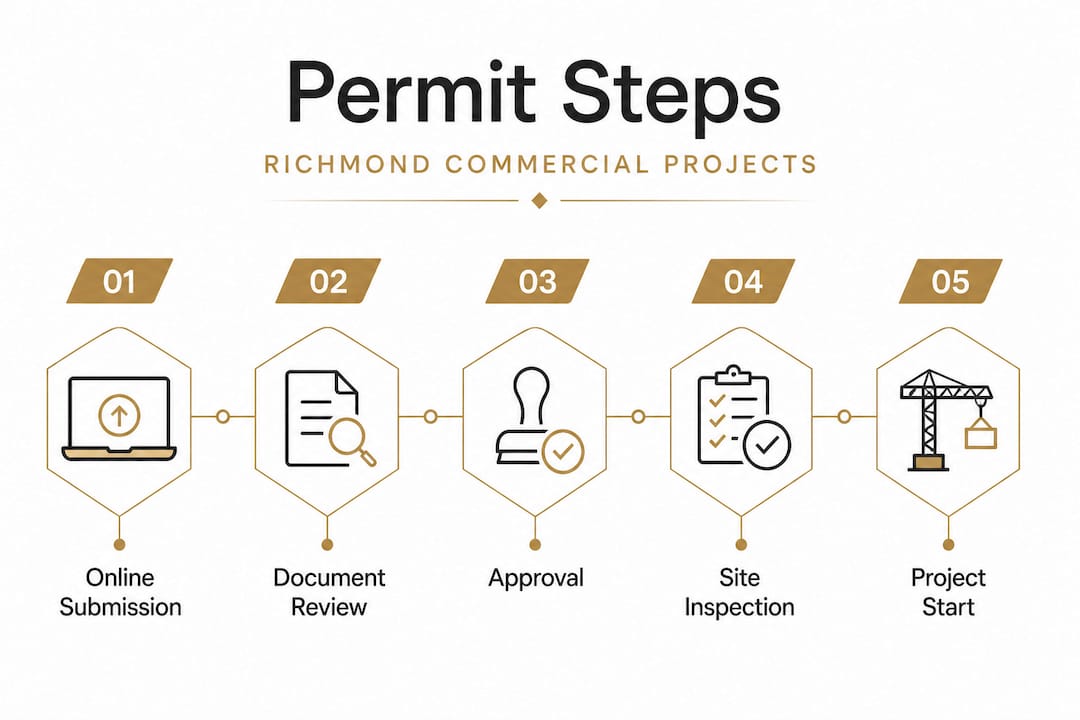
Review timelines vary based on project value:
| Project value | Estimated review time |
|---|---|
| Under $1.5 million | 5 to 10 business days |
| $1.5 million to $20 million | 10 to 20 business days |
| Over $20 million | 30 or more business days |
Getting your documents right the first time is critical. A single missing drawing or unlicensed contractor on your application can reset the review clock entirely.
"Incomplete submissions are the single biggest cause of permit delays for commercial renovations. Organizing every document before you submit saves weeks of back-and-forth."
Here are the most important steps to avoid permit delays:
- Confirm contractor credentials early. Verify DPOR Class A licensing and city business license status before signing any contract.
- Submit a complete PDF plan set. Every required drawing, including site, floor, elevations, sections, and details, must be in one file.
- Apply for MEP permits separately. Mechanical, electrical, and plumbing permits are distinct submissions and each needs their own complete documentation.
- Plan around review timelines. If your project falls in the $1.5 million to $20 million range, build at least four weeks into your schedule for review alone.
- Use the Permit Portal's pre-submission checklist. The city provides a checklist; use it before uploading to catch omissions.
For deeper context on permit strategy, navigating tenant improvement permits outlines common pitfalls that apply across commercial project types. Pairing that knowledge with Richmond-specific requirements puts you in a strong position before your first submission.
Understanding permit mechanics also connects directly to commercial renovation strategies that experienced contractors use to keep projects moving through regulatory review without losing momentum.
Budgeting your Richmond renovation: Real cost examples and planning tips
With permit requirements in hand, the next major consideration is cost. Getting the numbers right early protects you from the most damaging budget surprises later.
Real permit data from Richmond projects gives a reliable picture of what commercial renovations actually cost. Recent permit values show commercial renovations in Richmond ranging from $200,000 for tenant refits and interior remodels up to $428,000 for warehouse renovations and restaurant build-outs. These numbers reflect permitted project values and represent a useful baseline for planning.
Here's a comparison of typical renovation types and their cost ranges in Richmond:
| Renovation type | Typical permitted value range | Key cost drivers |
|---|---|---|
| Interior tenant refit | $200,000 to $250,000 | Finishes, millwork, MEP upgrades |
| Restaurant build-out | $250,000 to $350,000 | Commercial kitchen, ventilation, plumbing |
| Warehouse renovation | $300,000 to $428,000 | Structural, HVAC, lighting, dock improvements |
| Office remodel | $200,000 to $300,000 | Layout, technology infrastructure, finishes |
Several factors push costs up or down significantly:
- Scope of MEP work. Mechanical, electrical, and plumbing upgrades are often the most expensive line items. Replacing aging HVAC or upgrading electrical panels adds real cost but also real long-term value.
- Historic building status. Properties in Richmond's historic districts carry additional requirements around materials and structural preservation, which can add 15 to 25 percent to renovation costs.
- Structural changes. Removing load-bearing walls, adding mezzanines, or reconfiguring floor plates requires engineering review and adds complexity.
- Phased occupancy. If you need to keep part of the space operational during construction, phasing adds scheduling complexity and typically increases labor costs.
Pro Tip: Build a contingency fund of at least 15 percent of your total budget before you start. Commercial renovations almost always surface hidden conditions, whether it's outdated wiring behind walls or unexpected foundation issues. A contingency fund keeps the project moving without requiring a new financing round.
For businesses considering a warehouse renovation, operational efficiency gains often justify higher upfront investment. Layouts that improve workflow, reduce travel time, and support modern inventory systems generate measurable returns within a few years. Understanding why investing in renovation pays off helps frame budget conversations with stakeholders and lenders.
Common cost overruns to watch for include scope creep (gradual additions to the project that weren't in the original plan), unforeseen structural conditions discovered during demolition, and supply chain delays on specialty materials that extend the project timeline and inflate labor hours.
Choosing qualified contractors and vendors
Accurate budgeting depends on hiring reliable professionals. In Richmond, contractor qualifications are not just best practice; they are a legal requirement for permitted commercial work.
As outlined in Richmond's commercial plan submittal requirements, contractors working on commercial renovations must hold a DPOR Class A license and a city business license if they have completed more than $25,000 in prior work in the city. These credentials must be documented in your permit application.
Beyond the legal minimums, here is what to verify before signing a contract with any contractor:
- Valid DPOR Class A license. Confirm it is current and not under any disciplinary action. The DPOR public lookup tool makes this easy to check.
- City of Richmond business license. Required for any contractor with significant prior work in the city.
- General liability insurance. Minimum $2 million per occurrence is standard for commercial projects. Request a certificate of insurance directly from the insurer.
- Workers' compensation coverage. All workers on site must be covered. Ask for documentation upfront.
- Subcontractor management plan. Know who your general contractor is bringing in for MEP, specialty finishes, and other trades. Each subcontractor should also carry proper licensing and insurance.
- Project references from comparable commercial work. Ask for references from recent projects similar in scope and type to yours, not just any past project.
Pro Tip: Ask potential contractors to walk you through a recent permit submission they managed. How they describe the process tells you a lot about whether they understand Richmond's specific requirements or are learning on your dime.
The difference between a licensed, insured contractor and an unqualified one is not just legal risk. It is project risk. Substandard work on electrical systems, structural modifications, or fire-rated assemblies can fail inspection, require expensive remediation, or create liability for the property owner. Working with licensed contractors is the clearest way to protect your investment and your timeline.
Interview at least three contractors before selecting one. Compare not just their bids but their communication style, understanding of Richmond's permit process, and ability to provide a realistic project schedule.
Design and execution: Spaces for modern business needs
Once you have selected your team, the focus shifts to designing a space that truly serves your business goals. Modern commercial renovation is no longer just about refreshing surfaces; it is about rethinking how your space functions.
Here is a practical sequence for planning your renovation design:
- Audit how your space is actually used. Survey employees and customers. Identify underused areas, bottlenecks, and functions that lack dedicated space.
- Define your priorities before meeting with designers. Know whether your primary goals are increasing capacity, improving workflow, supporting hybrid work, or upgrading customer experience.
- Work with your architect or designer to create a space plan. This is a scaled floor plan showing how functions are organized, traffic flows, and key dimensions. Do this before selecting finishes.
- Identify any historic or structural constraints early. If your building has heritage designation or is in a historic district, bring these constraints into the design phase immediately.
- Specify technology infrastructure needs. Data cabling, AV systems, security, and access control are much cheaper to install during construction than after walls are closed.
- Review the design against your permit requirements. Confirm that the space plan, occupancy loads, and egress paths meet code before finalizing drawings.
Hybrid work trends are directly reshaping how Richmond businesses use their commercial space. A notable example: the Martin Agency's 17,500 square foot renovation at their Shockoe Slip headquarters prioritized reimagining existing square footage over expanding it, incorporating wellness areas and flexible event spaces that support different modes of working throughout the day. This approach is becoming the standard for office-focused renovations across Richmond.
Historic properties require a separate layer of planning. A Mass Mutual Richmond case study on a historic building renovation illustrates a key challenge: penetrating original floor systems for new infrastructure requires custom solutions, such as purpose-built sleeves, to preserve the structural integrity required for tax credit eligibility. Disturbing original fabric unnecessarily can disqualify a project from Virginia's Historic Rehabilitation Tax Credit, which can be worth 25 percent of eligible rehabilitation costs.
Key design priorities for modern Richmond commercial spaces include:
- Flexible layouts. Use movable partitions and modular furniture to allow the space to serve multiple configurations.
- Wellness and collaboration zones. Dedicated areas for focus work, team collaboration, and informal gathering improve productivity and tenant satisfaction.
- Energy-efficient systems. LED lighting, smart HVAC controls, and updated insulation lower operating costs over the building's life.
- Accessible design. ADA compliance is not optional, but accessible design done well also improves the experience for everyone in the space.
Reviewing construction best practices for commercial projects provides additional detail on sequencing trades and managing quality during execution. For a thorough walkthrough of how projects move from planning through completion, the commercial buildout guide covers each phase in practical terms.
What most guides overlook: Renovating for future flexibility
Here is where most renovation guides stop short: they focus on compliance and aesthetics but leave out the most important question, which is whether your finished space can adapt as your business evolves.
In our experience working on commercial projects, the renovations that hold their value longest are not the ones with the highest-end finishes. They are the ones built with flexibility in mind from the start. Raised access flooring, modular millwork, oversized electrical panels, and distributed data infrastructure cost a modest premium upfront but dramatically reduce the cost of future changes.
Richmond's commercial real estate market has been shifting. Businesses that locked into rigid, single-use layouts in 2020 found themselves back in the planning stages by 2023 as team sizes and work patterns changed. The lesson is clear: the most valuable renovation decision you can make right now is to design for multiple futures, not just your current one.
Short-term thinking in renovation usually shows up as reducing scope to save money today. Cutting corner on electrical capacity, HVAC zoning, or structural reinforcement to trim the budget often creates much higher costs two or three years out when the next upgrade cycle arrives. Building in capacity now, even at a small premium, is almost always the better financial decision when you look at the total cost of ownership over ten years.
Adaptable renovation strategies lay out how forward-thinking businesses approach this problem systematically, incorporating future adaptability into every phase of the design and construction process rather than treating it as an afterthought.
The businesses in Richmond that will get the most out of their renovation investments are the ones asking not just "what do we need today?" but "what will we need in five years, and can this space support it?"
Take the next step with Richmond commercial renovation experts
Planning a commercial renovation in Richmond involves coordinating permits, budgets, contractors, and design decisions that all affect each other. Getting any one of them wrong creates delays, cost overruns, or a finished space that doesn't fully serve your business.

Multigroup Contracting brings hands-on experience in commercial tenant improvements, warehouse renovations, retail build-outs, and complex office remodels to clients across the Metro Vancouver region and beyond. Our team handles permit coordination, contractor vetting, scheduling, and quality management so you don't have to manage every detail yourself. If you're planning a renovation and want to move from concept to completion with fewer surprises, visit multigroup.ca to review our project portfolio and connect with our team directly. We're ready to help you build a space that works now and stays relevant as your business grows.
Frequently asked questions
How long does permit review take for most Richmond commercial renovations?
Permit reviews range from 5 to 10 business days for smaller projects under $1.5 million to 10 to 20 business days for projects valued up to $20 million, with timelines extending to 30 or more days for larger work.
Do I need a city business license if my contractor has done previous work over $25,000?
Yes. Richmond requires a city business license for any contractor with prior work over $25,000 in the city, in addition to a current DPOR Class A license.
What are typical budget ranges for different types of commercial renovations in Richmond?
Recent permitted project values show commercial renovations ranging from $200,000 for tenant refits and interior remodels up to $428,000 for warehouse and restaurant upgrades, depending on scope and complexity.
What are special considerations for renovating historic commercial properties?
Historic renovations in Richmond require preserving structural integrity and minimizing visual disturbance to original building fabric in order to remain eligible for Virginia's Historic Rehabilitation Tax Credit, which can offset up to 25 percent of qualified costs.