

TL;DR:
- Obtaining permits before renovations ensures work complies with codes, avoiding costly legal and financial issues.
- The necessity for permits depends on project scope, with structural and electrical work almost always requiring approval from local authorities.
The permit process for renovations is the formal authorization system through which homeowners and property investors obtain legal approval from local building departments before starting remodeling work. Skipping this process is not a calculated risk. Unpermitted renovations lead to title complications, insurance claim denials, and refinancing challenges that can cost far more than the permits themselves. The process covers four main permit categories: building, electrical, plumbing, and mechanical. Fees range from a few hundred dollars for minor work to $15,000 or more for major additions, and timelines run anywhere from one business day to six months depending on project complexity.
What types of renovation projects require permits?
Permits are required for structural changes, major electrical work, plumbing relocation, HVAC modifications, and exterior envelope changes. Cosmetic updates generally do not trigger the home improvement permit process. Understanding the line between the two saves time, money, and legal exposure.
The clearest way to think about it: if the work affects the structure, safety systems, or building envelope of your home, a permit is almost certainly required. Removing a load-bearing wall in a Surrey townhouse, adding a bathroom in a Burnaby basement suite, or installing a new electrical panel in a North Vancouver home all require permits. Replacing a faucet, repainting a living room, or swapping out flooring does not.
Regional variability matters here. Local municipal websites are the only authoritative source for permit requirements, since there are no universal provincial or federal standards that apply to every city. What Richmond requires for a deck addition may differ from what Coquitlam requires for the same project. Always check with your specific municipality before assuming a project is permit-free.
| Work Type | Permit Required? | Examples |
|---|---|---|
| Structural changes | Yes | Removing walls, adding beams, foundation work |
| Electrical modifications | Yes | Panel upgrades, new circuits, rewiring |
| Plumbing relocation | Yes | Moving drains, adding fixtures, new supply lines |
| HVAC installation | Yes | New furnace, ductwork, heat pump |
| Exterior changes | Yes | New windows, roofing, additions, decks |
| Cosmetic updates | No | Painting, flooring, cabinet refacing |
| Minor fixture replacement | No | Faucets, light fixtures, door hardware |
Pro Tip: If you are unsure whether your project needs a permit, call your local building department directly. A five-minute conversation can prevent months of legal headaches and forced demolition orders.
How to apply for renovation permits step by step
The application process follows a predictable sequence. Knowing each stage before you start prevents the most common source of delays: incomplete submissions.

Step 1: Determine which permits you need. Review your project scope against your municipality's permit requirements. A kitchen remodel that relocates plumbing will need both a building permit and a plumbing permit. An HVAC replacement adds a mechanical permit to that list.
Step 2: Prepare your documentation. This is where most applications stall. Required documents typically include:
- Site plan showing property boundaries and existing structures
- Architectural drawings with dimensions and materials
- Structural engineer's drawings for load-bearing changes
- Energy compliance documentation where required
- Contractor license numbers and insurance certificates
Early involvement of a structural engineer before finalizing architectural plans prevents costly revisions, especially for load-bearing changes that affect the overall structure.
Step 3: Submit your application. Modern permit applications increasingly use digital portals, and submitting complete, high-quality documentation prevents delays and resubmissions. Cities like Vancouver and Burnaby have online permit portals that allow digital uploads and status tracking. Paper submissions are still accepted in some municipalities but typically take longer to process.
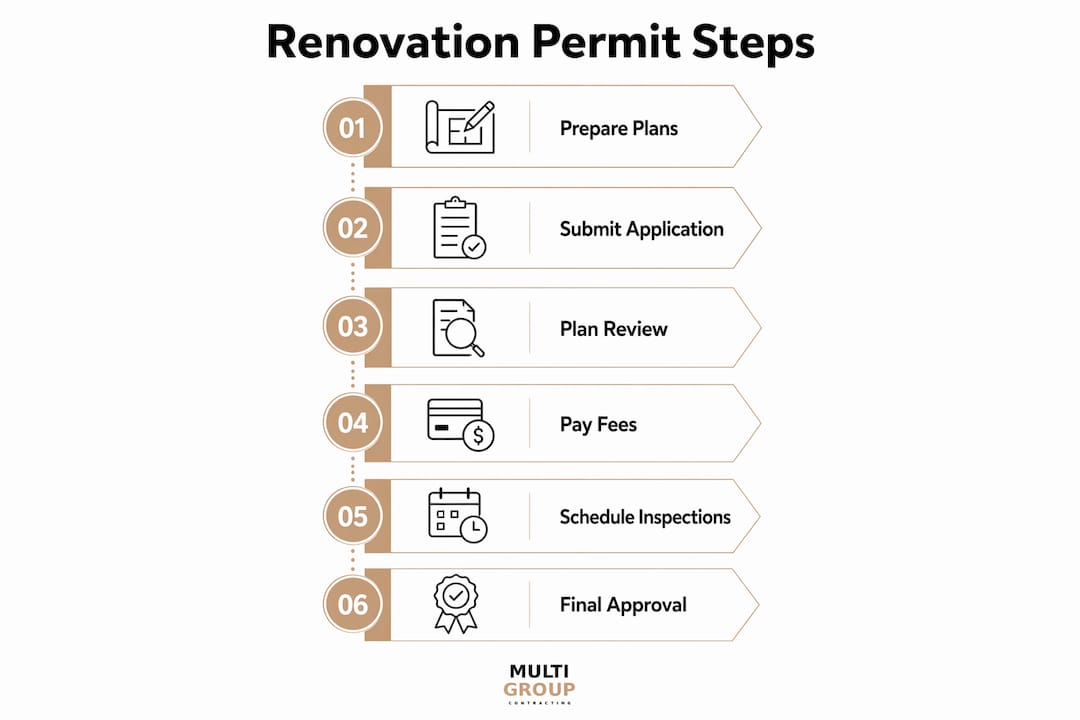
Step 4: Navigate the plan review. A building department examiner reviews your submission for code compliance. If corrections are required, you will receive a written list of deficiencies. Respond to each item specifically and resubmit promptly. Vague or partial responses restart the review clock.
Step 5: Pay fees and receive your permit. Once approved, you pay the assessed fees and receive your permit documents. Post the permit on-site where inspectors can see it.
Step 6: Schedule inspections. The typical inspection sequence includes foundation, framing, rough-in electrical and plumbing, insulation, and final inspection, with inspection fees included in permit costs. Schedule each inspection before covering the work. Inspectors cannot approve what they cannot see.
Step 7: Obtain final approval and close the permit. After the final inspection passes, the building department closes the permit. This document is your legal proof that the work was completed to code.
Pro Tip: Keep a dedicated permit folder with copies of the approved plans, all inspection reports, inspector names, and photos of concealed work before walls are closed. This documentation is critical for future home sales and insurance claims.
What do renovation permits cost, and how long do they take?
Setting a realistic budget and schedule requires understanding permit costs and timelines before construction begins. The numbers vary significantly by project type and municipality.
Kitchen remodels range from $800 to $3,500 in permit fees, while room additions typically cost between $3,000 and $15,000. Plan check fees often represent 65% of total permit costs, which means the review process itself is the largest single expense in the permitting budget.
| Project Type | Typical Permit Cost | Approval Timeline |
|---|---|---|
| Minor electrical or plumbing | $150 to $500 | 1 to 10 business days |
| Kitchen or bathroom remodel | $800 to $3,500 | 4 to 12 weeks |
| Room addition | $3,000 to $15,000 | 8 to 24 weeks |
| Full home remodel | $5,000 and up | 12 to 24 weeks |
Permit approval timelines depend on project complexity: over-the-counter permits can be approved in 1 to 10 business days, kitchen and bath renovations take 4 to 12 weeks, and major additions or full remodels require 8 to 24 weeks. These are baseline estimates. Missing documentation or correction cycles add weeks to every category.
Several factors extend timelines beyond these baselines:
- Incomplete plan sets that require multiple resubmissions
- Zoning variances or heritage reviews that require separate approvals
- High application volumes at the building department during peak construction seasons
- Permit requirements that trigger mandatory code upgrades, such as electrical panel upgrades or fire safety updates that were not budgeted
Expedited review is available in many municipalities for an additional surcharge, typically 50% to 100% above standard fees. For time-sensitive projects, the surcharge is often worth it.
Common mistakes that delay or derail the permit process
The renovation permits guide most homeowners wish they had read earlier is a short one. The same errors appear repeatedly across projects of every size.
Starting construction before permit approval. This is the most expensive mistake in the permit process for renovations. Stop-work orders, mandatory demolition of completed work, and doubled permit fees are all documented consequences. In Metro Vancouver, building inspectors have authority to order work torn out if it was completed without an approved permit.
Submitting incomplete or inaccurate plans. Every missing detail on a plan set triggers a correction notice and restarts the review cycle. Hire a qualified designer or architect to prepare drawings that meet your municipality's submission standards.
Confusing zoning requirements with building code. Zoning governs what you can build and where. Building code governs how you build it. A project can comply with building code and still violate zoning bylaws. Both must be checked independently before finalizing your design.
Not using a licensed contractor. Homeowners can pull permits but doing so transfers full liability to the homeowner. When a licensed contractor pulls the permit, responsibility for code compliance shifts to that professional. For most homeowners and investors, this distinction alone justifies hiring a licensed contractor for any permitted work.
Skipping required inspections. Inspections are not optional milestones. Closing walls before a rough-in inspection is approved means the inspector cannot verify the work, and the permit cannot be closed. The result is either an open permit on your title or a requirement to reopen walls.
Pro Tip: Document every inspection with the date, inspector's name, and photos of the work before it is concealed. This record protects you during future home sales, insurance claims, and refinancing applications.
Key takeaways
The permit process for renovations protects homeowners legally and financially by ensuring all remodeling work meets code requirements, passes mandatory inspections, and is documented for future resale and insurance purposes.
| Point | Details |
|---|---|
| Permits protect your investment | Unpermitted work risks insurance denials, title issues, and forced demolition orders. |
| Know what triggers a permit | Structural, electrical, plumbing, HVAC, and exterior work almost always require permits. |
| Documentation prevents problems | Keep approved plans, inspection reports, and photos of concealed work in a dedicated file. |
| Timelines vary by complexity | Simple permits close in days; major additions can take up to 24 weeks for approval. |
| Licensed contractors reduce liability | When a contractor pulls the permit, code compliance responsibility transfers to them. |
What working in Metro Vancouver has taught us about permits
After managing residential and commercial renovations across Vancouver, Burnaby, Richmond, Surrey, Coquitlam, and North Vancouver, the pattern is consistent: the projects that run smoothly are the ones where permits were identified and applied for before a single subcontractor was booked.
The common assumption is that permits slow projects down. The reality is that incomplete permit applications slow projects down. A well-prepared submission with complete drawings, structural engineer sign-offs, and accurate scope descriptions moves through plan review faster than a rushed submission that triggers three rounds of corrections.
Metro Vancouver municipalities each have their own submission requirements and processing timelines. Richmond's building department processes applications differently than the City of Vancouver's Development and Building Services Centre. Knowing those local nuances, including which departments to call and what format they prefer for drawings, is knowledge that only comes from repeated experience in those specific jurisdictions.
One thing that surprises many property investors: permit documentation directly affects resale value and mortgage refinancing. A home with closed permits on all renovation work is a cleaner asset than one with open or missing permits. Lenders and buyers both scrutinize this. The permit documentation you maintain today is a financial asset you will use years from now.
The permit process is not a bureaucratic obstacle. It is a quality assurance system that protects your investment, your occupants, and your legal standing. Treat it as part of the project, not a separate task to manage around it.
— MultigroupTeam
How Multigroup handles permits for your renovation
Multigroup Contracting manages the full permit process for renovation projects across Metro Vancouver, including Vancouver, Burnaby, Richmond, Surrey, Coquitlam, and North Vancouver. From identifying which permits apply to your specific project to preparing compliant documentation, submitting applications, and coordinating all required inspections, Multigroup handles every step so you do not have to.

Multigroup is licensed and insured in BC, and the team's direct experience with local building departments means fewer correction cycles and faster approvals. Whether you are planning a kitchen remodel, a basement suite, a commercial tenant improvement, or a full home renovation, Multigroup delivers the project on time, within budget, and with every permit properly closed. Contact Multigroup Contracting to discuss your project: call 778-819-5933, email info@multigroup.ca, or visit multigroup.ca.
FAQ
What is the permit process for renovations?
The permit process for renovations is the formal sequence of applying to your local building department, submitting plans for review, paying fees, and passing mandatory inspections before and during construction. The process ends when the building department issues final approval and closes the permit on your property title.
Do all home renovations require a building permit?
No. Cosmetic work such as painting, flooring, and minor fixture replacements does not require permits. Structural changes, electrical panel upgrades, plumbing relocation, HVAC installation, and exterior modifications almost always do. Check your specific municipality's requirements before starting any project.
How long does it take to get a renovation permit approved?
Approval timelines range from 1 to 10 business days for simple over-the-counter permits to 8 to 24 weeks for major additions or full remodels. Incomplete applications and correction cycles are the primary cause of delays beyond these baseline timelines.
Should a homeowner or contractor pull the renovation permit?
A licensed contractor pulling the permit transfers code compliance liability to that professional. When homeowners pull their own permits, they assume full legal responsibility for the work meeting code. For most renovation projects, having a licensed contractor handle the permit is the lower-risk choice.
What happens if you renovate without a permit?
Unpermitted renovations can result in stop-work orders, mandatory demolition of completed work, fines, insurance claim denials, and title complications that affect your ability to sell or refinance the property. Retroactively permitting completed work is possible in some cases but typically costs more and requires opening walls for inspection.