

TL;DR:
- Canadian construction projects rely on core documents like contracts, drawings, and permits to define scope and manage risk. Legal agreements such as CCDC 2 and 5B, along with detailed technical and financial records, ensure proper project execution and compliance in BC. Proper document control from initial planning through occupancy prevents delays, disputes, and regulatory issues.
Every Canadian construction project, whether a Metro Vancouver tenant improvement or a warehouse renovation in Burnaby, depends on the same core set of documents. These records define scope, allocate risk, satisfy regulators, and protect every party when disputes arise. The essential construction paperwork for a BC project includes:
- Contract agreement (typically CCDC 2 for stipulated price work)
- General and special conditions
- Architectural and engineering drawings stamped by registered professionals
- Project specifications
- Construction schedule and schedule of values
- Bill of quantities and cost estimates
- Bid documents and tender packages
- Change orders
- Daily construction reports and meeting minutes
- Submittals and certificates of insurance
- Building permits and zoning approvals
- Letters of Assurance (Schedules A, B, C-A, C-B under BC Building Code 2024)
- Safety plans and compliance records
- Environmental assessments
- Warranties and guarantees
- Inspection reports and quality control records
Together, these documents form a construction document checklist that governs every phase from procurement through occupancy.
What contract documents do you actually need on a Canadian project?
Construction contracts are the legal backbone of any project. In Canada, the Canadian Construction Documents Committee (CCDC) develops the standard forms that owners, contractors, and designers rely on across every province. CCDC documents are consensus-built contracts that fairly allocate risk among all parties, which is why they are the most trusted forms in the industry.
The key contract documents for a typical BC project include:
- CCDC 2 (Stipulated Price Contract): The standard prime contract between owner and contractor, establishing a fixed lump-sum price with monthly progress payments. It covers general provisions, administration, changes in the work, dispute resolution, insurance, and owner takeover.
- CCDC 5B (Construction Management Contract): Used when an owner engages a construction manager for both pre-construction advisory services and the construction phase itself.
- General conditions: Embedded within CCDC forms, these set out administrative procedures, the consultant's authority, and default notice requirements.
- Special conditions: Project-specific amendments that modify or supplement the general conditions for a particular scope.
- Scope of work: A precise written description of what the contractor is and is not responsible for delivering.
- Insurance requirements: Minimum coverage thresholds for general liability, property, and professional liability, as specified in the contract.
CCDC 2's administrative procedures cover changes in the work, dispute resolution, insurance, and owner takeover provisions, all designed to reduce project risk and clarify responsibilities before a problem surfaces.
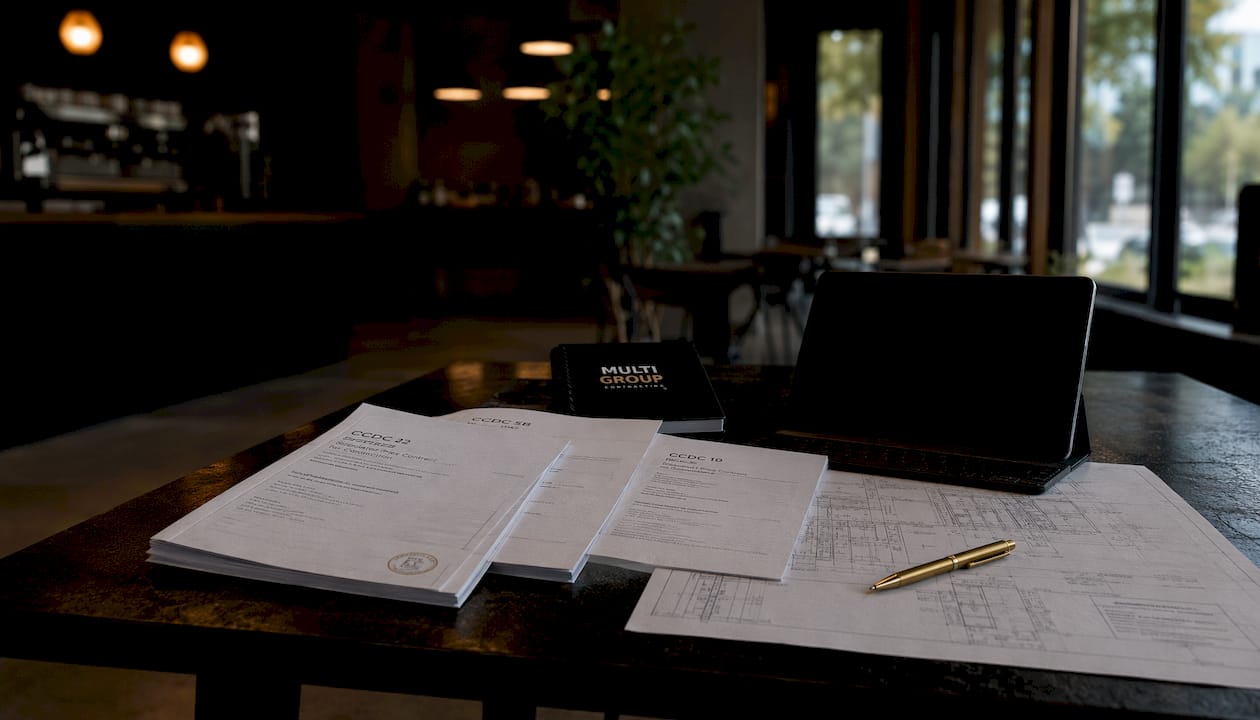
Why drawings, specifications, and Letters of Assurance matter
Technical documents translate design intent into buildable reality. Without them, contractors cannot price accurately, inspectors cannot verify compliance, and owners have no record of what was built.
Key technical documents include:
- Architectural drawings and blueprints: Floor plans, elevations, sections, and details stamped by a BC-registered architect or engineer.
- Structural, mechanical, and electrical drawings: Discipline-specific plans prepared and sealed by the relevant registered professional.
- Project specifications: Written standards for materials, workmanship, testing, and quality, typically organised using Construction Specifications Canada (CSC) format.
- Letters of Assurance: Under the BC Building Code 2024, Schedules A, B, C-A, and C-B must be signed by registered professionals and submitted to the Authority Having Jurisdiction, as mandated by BC Building Code 2024.
- Shop drawings and product data: Submitted by the contractor to confirm that proposed materials and fabrications meet specification requirements.
For BC Building Code compliance, every set of drawings must be stamped and signed before a permit application is considered complete. Missing a professional seal is one of the most common reasons permit reviews stall.
Pro Tip: Have your registered professional confirm which Letter of Assurance schedules apply to your specific project type before submitting the permit package. Not every schedule is required for every building classification, and submitting the wrong set delays review.

Schedules, cost documents, and bid materials
Accurate financial and scheduling documents keep a project on budget and on time. These records also form the basis for contractor selection and payment certification.
- Construction schedule: A timeline, often in Gantt chart format, showing the sequence and duration of all major activities. It becomes a contract document when referenced in the agreement.
- Schedule of values: A breakdown of the contract price by work activity or trade, used to certify monthly progress payments.
- Bill of quantities: A detailed list of materials, labour, and work items with estimated quantities, allowing contractors to price consistently during bidding.
- Cost estimates: Prepared at various project stages (conceptual, schematic, design development, and tender) to track budget alignment.
- Bid documents and tender packages: Include instructions to bidders, bid forms, drawings, specifications, and any addenda issued during the tender period.
- Addenda: Written amendments to bid documents issued before tender closing, which become part of the contract once incorporated.
Accuracy across these documents is not optional. A schedule of values that does not align with the contract drawings creates payment disputes that slow every subsequent phase of the project.
How change orders, daily reports, and submittals keep projects on track
Once construction begins, documentation shifts from planning to active management. Three categories of records are particularly critical at this stage.
- Change orders: Formal written amendments to the contract that record approved changes in scope, cost, or schedule. Clear processes for submitting change orders within contracts prevent expensive disputes and work delays on-site.
- Contemplated change notices and change directives: Preliminary documents used when a change is being evaluated or must proceed before pricing is finalised.
- Daily construction reports: Written records of site conditions, labour counts, equipment on site, weather, and work completed each day. They are the primary evidence in delay and deficiency claims.
- Meeting minutes: Official records of decisions made during site meetings, owner-architect-contractor meetings, and coordination calls.
- Submittals: Shop drawings, product data sheets, and samples submitted by the contractor for consultant review and approval before installation.
- Certificates of insurance: Proof that the contractor and subcontractors carry the coverage required by the contract. Submittals and certificates of insurance validate that materials, methods, and coverage meet contract and regulatory requirements, protecting all parties.
- Requests for information (RFIs): Formal written queries from the contractor to the consultant seeking clarification on drawings or specifications.
How to organise construction documents so nothing falls through the cracks
Effective construction document management prevents costly errors and delays by ensuring all stakeholders have access to accurate, approved versions at all times. On a Metro Vancouver commercial renovation, that means one missed revision can send a subcontractor working from outdated drawings, with real cost consequences.
Practical steps for managing your construction document checklist:
- Establish a document control system early: Assign a document controller or designate a project manager responsible for version tracking before the project starts.
- Use a centralised digital platform: Cloud-based project management tools allow all parties to access current drawings, specifications, and correspondence from any location.
- Apply a clear revision numbering protocol: Every drawing and specification revision must carry a revision number, date, and description of changes.
- Distribute only current documents: Archive superseded versions clearly and restrict access so field teams always work from the latest approved set.
- Maintain a correspondence log: Track all RFIs, submittals, change orders, and meeting minutes with issue dates and response deadlines.
- Preserve records for the full limitation period: In BC, the limitation period for construction claims is generally two years from discovery, so project records must be retained well beyond project closeout.
Pro Tip: Set up your folder structure before the project kicks off, not after. Organising documents retroactively mid-project is far more time-consuming and increases the risk of losing a critical record.
Canadian standards and BC compliance documents you cannot skip
Canadian construction operates within a well-defined framework of industry standards and provincial regulations. Understanding which documents are legally required, versus which are simply best practice, protects owners and contractors alike.
The Canadian Construction Documents Committee, formed in 1974, is Canada's only source for recognised standard construction industry documents. CCDC forms are endorsed by the Association of Consulting Engineering Companies-Canada (ACEC), the Canadian Construction Association (CCA), Construction Specifications Canada (CSC), and the Royal Architectural Institute of Canada (RAIC).
Key compliance documents for BC and Metro Vancouver projects:
- BC Building Code 2024 compliance package: Drawings, specifications, and Letters of Assurance (Schedules A, B, C-A, C-B) submitted to the Authority Having Jurisdiction before permit issuance.
- Building permit application: For commercial renovations in Vancouver, complete document packages including professionally stamped drawings are required. Under the Tenant Improvement Program, complete and accurate submissions support timely permit issuance.
- Zoning and development approvals: Confirm that the proposed use and construction comply with local zoning by-laws before design is finalised.
- Occupancy permit: Issued after final inspection confirms the completed work meets the approved permit drawings and BC Building Code requirements.
- WorkSafeBC compliance records: Safety plans, hazard assessments, and incident reports required under BC occupational health and safety regulations.
- Environmental assessments: Required for projects involving soil disturbance, hazardous materials (asbestos, lead paint), or sites near sensitive environmental areas.
- Lien releases and statutory declarations: Protect owners from liens filed by unpaid subcontractors or suppliers at project closeout.
- Warranties and guarantees: Manufacturer warranties for installed products and contractor warranties for workmanship under CCDC 2.
Note on Letters of Assurance: Many projects in Metro Vancouver stall because owners do not submit the required Letters of Assurance before the City begins permit review. These signed accountability documents are required before building permits can be issued, even when the drawings themselves are complete and accurate.
For a detailed Vancouver permitting checklist, including which documents apply to tenant improvements versus new builds, Multigroup has published step-by-step guidance for Metro Vancouver projects.
Work with a contractor who manages the paperwork from day one
Multigroup handles the full construction document process for commercial and residential projects across Metro Vancouver, from permit applications and CCDC contract administration to daily reporting and final inspections. Whether you are planning a tenant improvement in Vancouver or a retail buildout in Burnaby or Surrey, Multigroup's project managers keep every document current, compliant, and accessible throughout the build. Contact Multigroup to discuss your project.
Key takeaways
A complete construction document checklist, anchored by CCDC standard contracts and BC Building Code compliance documents, is the single most effective way to protect a Canadian construction project from disputes, delays, and regulatory setbacks.
| Point | Details |
|---|---|
| CCDC contracts are the Canadian standard | CCDC 2 and CCDC 5B fairly allocate risk and are endorsed by four national industry organisations. |
| Letters of Assurance are mandatory in BC | Schedules A, B, C-A, and C-B, signed by registered professionals, must be submitted before permit review begins. |
| Change orders require formal documentation | Written change orders with clear scope, cost, and schedule details prevent costly on-site disputes. |
| Document control starts before construction | A centralised system with version tracking must be in place before the project kicks off, not after. |
| Occupancy permits close the compliance loop | Final inspections and occupancy permits confirm the completed work meets approved drawings and BC Building Code requirements. |
FAQ
What documents are needed for construction in Canada?
Every Canadian construction project requires a contract agreement (typically CCDC 2), architectural and engineering drawings stamped by registered professionals, project specifications, a construction schedule, cost documents, building permits, and Letters of Assurance under the BC Building Code where applicable.
What are the five main contract documents in a construction project?
The five core contract documents are the agreement, general conditions, supplementary conditions, drawings, and specifications. In Canada, CCDC 2 packages the agreement and general conditions into a single standard form endorsed by national industry organisations.
What is included in construction documents?
Construction documents include all drawings, specifications, schedules, contract forms, permits, change orders, submittals, daily reports, safety records, and compliance certificates needed to plan, execute, and close out a project in accordance with the contract and applicable building codes.
What are the five essential elements of a construction contract?
A construction contract requires an offer and acceptance, consideration (the contract price), defined scope of work, a schedule or timeline, and terms covering changes, disputes, and insurance. CCDC 2 addresses all five within its standard sections, including provisions for changes in the work and dispute resolution.