
TL;DR:
- Metro Vancouver construction includes residential, commercial, industrial, and infrastructure segments.
- Building materials like mass timber and prefab are gaining popularity for faster, sustainable building processes.
- Skilled trades shortages and complex permitting processes are major factors influencing project timelines and success.
Metro Vancouver is not simply a large city with a busy construction calendar. It accounts for 55% of BC's total housing starts, employs roughly 152,000 construction workers, and faces land constraints that force builders to think differently than they would anywhere else in Canada. If you are a property owner or developer planning a project here, the rules, timelines, materials, and workforce realities are genuinely different from those in other regions. This article breaks down what Metro Vancouver construction actually includes, which trends are reshaping projects right now, and what you need to know before you hire a contractor or break ground.
Table of Contents
- What does Metro Vancouver construction include?
- Key trends shaping construction in Metro Vancouver
- What property owners and developers need to know
- Outlook: Challenges and opportunities ahead
- Our perspective: What most property owners don't realize about Metro Vancouver construction
- Ready to move your project forward?
- Frequently asked questions
Key Takeaways
| Point | Details |
|---|---|
| Metro Vancouver leads BC | The region accounts for over half of BC construction starts and employs the majority of the province’s workforce. |
| Trends favor renovations | Land limits and affordability drive property owners toward renovations rather than new builds. |
| Workforce shortages persist | Developers face a major challenge from skilled trades shortages, impacting timelines and costs. |
| Innovation is critical | New materials like mass timber and prefab methods can offset delays and reduce carbon impact. |
What does Metro Vancouver construction include?
Most people picture residential condos when they think of construction in Metro Vancouver. That picture is accurate but incomplete. The sector spans four broad segments: residential, commercial, industrial, and infrastructure. Each one carries its own permitting requirements, workforce demands, and cost pressures. Understanding all four helps property owners and developers plan more realistically.
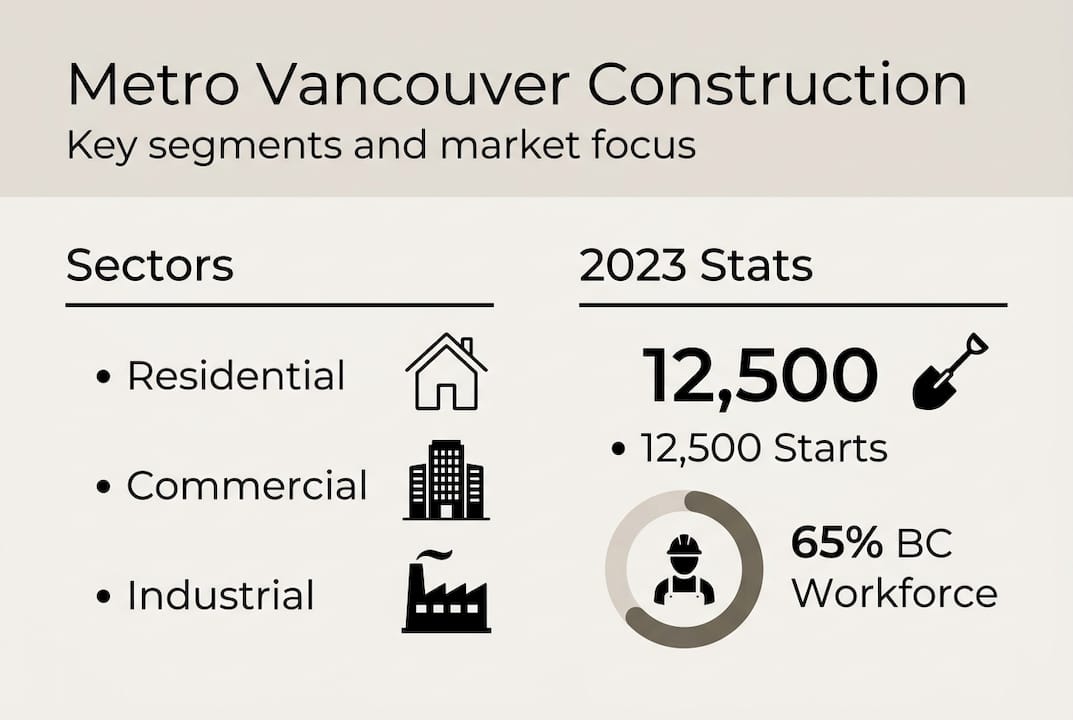
Residential construction is the largest segment by volume. Metro Vancouver recorded 12,500 housing starts in 2023 alone, representing 55% of BC's total. That figure includes single-family homes, townhouses, low-rise apartments, and high-rise condominiums. The region's residential construction trends continue to shift toward higher density, driven by land scarcity and municipal zoning reforms.
Commercial construction covers office towers, retail fit-outs, restaurants, and tenant improvement projects inside existing buildings. Tenant improvements, often called TIs, involve customizing leased commercial space to meet a business's specific needs. This segment has grown steadily as businesses retrofit older spaces rather than commission new builds.
Industrial construction is where Metro Vancouver's market stands out sharply. The future of commercial construction increasingly intersects with industrial demand: industrial vacancy sat at just 3.8% in Q1 2025, with 5.1 million square feet currently under construction. Distribution centers, warehouse upgrades, and cold storage facilities are all in high demand.
Here is a breakdown of key market statistics:
| Segment | Key Metric | Figure |
|---|---|---|
| Housing starts | Metro Vancouver, 2023 | 12,500 units |
| BC dwellings completed | Province-wide, 2023 | 28,400 units |
| Industrial vacancy | Q1 2025 | 3.8% |
| Industrial under construction | Q1 2025 | 5.1 million sf |
| Construction employment | Metro Vancouver total | 152,000 workers |
A few factors drive this activity at a local level:
- Population growth sustained by immigration targets keeps housing demand elevated
- Urban densification pushes developers toward multi-unit formats on smaller lots
- E-commerce growth sustains near-record industrial demand in suburban municipalities
- Aging building stock creates a large renovation and retrofit market across all segments
The construction workforce here represents 65% of BC's total construction employment, which means Metro Vancouver's labor market is tight and competitive. Project timelines are directly tied to how well contractors manage workforce scheduling.
Key trends shaping construction in Metro Vancouver
With the scope understood, it is crucial to explore which trends are driving today's construction projects in this region.
One of the most significant shifts involves building materials. Mass timber, which refers to engineered wood products like cross-laminated timber (CLT) used for structural elements, is gaining traction. Mass timber offers carbon sequestration benefits, erection coordination savings of 20 to 30%, and in some applications achieves cost parity with concrete. There can be a 10 to 30% cost premium in other scenarios, but schedule gains often offset that figure. For developers working on tight timelines, faster erection translates directly into lower carrying costs.
The other major material trends follow a clear pattern:
- Prefabricated construction continues to grow, reducing on-site labor hours and improving quality control in a tight labor market
- Concrete and steel remain the standard for high-rise residential and large commercial projects where load requirements demand proven performance
- Hybrid systems combining mass timber with concrete cores are appearing in mid-rise commercial and mixed-use buildings
A useful comparison for developers evaluating material choices:
| Material | Build speed | Carbon profile | Cost trend | Best use case |
|---|---|---|---|---|
| Mass timber | Fast | Low (sequesters carbon) | Moderate | Mid-rise, office, mixed-use |
| Prefab panels | Very fast | Low to moderate | Competitive | Residential, repetitive units |
| Concrete | Moderate | High | Rising | High-rise, industrial |
| Steel | Fast | Moderate | Volatile | Long-span commercial |
The renovation versus new build question is reshaping how developers think about opportunity. Renovation trends in Vancouver show accelerating activity as land costs and limited available parcels make ground-up construction financially challenging in established neighborhoods. Retrofitting existing commercial or residential buildings often delivers faster returns and fewer permitting complications.
Sustainability requirements are also tightening. BC's building code increasingly favors low-carbon materials and energy-efficient systems, which means project teams need to factor these choices in early. Choosing mass timber or high-performance insulation is no longer just an environmental statement. It is increasingly a regulatory and financial consideration.
Pro Tip: Ask your contractor about mass timber or prefab options during early design discussions, not after drawings are finalized. Switching structural systems late in the design process adds cost and delays.
What property owners and developers need to know
Now that trends are clear, here is what matters most for property owners and project initiators on the ground.
The most pressing practical issue is the skilled trades shortage. Metro Vancouver is projected to need 18,000 additional skilled workers by 2032. That gap affects every project category. When trades are scarce, scheduling becomes a competitive advantage. Contractors who maintain strong relationships with subcontractors and trade partners can keep projects moving. Those who cannot may leave your project stalled mid-frame.
For developers, mass timber and prefab reduce both timelines and on-site labor requirements, which is a meaningful advantage in this environment. Seismic expertise is also non-negotiable in Metro Vancouver. The region sits in one of Canada's highest seismic hazard zones, and structural design must account for earthquake loading. Contractors without local seismic experience create real liability for project owners.
Here is what to look for when vetting a general contractor:
- VRCA affiliation: The Vancouver Regional Construction Association represents credible, accountable contractors in this market
- Local permit experience: Contractors familiar with municipal processes in Vancouver, Burnaby, Surrey, and other Metro cities navigate approvals faster
- Seismic design knowledge: Confirm the contractor understands BC's seismic requirements and works with engineers who specialize in them
- Trade relationships: A contractor with established subcontractor networks is better positioned to maintain schedules
- Portfolio relevance: Request examples of completed projects that match your project type and scale
Pro Tip: Request references from projects completed in the same municipality as yours. Permitting cultures vary significantly between Metro Vancouver cities, and local experience matters.
Good project management in Metro Vancouver means understanding not just construction but also the administrative layers: development permits, building permits, engineering reviews, and inspections. These steps add time if not managed proactively. Experienced construction companies in Vancouver treat permit management as a core service, not an afterthought.

Technologies like building information modeling, or BIM, allow project teams to detect coordination conflicts between structural, mechanical, and electrical systems before construction begins. That early conflict resolution prevents costly on-site changes and keeps schedules intact.
Outlook: Challenges and opportunities ahead
Looking ahead, Metro Vancouver's construction market is steady but measured. The low vacancy and rising investment tell one story, while affordability pressures and land scarcity tell another. Developers are increasingly cautious about large ground-up projects in high-cost areas, which is shifting capital toward renovations and adaptive reuse.
Here are the key opportunities and risks worth tracking over the next few years:
- Renovation market growth: As new land becomes harder to justify, improving what already exists delivers faster returns with fewer permitting hurdles
- Industrial demand continuation: Distribution, cold chain, and light manufacturing needs show no sign of softening in Metro Vancouver's suburban markets
- Transit-oriented development: Provincial legislation is accelerating density near SkyTrain stations, creating focused opportunity corridors for residential and mixed-use projects
- Modular and prefab scaling: As supply chains for prefab components mature, cost and quality are both improving, making this option more viable for a wider range of project types
"Low vacancy, rising investment, and sustained demand confirm Metro Vancouver's construction market remains active, but affordability constraints and land scarcity mean developers must be strategic. Renovations over new builds is an increasingly sound approach in dense, established areas."
For those considering Metro Vancouver commercial construction, the opportunity window is real but requires discipline. Projects that succeed here share common traits: early contractor engagement, realistic permit timelines, trades secured well in advance, and material choices made with both budget and regulation in mind.
The market will not slow dramatically, but it will continue to reward those who plan carefully over those who move fast without local knowledge.
Our perspective: What most property owners don't realize about Metro Vancouver construction
Most of the project challenges we see come from one source: applying assumptions that work elsewhere but fail here. A developer who successfully completed projects in Calgary or Toronto often arrives in Metro Vancouver expecting similar timelines, similar labor availability, and similar permitting culture. That expectation creates problems quickly.
Permitting in Metro Vancouver is not slow because of bureaucratic laziness. It reflects the genuine complexity of building in one of Canada's most regulated urban environments. Seismic review, environmental assessments, heritage overlays, and density negotiations all add steps that simply do not exist in other cities.
Material choices are another area where conventional wisdom backfires. Assuming concrete is always the fastest or cheapest option ignores the documented schedule advantages of mass timber and prefab in mid-rise applications. The right choice depends on project type, timeline, and the specific trades available when your project is scheduled to start.
Our experience with Metro Vancouver project management confirms that the most successful projects invest in local expertise early. That means contractors who know the municipal staff, engineers who understand BC's seismic standards, and project managers who treat permit tracking as a priority from day one. Region-specific knowledge is not a nice-to-have in this market. It is what separates projects that finish on time from those that do not.
Ready to move your project forward?
If you are planning a residential renovation, commercial fit-out, new build, or industrial upgrade in Metro Vancouver, working with a contractor who knows this market is the clearest path to a successful outcome.

Multigroup Contracting brings hands-on experience across the full range of Metro Vancouver construction projects, from high-end residential interiors to warehouse renovations and retail buildouts. We handle permitting, scheduling, trades coordination, and quality control so property owners and developers can focus on their vision. Our team of Metro Vancouver construction experts is ready to discuss your project, answer your questions, and help you move forward with confidence. Contact us today to start the conversation.
Frequently asked questions
What types of projects are most common in Metro Vancouver construction?
Residential condos, apartment renovations, and commercial fit-outs are the most prevalent due to high demand and urban density. Metro Vancouver recorded 12,500 housing starts in 2023, representing 55% of BC's total output.
How long does it take to get construction permits in Vancouver?
Permit timelines have improved recently, with approvals in Vancouver averaging 7.7 months. Working with a contractor experienced in local municipal processes can help avoid unnecessary delays.
What building materials are trending in Metro Vancouver construction?
Mass timber is growing in popularity because it offers carbon sequestration and 20 to 30% coordination savings during erection, while concrete and steel remain the go-to options for high-rise and heavy industrial applications.
Are there enough skilled trades for new construction projects?
Not yet. Metro Vancouver faces an ongoing shortage, with 18,000 additional skilled trades projected to be needed by 2032, making early contractor engagement and scheduling critical for project owners.
What makes a reliable Metro Vancouver contractor?
Contractors with VRCA affiliation, documented seismic expertise and local project experience are consistently the most reliable for maintaining quality and meeting timelines in this region.