

TL;DR:
- Planning leasehold improvements in Metro Vancouver involves navigating complex permits, tax classifications, and construction challenges.
- Understanding the distinctions between landlord and tenant improvements, obtaining proper permits, and documenting costs are crucial for success.
Planning a leasehold improvement in Metro Vancouver feels straightforward until the permit office sends your application back with corrections, or your accountant raises questions about how to classify the costs. Commercial tenants and property owners across the region face the same cycle: ambition, confusion, delay, and cost overruns. The rules are real, the stakes are high, and the margin for error is thin. This guide breaks down every critical phase of a leasehold improvement project, from understanding what qualifies as a leasehold improvement to navigating permits, managing tax treatment under Canada Revenue Agency (CRA) rules, and executing the work on time and on budget.
Table of Contents
- Understanding leasehold improvements in Vancouver
- Permitting process: What you need to know
- Tax implications for leasehold improvements
- Step-by-step: Executing your leasehold improvement project
- The uncomfortable truth most experts won't tell you about leasehold improvements
- Take the next step with expert guidance
- Frequently asked questions
Key Takeaways
| Point | Details |
|---|---|
| Permits are essential | Most leasehold improvements in Metro Vancouver require permits, and processes vary by municipality. |
| Tax treatment matters | Leasehold improvements are governed by CRA’s CCA framework, so correct classification is crucial for deductions. |
| Certified professionals accelerate | Involving a certified professional can streamline permit review and allow earlier project starts. |
| Preparation prevents delays | Careful planning and adherence to requirements can minimize costly project setbacks. |
| Professional guidance helps | Expert support ensures compliance, efficiency, and successful leasehold improvements in Vancouver. |
Understanding leasehold improvements in Vancouver
A leasehold improvement is any permanent modification made to a rented commercial space to make it suitable for the tenant's specific business operations. These improvements become part of the building structure and generally cannot be removed when the lease ends, which is why they carry unique regulatory and financial implications.
Common leasehold improvement projects in Metro Vancouver include:
- Partition walls and interior framing to create offices, meeting rooms, or retail zones
- Flooring upgrades, including polished concrete, luxury vinyl tile, or carpet systems
- HVAC modifications, such as adding dedicated ventilation for a kitchen or server room
- Lighting system overhauls, including LED retrofits and specialty track lighting
- Plumbing rough-ins for additional washrooms or coffee bar stations
- Millwork and custom cabinetry built into walls as permanent fixtures
- Electrical panel upgrades to support higher equipment loads
Understanding tenant improvement basics is the first step to planning any commercial buildout correctly.
It is also important to distinguish between landlord improvements and tenant improvements. Landlord improvements are funded and controlled by the building owner, typically completed before a tenant takes possession. Tenant improvements are funded by the tenant (sometimes with a landlord allowance) and carried out during the lease term. Each category triggers different permitting obligations and tax treatments, so knowing which applies to your project matters from day one.
Key distinction: Even if your landlord offers a tenant improvement allowance (a cash contribution toward your renovation costs), the permit obligations and CRA classification rules still apply to the actual improvements you make to the space.
Building permits are typically required for renovations and alterations across jurisdictions in Metro Vancouver, though the specific pathway varies by municipality and project scope. Skipping this step is not a shortcut; it creates liability for the tenant, the landlord, and any future sale or lease transaction involving the property.
Permitting process: What you need to know
Now that you know what leasehold improvements are, it is time to look closely at the regulatory steps required to move them forward legally in Metro Vancouver.
Permit requirements differ across cities in the region. Surrey, Burnaby, Coquitlam, Richmond, and Vancouver each operate under their own building departments with separate application portals, review timelines, and documentation standards. However, most follow a similar framework for commercial tenant work.
Permit types you may encounter:
| Permit type | Typical scope | Who applies |
|---|---|---|
| Minor tenant improvement | Cosmetic work, minor partitions, no structural changes | Tenant or landlord |
| Tenant improvement | Interior alterations, mechanical/electrical changes | Tenant with engineer or architect |
| Landlord improvement | Base building work before tenant occupancy | Landlord or property manager |
| Change of occupancy | New use type in existing space | Tenant with professional support |
Building permits are required whether the work is classified as a minor tenant improvement or a full tenant improvement, with the distinction affecting review complexity and timelines.
Steps to move through the permit process efficiently:
- Confirm the scope with your design team. Engage an architect or interior designer early to determine which permit category applies.
- Prepare permit drawings. These must meet the applicable building code and zoning requirements for your municipality.
- Submit your application. Use the city's online portal or counter service, depending on the jurisdiction.
- Respond to reviewer comments quickly. Delays in responding to correction notices are one of the most common causes of project timeline overruns.
- Schedule required inspections. Framing, electrical, mechanical, and final occupancy inspections must be coordinated with city inspectors.
- Receive final approval and occupancy sign-off. Never open a renovated space to the public without this step.
Vancouver's Certified Professional (CP) program allows a certified professional to take on a greater role in the review and inspection process, which can enable staged permit issuance. This means construction can begin on certain portions of the project before the full permit is issued, potentially saving weeks on a tight schedule.
Pro Tip: Hire a contractor who has worked directly with your target city's building department. Familiarity with local reviewers, typical correction notes, and submission formats can shave weeks off the permit timeline.
Review the detailed breakdown of Vancouver permit steps and commercial renovation regulations to build a realistic timeline before you sign your lease or commit to an opening date.
Tax implications for leasehold improvements
With permits in hand, the next critical factor to address before breaking ground is how the Canada Revenue Agency (CRA) treats leasehold improvements for tax purposes.

Many business owners assume they can simply expense renovation costs in the year they are incurred. That is rarely the case for leasehold improvements. Because these improvements become a permanent part of the building and provide an economic benefit over multiple years, the CRA classifies them as capital expenditures, not deductible operating expenses.
CCA Class 13: The leasehold improvement category
Leasehold improvements are classified under Class 13 of the CRA's Capital Cost Allowance (CCA) framework. CCA is the tax system's version of depreciation, allowing businesses to deduct a portion of capital asset costs over time rather than all at once.
Class 13 uses a straight-line depreciation method tied to the remaining lease term, with a specific formula:
- The maximum annual deduction is calculated based on the lesser of 20 years or the remaining lease term plus one renewal period
- The CCA rate is determined by dividing the cost of the improvement by the allowable term
- Half-year rule applies in the first year of acquisition, meaning only 50% of the normal deduction is available
| Scenario | Lease term remaining | Allowable deduction period |
|---|---|---|
| New 5-year lease with one renewal | 5 years + 5 years | Up to 10 years |
| Mid-lease improvement, 3 years left | 3 years + renewal | Based on remaining term |
| No renewal option in lease | Remaining term only | Potentially shorter write-off |
Key distinctions to keep in mind:
- Capital vs. expense: Repairs that restore a space to its original condition may be expensed. Improvements that add value or extend useful life must be capitalized.
- Ownership matters: Only tenants who hold a leasehold interest and bear the cost of the improvement can claim the Class 13 deduction.
- Landlord allowances: If your landlord contributes funds toward your improvements, this may reduce your eligible CCA base or create income inclusion obligations. Always verify with a tax advisor.
Pro Tip: Document every cost associated with your leasehold improvement project in detail, including design fees, permit fees, and construction invoices. CRA expects clear records separating capital costs from operating costs if you are ever audited.
Before moving into the execution phase, it helps to understand how the financial planning connects to the physical buildout. Reviewing commercial buildout phases can clarify how to structure your budget and timeline so that capital and expense items are correctly tracked from the start.
Step-by-step: Executing your leasehold improvement project
With regulatory and tax factors covered, you are ready to move into the active project phase. Execution requires a clear structure, the right team, and consistent oversight.
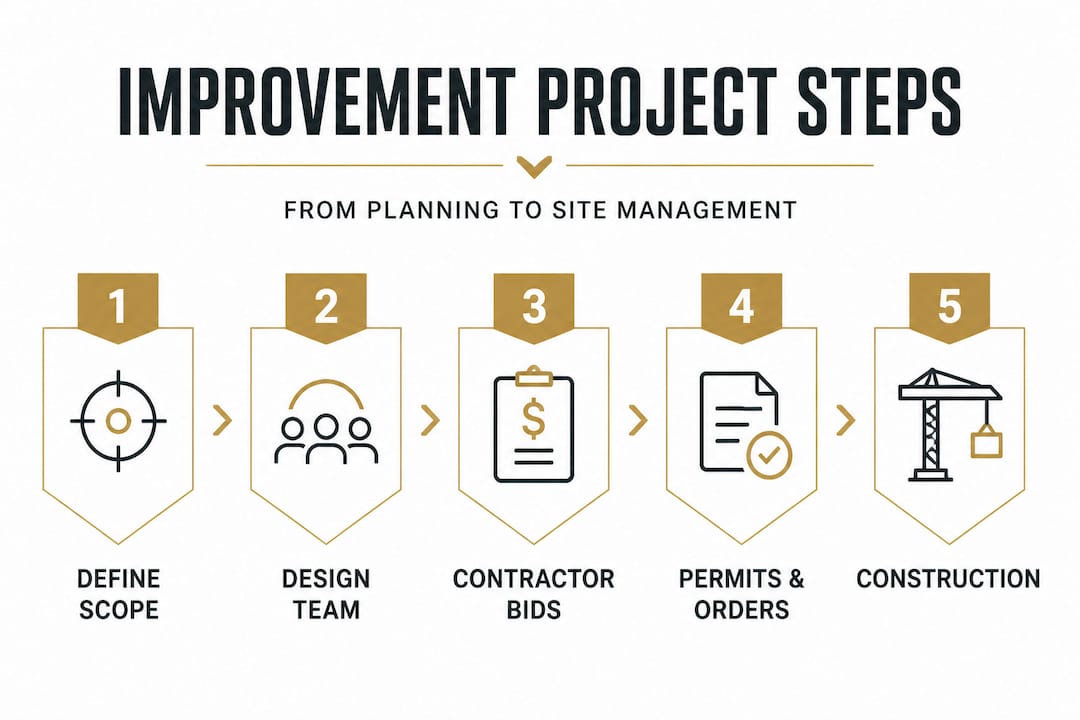
Phase 1: Define the project scope
Start with a written scope of work. This document describes every element of the renovation, including specific finishes, mechanical requirements, and structural changes. Vague scopes lead to change orders, which add cost and delay. Be specific about flooring types, wall heights, door hardware, and HVAC requirements from the beginning.
Phase 2: Engage your design and professional team
For any project requiring a permit, you will need drawings stamped by a licensed architect or engineer. Some jurisdictions also require structural engineering sign-off for partition walls or mezzanine additions. Interview two or three firms and ask to see examples of similar commercial projects they have completed in Metro Vancouver.
Phase 3: Collect and compare contractor bids
Collect at least three bids from general contractors. Bids should be itemized so you can compare line by line. Watch for unusually low bids, which often indicate missing scope items that will appear later as change orders. A detailed bid reflects a contractor who has read your drawings carefully.
Building permits and project milestones must align with city review timelines and the involvement of licensed professionals throughout construction.
Phase 4: Submit permits and begin procurement
Once your contractor is selected and contract signed, submit your permit application immediately. Use the waiting period productively by ordering long-lead items such as custom millwork, specialty lighting fixtures, HVAC equipment, and flooring materials. Supply chain delays in Metro Vancouver can add four to eight weeks to a project if procurement is not started early.
Phase 5: Construction and site management
Daily site oversight is essential. Your general contractor should provide regular progress updates and flag any discrepancies between the drawings and existing conditions. This is also the phase where deficiencies in the original permit drawings tend to surface, requiring quick decisions to keep the project moving.
Common mistakes to avoid during execution:
- Starting construction before the permit is issued (this creates stop-work risk and potential fines)
- Failing to document field changes in writing (verbal approvals from a landlord's property manager are not sufficient)
- Overlooking coordination between trades, such as electrical rough-in conflicting with HVAC ductwork
- Not scheduling inspections in advance, which can create idle time on site when inspectors are backlogged
Pro Tip: Ask your contractor to provide a two-week lookahead schedule updated weekly. This simple tool identifies bottlenecks before they become delays and keeps all subcontractors aligned.
Review the full range of tenant improvement services available in Metro Vancouver to understand what a full-service contractor can manage on your behalf, from permit submission through final inspection.
The uncomfortable truth most experts won't tell you about leasehold improvements
Here is something most project guides leave out: even when you follow every step correctly, things will still go sideways. That is not pessimism. It is the reality of commercial construction in Metro Vancouver, and acknowledging it early is what separates projects that recover quickly from projects that spiral.
Permit timelines, even with a certified professional involved, are not guaranteed. The CP program can streamline review and allow staged construction, but it does not eliminate reviewer questions, site-specific complications, or department backlogs. We have seen well-prepared applications take twice as long as expected because a reviewer flagged an interpretive issue with the building code that required an additional engineering letter. There was no way to predict it. The only response was fast communication and a proactive design team.
The same applies to tax treatment. Business owners who assume their accountant is up to date on leasehold improvement nuances are sometimes surprised at year-end when CCA calculations do not match their expectations. Class 13 rules interact with lease renewal options, landlord contribution structures, and mid-year improvement timing in ways that create variability. The rules are not ambiguous, but they do require someone who works with commercial leases regularly to apply them correctly.
The deeper issue is that leasehold improvement projects in Vancouver require sustained attention, not just a strong start. Many operators put enormous effort into the planning phase and then reduce oversight once construction begins. That is precisely when problems compound. Site conditions in older commercial buildings often reveal surprises: undersized electrical panels, asbestos-containing materials in older drywall or floor tiles, or HVAC systems that are not zoned the way the existing drawings suggest. Each of these requires a decision that affects budget, schedule, and sometimes permits.
Flexibility and clear communication are not soft skills in this context. They are operational requirements. Build a contingency of 10 to 15 percent into your budget, maintain a single point of contact between your business and your contractor, and expect to make several real decisions under time pressure. Understanding the future of commercial construction in Metro Vancouver also helps you anticipate where regulations and material costs are heading, so your space remains functional and compliant well beyond the initial buildout.
Take the next step with expert guidance
Planning a leasehold improvement project in Metro Vancouver involves more moving parts than most business operators anticipate. Between permit requirements, CRA tax classifications, contractor selection, and site-level decisions, the process demands both technical knowledge and practical experience.

Multigroup Contracting works with commercial tenants, property owners, and developers across Metro Vancouver to manage every phase of leasehold improvement projects. From permit applications to final inspections, the team handles the details so you can stay focused on your business. Whether you are building out a new retail space, reconfiguring a warehouse, or renovating a coffee shop, professional support from an experienced general contractor makes the difference between a project that finishes on time and one that does not. Reach out to discuss your project scope, timeline, and budget, and get clear answers before the first drawing is drafted.
Frequently asked questions
Do I need a permit for every commercial renovation in Vancouver?
Most commercial renovations require a permit, but the exact permit type depends on the scope and municipality. Permit requirements vary by jurisdiction and project scale, so always confirm with your local building department before starting any work.
Can tenants claim tax deductions for leasehold improvements?
Tenants may claim deductions only if they own a leasehold interest and the improvement qualifies under CRA rules. Leasehold improvements must be capital in nature and meet CRA guidelines to qualify for Class 13 Capital Cost Allowance deductions.
What does a certified professional do in the permit process?
A certified professional can manage permit review and inspection on behalf of the building department, potentially allowing staged construction to begin faster. CP program involvement can streamline the review process, though it does not eliminate all potential delays or reviewer questions.
How do I avoid common mistakes in leasehold improvements?
Careful scope definition, early permit submission, and coordination between your design team, contractor, and tax advisor are the most effective ways to avoid costly mistakes. Reviewing permit requirements before signing your lease gives you the clearest picture of total project cost and timeline.
Recommended
- Tenant improvement guide: navigate Vancouver permits in 2026
- What Is Tenant Improvement? A Guide for Metro Vancouver Tenants
- Your residential construction checklist for Vancouver success
- Property Renovation Guide: Expert Steps for Vancouver Homes
- Commercial Renovation Permits: Ensuring Legal Compliance