

TL;DR:
- Reviewing contractor bids involves verifying scope accuracy, normalizing allowances, and assessing qualifications before comparison. Bid leveling ensures true costs are revealed by aligning scope, allowances, and exclusions across bids, preventing misleading lowest offers. A thorough bid evaluation protects investments and increases the likelihood of selecting a contractor who can deliver within scope and budget.
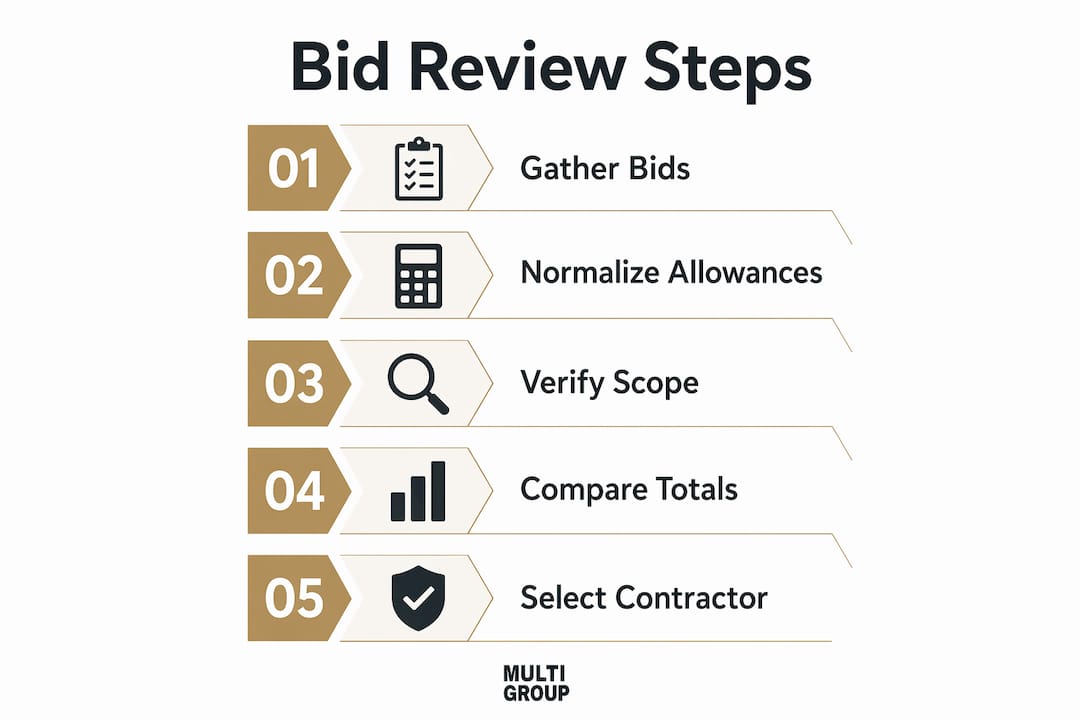
Reviewing contractor bids is the process of systematically analyzing detailed proposals to verify scope accuracy, compare pricing on equal terms, and identify risk before you commit to a contract. The industry term for this process is bid evaluation, and the core methodology used to make bids comparable is called bid leveling. Property owners and developers in Metro Vancouver, Burnaby, Richmond, Surrey, and Coquitlam who skip this process routinely face change orders, budget overruns, and contractor disputes that could have been caught at the proposal stage. A structured approach to evaluating contractor proposals protects your investment and gives you the clarity to choose the right team with confidence.
How to review contractor bids: what to look for in every proposal
Every bid you receive is a document that tells you two things: what the contractor plans to build, and what they are choosing not to include. Both matter equally. Bid review reduces risk by combining multiple steps, including screening, detailed cost analysis, and reference checks, rather than choosing the lowest price alone.

Start by reading the scope of work text carefully before you look at the total price. The scope defines what the contractor is responsible for delivering. Vague language like "general carpentry" or "electrical as required" signals that the contractor is leaving room to charge more later through change orders.
Here is what to examine in every bid you receive:
- Scope of work text: Confirm it matches your project drawings and specifications exactly. Any gap between your scope and the contractor's scope becomes a future change order.
- Line-item breakdowns: A detailed bid separates costs by trade or task, such as framing, mechanical, electrical, and finishes. This lets you compare pricing allocation across bids and spot where one contractor is pricing significantly higher or lower.
- Allowances: An allowance is a placeholder dollar amount for items not yet fully specified, such as tile or light fixtures. Allowances that are too low mask true costs and will exceed budget once actual selections are made.
- Exclusions: Every exclusion is a cost you will pay separately. Common exclusions include permit fees, engineering, hazardous material removal, and temporary site services. A bid with a long exclusions list is not necessarily cheaper.
- Payment schedule: Milestone-based payments tied to completed work are standard practice. Deposits over 10 to 15% of the contract value before work begins are a red flag in most residential and commercial renovation contexts.
- Material specifications: Bids that list "builder grade" or "as per allowance" without naming specific products leave quality undefined. This is how a low bid delivers a low-quality result.
Pro Tip: Ask every contractor to confirm in writing who pulls the permits, who attends inspections, and what the warranty covers. These three items are frequently omitted from bids and become sources of dispute during or after construction.
What is bid leveling and why does it change everything?
Bid leveling is the process of normalizing scope, plugging missing information, and adjusting bids so you can compare them like-for-like. Without it, you are comparing a fully loaded proposal against a stripped-down one and treating them as equivalent. The lowest nominal bid is frequently not the lowest actual cost once you account for scope differences.
The process follows five clear steps:
- Collect all bids and create a master line-item matrix. List every scope item, allowance, and exclusion from all bids in a single spreadsheet. Tools like Buildxact are purpose-built for this task and reduce manual error significantly.
- Identify discrepancies. Flag every item where one contractor has included a cost and another has excluded it, or where allowance amounts differ significantly.
- Normalize allowances. Set a common baseline for every allowance category. If your tile allowance is $8 per square foot in one bid and $4 in another, adjust both to a realistic market rate before comparing totals.
- Account for waste and consumption factors. Standard waste factors of 10 to 15% apply to materials like tile and flooring. A bid that omits waste factors is underestimating quantities and will generate change orders.
- Request clarifications and revisions. Once you have identified gaps, go back to each contractor with specific written questions. Ask them to revise their bid to include missing items or confirm their exclusions explicitly.
| Bid Component | What to normalize |
|---|---|
| Allowances | Set a single realistic dollar amount for each category across all bids |
| Exclusions | Add estimated costs for excluded items to each bid total |
| Waste factors | Apply 10 to 15% to tile, flooring, and similar materials if not included |
| Permit fees | Confirm inclusion or add current Metro Vancouver permit cost estimates |
| Contingency | Verify each bid addresses unforeseen conditions consistently |
Pro Tip: Building a side-by-side comparison sheet and normalizing bids before comparing totals removes ambiguity and exposes true cost differences that a surface-level review will miss entirely.
What criteria beyond price should you evaluate?
Price is one input in a multi-factor decision. A contractor who delivers on time, communicates clearly, and manages subcontractors well is worth more than a marginally lower bid from one who does not. A structured evaluation checklist includes screening unqualified bids, detailed cost analysis, and reference checks as distinct steps.
Consider these factors when assessing contractor quotes for commercial or residential projects in Metro Vancouver:
- Relevant experience: Has the contractor completed projects of similar type and scale? A general contractor experienced in tenant improvements and warehouse renovations in Burnaby or Richmond brings local knowledge that reduces risk on your project.
- Licenses and insurance: Verify the contractor holds a valid BC business license and carries general liability and WorkSafeBC coverage. Licensed contractors in Vancouver carry these credentials as a baseline requirement.
- Safety record and quality assurance plan: Ask for the contractor's safety program and any quality control documentation. Projects with formal QA processes have fewer deficiencies at handover.
- Timeline realism: Review the proposed schedule against your project's complexity. A 10-week schedule for a full tenant improvement in North Vancouver that similar projects take 16 weeks to complete is a warning sign, not a selling point.
- Submittal handling: Submittals represent contractor responsibility for coordination and content accuracy. Ask each contractor how they manage submittal schedules and confirm their coordination commitments in writing before you sign.
- References from similar projects: Contact at least two references from projects comparable to yours. Ask whether the contractor stayed on budget, communicated proactively, and whether the client would hire them again.
The goal at this stage is to identify the contractor who offers the best combination of complete scope, realistic schedule, verified qualifications, and fair pricing. That combination protects your project from the most common failure points in Metro Vancouver construction.
How to handle clarifications, negotiations, and final selection
Once bid leveling is complete and you have evaluated qualifications, you will likely have one or two leading candidates. The next step is structured clarification and, where appropriate, negotiation.
Follow this sequence to reach a sound final decision:
- Prepare written clarification questions. Base every question on a specific discrepancy or gap identified during bid leveling. Vague questions produce vague answers. Ask "Please confirm whether your bid includes permit fees for the City of Surrey" rather than "Can you clarify your scope?"
- Send questions to all shortlisted contractors simultaneously. This keeps the process fair and gives you comparable responses to evaluate side by side.
- Evaluate responses for completeness and transparency. A contractor who answers every question directly and revises their bid accordingly demonstrates the communication style you will work with throughout the project.
- Negotiate scope adjustments, not just price. If a contractor's bid is above budget, ask whether specific scope items can be phased, value-engineered, or substituted with equivalent materials. Cutting price without adjusting scope creates a contractor who will recover margin through change orders.
- Conduct reference checks before making a final decision. Checking references from similar past projects validates contractor reliability in a way that no bid document can. Ask specifically about budget adherence, communication during construction, and whether the client would hire the contractor again.
- Document all agreed changes before signing. Every clarification, scope revision, and pricing adjustment agreed during this process must be reflected in the final contract. Verbal agreements made during bid review have no legal standing once construction begins.
Before you reach this stage, reviewing the right questions to ask contractors during the bid process will sharpen your clarification list and reduce back-and-forth significantly.
Key takeaways
Effective bid evaluation requires bid leveling, scope verification, and qualifications review before any price comparison is meaningful.
| Point | Details |
|---|---|
| Read scope before price | Verify the scope of work matches your project specs before comparing any dollar totals. |
| Use bid leveling | Normalize allowances, exclusions, and waste factors across all bids to compare true costs. |
| Flag low deposits and vague specs | Deposits over 10 to 15% and unspecified materials are concrete red flags in any bid. |
| Evaluate beyond price | Assess experience, licenses, schedule realism, and safety records as part of every review. |
| Confirm everything in writing | All clarifications and scope changes must appear in the final contract before signing. |
What I've learned from reviewing bids in the Metro Vancouver market
Working on construction projects across Burnaby, Richmond, Coquitlam, and North Vancouver, I have seen the same pattern repeat itself. A property owner receives three bids, picks the lowest number, and calls it due diligence. Six months later, they are managing a project that has exceeded the highest bid they originally received.
The bids that look cheapest on paper almost always have the longest exclusions lists. I have reviewed proposals where permit fees, engineering, and site cleanup were all excluded, adding $30,000 to $60,000 to a bid that appeared competitive. Once those costs were added back, the "lowest" bid was actually the most expensive option.
Bid leveling changed how I approach every project evaluation. Building a master matrix and normalizing every allowance takes a few hours, but it consistently reveals the true cost picture before any money changes hands. The contractors who push back on detailed clarification questions are usually the ones who rely on change orders to make their margin.
One thing I tell every property owner in Metro Vancouver: a detailed bid is a sign of a capable contractor. When a contractor takes the time to specify materials by name, list every exclusion explicitly, and provide a milestone-based payment schedule, they are showing you how they manage projects. That transparency at the bid stage predicts how they will communicate during construction.
The goal is not to find the cheapest contractor. The goal is to find the contractor whose bid reflects the full scope of your project at a fair price, backed by the qualifications and track record to deliver it.
— Momo
Work with a contractor who makes bid review straightforward

Multigroup Contracting provides detailed, line-item proposals for every project, from tenant improvements and warehouse renovations in Burnaby and Surrey to retail buildouts and coffee shop renovations across Metro Vancouver. Every Multigroup bid includes a clear scope of work, named material specifications, milestone-based payment terms, and full permit handling. Multigroup is licensed and insured in BC, giving property owners and developers the confidence that what is written in the proposal is what gets built. To discuss your project and receive a thorough, transparent proposal, contact Multigroup Contracting at 778-819-5933, info@multigroup.ca, or visit multigroup.ca.
FAQ
What does bid leveling mean in construction?
Bid leveling is the process of normalizing contractor bids by aligning scope, adjusting allowances to a common baseline, and accounting for exclusions so that all proposals can be compared on equal terms. Without bid leveling, comparing bid totals directly produces a misleading picture of true project cost.
How many contractor bids should you get for a renovation?
Three bids is the standard practice for most residential and commercial renovation projects. Three proposals give you enough data to identify outliers, whether unusually high or low, without creating an unmanageable review process.
What is a red flag in a contractor bid?
Unusually low bids often contain exclusions, vague product specifications, or underestimated allowances that mask true costs. A deposit requirement exceeding 10 to 15% of the contract value before work begins is also a concrete warning sign.
Should you always choose the lowest contractor bid?
No. The lowest bid frequently reflects an incomplete scope, low allowances, or missing line items that will surface as change orders during construction. Evaluating bids on scope completeness, contractor qualifications, and timeline realism produces better project outcomes than selecting on price alone.
How do you verify a contractor's license and insurance in BC?
Confirm the contractor holds a valid BC business license and carries general liability insurance and WorkSafeBC coverage by requesting certificates directly. You can also verify WorkSafeBC registration status through the WorkSafeBC online registry before signing any contract.