
TL;DR:
- Portland's retail permitting process is strict, detailed, and unforgiving of shortcuts, often causing delays and extra costs. Proper planning, timely document submission, and understanding inspection sequences are essential to avoid permit expiration and project stalls. Working with experienced local contractors ensures compliance and helps open retail spaces on time and within budget.
Retail owners who skip even one step in Portland's permitting process often pay for it in weeks of delays and thousands of dollars in unexpected costs. Portland's regulatory environment is detailed, sequenced, and unforgiving of shortcuts. Whether you're opening a boutique on Alberta Street or a specialty shop in the Pearl District, the gap between a smooth grand opening and a stalled project usually comes down to preparation. This guide walks you through every stage of a Portland retail buildout, from understanding the local regulatory landscape to navigating final inspections, so you can open on time and on budget.
Table of Contents
- Understand Portland's retail buildout landscape
- What you need before you build: Preparation essentials
- Step-by-step: Navigating permits and inspections
- Troubleshooting and avoiding common mistakes
- What to expect at completion and opening
- What most retail buildout guides miss about Portland
- Get expert help for your Portland retail buildout
- Frequently asked questions
Key Takeaways
| Point | Details |
|---|---|
| Permitting criticality | Missing steps in Portland’s permitting can delay opening by weeks or months. |
| Backwards scheduling | Build your timeline from known city deadlines to avoid shutdowns and fees. |
| Final inspection required | A 999 Final Permit inspection is mandatory to close your permit and launch legally. |
| Track costs and milestones | Proactive tracking can prevent surprise budget overruns and permit expirations. |
| Expert help pays off | Local professionals can smooth out regulatory snags and speed up your buildout. |
Understand Portland's retail buildout landscape
Portland is a city with strong planning values, and that shows up in how strictly it manages commercial construction and tenant improvements. The city's Bureau of Development Services oversees permitting for retail spaces, and the process involves multiple agencies, detailed code compliance reviews, and a specific inspection sequence that must be followed precisely.
One of the most common misconceptions among first-time retail builders is that a consultation inspection carries the same weight as a required inspection. It does not. As Portland's own guidance makes clear, consultation inspections are not a substitute for required approved inspections, and a 999 Final Permit inspection is mandatory to close your permit. Missing this distinction can leave your permit in an indefinite "under inspection" status, which stalls your opening and can trigger permit expiration.
Timeline escalation is a real and well-documented risk. The James Beard Public Market project is a high-profile example: permitting and development delays pushed the opening to 2027, with costs climbing substantially along the way. While most retail buildouts are smaller in scale, the core lesson applies universally. Nonlinear permitting processes and planning missteps can derail any project, regardless of size.
For a broader look at what navigating the renovation process in Portland actually involves, including zoning and use considerations, the complexity becomes even clearer. Portland also follows the Oregon building code for structural and safety elements, which adds another layer of compliance to manage.
Common Portland-specific obstacles retail owners face:
- Nonlinear permitting where steps must be completed in a specific order
- Zoning and land use reviews that can add weeks before permits are issued
- Utility and fire safety inspections that require separate coordination
- Historic district or design review requirements for certain neighborhoods
- Energy compliance documentation under Oregon's energy code
- Contractor licensing verification required before permit issuance
Inspection and consultation comparison:
| Type | Purpose | Required for permit closure? |
|---|---|---|
| Consultation inspection | Advisory, non-binding review | No |
| Framing inspection | Structural verification | Yes |
| Electrical inspection | Wiring and panel compliance | Yes |
| Mechanical inspection | HVAC and ventilation review | Yes |
| 999 Final inspection | Overall code compliance check | Yes |
Understanding this table isn't just academic. It determines whether your permit closes on schedule or sits open for months after construction ends.
What you need before you build: Preparation essentials
Preparation is where most retail buildout problems are actually created, even if they only show up later during inspections or permit reviews. Getting organized before you break ground is the single highest-leverage thing you can do for your project.

The documents and submissions you need to have ready include architectural drawings stamped by a licensed Oregon architect, mechanical and electrical plans, a code compliance narrative, and your certificate of occupancy application. These aren't just formalities. Reviewers use them to verify that your space meets fire egress, accessibility, and structural requirements before a single wall goes up.
Your buildout team matters just as much as your paperwork. You need a licensed general contractor, an architect familiar with Portland's commercial code, a mechanical engineer for HVAC design, and potentially a code consultant if your space involves complex use classifications. Understanding construction terminology will help you communicate effectively with each of these professionals and catch errors before they cost you money.
Scheduling is where most teams make their biggest strategic mistake. Many retail owners set a desired opening date and work forward, trying to fit permitting into whatever time is left. The smarter approach is the opposite. Portland's Development Hub PDX operates on specific submission windows with hard deadlines. Miss a fee period window, and your application may sit in queue for an extended time, pushing your entire schedule back.
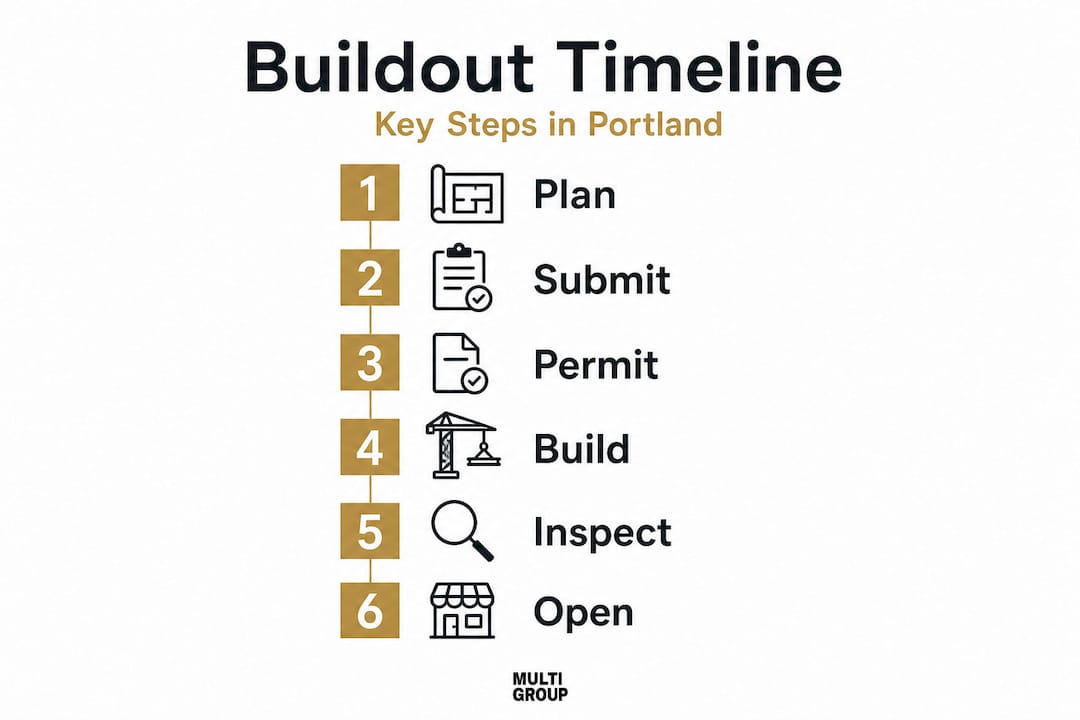
For detailed guidance on managing tenant improvement scheduling and understanding how permit timelines interact with construction phases, having a structured resource helps enormously.
Preparation essentials and responsible parties:
| Item | Responsible party | Notes |
|---|---|---|
| Stamped architectural drawings | Licensed architect | Required before permit submission |
| Mechanical and electrical plans | Engineers of record | Must align with Oregon energy code |
| Contractor licensing verification | General contractor | Must be on file with BDS |
| Code compliance narrative | Architect or code consultant | Addresses specific use requirements |
| Permit application and fees | Owner or contractor | Submit within active fee window |
| Certificate of occupancy application | Owner or contractor | Filed at or near final inspection |
Pro Tip: Build your entire project timeline backwards from Portland's next published fee-period submission window, not from your desired opening date. This single scheduling shift prevents the majority of timeline slippage that retail owners experience.
Step-by-step: Navigating permits and inspections
Once your preparation is complete, the actual permitting and inspection sequence begins. This is where attention to detail pays off, because each step must be completed in order and documented correctly.
Here is the proven step-by-step process for a Portland retail buildout:
-
Submit permit application. Submit all documents through Development Hub PDX during the active submission window. Include your stamped plans, compliance narrative, contractor information, and applicable fees.
-
Plan review. The Bureau of Development Services reviews your submission for code compliance, land use, and structural adequacy. Review times vary but typically run two to six weeks for commercial projects. Respond promptly to any correction requests to avoid additional review cycles.
-
Permit issuance. Once plans are approved and fees paid, your permit is issued. Post it visibly at the job site. Work cannot legally begin without it.
-
Begin construction with required inspections. Schedule each required inspection at the appropriate construction milestone. Framing inspections happen before walls are closed. Electrical rough-in inspections occur before drywall. Never cover work that hasn't been inspected.
-
Consultation inspections (optional). If you want a pre-inspection walkthrough with an inspector, you can request a consultation. These are genuinely useful for catching issues early, but remember that consultation inspections do not count as approved permit inspections. A 999 Final Permit inspection is still required for closure.
-
Final inspection (999). Once all work is complete, schedule the 999 Final inspection. This is the official review that confirms all required inspections passed and all code requirements are met.
-
Permit closure. After the 999 inspection passes, your permit is officially closed. You can now obtain your certificate of occupancy and open your doors legally.
Tracking where you are in this sequence is as important as completing each step. Understanding each commercial buildout phase helps you anticipate what's coming and avoid scrambling at critical milestones.
Warning: If you complete construction but skip the 999 Final Permit inspection, your permit remains in "under inspection" status indefinitely. This can lead to permit expiration, which creates legal liability and may require you to reopen the permit at additional cost before the space can be legally occupied.
Pro Tip: Use Portland's online permit tracking portal to check your permit status weekly throughout construction. Don't assume inspections are auto-scheduled. You or your contractor must proactively request each inspection at the right time.
Troubleshooting and avoiding common mistakes
Even well-prepared retail owners run into setbacks. The key is knowing which problems are most likely and having a plan to address them before they compound.
Inspection failures are one of the most common causes of delay. An inspector might flag a fire-rated assembly that wasn't installed correctly, or an electrical panel that doesn't meet current code. The fix itself is usually straightforward, but the re-inspection wait time adds days or weeks to your schedule. Catching these issues early, during framing or rough-in phases, is far less costly than discovering them at the final inspection.
Permit expiration is another serious risk. In Portland, permits that sit inactive for extended periods can expire. If your project stalls due to contractor availability, supply chain delays, or financing issues, you must monitor your permit status and apply for extensions before expiration occurs. As seen with large-scale projects, delays in retail development consistently produce higher costs and longer timelines, often because initial setbacks are not addressed quickly enough.
The relationship between your contractor and the city inspectors also matters more than most retail owners realize. Contractors who have a history of clean inspections and professional communication with Portland's Bureau of Development Services tend to move through the system faster. This is one of the strongest arguments for working with licensed contractors who have direct experience in Portland's commercial permitting environment.
Common mistakes and how to avoid them:
- Scheduling inspections too late in the construction sequence, requiring work to be opened up for access
- Submitting permit applications outside the active fee window, causing queue delays
- Treating consultation inspections as approval checkpoints when they are not
- Failing to post permits visibly on the job site, which can halt work immediately
- Not tracking permit expiration dates, leading to expired permits that require reactivation
- Hiring contractors who are unfamiliar with Portland's specific inspection sequencing requirements
- Overlooking fire marshal coordination for sprinkler or suppression system requirements
Pro Tip: Create a physical documentation binder and a digital backup folder for every permit, inspection report, plan approval, and communication with city agencies. If a dispute arises or an inspection result is questioned, your documentation is your defense.
What to expect at completion and opening
The final phase of your retail buildout is both the most exciting and the most consequential for staying compliant. Skipping any step here can delay your opening or create legal exposure after you've already invested everything into getting this far.
Here is what you need to complete before opening your retail space:
-
Confirm all required inspections have passed. Review your permit record to verify every inspection has an approved result. Any open or failed inspections must be resolved before the 999 Final can be scheduled.
-
Schedule the 999 Final Permit inspection. Contact Portland's Bureau of Development Services to book the final inspection. Have all your documentation ready, including any correction reports and re-inspection sign-offs.
-
Pass the 999 Final inspection. The inspector will verify that all work matches your approved plans and that the space meets code. As the city's guidance states, without a final 999 inspection, the permit remains under inspection and may expire, preventing legal occupancy.
-
Obtain your certificate of occupancy. This document confirms that the space is legally habitable and compliant. Some landlords and business license applications require this before you can operate.
-
Complete any landlord or building management requirements. Many Portland commercial landlords have their own punch list and close-out requirements separate from the city's process.
-
Coordinate with utilities. Confirm that electrical, water, and gas services are fully commissioned and metered correctly before you open.
For more guidance on managing the final stage of a buildout, including communication with inspectors and landlords, solid project management practices make the difference between a confident opening and a scrambled one.
Completion milestones and verification points:
| Milestone | Verification point | Risk if skipped |
|---|---|---|
| All inspections passed | Permit record shows approved status | Cannot schedule 999 Final |
| 999 Final inspection | Inspector approval on file | Permit stays open, space unlawful |
| Certificate of occupancy | Document issued by BDS | Business license may be denied |
| Utility commissioning | Service provider confirmation | Safety and operational risk |
| Landlord sign-off | Lease or TI agreement compliance | Lease breach exposure |
What most retail buildout guides miss about Portland
Most step-by-step guides describe what to do. Fewer explain what experienced Portland builders have learned from doing it wrong first.
The single most overlooked risk is the consultation inspection misconception. Many retail owners and even some contractors treat these sessions as informal approvals. They are not. Portland's official position is explicit: required approved inspections are the only ones that count toward permit closure. Walking away from a consultation feeling reassured is fine. Walking away thinking you've checked a box is a serious error.
The second overlooked risk is the fee-period deadline system. Most buildout timelines are built around construction phases. Portland's system requires that you also build around administrative windows. Miss the fee submission window, and your project enters a holding pattern that no amount of urgency from your team can fix.
Our experience with tenant improvements across complex regulatory environments tells us that over-preparing for Portland's system is never wasted effort. The cost of submitting one extra document, building in one extra inspection buffer, or hiring a code consultant for a single review session is almost always lower than the cost of a two-week delay. Retail owners who internalize this tend to open on time. Those who treat permitting as a back-office afterthought routinely don't.
The contrarian insight here is this: your permit and fee deadlines should be the foundation of your project schedule, not your desired opening date. Everything else, including construction phasing, contractor scheduling, and fixture procurement, must be organized around those hard administrative milestones. For deeper context on how this applies to tenant improvement projects of varying complexity, the principle holds across every scale of commercial buildout.
Get expert help for your Portland retail buildout
Portland's retail buildout process is detailed, sequential, and easy to get wrong without direct local experience. The stakes are real. Delays cost money, missed inspections cost time, and permit expiration can halt a project entirely. The most effective way to protect your investment is to work with a team that already knows Portland's system inside and out.
Multigroup Contracting brings proven expertise in retail buildouts, tenant improvements, and commercial construction to every project we take on. We handle permit coordination, inspection scheduling, contractor management, and code compliance so you can focus on your business. Our team understands the sequencing requirements, the fee-period windows, and the documentation standards that Portland projects demand. Whether you're starting from a raw shell or renovating an existing retail space, we deliver quality work on a schedule that respects your opening date. Contact Multigroup Contracting today to discuss your Portland retail buildout project.
Frequently asked questions
What is the biggest risk in Portland retail buildouts?
Permitting and inspection delays are the largest risk in Portland retail buildouts, causing costly timeline overruns when sequencing requirements are not carefully managed from the start.
Do consultation inspections let me skip regular inspections in Portland?
No. Consultation inspections do not substitute for required approved inspections, and your permit cannot be closed without completing all mandatory inspections, including the 999 Final.
How can I avoid permit expiration during my buildout?
Track your 999 Final inspection closely and schedule it as soon as all required inspections are passed, ensuring your permit is officially closed before its expiration date.
Why do Portland retail buildout projects often go over budget?
Delays in permitting and development create cascading cost increases, particularly when nonlinear planning processes cause unanticipated holds that extend contractor and lease overhead costs.
What's a key scheduling tip for Portland retail builds?
Always build your project timeline backwards from Portland's published submission windows and fee-period deadlines, not from your preferred opening date, to avoid administrative delays that no amount of construction speed can recover.