

TL;DR:
- Warehouse renovation involves a comprehensive redesign of layout, systems, safety, and workflow to improve efficiency and safety. Proper planning, including assessments, phased execution, and compliance checks, is essential to minimize disruption and maximize ROI. Post-renovation, tracking KPIs like pick rate and safety incidents ensures continuous improvement and operational success.
Warehouse renovation is not about giving your facility a fresh coat of paint or swapping out a few shelves. For Metro Vancouver business owners, it's a structural, operational, and logistical transformation that touches every layer of how your facility functions. Done right, it can dramatically reduce pick times, improve safety compliance, and scale with your business growth. Done wrong, it drains budget, disrupts operations, and leaves you with a space that looks different but works no better than before. This guide covers what renovation truly means, how to execute it successfully, and how to measure whether it's working.
Table of Contents
- Defining warehouse renovation: What it really means
- Key stages of a successful warehouse renovation
- Permitting, compliance, and 'second-order' engineering challenges
- How to renovate live: Phasing, safety, and minimizing disruption
- Measuring renovation success: KPIs and the ongoing feedback loop
- What most guides miss: The true ROI lives in workflow, not just the walls
- Ready to optimize your warehouse? Next steps with expert support
- Frequently asked questions
Key Takeaways
| Point | Details |
|---|---|
| Renovation is holistic | Warehouse renovation means comprehensive workflow, safety, and storage upgrades—not just cosmetic changes. |
| Step-by-step approach | A phased, structured renovation plan ensures safety and minimal operational disruption. |
| Permits and compliance | Local permits and compliance for key upgrades can affect schedule and budget, so plan ahead. |
| Live renovation tactics | Careful phasing and safety planning let you modernize without halting operations. |
| KPI measurement | Track logistics KPIs after renovation to verify your investment pays off and make continuous improvements. |
Defining warehouse renovation: What it really means
Warehouse renovation is a holistic process. It covers physical layout changes, systems upgrades, safety improvements, and workflow redesign, all working together toward a functional goal. It's not just a construction project. It's an operational overhaul that happens to involve construction.
That distinction matters. A lot of operators make decisions based on surface-level thinking: "We need more racking." "We need a mezzanine." "The loading dock is too tight." These observations might be accurate, but they treat symptoms rather than root causes. A renovation that starts from these single-point fixes often creates new bottlenecks elsewhere.
What separates a basic upgrade from a true renovation or retrofit comes down to scope and intent. A basic upgrade replaces or adds specific assets without changing how the facility flows. A full renovation reconfigures the space to match how products and orders actually move through it. Warehouse renovation ideas that focus purely on hardware without addressing process design rarely deliver lasting improvement.
Here's what a warehouse renovation actually addresses:
- Layout and flow: How product enters, moves, and exits the facility
- Storage systems: Racking types, density, and accessibility by SKU velocity
- Safety and compliance: Aisle widths, fire suppression systems, emergency egress
- Mechanical and electrical systems: Power capacity, lighting, HVAC, and material handling equipment
- Operational continuity: Keeping the facility functional during the renovation process itself
"A common renovation methodology is to start with a functional assessment of current operations, then redesign layout and storage systems to match product movement and order flow needs." Successful warehouse retrofit
The value of renovating a commercial facility like a warehouse goes well beyond aesthetics. It directly impacts your throughput capacity, team productivity, and the facility's long-term asset value. Understanding that scope upfront is what separates projects that deliver ROI from those that don't.
Key stages of a successful warehouse renovation
With an understanding of what renovation really means, here's how a project typically unfolds, step by step.
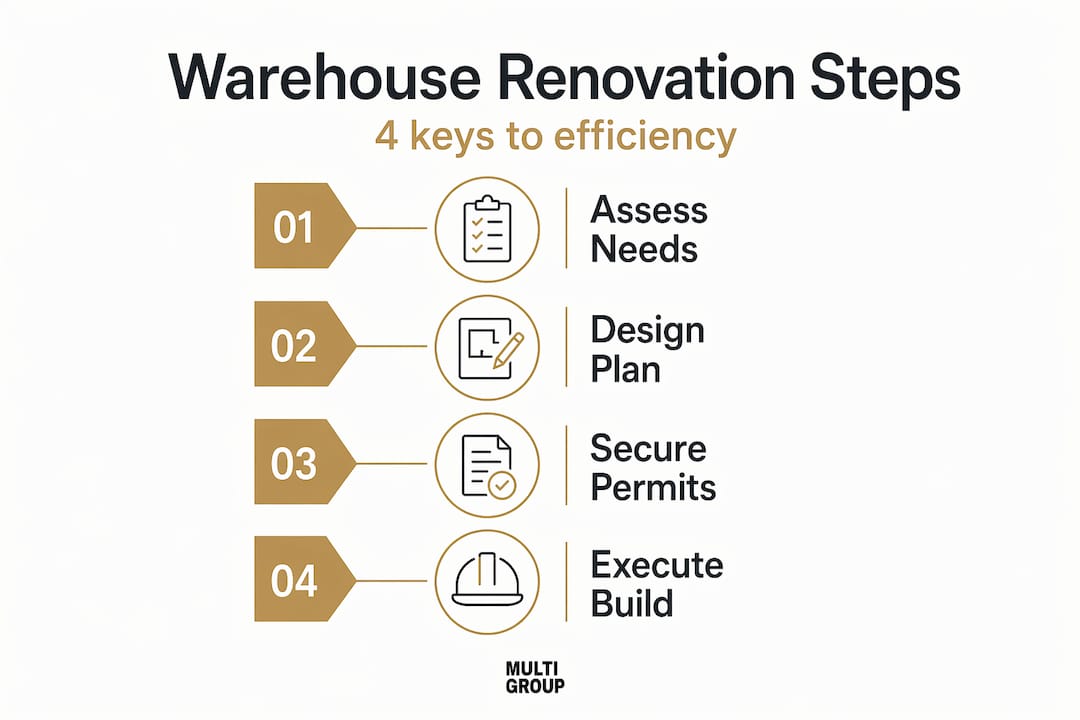
A well-run warehouse renovation follows a structured sequence. Skipping stages, especially the early assessment stages, is one of the most common and costly mistakes operators make. Here is the typical flow:
- Functional assessment: Audit current operations, order patterns, equipment condition, and storage utilization. Identify where the facility is losing time, space, or accuracy.
- Flow and layout design: Redesign the floor plan based on stock movement data. Place high-velocity SKUs closest to pick and dispatch areas. Reconfigure aisles for equipment clearance and throughput.
- Safety and compliance review: Check that the new design meets all applicable codes, including fire suppression coverage, emergency exit paths, and seismic anchoring requirements for racking.
- Phased execution planning: Map out which areas will be renovated first, how product will be temporarily stored or rerouted, and what the schedule looks like relative to peak operational periods.
- Execution and construction: Carry out the physical work, including demolition, installation, systems upgrades, and finishing, according to the phased plan.
- Monitoring and verification: After go-live, monitor results via KPIs to confirm that the renovation is delivering the intended improvements.
Here's a comparison of what's essential versus what's optional, depending on your facility's specific needs:
| Stage | Essential for all projects | Optional or project-specific |
|---|---|---|
| Functional assessment | Yes | N/A |
| Layout redesign | Yes | Scope varies |
| Safety and compliance check | Yes | N/A |
| Mezzanine or elevated platforms | No | High-density storage scenarios |
| Automation integration | No | High-volume operations |
| Racking system replacement | Depends on condition | Often included in full retrofits |
| Lighting upgrades | Recommended | Often phased |
| Phased execution planning | Yes | N/A |
Pro Tip: Before engaging a contractor, complete your own basic operational audit. Document current pick times, storage utilization percentages, and safety incident logs. This data will directly shape your renovation brief and help you evaluate design proposals objectively.
Working with contractors experienced in Metro Vancouver renovation strategies is especially important for industrial facilities, where local codes, site constraints, and logistics realities all influence project design. Strong renovation project management at every stage is what keeps these complex projects on time and on budget.
Permitting, compliance, and 'second-order' engineering challenges
Of course, all renovations must follow local codes, and engineering surprises can derail even the best plan.
Permitting in Metro Vancouver for warehouse modifications is more specific than many operators expect. It's not just about building permits for new walls or floors. When you start modifying storage systems, adding elevated structures, or changing fire suppression layouts, you enter specialized regulatory territory.
According to Surrey's vertical storage systems permit requirements, for warehouses where storage systems change materially, such as adding racking above certain heights or installing elevated walking platforms, local permitting is required before work begins. This applies across most Metro Vancouver municipalities, not just Surrey.
Beyond permits, there's a category of issues that contractors call "second-order" engineering challenges. These are not directly caused by the renovation you're planning, but they are triggered by it. Warehouse retrofit projects consistently encounter edge-case engineering impacts such as sprinkler coverage requirements and electrical capacity constraints. For example:
- Installing taller racking may require your fire suppression system to be redesigned entirely
- Adding a mezzanine introduces load calculations that affect the existing slab and structure
- Upgrading material handling equipment may exceed your current electrical panel capacity
- Removing walls or partitions can affect HVAC distribution and require mechanical rebalancing
| Trigger | Code or system affected | Practical solution |
|---|---|---|
| Racking above 8 feet | Fire suppression (NFPA 13) | Engage fire suppression engineer early |
| Mezzanine addition | Structural, seismic, egress codes | Full structural assessment required |
| New electrical equipment | Panel capacity and wiring codes | Electrical load study before design |
| Layout reconfiguration | Emergency exit paths | Update egress plan in construction drawings |
| Hazardous material storage | Building and fire codes | Consult fire marshal before finalizing layout |
This is why the sequential renovation guide approach matters so much. Catching these triggers early in the design process prevents costly redesigns and construction holdups later.
Pro Tip: Start permit applications and all engineering assessments simultaneously, not sequentially. Using permitting and scheduling tools alongside your contractor can help you identify overlapping timelines and avoid cascading delays that push your completion date back by weeks.
How to renovate live: Phasing, safety, and minimizing disruption
Once all permits and assessments are in place, successful operators focus on renovation methods that protect both safety and day-to-day function.
Running a live warehouse renovation requires careful choreography. Your building is still a working facility, with staff, forklifts, inventory, and customer orders moving through it every day. The renovation cannot stop that.
Phased execution strategies including temporary buffering, off-peak scheduling, and staged commissioning are essential to protect safety and operational continuity throughout the project. Here is a practical numbered sequence for managing a live renovation:
- Define clear renovation zones with physical barriers, temporary fencing, and signage
- Establish buffer storage areas before demolition begins in any active zone
- Brief all warehouse staff on changed traffic patterns and emergency procedures
- Schedule demolition and heavy construction during the lowest-activity period, typically nights or weekends
- Stage handovers zone by zone, so completed areas return to productive use before the next zone goes offline
The top risks in a live warehouse renovation include:
- Forklift and pedestrian conflicts near active construction zones
- Falling debris from overhead work on racking or mezzanines
- Inventory misplacement during temporary storage transitions
- Fire hazard from hot works (welding, cutting) near combustible materials or inventory
- Staff disorientation in modified floor layouts without updated wayfinding
Operational continuity is not just a convenience for logistics businesses. It's a financial imperative. Even a single day of unplanned downtime can cost more than several weeks of careful phased renovation planning.
For complex, multi-zone renovations, working with a contractor experienced in phased renovation planning ensures that the sequencing is practical and protects your team throughout. The contractor's scheduling must align with your order fulfillment calendar, not just construction logic. Strong operation and maintenance strategies during construction keep facilities running safely from day one through final handover.
Measuring renovation success: KPIs and the ongoing feedback loop
After the dust settles and operations resume, you need to know if your renovation worked and how to keep improving.
Too many operators complete a warehouse renovation and then simply return to business as usual without measuring what changed. That approach misses the most valuable part of the process: the data that tells you whether your investment is paying off and where the next round of improvements should focus.
Tracking the right metrics after a renovation is straightforward if you established baseline numbers before the project began. Here are the KPIs that matter most:
- Order pick rate: Units or orders picked per labor hour. This directly reflects how well your new layout serves your team.
- Order accuracy: Percentage of orders fulfilled without errors. Improved layout and clearer zoning typically drive this number up.
- Throughput capacity: Total units processed per shift or per day. A key measure of whether the new flow is working at scale.
- Equipment downtime: Time lost to equipment failures or congestion. Reduced downtime often signals that the new layout eliminates previous pinch points.
- Safety incidents: Frequency of near-misses, minor injuries, and reportable incidents. A well-designed renovation should reduce this significantly.
- Storage utilization: Percentage of available space actually in productive use. Over-building storage that sits empty is as problematic as running out of space.
Key statistic: Warehouse operators who implement layout-driven renovations and actively track post-project KPIs consistently report efficiency gains in the range of 15% to 30% in pick rate improvement within the first six months. Facilities that also address safety through their renovation see a measurable reduction in incident frequency, which directly reduces liability costs and staff turnover.
Warehouse efficiency upgrades deliver the strongest long-term returns when paired with a continuous improvement mindset. Set a formal 30, 60, and 90-day review schedule after your renovation goes live. Bring your team leads into those reviews. They see problems from the floor level that managers and contractors miss entirely.
What most guides miss: The true ROI lives in workflow, not just the walls
While successful projects follow all the steps above, experience shows that the biggest wins often come where few people focus.
Here's an uncomfortable reality about warehouse renovations: most operators over-invest in physical hardware and under-invest in process alignment. They spend months selecting the right racking system, obsessing over the mezzanine footprint, and debating automation options. Then they launch the renovated facility with the same workflows, the same handoff habits, and the same informal workarounds that caused the original inefficiencies.
New shelves do not change behavior. A better layout only delivers its potential when your team actually works within it the way it was designed. That means updating your pick-and-pack SOPs to reflect the new flow. It means cross-training staff so they can adapt when zones shift or volumes spike. It means building a simple, repeatable feedback loop where floor staff can flag layout problems before they calcify into permanent workarounds.
In our experience working on commercial facilities across Metro Vancouver, the projects that deliver the highest renovation ROI are not always the ones with the biggest construction budgets. They're the ones where the operator treated the renovation as a trigger for operational change, not just a physical upgrade.
Pro Tip: After your renovation is complete, hold a structured debrief with your floor team at the 30-day mark. Ask them to identify three things that are working better and three things that still cause friction. Those six data points are more valuable than any consultant's report.
The facilities that compound those early efficiency gains over time are the ones where management stays actively engaged with how the space is being used, not just how it was designed to be used. Renovation is the starting line, not the finish line.
Ready to optimize your warehouse? Next steps with expert support
If you're serious about making your warehouse work harder for your business, here's how to get started with expert help in your own backyard.
Warehouse renovation is one of the most complex and high-stakes categories of commercial construction. The operational, regulatory, and logistical variables involved require a contractor with direct experience in industrial environments, not just general commercial buildouts.

Multigroup Contracting brings hands-on expertise in warehouse renovation services across Metro Vancouver, covering everything from initial assessments and permit handling to full phased execution and project closeout. Whether you're reconfiguring an existing facility or planning a full operational retrofit, we manage the details so your business keeps moving. Explore practical warehouse renovation ideas to start building your brief, then connect with our team for a tailored consultation.
Frequently asked questions
What triggers the need for a warehouse renovation?
Common triggers include process bottlenecks, storage limitations, new product lines, or simply outgrowing the logistics capacity of your current setup. Frequent picking errors or rising safety incidents are also strong signals that the facility layout needs to change.
Do I need permits for new racking or mezzanines?
Many Metro Vancouver jurisdictions require specific permits for high racking and elevated platforms, so always check local regulations before starting any work. As Surrey's storage systems permit guidelines confirm, when storage systems change materially, local permitting is required before work starts.
How can I renovate without shutting down my warehouse?
Phased execution strategies, like temporary buffering and off-peak scheduling, let you renovate while keeping operations running safely. These phased execution strategies are specifically designed to protect both safety and continuity throughout the construction period.
What KPIs should I track after my renovation?
Monitor key metrics like order accuracy, pick speed, throughput, equipment downtime, and safety incidents to get a clear picture of your renovation's real-world impact. As the warehouse retrofit process recommends, monitoring results via KPIs after go-live is a core part of the process, not an afterthought.