

TL;DR:
- Understanding BC's legal protections, like the 10% holdback, is essential for project safety.
- Vet contractors thoroughly using licenses, insurance, reviews, and local experience to avoid disputes.
- Clear contracts, proper documentation, and local expertise prevent common delays and legal issues.
Hiring the wrong contractor in Metro Vancouver can cost you far more than money. Disputes, unfinished work, and legal complications from unpaid subcontractors are real risks that property owners and business operators face every year. BC's construction laws add another layer of complexity that out-of-province contractors and inexperienced local firms often mishandle. This guide walks you through every critical step, from understanding your legal protections before breaking ground to resolving disputes after the job is done. Whether you're planning a tenant improvement, a warehouse renovation, or a residential build, these steps will help you hire with confidence and protect your investment.
Table of Contents
- What to know before you start: Laws, risks, and requirements
- How to find trustworthy contractors: Research, vetting, and reviews
- The hiring process: Contracts, payments, and protecting yourself
- Troubleshooting and aftercare: Dealing with disputes and unfinished work
- Why clear contracts and local expertise make all the difference
- Ready to hire with confidence? Start your project with trusted experts
- Frequently asked questions
Key Takeaways
| Point | Details |
|---|---|
| Know your legal duties | Understand holdback requirements and check for property restrictions before starting projects. |
| Vet contractors thoroughly | Always verify licensing, insurance, and independent reviews before signing any contract. |
| Never pay fully upfront | Hold back 10% of payments and avoid full payment until all work is finished and the legal period has expired. |
| Handle disputes smartly | Use holdback funds to resolve liens and consult experts if disagreements arise. |
What to know before you start: Laws, risks, and requirements
Before you contact a single contractor, you need to understand the legal framework that governs construction in British Columbia. Metro Vancouver has specific requirements that can catch property owners off guard, and skipping this preparation phase is one of the most common reasons projects go sideways.
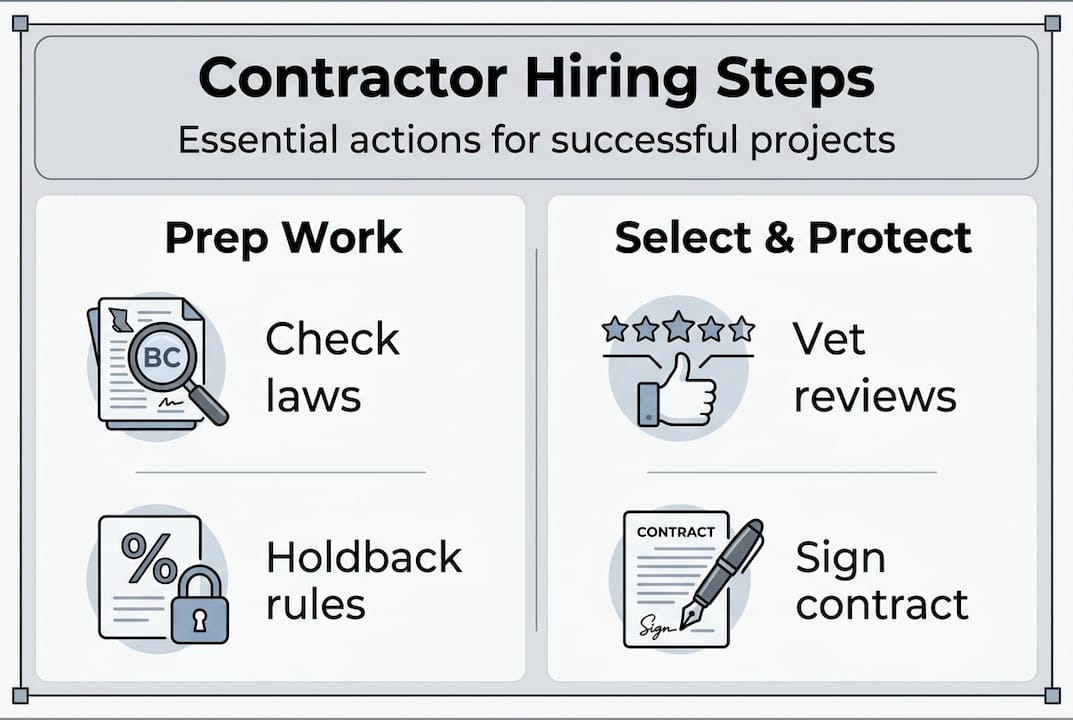
The most important financial protection you have as an owner is BC's mandatory holdback rule. Under the Builders Lien Act, you are required to retain 10% of each payment for 55 days after substantial completion. This holdback exists to protect you against liens filed by unpaid subcontractors or suppliers who worked on your project without your direct knowledge. If your general contractor doesn't pay their trades, those trades can register a lien against your property. The holdback is your buffer.
Another requirement that surprises many owners is the need to check for archaeological sites on your property before any digging begins. BC law requires this step, and you can search the provincial registry or hire a qualified archaeologist to assess the site. Ignoring this can halt your project entirely.
Before you hire, confirm every contractor can provide:
- A valid BC contractor license
- Proof of liability insurance and WorkSafeBC coverage
- Documented experience with the required work permits
- References from recent, comparable Metro Vancouver projects
Understanding licensed contractor basics is essential before you sign anything. Permits are not optional. Building without the required permits exposes you to stop-work orders, fines, and complications when you sell or refinance the property.
| Requirement | Why it matters | Who is responsible |
|---|---|---|
| 10% payment holdback | Protects against subcontractor liens | Property owner |
| Archaeological site check | Legal requirement before excavation | Property owner / contractor |
| Building permits | Required for legal construction | General contractor |
| WorkSafeBC coverage | Protects workers and limits owner liability | Contractor |
| Liability insurance | Covers property damage and injuries | Contractor |
Pro Tip: Request a Certificate of Insurance directly from your contractor's insurer, not just a copy from the contractor. This confirms the policy is active and lists you as an additional insured where applicable.
Understanding why professional contractors matter goes beyond just quality work. It's about legal compliance, financial protection, and having a clear chain of accountability from day one.
How to find trustworthy contractors: Research, vetting, and reviews
Once you've met the basic requirements, the next challenge is sifting through options to find the best fit. Metro Vancouver has hundreds of contractors, and the quality gap between them is significant. A systematic approach to vetting protects you from making a costly choice based on a low bid alone.

Start with independent review platforms. Vetted review platforms like BBB and HomeStars give you a more objective picture than referrals alone. Google reviews are also valuable, especially when the contractor has responded to negative feedback professionally. A pattern of complaints about delays, communication, or billing is a red flag regardless of how polished their website looks.
Understanding what a general contractor does helps you ask the right questions during interviews. A qualified GC manages trades, coordinates permits, maintains schedules, and serves as your single point of contact. If a candidate can't clearly explain how they handle subcontractor coordination, that's a warning sign.
Follow this sequence when vetting contractors:
- Verify their BC contractor license through the provincial registry
- Confirm active WorkSafeBC and liability insurance coverage
- Check BBB, HomeStars, and Google for reviews from the past 24 months
- Request a list of three to five recent Metro Vancouver projects with contact references
- Ask directly about their experience with your specific project type
- Evaluate how clearly and promptly they communicate during the inquiry stage
| Vetting factor | Strong candidate | Weak candidate |
|---|---|---|
| License verification | Current, no complaints | Expired or unverifiable |
| Insurance | Certificate provided directly | Only a copy from contractor |
| References | Recent, local, similar scope | Old or out-of-region projects |
| Communication | Prompt, clear, detailed | Slow, vague, or evasive |
| Bid detail | Itemized with scope clarity | Lump sum with no breakdown |
Pro Tip: When comparing bids, the lowest number is rarely the safest choice. A bid that's significantly lower than others often means the contractor has missed scope items, plans to use cheaper materials, or will request change orders to recover margin later.
Good construction project management starts at the selection stage. The contractor you choose sets the tone for every decision that follows.
The hiring process: Contracts, payments, and protecting yourself
After you've chosen a qualified contractor, it's time to lock down the details and protect your investment. A verbal agreement or a vague written contract is not enough. In BC construction, the contract is your primary legal tool.
Every contract should include the full scope of work in writing, a clear project timeline with milestones, a payment schedule tied to completed phases, and a change order process that requires written approval before additional costs are incurred. Ambiguity in any of these areas creates room for disputes later.
Payment structure best practices:
- Never pay more than 10 to 15% as a deposit before work begins
- Tie each payment to a specific, verifiable milestone
- Always retain the mandatory 10% holdback on every payment until 55 days after substantial completion
- Get receipts and written confirmation for every payment made
- Document all change orders with cost, timeline impact, and both parties' signatures
What your contract must include:
- Full project scope and specifications
- Start date and substantial completion date
- Payment schedule with milestone triggers
- Change order process and approval requirements
- Dispute resolution process
- Warranty terms for labor and materials
- Insurance and permit responsibilities
Pro Tip: Keep a dedicated project folder, physical or digital, with every email, text, invoice, photo, and signed document. If a dispute arises, this record is your strongest asset.
Reviewing contractor liability guidance before you sign helps you understand where your exposure lies and what provisions to insist on. A well-drafted contract is not a sign of distrust. It's a sign of professionalism on both sides.
Troubleshooting and aftercare: Dealing with disputes and unfinished work
Even with careful planning, challenges sometimes arise. Here's what to do if things go off-track.
If work is delayed, document the delay in writing immediately and reference the timeline in your contract. If the contractor is unresponsive, send a formal written notice specifying the issue and a reasonable deadline for resolution. Keep all communication in writing from this point forward.
Common issues and how to handle them:
- Defective work: Document with dated photos, reference the contract specifications, and request written correction within a defined timeframe
- Incomplete work: Withhold remaining payments until the scope is fulfilled as contracted
- Billing disputes: Compare invoices against the approved payment schedule and change orders
- Abandoned project: Contact a construction lawyer immediately and preserve all documentation
When it comes to liens, holdback funds resolve lien claims when managed correctly, but if a lien is filed against your property, consult a construction lawyer without delay. Liens have strict timelines, and missing a response window can limit your options significantly.
Pro Tip: Request a statutory declaration from your general contractor before releasing the final holdback. This is a signed legal statement confirming all subcontractors and suppliers have been paid.
Understanding the benefits of professional handling becomes especially clear during disputes. Contractors who operate with proper documentation, licensed trades, and transparent billing are far easier to hold accountable when something goes wrong.
After project completion, confirm that all permits have been closed out and final inspections have passed. Get warranty terms in writing, including who to contact and how to submit a warranty claim. A reliable contractor will provide this without you having to ask.
Why clear contracts and local expertise make all the difference
Here's something most guides won't tell you: many construction disputes in Metro Vancouver don't happen because a contractor was dishonest. They happen because both parties assumed the same contract meant the same thing, and it didn't.
Vague scope descriptions, undefined timelines, and missing change order clauses create genuine ambiguity. When a project hits a complication, that ambiguity becomes a dispute. Even experienced contractors with strong reputations can struggle when they're unfamiliar with Metro Vancouver's specific permitting timelines, municipal requirements, or archaeological protocols.
We've seen projects delayed not by poor workmanship but by a contractor who didn't know which municipality required a separate development permit or how long a specific inspection queue runs. Local knowledge is not a bonus. It's a baseline requirement.
The lesson is this: don't evaluate a contractor only on their portfolio. Evaluate their familiarity with Vancouver commercial construction regulations, their contract clarity, and how they handle the unexpected. That's where real expertise shows.
Ready to hire with confidence? Start your project with trusted experts
Navigating BC's construction laws, vetting contractors, and drafting airtight contracts takes time and knowledge most property owners don't have on hand. That's where working with a proven Metro Vancouver general contractor makes a real difference.

Multigroup Contracting handles every detail from permits and compliance to subcontractor coordination and final inspections. Whether you're planning a commercial tenant improvement, a retail buildout, or a residential renovation, the team brings local expertise and full project management to every job. Start with a consultation and avoid the common mistakes that derail projects before they begin. Explore what a find a licensed contractor partnership looks like when every step is handled with care.
Frequently asked questions
What is the mandatory holdback when hiring a contractor in BC?
BC law requires you to retain 10% of each payment for 55 days after substantial completion, protecting you against liens from unpaid subcontractors or suppliers.
How can I check if my Vancouver property has archaeological restrictions?
You can search for archaeological sites through the BC government registry or hire a qualified archaeologist to assess your property before any excavation begins.
What should I do if a contractor files a lien against my property?
Holdback funds are designed to resolve lien claims, but you should consult a construction lawyer immediately since lien timelines are strict and missing a deadline can limit your legal options.
Is it safe to pay a contractor the full amount before the job is finished?
Never pay 100% upfront; always retain the required holdback and wait until the lien period has expired to confirm all trades and suppliers have been paid before releasing final funds.