

TL;DR:
- In Metro Vancouver, general contractors typically handle permits as part of their services, not separate expediter firms.
- Effective permit management requires proactive review, document preparation, application tracking, and inspection coordination by experienced contractors.
- Owners should actively stay engaged, verify contractor permit experience, and ensure clear communication to avoid delays and costs.
Navigating construction permits in Metro Vancouver trips up many property owners before a single wall goes up. A common assumption is that you need to hire a specialized permit expediter, a third-party professional whose sole job is to shepherd applications through city hall. In reality, building permits in British Columbia are typically handled by general contractors as part of their standard service offering. Understanding who does what, and what to expect throughout the process, puts you in a far stronger position to keep your project on schedule and on budget.
Table of Contents
- Why permit handling matters in Metro Vancouver
- What contractors do in the permit process
- Contractors vs. permit expediters: How Metro Vancouver is different
- How to choose and partner with the right contractor for permit success
- Our take: What property owners overlook about permits and contractors
- Start your permit-ready project with expert guidance
- Frequently asked questions
Key Takeaways
| Point | Details |
|---|---|
| Contractors are key | In Metro Vancouver, general contractors typically handle all permit processes as part of their contract. |
| Expeditor model differs | Unlike other cities, specialized permit expediters are rare locally, so your contractor is your main guide. |
| Ask the right questions | Choose contractors with strong local permit experience and demand transparency about their approach. |
| Be an active client | Stay involved and request regular updates to avoid costly surprises and keep your project on track. |
Why permit handling matters in Metro Vancouver
Metro Vancouver is not a single permitting jurisdiction. It spans more than 20 municipalities, each with its own building department, fee schedule, zoning bylaws, and review timelines. A project in Burnaby follows a different process than one in Surrey, Coquitlam, or the City of Vancouver itself. That fragmentation alone is enough to cause serious delays if your contractor is not familiar with the specific city where your project sits.
Permit delays are not a minor inconvenience. They can push back trade scheduling, disrupt financing draws, and add real costs to your project. A two-month delay in permit approval can mean two months of carrying costs on a property generating zero revenue. For commercial projects like retail buildouts, coffee shop renovations, or tenant improvements, those delays translate directly into lost business income.
Why permits are non-negotiable:
- Working without a permit exposes property owners to stop-work orders and fines
- Unpermitted work creates significant problems when refinancing or selling the property
- Insurance claims related to unpermitted work can be denied
- Safety inspections during construction catch structural, electrical, and fire-code issues early
- Resale values depend on clean title and a full permit history
There is an important distinction to understand here. Because general contractors in Vancouver typically integrate permit handling into their core services, the local market has not developed a robust standalone permit expediter industry. This is different from cities like Los Angeles or New York, where dedicated permit expediting firms are common. In Metro Vancouver, the permit management responsibility sits with your contractor, and that makes choosing the right one a critical decision.
Effective Metro Vancouver project management starts at the permit stage, not after approvals arrive. Contractors who treat permitting as an afterthought or hand it off without experience are the ones who cause costly delays.
What contractors do in the permit process
A well-organized contractor does not wait for permit applications to become a problem. They start reviewing permit requirements from the moment they assess your project scope. This proactive approach is what separates experienced firms from those who simply build what they're told and hope the paperwork follows.
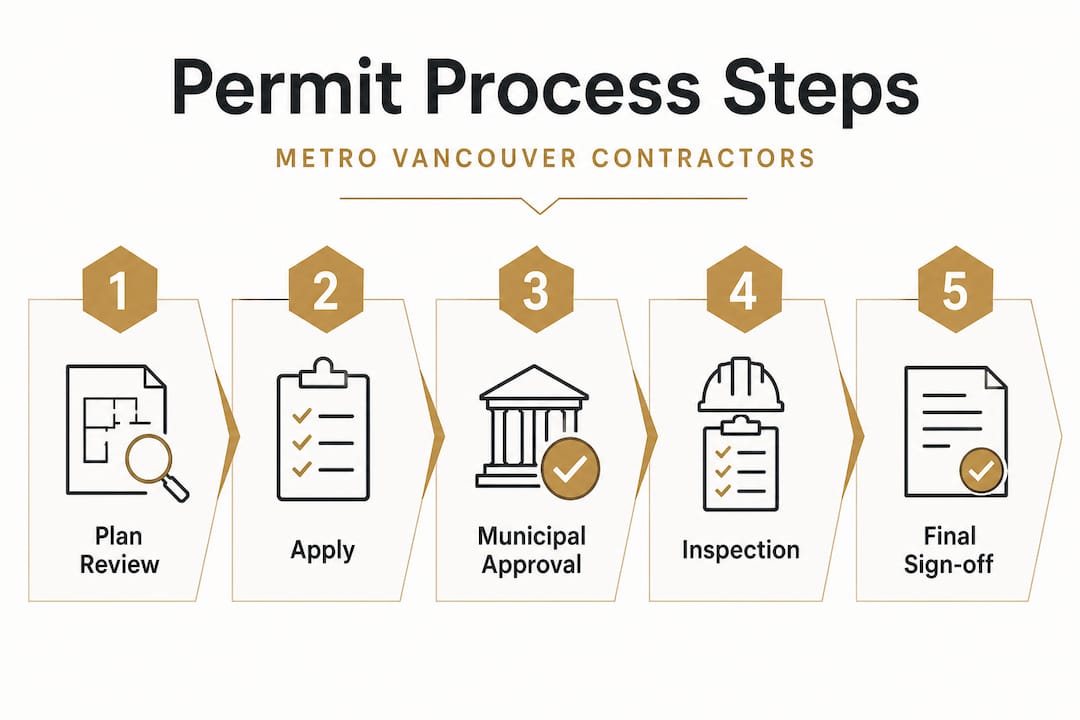
Here is a realistic, step-by-step look at what a competent contractor manages during the permit process:
- Initial permit assessment. Before any construction begins, the contractor reviews your project plans and identifies every permit required. This includes building permits, electrical permits, plumbing permits, and any required development variance permits if the project involves zoning considerations.
- Document preparation. The contractor coordinates with architects, structural engineers, and mechanical designers to compile the full permit package. This typically includes site plans, floor plans, elevations, mechanical drawings, and completed municipal application forms.
- Application submission. The contractor submits the full package to the correct municipal building department. In Metro Vancouver, many cities now use online portals, but requirements for stamped drawings and supporting documentation still vary by jurisdiction.
- Application tracking and responding to queries. City plan checkers routinely issue comments requesting clarifications or revisions. A responsive contractor turns these around quickly, which is often the difference between a four-week review and a four-month one.
- Inspection scheduling and coordination. Once permits are issued, specific inspections are required at defined stages of construction: footings, framing, insulation, electrical rough-in, plumbing rough-in, and final occupancy. Your contractor schedules these inspections, ensures the work is ready, and accompanies the inspector to address any field issues on the spot.
- Deficiency resolution. If an inspector notes a deficiency, a capable contractor resolves it quickly and books a re-inspection without dragging the timeline out further.
Because general contractors integrate permit handling as a core part of their workflow, owners benefit from a single point of accountability. You are not chasing two different parties when a question arises about whether an inspection has been booked or a query has been answered.

The advantages of hiring a licensed contractor extend specifically to permit management. Licensed contractors carry the professional credentials that municipalities require to pull permits, and they carry liability insurance that protects owners if something goes wrong during the process.
Pro Tip: When interviewing contractors, ask specifically about their permit history. Request examples of recent projects in the same municipality as yours and ask whether they have ever had a stop-work order issued and how they resolved it. The answers reveal a lot about their operational discipline.
Contractors vs. permit expediters: How Metro Vancouver is different
In larger North American cities, a separate industry of permit expediters has developed. These are firms or individuals who specialize purely in navigating building department processes. They know the clerks, they understand submission requirements, and they can sometimes accelerate review times through familiarity with the system. They do not, however, manage construction.
In Metro Vancouver, permit handling is integrated by general contractors rather than delegated to standalone specialists. The practical result is that your contractor is responsible for both building your project and getting it legally approved. That integration has real advantages, but it also concentrates significant responsibility in one party.
| Factor | General contractor (Metro Vancouver) | Standalone permit expediter |
|---|---|---|
| Handles permit filing | Yes, as part of full service | Yes, as their only service |
| Coordinates with design team | Yes, directly | Limited, depends on contract |
| Responds to city queries | Yes, with technical knowledge | Yes, but without build context |
| Manages inspections | Yes, on-site with inspectors | No, typically not involved |
| Cost structure | Included or clearly itemized | Separate fee, $1,000 to $5,000+ |
| Availability in Metro Vancouver | Common | Rare to nonexistent |
| Risk if issues arise | One accountable party | Coordination gaps between firms |
"For Vancouver projects, hiring a reputable contractor means you won't need a separate expediter. The contractor's construction knowledge actually accelerates the permit process because they can answer technical questions from plan checkers on the spot."
The contractor-led model works well when you select a contractor with demonstrable permit experience in your specific municipality. It creates friction when owners choose contractors primarily on price and discover the firm lacks familiarity with local permitting nuances. Reviewing the track records of construction companies in Vancouver before signing a contract is time well spent.
Understanding this structural difference between Metro Vancouver and other markets helps set realistic expectations. You will not find a permit expediter to hire separately for most residential or commercial projects here. Your contractor is your permitting partner, full stop.
How to choose and partner with the right contractor for permit success
Selecting a contractor purely on the basis of their construction portfolio is not enough. You need to evaluate their permit management capability as a distinct, measurable skill set. Here is how to approach that selection process effectively.
What to ask and verify before signing:
- Request a list of projects completed in the same municipality, along with permit numbers you can verify with the city
- Ask for the name and role of the person on their team who will be your primary city liaison during the permit process
- Confirm whether permit application fees are included in their contract price or billed separately as a disbursement
- Ask how they communicate permit status updates and how frequently you can expect to hear from them
- Request client references specifically about their experience with the permit and inspection process, not just the finished construction
The future of commercial construction in Metro Vancouver involves increasingly complex projects with more layers of municipal oversight. Contractors who invest in permit management systems, digital tracking tools, and city relationships are better positioned to deliver those projects on schedule.
Budget planning is another area where permit handling has direct impact. Permit fees in Metro Vancouver are calculated based on the construction value of the project, and they vary considerably between municipalities. These fees can run from a few thousand dollars for a small renovation to tens of thousands for a new commercial build. Understanding current renovation costs in Vancouver includes accounting for these permit fees as a real project cost, not an afterthought.
Pro Tip: Build permit timelines directly into your contract. Specify what happens if permit approval takes longer than projected, how carry costs will be handled, and what the contractor's obligation is to keep the application active and responsive. Leaving this undefined creates disputes later.
The best contractor relationships are built on transparency. You should receive regular updates on permit status without having to ask. If your contractor is not proactively communicating about where your application stands, that is a signal worth paying attention to.
Partnerships work best when owners stay engaged. Review every permit condition that gets issued and ask your contractor to explain any that are unclear. Those permit conditions are legal requirements for your project, and understanding them protects you as much as it protects the contractor.
Our take: What property owners overlook about permits and contractors
Here is an uncomfortable reality that does not get discussed often enough: not every contractor understands every city's permitting quirks, even if they've been building in Metro Vancouver for years. Each municipality updates its bylaws, changes its submission requirements, and adjusts its review processes. A contractor who handled permits flawlessly in Surrey three years ago may be out of step with current Burnaby requirements today.
Because general contractors handle permits as an integrated part of their services, many owners assume this means their contractor is automatically current on all local requirements. That assumption is worth testing. Ask directly: when did they last pull a permit in your specific city? Who on their team tracks bylaw updates?
Vancouver's lack of a dedicated permit expediter market shifts a layer of risk onto you as the owner. You cannot outsource permitting to a third-party specialist the way you might in another city. Your contractor carries it all, which is efficient when it works and problematic when it doesn't. That reality should sharpen your selection criteria.
We've seen the pattern clearly through our own Metro Vancouver project management experience: the builds that run smoothly are the ones where owners stay active participants. They check in on permit status. They push for timelines to be documented in the contract. They ask follow-up questions when an inspection result is vague. They don't simply trust that the experts have it handled.
"The most successful builds we've seen blend proactive owners with permit-savvy contractors."
That is not a cliche. It reflects a consistent pattern. Owners who engage during the permit phase catch errors earlier, avoid expensive design changes mid-construction, and end up with cleaner project records that serve them well when they sell or refinance. Staying informed is not micromanaging. It is sound project governance.
Start your permit-ready project with expert guidance
Metro Vancouver's permitting environment rewards owners who choose their contractor carefully and stay engaged throughout the approval process.

At Multigroup Contracting, we manage permits as a fully integrated part of every project we deliver, from initial application through final inspections. Our team knows the specific requirements of cities across Metro Vancouver, maintains active relationships with building departments, and keeps clients informed at every step. Whether you're planning a commercial tenant improvement, a retail buildout, or a residential renovation, the right contractor makes the permit process straightforward rather than stressful. Reach out to our team for a consultation and get clear guidance on the next steps for your specific project goals.
Frequently asked questions
Do general contractors in Metro Vancouver always handle permits?
Yes, most general contractors in Metro Vancouver include permit handling as part of their core services. Dedicated permit expediters are rare in this market, so your contractor is your primary permit resource.
What documents does my contractor need for a building permit application?
Typical documents include architectural drawings, site plans, structural engineering reports, mechanical drawings, and completed municipal application forms. Requirements vary by city and project type.
How long does the permit process usually take?
Processing times vary widely, from a few weeks for straightforward residential renovations to several months for complex commercial projects. Permit timelines depend on the municipality, project complexity, and how quickly your contractor responds to city queries.
Can I file for permits myself instead of using a contractor?
Property owners can apply directly, but most find that experienced contractors reduce errors and delays significantly. A contractor's technical knowledge also helps when building departments request clarifications during the review.