

TL;DR:
- Construction scheduling systematically organizes tasks, resources, and timelines to ensure projects finish on time and within budget. Effective scheduling reduces delays by up to 65%, using methods like CPM, LOB, or blended approaches for different project types. Modern tools like 4D BIM and disciplined planning improve coordination, predictability, and communication across teams.
Construction scheduling is the structured process of organising tasks, resources, and timelines to deliver a project on time and within budget. Without it, even well-funded builds fall apart. Schedule failures cost the Canadian industry $5.2 billion annually, with 71% of projects finishing late by an average of 4.7 months. For project managers, contractors, and property developers working in Metro Vancouver and across BC, this guide to scheduling construction projects covers the methods, tools, and execution steps that separate reliable delivery from costly overruns.
What is construction scheduling and why does it matter?
Construction scheduling is defined as the systematic coordination of work sequences, trade handoffs, resource allocation, and time to complete a project as planned. The industry term is "schedule control," and it goes well beyond a simple Gantt chart on a wall. A schedule is the key communication tool that tells every party what work needs doing, by whom, and when. It also forecasts the impact of changes and disruptions before they become crises.
The role of scheduling in construction is not administrative. It is operational. A poorly built schedule creates cascading delays: a late concrete pour pushes the framing crew, which delays mechanical rough-in, which stalls the drywall trade. In BC, permitting timelines add another layer of complexity. The City of Vancouver and surrounding Metro municipalities each have their own review cycles, and a schedule that ignores permit lead times is built on false assumptions from day one.
Structured schedule control frameworks reduce delays by up to 65% and improve trade coordination by 80%. Those are not marginal gains. They represent the difference between a project that closes on time and one that burns through contingency reserves and damages client relationships.
What are the main scheduling methods used in construction?
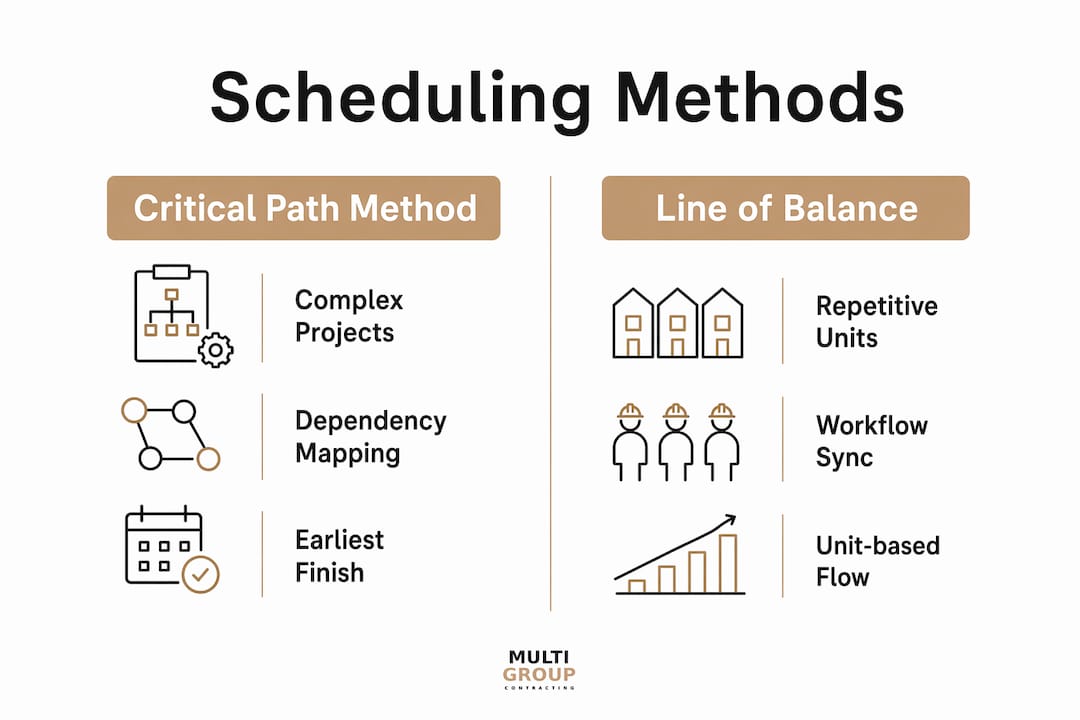
Two methods dominate construction project management: the Critical Path Method (CPM) and Line of Balance (LOB). Choosing between them depends on project type and complexity.
Critical Path Method (CPM)
CPM maps every activity in a project, identifies dependencies between them, and calculates the longest sequence of tasks that determines the earliest possible completion date. That sequence is the critical path. Any delay on a critical path activity delays the entire project. CPM is standard for complex commercial and industrial projects where activities are highly interdependent, such as a multi-storey office renovation or a warehouse conversion in Burnaby.
Line of Balance (LOB)
LOB is preferred for repetitive unit-based construction, such as high-rise residential towers or multi-unit strata developments. It tracks the rate of production across identical or similar units rather than mapping individual task dependencies. A developer building 80 suites in Richmond benefits from LOB because it shows whether each trade is maintaining the pace needed to hand off to the next crew on schedule.
Blended approaches and probabilistic scheduling
Many teams now blend CPM for the master schedule and LOB for repetitive workflows within the same project. This combination gives project managers a complete picture: the overall critical path plus the production rhythm of repetitive tasks. Traditional CPM schedules succeed only 40–50% of the time in predicting actual completion dates. Probabilistic scheduling using Monte Carlo simulations improves that accuracy to 80–85% by incorporating duration uncertainty, resource constraints, and historical data.
Pro Tip: Run a Monte Carlo simulation on your CPM schedule before presenting a completion date to a client or lender. It takes the guesswork out of confidence intervals and gives you a defensible range rather than a single date that may prove wrong.
| Method | Best suited for | Key advantage |
|---|---|---|
| CPM | Complex commercial and industrial builds | Identifies critical dependencies clearly |
| LOB | Repetitive unit construction (high-rises, strata) | Tracks production rate across identical units |
| Blended CPM + LOB | Mixed-use or phased projects | Combines dependency mapping with production rhythm |
| Probabilistic (Monte Carlo) | High-risk or large-scale projects | Improves completion date accuracy to 80–85% |
Which tools support effective construction scheduling in 2026?
Digital scheduling tools have moved well beyond spreadsheets. The most significant advance in 2026 is 4D BIM, which links a 3D building model directly to the project schedule. 4D BIM has become a functional requirement for large-scale Canadian infrastructure and institutional projects. It enables time-based clash detection and real-time visual resource management, which is especially valuable on tight urban sites in Metro Vancouver where crane access, laydown areas, and trade sequencing must be coordinated to the day.
Key capabilities that modern scheduling tools provide:
- 4D BIM integration: Visualise construction sequence week by week, catching spatial conflicts before they occur on site.
- Resource histograms: Display labour and equipment demand over time, revealing peaks that exceed capacity before they cause delays.
- Real-time progress tracking: Connect field data to the schedule so that updates reflect actual site conditions, not last week's assumptions.
- Integration with project management workflows: Link the schedule to RFI logs, submittals, and procurement tracking so that delays in one area automatically flag downstream impacts.
- Cloud-based collaboration: Allow the general contractor, trades, and owner to view the same live schedule, reducing miscommunication across distributed teams.
For smaller commercial renovation projects, such as a retail buildout in Surrey or a coffee shop fit-out in North Vancouver, enterprise-level 4D BIM may be more than the project requires. Mid-range scheduling programs that support CPM logic and resource loading deliver strong results at a proportionate cost. The key is choosing a tool that your team will actually use and update consistently.
How to build and execute a reliable construction schedule
Effective construction timeline planning starts before a single task is entered into software. The preparation stage determines whether the schedule will be reliable or merely optimistic.
Step 1: Define scope and gather prerequisites
Confirm the full project scope, including all drawings, specifications, and BC Building Code requirements. Identify which permits are required and request them as early as possible. In Metro Vancouver, building permit timelines vary by municipality and project complexity. A pre-construction planning phase that accounts for permit lead times prevents the most common cause of early schedule failure.
Step 2: Involve experienced estimators in activity durations
Experienced resources must be involved in the estimating stage to identify accurate activity durations and dependencies. Schedules built without input from the people doing the work suffer from "garbage in, garbage out." A project manager who has never framed a wall should not be assigning framing durations without consulting the framing subcontractor.
Step 3: Build logical sequencing and assign durations
Map every activity, assign realistic durations based on crew size and site conditions, and define dependencies. Avoid the common error of compressing durations to hit a desired end date. Overly optimistic durations are the single most common cause of schedule collapse in the first month of construction.
Step 4: Apply look-ahead planning
Look-ahead planning best practice uses a 4–6 week window divided into three zones: immediate execution (weeks 1–2), final preparation (weeks 3–4), and constraint resolution (weeks 5–6). This keeps the team focused on near-term deliverables while identifying obstacles far enough in advance to resolve them. Rolling wave planning varies detail progressively: hour-by-hour for the next four weeks, daily for weeks 5–8, and weekly thereafter.
Step 5: Monitor, update, and communicate
A schedule that is not updated is not a schedule. It is a historical document. Update progress weekly, compare actual versus planned, and communicate changes to all trades immediately. Pull-planning, where trades collaboratively commit to sequencing and timing, improves schedule reliability to 85%. That collaborative commitment is what turns a plan into a shared accountability tool.
Pro Tip: Build a construction scheduling checklist into your project startup process. A consistent checklist catches missing prerequisites before they become mid-project surprises.
How to manage risks and contingencies within your schedule
Risk management is a continuous process, not a one-time exercise at project kickoff. Successful teams shift from a single risk assessment to ongoing adjustment throughout construction. The schedule is the primary tool for tracking and communicating those adjustments.
Key risk variables that affect construction schedules in BC and across Canada:
- Permitting delays: Municipal review timelines in Metro Vancouver can extend unexpectedly. Build permit milestones into the schedule with buffer, and track them as critical path items.
- Supply chain variability: Long-lead items such as electrical switchgear, glazing systems, and custom millwork require early procurement. Flag these in the schedule and assign procurement deadlines that precede installation dates by a realistic margin.
- Trade coordination and handoff delays: Gaps between subcontractors are a leading cause of lost time. Define handoff criteria clearly in the schedule so that each trade knows exactly what conditions must be met before they can begin.
- Provincial regulatory differences: Working across Canadian provinces involves navigating differing building codes, lien statutes, and safety regulations. Maintain a permit register per province and assume the strictest timelines when planning cash-flow-dependent schedules.
- Labour procurement and eligibility: Labour eligibility and procurement rules heavily influence productivity and schedule reliability. Reducing these constraints improves schedule flexibility and on-site output.
Contingency planning works best when it is tied to specific, identified risks rather than a generic percentage added to the total duration. A 10% schedule contingency applied uniformly tells you nothing about where the risk actually lives. A contingency buffer assigned to the permit review milestone, the glazing delivery window, and the mechanical rough-in handoff tells you exactly where to focus attention.
Key takeaways
Effective construction scheduling requires accurate inputs, the right method for the project type, and continuous updating throughout the build.
| Point | Details |
|---|---|
| Choose the right method | Use CPM for complex commercial projects and LOB for repetitive unit builds; blend both when the project warrants it. |
| Invest in preparation | Involve experienced estimators and confirm permit timelines before building the schedule. |
| Apply look-ahead planning | Use a 4–6 week rolling window to resolve constraints before they delay trades. |
| Manage risk continuously | Assign contingency buffers to specific identified risks, not as a generic percentage. |
| Update and communicate | A schedule updated weekly and shared with all trades is the most reliable project management tool available. |
What I have learned scheduling projects in Metro Vancouver
After working through commercial renovations, tenant improvements, and new builds across Metro Vancouver, the pattern is consistent: the projects that finish on time are the ones where the schedule was treated as a living document, not a submission requirement.
The biggest mistake I see is treating the permit process as something that happens before the schedule starts. In BC, permit timelines are part of the schedule. A development permit, a building permit, and a trade permit each have their own review cycles. If you do not put those milestones on the critical path from day one, you are planning in a vacuum.
The second lesson is about trade communication. A schedule that lives only in the project manager's laptop is not a communication tool. The framing crew, the mechanical contractor, and the electrical sub all need to see the same picture. When trades understand the sequence and their role in it, handoffs happen faster and conflicts surface earlier when they are still cheap to fix.
Modern tools like 4D BIM are genuinely useful for large institutional and infrastructure projects. For a mid-size commercial renovation in Coquitlam or a leasehold improvement in Richmond, the value comes from disciplined CPM scheduling combined with weekly look-ahead meetings. The tool matters less than the discipline behind it.
— MultigroupTeam
Multigroup's approach to construction scheduling in Metro Vancouver
Multigroup brings the same scheduling discipline described in this article to every project it manages across Metro Vancouver, from warehouse renovations in Delta to retail buildouts in Langley.

Permit handling, trade coordination, and timeline management are built into Multigroup's project management process from the first site meeting. For businesses planning a commercial renovation or tenant improvement in Metro Vancouver, Multigroup's team develops a realistic schedule grounded in BC Building Code requirements, local permit timelines, and actual site conditions. Contact Multigroup to discuss your project and get a schedule-driven plan that holds.
FAQ
What is construction scheduling?
Construction scheduling is the process of organising tasks, resources, and timelines to complete a project on time. It serves as the primary communication tool between the general contractor, trades, and owner throughout the build.
What is the Critical Path Method in construction?
CPM identifies the longest sequence of dependent tasks in a project, determining the earliest possible completion date. Any delay on a critical path activity directly delays the project finish date.
How far in advance should look-ahead planning cover?
Best practice uses a 4–6 week look-ahead window, with the first two weeks focused on immediate execution and weeks five and six focused on resolving upcoming constraints before they affect the schedule.
Why do most construction projects finish late?
71% of Canadian construction projects finish late by an average of 4.7 months, most often due to inaccurate duration estimates, poor trade coordination, and permit delays that were not built into the original schedule.
How does 4D BIM improve construction scheduling?
4D BIM links a 3D building model to the project schedule, enabling time-based clash detection and visual resource management. It is now a standard requirement for large-scale Canadian infrastructure and institutional projects.