

TL;DR:
- In Metro Vancouver, the most reliable alternative to desakota.ca for commercial projects is hiring a local licensed general contractor who manages permits, schedules, and quality.
- Contractor-matching platforms are quick but lack permit support, while referral networks offer leads but require thorough vetting.
- A licensed local GC ensures compliance, reduces delays, and provides end-to-end project management for tenant improvements and renovations.
For most commercial and residential projects in Metro Vancouver, the best alternatives to desakota.ca fall into three practical routes: contractor-matching platforms, referral networks and trade associations, and direct licensed general contractors. Of these, hiring a local licensed general contractor with end-to-end project management is the strongest choice for property managers, business owners, and developers who need BC Building Code compliance, WCB coverage, and municipal permit handling built into the contract from day one. Multigroup Contracting is a recommended local option covering the full Metro Vancouver region.
The three routes at a glance:
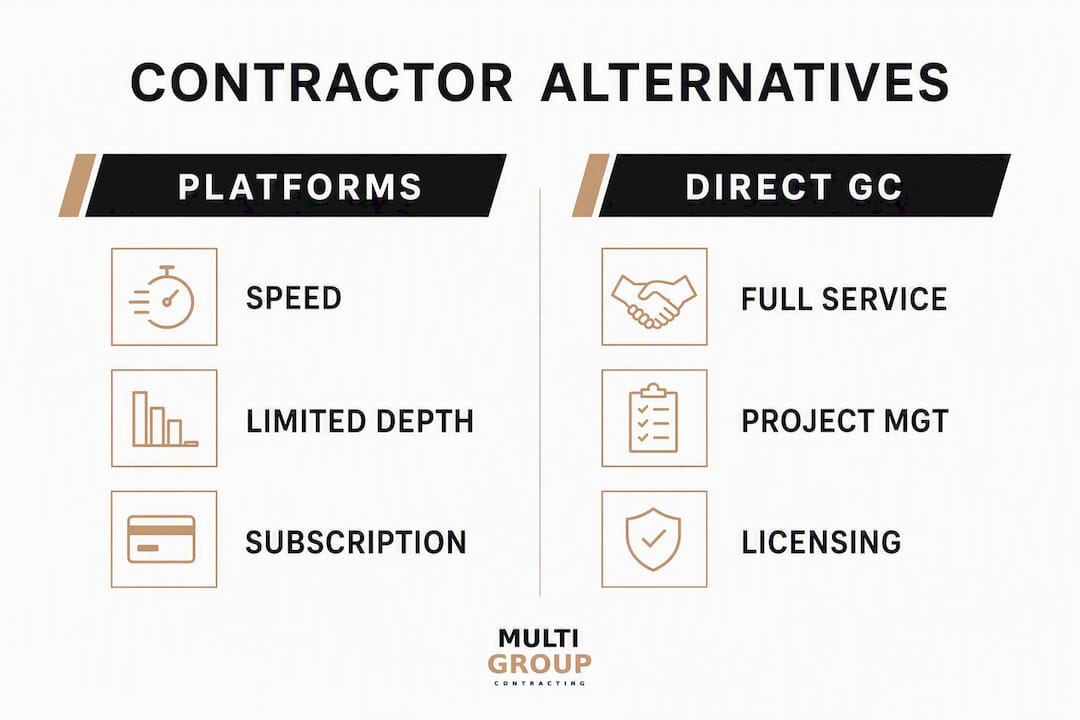
- Contractor-matching platforms: Fast to access, useful for small scopes, but typically limited on permit support and project management depth.
- Referral networks and trade associations: Good for sourcing leads quickly, though vetting responsibility stays with you and written warranties are rarely included.
- Direct licensed general contractors (local GC): The most reliable path for tenant improvements, warehouse renovations, retail buildouts, and commercial renovation Vancouver projects where permits, schedule, and quality all matter.
Table of Contents
- What are the best desakota.ca alternatives for Metro Vancouver?
- How do you vet and choose a licensed contractor in Metro Vancouver?
- What do tenant improvements and warehouse renovations cost in Metro Vancouver?
- Key takeaways
- Why a local licensed general contractor is usually the right call
- Multigroup Contracting as a licensed local alternative
- Useful resources for Metro Vancouver permit and compliance verification
- FAQ
What are the best desakota.ca alternatives for Metro Vancouver?
The table below maps each route against the dimensions that matter most to property managers and developers.
| Category | Best for | Pricing model | Metro Vancouver coverage | Licensing, insurance & permits | Project management | Vetting & reviews | Time to hire |
|---|---|---|---|---|---|---|---|
| Contractor-matching platform | Small TI, quick repairs | Varies by bid | Broad, but inconsistent | Contractor-dependent | Referral only | Platform ratings | 1–3 days |
| Referral network / trade association | Sourcing multiple trades | Varies | Regional | Contractor-dependent | None included | Member directory | 3–7 days |
| Design-build firm | Complex fit-outs needing integrated design | Premium fee | Select firms | Licensed, full permit support | Integrated design + build | Portfolio-based | 1–3 weeks |
| Direct licensed GC (local) | TI, warehouse renovation BC, retail buildout, residential | Fixed-price or GMP | Full Metro Vancouver | Licensed, WCB, liability, BC Building Code, permits | End-to-end | References + portfolio | 1–2 weeks |
Contractor-matching platforms work when speed matters more than depth. For a small office refresh or a single-trade repair, a platform can surface bids quickly. The tradeoff is that permit handling and project management are typically not included, so you coordinate those yourself.
Referral networks and trade associations are useful for sourcing candidates, but they rarely provide end-to-end project management or written warranties. Leads still require full vetting on your side before you sign anything.
Design-build firms integrate design and construction under one contract, which can close scope gaps on complex restaurant or medical fit-outs. That integration comes at a premium, making design-build less cost-effective for straightforward tenant improvements.
Direct licensed general contractors offer the most complete package for commercial renovation Vancouver and warehouse renovation BC projects. A local GC handles permits, manages subtrades, carries WCB clearance and commercial liability insurance, and delivers a written contract with a warranty. For phased or multi-unit TI projects, a GC with proven scheduling capacity in Metro Vancouver reduces handover delays significantly.
How do you vet and choose a licensed contractor in Metro Vancouver?
The most reliable selection method combines a documented vetting checklist with a pre-bid site visit and a written contract that specifies permits, BC Building Code compliance, and warranty terms. Skipping any one of these steps is where cost overruns and schedule slippage typically originate.
Vetting checklist:
- Confirm BC contractor licence and registration.
- Request a current WCB clearance letter and commercial liability insurance certificate.
- Review a project portfolio with at least three comparable Metro Vancouver projects.
- Confirm the GC handles permit applications and plan check submissions directly.
- Ask for the GC's current work-in-progress (WIP) to assess capacity.
- Clarify which subtrades are in-house versus subcontracted, and how subs are vetted.
- Confirm a written warranty and the process for warranty remedies.
Questions to ask during pre-qualification:
- What are your insurance limits, and can you provide a certificate naming us as additional insured?
- Which municipality will you pull permits from, and what is your typical plan check timeline?
- How do you handle change orders, and what triggers a change order versus a scope clarification?
- Can you provide three recent client references for comparable projects in Metro Vancouver?
Red flags to watch for:
- No permit plan or a vague answer about who handles permits.
- All-cash payment requests or no staged payment schedule.
- Scope described in general terms with no written breakdown.
- Absent or unverifiable references.
- No WCB clearance or proof of liability insurance.
Contract requirements to confirm before signing:
- Fixed-price, GMP (guaranteed maximum price), or unit-rate structure clearly stated.
- Payment schedule tied to project milestones, not calendar dates.
- Lien holdback in compliance with BC's Builders Lien Act.
- Warranty period, scope, and remedy process in writing.
- Completion definition and substantial performance criteria.
Pro Tip: Request a pre-bid site walk with each shortlisted contractor. Site conditions, such as existing MEP routing, asbestos, or structural constraints, materially change cost estimates. A contractor who walks the site before bidding will produce a far more accurate proposal and generate fewer change orders once work begins.
What do tenant improvements and warehouse renovations cost in Metro Vancouver?
Expect wide ranges, but the figures below serve as reliable planning benchmarks for budgeting and RFP scoping. Permit scope, MEP complexity, existing site conditions, and finish level are the primary cost drivers.
| Project type | Typical cost range (CAD) | Typical timeline |
|---|---|---|
| Small tenant improvement (TI) under 2,000 sq. ft. | For planning, consult a licensed general contractor to obtain a tailored cost estimate; price per square foot varies based on scope and complexity | 6–12 weeks |
| Mid-size retail fit-out (2,000–7,500 sq. ft.) | For planning, consult a licensed general contractor to obtain a tailored cost estimate; price per square foot varies based on scope and complexity | 10–18 weeks |
| Restaurant / coffee shop renovation | For planning, consult a licensed general contractor to obtain a tailored cost estimate; price per square foot varies based on scope and complexity | 12–20 weeks |
| Warehouse renovation BC (racking + MEP upgrades) | For planning, consult a licensed general contractor to obtain a tailored cost estimate; price per square foot varies based on scope and complexity | 10–20 weeks |
| High-end residential interior | For planning, consult a licensed general contractor to obtain a tailored cost estimate; price per square foot varies based on scope and complexity | 16–30 weeks |
Cost driver note: Mechanical and electrical complexity, hazardous material remediation (asbestos, lead), and custom millwork are the items most likely to push a project toward the top of its range. Warehouse renovations that include MEP upgrades require coordination with industrial racking suppliers and mechanical contractors, which extends schedules beyond what structural-only scopes require.
Permit timelines add to the schedule. In Metro Vancouver, a standard commercial permit can take 4–10 weeks depending on the municipality and project complexity. Hiring a local licensed GC with established municipal contacts reduces that friction. For construction scheduling in Metro Vancouver, building permit lead time into the project timeline from the outset prevents downstream delays.
For prequalification to contract signing, budget 2–4 weeks when running a proper three-bid process with comparable scope documents.
Key takeaways
For most Metro Vancouver projects, a direct licensed general contractor with end-to-end project management, permit handling, and BC Building Code compliance is the most reliable alternative to desakota.ca.
| Point | Details |
|---|---|
| Local licensed GC is the top choice | Covers permits, WCB, BC Building Code, and project management under one contract. |
| Vetting checklist is non-negotiable | Confirm licence, WCB clearance, insurance, portfolio, and written warranty before signing. |
| Request three comparable bids | Identical scope documents reveal outlier pricing and missing items across proposals. |
| Cost ranges vary by project type | Costs for small TI and warehouse renovation BC projects vary significantly depending on scope, finishes, and MEP complexity—obtain a tailored quote from a licensed general contractor. |
| Multigroup Contracting covers Metro Vancouver | Handles TI, warehouse renovation, retail buildout, and commercial renovation Vancouver end-to-end. |
Why a local licensed general contractor is usually the right call
Contractor-matching platforms and referral networks have their place, but they transfer coordination risk back to the client. Permit applications, trade scheduling, BC Building Code interpretation, and inspection management all require someone accountable on site. A licensed local GC absorbs that accountability.
Local knowledge matters more than it sounds. Municipal plan check expectations differ between the City of Vancouver, Burnaby, Surrey, and Richmond. A GC with an established track record across Metro Vancouver municipalities knows which details trigger re-submissions and which inspection sequences can run concurrently. That experience shortens permit timelines in ways a platform-sourced contractor from outside the region cannot replicate.
End-to-end project management also protects the budget. Property managers who prioritise permit handling and predictable timelines over the lowest bid consistently see better outcomes. The cheapest bid often omits permit costs, hazard remediation allowances, or a realistic contingency, and those omissions surface as change orders mid-project.
Multigroup Contracting's workflows are built around this reality. Tenant improvements, warehouse renovation BC, retail buildouts, and commercial renovation Vancouver projects each follow distinct prequalification and scheduling processes, with permit handling and lien holdback compliance built into every contract.
Multigroup Contracting as a licensed local alternative
Multigroup Contracting delivers licensed general contracting and full project management for tenant improvements, retail buildouts, office renovations, and warehouse renovations across Metro Vancouver, including Burnaby, Richmond, Surrey, Coquitlam, North Vancouver, West Vancouver, New Westminster, Langley, and Delta.
Every project includes permit application and management, BC Building Code compliance, WCB clearance, staged payment schedules, and a written warranty. For tenant improvements and warehouse renovation BC projects specifically, Multigroup uses distinct scoping and scheduling workflows tailored to the project size and municipality. The first step is a site review, where scope, permit requirements, and budget parameters are confirmed before any proposal is issued.
To request a site review or submit an RFP, visit multigroup.ca and connect with the project team directly.
Useful resources for Metro Vancouver permit and compliance verification
Before issuing an RFP or signing a contract, confirm permit requirements and insurance obligations through these authoritative sources:
- City of Vancouver Development and Building Services: Check permit application requirements, processing timelines, and occupancy classifications for Vancouver projects.
- BC Building Code (Province of BC): The governing code reference for structural, fire separation, mechanical, and accessibility requirements on all BC construction projects.
- WorkSafeBC: Confirm WCB registration requirements, clearance letter procedures, and employer obligations for construction sites in BC.
- City of Burnaby Building Division: Permit portal for Burnaby commercial and residential projects.
- City of Surrey Building Permits: Permit applications and inspection scheduling for Surrey projects.
Keep WCB clearance letters, liability insurance certificates, and municipal permit confirmations in your vetting file for every contractor you shortlist.
FAQ
What are the main alternatives to desakota.ca for Metro Vancouver?
The three main routes are contractor-matching platforms, referral networks or trade associations, and direct licensed general contractors. For projects requiring permits, BC Building Code compliance, and end-to-end project management, a local licensed GC is the most complete option.
How do I verify a contractor is licensed and insured in BC?
Request the contractor's BC licence number, a current WCB clearance letter, and a commercial liability insurance certificate naming you as additional insured. WorkSafeBC's online clearance tool lets you verify WCB status directly.
What does a tenant improvement typically cost in Metro Vancouver?
Cost varies by project and is best determined in consultation with a licensed general contractor, since MEP complexity, finish level, and municipal requirements influence pricing.
Does Multigroup Contracting handle permits for commercial projects?
Yes. Multigroup manages permit applications, plan check submissions, and inspection coordination as part of its standard project management process for commercial renovation Vancouver and warehouse renovation BC projects.
How long does it take to hire a licensed GC in Metro Vancouver?
Running a proper three-bid process with a pre-bid site walk typically takes 2–4 weeks from prequalification to contract signing, with permit timelines adding 4–10 weeks to the overall project schedule depending on the municipality.