
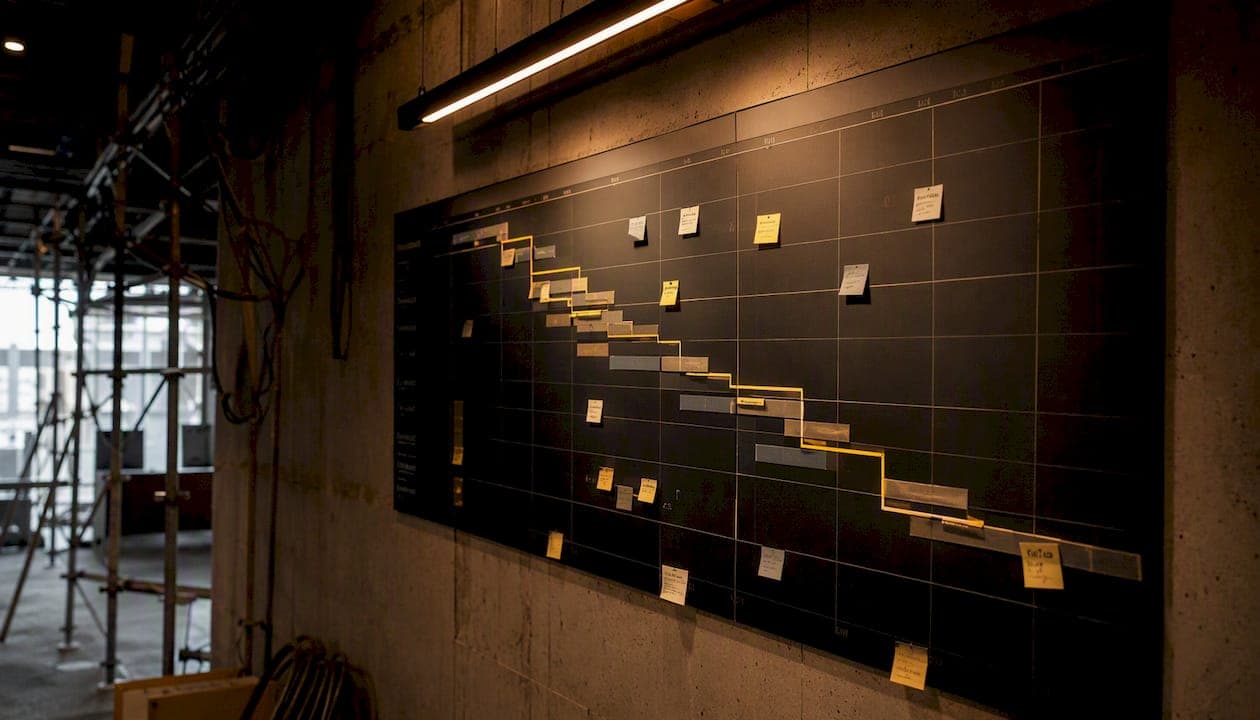
Construction schedule acceleration is a deliberate, targeted effort to shorten project duration by changing sequence, resources, or methods. Use it only when the critical-path gain justifies the cost, safety, and quality trade-offs involved. That decision rule matters more than any specific technique.
Before committing to an acceleration plan, run through this three-point check:
- Value driver confirmed: Early completion delivers a measurable benefit — avoided liquidated damages, earlier revenue, or a contractual incentive that outweighs the premium cost.
- Critical path confirmed: The activities you plan to shorten actually sit on the critical path. Accelerating float-rich activities wastes money and changes nothing on the delivery date.
- Client and contract aligned: The owner has either directed acceleration in writing or agreed to fund it. Proceeding without that alignment creates a constructive acceleration risk.
Once those three boxes are ticked, run a quick crash analysis on your baseline schedule. Calculate the cost per day saved for your top three critical-path candidates and produce a single recommendation: proceed, plan further, or reject. If acceleration follows an excusable delay you have not yet been compensated for, trigger your notice obligations immediately before spending a dollar on premium resources. The contract and legal section below covers that step in detail.
Pro Tip: Lock your baseline schedule before any acceleration work begins. An unlocked or revised baseline makes it nearly impossible to prove what changed, what it cost, and why — the three things you need if the claim goes to arbitration.
Key takeaways
Effective construction schedule acceleration requires confirmed critical-path analysis, a realistic time–cost trade-off calculation, and contemporaneous documentation from day one to protect both schedule control and claims entitlement.
| Point | Details |
|---|---|
| Confirm the critical path first | Accelerating float-rich activities wastes budget and does not move the completion date. |
| Run the crash analysis before spending | Calculate cost per day saved for each candidate activity and compare against the value of early completion. |
| Document notices immediately | Missing a notice deadline under CCDC or project-specific contract terms can extinguish entitlement, as Canadian arbitration practice confirms. |
| Limit overmanning to avoid congestion | Adding labour beyond site capacity reduces productivity; stage crew increases and measure results before scaling up. |
| Protect quality and safety explicitly | Budget for additional supervision, quality checkpoints, and safety controls as mandatory cost lines, not optional extras. |
| Multigroup for Metro Vancouver projects | Multigroup provides crash analysis, prefabrication coordination, and turnkey acceleration delivery for commercial TI and retail buildouts across Metro Vancouver. |
Table of Contents
- What does construction schedule acceleration actually mean?
- How does a recovery plan differ from an acceleration plan?
- Which acceleration techniques actually move the critical path?
- How do you model acceleration and calculate the time–cost trade-off?
- What are the legal and contractual risks of acceleration in Canada?
- What does acceleration actually cost, and how do you manage the risks?
- Step-by-step acceleration plan for project managers
- How do you document and prove acceleration costs if there is a dispute?
- Canadian case studies and what they teach about accelerated delivery
- Why acceleration plans fail more often than they should
- Multigroup's acceleration services for Metro Vancouver projects
- Sources
- FAQ
What does construction schedule acceleration actually mean?
In Canadian construction practice, "acceleration" covers three distinct situations, and mixing them up creates serious contractual exposure. The industry term most practitioners use is accelerated performance, and it sits inside the broader category of schedule management techniques.
Voluntary acceleration
The owner or contractor chooses to finish earlier than the contract requires — typically to capture a market window, avoid seasonal risk, or meet a tenant's opening date. No one is directing it; no excusable delay triggered it. Cost is borne by whoever benefits, and there is no entitlement claim against the other party.
Directed acceleration
The owner issues a written instruction to shorten the schedule. This is the cleanest scenario legally: the directive is documented, the contractor prices the premium, and both parties sign a change order. Most standard Canadian contract forms (CCDC 2, for example) contemplate this through their change-directive provisions.
Constructive acceleration
This is where disputes arise. Constructive acceleration occurs when an owner refuses or ignores a valid extension-of-time request, then continues to hold the contractor to the original completion date. The contractor, facing liquidated damages, speeds up at its own expense — and later claims the cost. Canadian claims practice emphasises that courts and arbitrators treat the doctrine cautiously: you must prove each element, and contemporaneous records are the difference between a successful claim and an expensive loss.
The six-step constructive acceleration checklist used in claims literature requires proof of:
- An excusable delay that entitled the contractor to a time extension
- Timely notice of that delay given to the owner
- A denied or ignored extension-of-time request
- Owner direction (explicit or implied) to finish within the unextended time
- Contractor notice that it considers the owner's conduct a directive to accelerate
- Actual acceleration performed and documented costs incurred
Pro Tip: Check your contract for three things before any acceleration discussion: the time-of-the-essence clause, the notice window for delay claims (often 7–10 days under CCDC forms), and the extension-of-time procedure. Missing a notice deadline can extinguish entitlement entirely, regardless of how strong the underlying delay claim is.
How does a recovery plan differ from an acceleration plan?
Project managers often conflate these two, and the confusion is costly. A recovery plan and an acceleration plan have different objectives, different cost profiles, and different stakeholder expectations.
A recovery plan aims to bring a delayed project back to the original contract completion date using resources already on site or available at standard rates. Typical tactics include re-sequencing activities to exploit float, tightening subcontractor coordination, eliminating non-productive time, and pulling forward activities that were scheduled conservatively. The cost premium is modest — often absorbed within the project contingency — and the owner's involvement is minimal unless the delay was their fault.
An acceleration plan goes further. It targets a completion date earlier than the current forecast, or recovers time that cannot be recovered through re-sequencing alone. It requires premium resources: overtime, additional crews, shift work, prefabricated components, or expedited procurement. The cost is real and material, and it needs owner buy-in before work begins.
Use this decision checklist to pick the right approach:
- Recovery plan is enough when: Float exists on near-critical paths; re-sequencing can absorb the delay; the cost of premium resources exceeds the value of early completion; the delay is contractor-caused and no incentive applies.
- Acceleration plan is warranted when: The critical path has no remaining float; liquidated damages exceed the acceleration premium; the owner has offered an early-completion bonus; a tenant's opening date or a regulatory deadline makes early delivery non-negotiable.
Recovery actions include pulling float from non-critical activities, tightening delivery windows, and re-sequencing mechanical and electrical rough-in to run concurrently with framing. Acceleration actions include crashing critical-path activities with overtime, fast-tracking design and construction to overlap phases, and substituting prefabricated assemblies for site-built work. The construction project management workflow guide from Multigroup covers re-sequencing logic in more detail for Metro Vancouver commercial projects.
Which acceleration techniques actually move the critical path?
Acceleration is a resource-optimisation problem, not simply a matter of working harder. The techniques below each carry a different speed, cost, and risk profile. The right shortlist depends on your project type, site capacity, and how much of the critical path each technique can realistically shorten.
Crashing (overmanning and overtime)
Adding labour or equipment to critical-path activities to compress their duration. Overtime — typically 10-hour days or weekend shifts — is the fastest technique to deploy but produces diminishing returns quickly. Beyond roughly 50–60 hours per week, productivity per hour drops and error rates climb. Overmanning compounds the problem when site space limits how many crews can work simultaneously without interfering with each other.
Fast-tracking (overlapping phases)
Starting construction before design is complete, or beginning later trades before earlier ones finish. Fast-tracking can shorten the overall schedule significantly, but it transfers design risk to the field: if drawings change after construction begins, rework costs can exceed the time savings. It works best on projects with well-defined scope and experienced design teams.
Multiple shifts
Running day and night shifts effectively doubles productive hours without adding congestion. The cost premium includes shift differentials, additional supervision, lighting, and security. Quality handover between shifts needs a formal protocol — a night crew that does not know what the day crew left unfinished is a rework risk.
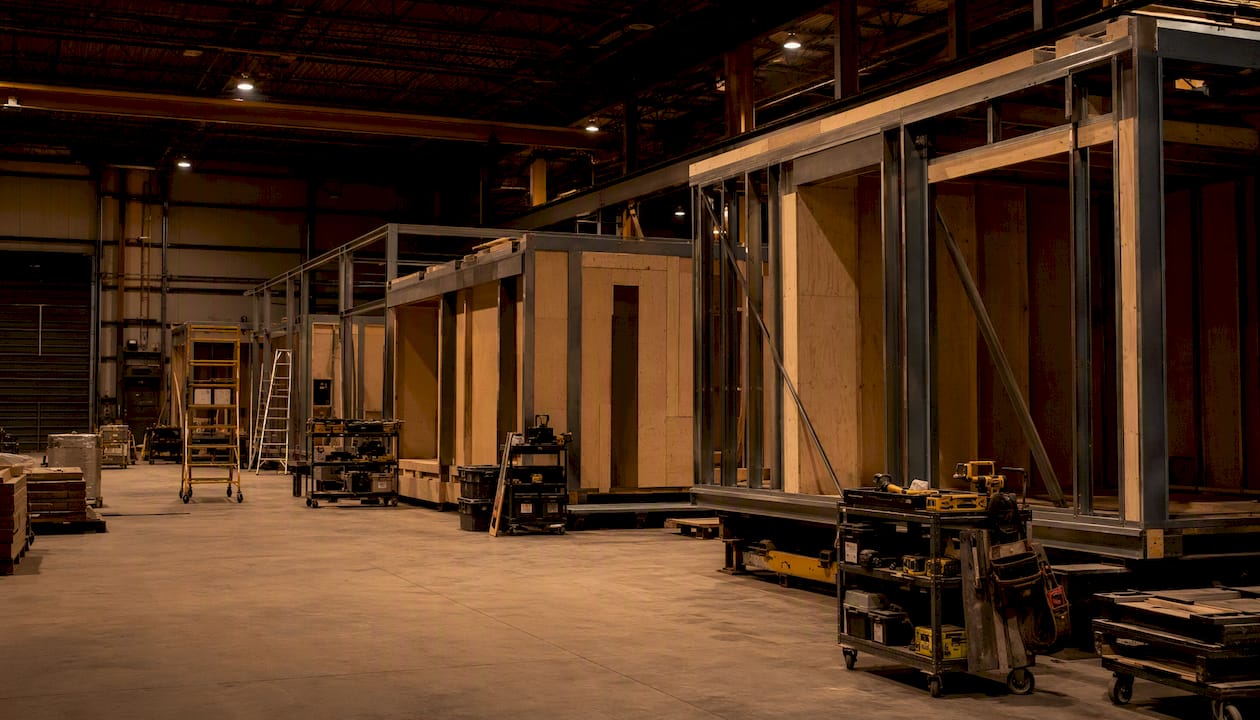
Prefabrication and modular construction
Moving work off site into a controlled factory environment reduces field time, weather exposure, and site congestion. A University of Alberta case study found offsite prefabrication reduced project duration, lowered costs, and cut carbon emissions compared with conventional stick-built methods — though those figures come from a single project and will vary by scope and site conditions. In Metro Vancouver and across BC, prefabrication carries an additional advantage: assemblies fabricated indoors are unaffected by rain delays and winter shutdowns that routinely add weeks to exposed site work.
Early procurement and long-lead buy
Ordering structural steel, mechanical equipment, glazing systems, and other long-lead items before design is finalised compresses the procurement-to-delivery gap. The risk is scope change after purchase orders are placed. Mitigate it by locking the scope of long-lead items first and designing around them.
Subcontractor premium packages
Negotiating accelerated mobilisation, extended hours, or dedicated crews with key subcontractors. This works when the subcontractor has capacity and the relationship supports a frank conversation about what acceleration actually costs them. Automated subcontractor coordination tools can help general contractors track commitments and flag coordination conflicts before they become delays.
Equipment augmentation and parallel work zones
Adding cranes, hoists, or material handling equipment to reduce wait times, or dividing the site into parallel work zones so multiple trades advance simultaneously. Both approaches require careful traffic and logistics planning to avoid congestion that negates the speed gain.
The table below compares these techniques across the dimensions that matter most for project selection.
| Technique | Speed gained | Cost premium (approx.) | Quality/rework risk | Safety/supervision needs | Best suited for | Lead time to implement |
|---|---|---|---|---|---|---|
| Crashing (overtime) | Low–moderate | 15% on affected scope | Moderate (fatigue-related errors) | Elevated; more supervision required | Any project type; short bursts | Days |
| Fast-tracking | Moderate–high | 10% on affected scope | High if scope not locked | Standard; design coordination critical | Commercial TI, phased builds | Weeks (design alignment) |
| Multiple shifts | Moderate–high | 20% on affected scope | Moderate (handover risk) | High; dedicated shift supervision | Large-footprint projects | 1–2 weeks |
| Prefabrication/modular | High | Variable; can reduce total cost | Low (factory QC) | Lower on site | Repetitive elements, cold-climate projects | 4 weeks (fabrication lead) |
| Early procurement | Moderate | 5–15% (expediting fees) | Low if scope locked | Standard | All project types | Weeks to months |
| Subcontractor premium packages | Moderate | 10–20% on sub scope | Low–moderate | Standard | Projects with key sub dependencies | Days to weeks |
| Equipment augmentation | Low–moderate | 5–15% on affected scope | Low | Moderate | Large sites with material handling constraints | Days |
| Parallel work zones | Moderate | 10–20% (coordination overhead) | Moderate (interface risk) | Elevated; zone coordination | Large floor-plate or multi-building projects | 1–2 weeks |
A critical caution: research on repetitive project scheduling confirms that accelerating non-critical activities is a common and expensive error. Target only activities on the confirmed critical path, and re-check the path after each change — acceleration on one chain can shift the critical path to a previously non-critical sequence.
How do you model acceleration and calculate the time–cost trade-off?
The analytic work happens before the first overtime dollar is spent. Follow these steps in order.
-
Verify and lock the baseline schedule. Confirm the baseline reflects the current contract scope, approved changes, and actual progress to date. A construction scheduling checklist helps confirm the baseline is complete before you start modelling. An unverified baseline produces unreliable crash calculations.
-
Identify the critical path and near-critical activities. Run a forward and backward pass through the schedule. Flag activities with zero float (critical) and those with five days or fewer of float (near-critical). Near-critical activities can become critical once you start compressing the primary chain.
-
Calculate crash cost and crash time for each candidate activity. For each critical-path activity, determine: normal duration, crash duration (the minimum achievable), normal cost, and crash cost. The cost slope — cost per day saved — is: (Crash Cost minus Normal Cost) divided by (Normal Duration minus Crash Duration).
-
Rank activities by cost slope, lowest first. Compress the cheapest activity first, then re-run the critical path. A new critical path may emerge. Continue compressing the cheapest available critical activity until the target duration is reached or the marginal cost per day saved exceeds the stakeholder value of one day's early completion.
-
Combine fast-tracking where crashing alone is insufficient. Overlapping design and construction phases can shorten the schedule without the same labour cost premium as crashing. Model the overlap carefully: identify the dependency between the design deliverable and the construction start, and quantify the rework risk if the design changes after construction begins.
-
Check site capacity and subcontractor availability. A safety-centric time–cost trade-off framework developed at the University of Alberta extends traditional crash analysis to include safety hazard controls as a cost line. Budget those controls explicitly — they are not optional when you add crews and compress timelines.
A simplified crash calculation for a single activity looks like this. Suppose a mechanical rough-in activity has a normal duration of 15 days at $45,000, and can be crashed to 10 days at $63,000. The cost slope is ($63,000 minus $45,000) divided by (15 minus 10) = $3,600 per day saved. If the value of one day's early completion to the owner is $5,000 (avoided user-cost or liquidated damages), crashing this activity is worth doing up to its crash limit.
Pro Tip: Diminishing returns arrive faster than most PMs expect. Adding a second crew to a confined space rarely delivers half the time saving of the first crew. Model site capacity explicitly — square metres of working space per trade, not just headcount — and set a hard limit on overmanning before you start.
CPM scheduling software with built-in time–cost trade-off modules can automate the ranking and re-path calculations, which is worth the investment on any project where the acceleration premium exceeds $100,000 CAD.
What are the legal and contractual risks of acceleration in Canada?
Canadian construction contracts and arbitration practice impose specific procedural requirements on acceleration claims. Missing a step can extinguish entitlement even when the underlying facts support the claim.
Contract clauses to review before accelerating
- Time-of-the-essence provisions (do they apply to milestones or only to substantial completion?)
- Notice windows for delay and change claims (CCDC 2 requires written notice within a defined period)
- Extension-of-time procedures and the owner's obligation to respond
- Liquidated damages rates and caps
- Acceleration payment terms, if any (some contracts include an explicit acceleration clause)
- No-damage-for-delay clauses, which may limit recovery even when the owner caused the delay
The constructive acceleration risk in practice
The six-step entitlement checklist described earlier is the standard framework Canadian claims practitioners use. The critical procedural step that contractors most often miss is step five: giving written notice that the contractor considers the owner's refusal to grant a time extension as a directive to accelerate. Without that notice, the claim is significantly harder to prove.
That BCCA leave decision is a practical reminder that the project record — daily logs, correspondence, schedule updates, resource records — is the claim. If the record is thin, the claim is thin, regardless of what actually happened on site.
Documentation to preserve entitlement
- Baseline schedule (locked, signed, dated)
- All schedule updates with revision history
- Written delay notices and owner responses
- Extension-of-time requests and denials
- Daily site reports (crew counts, hours, weather, delays, equipment)
- Resource records: time sheets, equipment logs, material delivery receipts
- Meeting minutes showing owner direction or refusal
- Invoices for premium costs (overtime, expediting, subcontractor premiums)
When to escalate and when to negotiate
If the owner has caused excusable delay and refuses to grant a time extension, the formal claims path is available — but negotiation is usually faster and cheaper. The City of Toronto's pilot on cost-plus-time tendering offers a useful model: rather than fighting over acceleration costs after the fact, the municipality structured procurement to include acceleration payments with defined caps, shifting the incentive to early delivery rather than delay disputes. That approach is worth raising with owners on large public-sector projects in Metro Vancouver and across BC.
What does acceleration actually cost, and how do you manage the risks?
Acceleration costs money in ways that are not always obvious at the outset. The direct premium — overtime rates, shift differentials, subcontractor mobilisation fees — is the visible part. The indirect costs are often larger: reduced productivity from congestion, increased supervision, quality failures that require rework, and safety incidents that stop the job entirely.
The City of Toronto municipal review estimated that acceleration payments typically raise capital cost by a premium in the range of 20%–40% in the Toronto context, and recommended clear caps and careful assessment of whether user-cost savings justify the premium.
The productivity relationship is non-linear. Adding labour reduces duration up to a point, then site congestion, crew interference, and coordination overhead start eating into the gains.
Mitigation measures that protect the value of acceleration:
- Staged overmanning: Add crews incrementally and measure productivity before adding more. One extra crew on a critical activity is often enough; two extra crews in the same space frequently produces less than one.
- Buffer activities: Maintain a small buffer of non-critical work that can absorb disruption without affecting the critical path. This gives the schedule resilience when acceleration on one front creates interference elsewhere.
- Enhanced supervision: Every additional crew needs proportional supervision. A foreman managing six trades simultaneously cannot maintain the quality standard that two foremen managing three trades each can.
- Safety controls: Compressed timelines increase incident risk. Budget explicitly for additional safety planning, toolbox talks, and site-specific hazard assessments when adding shifts or crews. The University of Alberta's safety-centric time–cost framework treats safety controls as a mandatory cost line in any acceleration plan.
- Quality checkpoints: Schedule formal quality inspections at defined milestones rather than relying on continuous supervision. A missed defect caught at a checkpoint costs far less than one discovered after enclosure.
- Pilot acceleration on low-risk scope: Before committing the full premium budget, accelerate one low-risk activity or zone first. Measure the actual productivity and cost against the model, then adjust the plan before scaling up.
Step-by-step acceleration plan for project managers
This checklist moves from the decision to accelerate through close-out. Follow the steps in order — skipping ahead creates gaps in both the schedule model and the claims record.
-
Confirm the decision to accelerate. Verify the three-point checklist from the opening section: value driver, critical path, and client/contract alignment. Get written owner sign-off or a change directive before proceeding.
-
Lock the baseline schedule. Date-stamp and archive the current approved baseline. This is the reference point for every subsequent claim, change order, and progress report.
-
Run the crash analysis. Identify critical-path activities, calculate cost slopes, and rank by cost per day saved. Set the target completion date and determine which activities to compress and by how much.
-
Procure premium resources. Issue purchase orders for overtime, additional crews, prefabricated components, or expedited materials. Confirm subcontractor capacity in writing before assuming availability.
-
Negotiate subcontractor acceleration agreements. Before overmanning any trade, ask: What is your actual crew capacity on this site? Does acceleration affect your warranty or quality obligations? Do you have union or travel constraints on additional labour? Who will supervise the additional crew? Get answers in writing.
-
Update the schedule and communicate. Issue a revised schedule showing the accelerated logic, new durations, and updated completion date. Distribute to all stakeholders — owner, consultants, subcontractors, and the authority having jurisdiction if permit milestones are affected. BC Building Code inspections need advance notice; compressing the schedule without notifying the building department can create inspection bottlenecks that negate the time savings.
-
Implement safety and quality planning. Produce a site-specific acceleration safety plan. Schedule quality checkpoints at enclosure, mechanical/electrical rough-in completion, and pre-drywall stages.
-
Execute daily reporting. Every day of accelerated work, the daily report must capture: activities completed, crew counts and hours per trade, equipment hours, delays and their cause, weather conditions, material receipts, RFI and approval status, any changes to activity logic, and baseline versus actual progress. This is the contemporaneous record that supports any future claim.
-
Monitor and adjust weekly. Re-run the critical path every week. Confirm that compressed activities are delivering the modelled time savings. If a technique is underperforming, adjust before the gap compounds.
-
Close out the acceleration period. At substantial completion, compile the acceleration cost summary: premium labour, overtime, subcontractor premiums, prefabrication costs, additional supervision, and safety measures. Compare against the modelled estimate and document variances. This package is the foundation for any cost recovery discussion with the owner.
Timing within the project lifecycle
Acceleration implemented in the first third of a project has the most leverage: more activities remain on the critical path, procurement lead times can still be influenced, and prefabrication can be planned rather than improvised. Acceleration in the final third is the most expensive and least effective — most of the schedule has already been consumed, trades are in finishing mode where overmanning creates congestion, and the critical path is often driven by inspections and approvals rather than labour. Pre-construction planning that identifies acceleration candidates before mobilisation consistently delivers better outcomes than reactive acceleration triggered by a delay event.
How do you document and prove acceleration costs if there is a dispute?
The evidence package for an acceleration claim has a predictable structure. Build it from day one, not after the dispute arises.
Evidence types to collect
- Controlled baseline schedule: The locked, approved baseline with revision history. Every approved change order that modified the baseline should be logged with its date and effect on duration.
- Schedule updates: Dated updates showing actual progress against baseline, with narrative explaining variances. Weekly updates during acceleration are the minimum; daily updates on high-risk activities are better.
- Resource records: Time sheets signed by foremen, equipment logs, subcontractor daily reports. These prove that additional resources were deployed, when, and at what cost.
- Procurement invoices: Purchase orders and invoices for overtime premiums, expedited materials, prefabricated components, and additional equipment. Match each invoice to the activity it supported.
- Written directives: Any owner instruction, email, or meeting minute that directed, implied, or refused to prevent acceleration. This is the documentary spine of a constructive acceleration claim.
- Meeting minutes: Contemporaneous records of all project meetings where schedule, delay, or acceleration was discussed. Minutes signed by both parties carry more weight than unilateral notes.
- Contemporaneous correspondence: Emails and letters sent at the time of the event, not reconstructed afterward. Courts and arbitrators give significant weight to the date stamp on contemporaneous records.
Documentation timeline
At the decision point: lock the baseline, issue the acceleration notice (if constructive), and open a dedicated cost code for acceleration premium costs.
Weekly during execution: update the schedule, compile resource records, and issue a weekly acceleration cost report showing cumulative premium spend against the model.
At completion: compile the full claim exhibit — a timeline graphic showing the delay event, the acceleration period, and the completion date, alongside a summary cost table reconciling modelled versus actual premium costs. Keep this exhibit to two pages. A concise package is easier to negotiate and easier for an arbitrator to follow.
Pro Tip: Maintain a change log that records every approved change, its effect on the baseline duration, and whether a time extension was granted. When a constructive acceleration claim arises, this log is the fastest way to demonstrate that the contractor was entitled to more time and did not receive it.
The scheduling guide from Multigroup covers baseline control and update protocols in detail for Metro Vancouver commercial projects.
Canadian case studies and what they teach about accelerated delivery
Samuel De Champlain Bridge
The Samuel De Champlain Bridge replacement in Montréal is the most cited Canadian example of large-scale accelerated construction. The project used precast concrete modules, prefabricated steel components, segmental construction, and parallel casting and erection to minimise on-site time and meet a 48-month schedule under severe winter conditions. The key lesson for Metro Vancouver practitioners is sequencing: by casting segments off site and erecting them in parallel with ongoing casting, the project avoided the serial dependency that makes conventional bridge construction so vulnerable to weather delays. The same logic applies to prefabricated mechanical and electrical assemblies in commercial tenant improvements — fabricate off site, install in a compressed window.
City of Toronto cost-plus-time pilot
The report also noted that municipal cost-for-time procurement models can shift bidder behaviour and attract contractors capable of delivering accelerated schedules — but only when daily rates and caps are carefully calibrated. For Metro Vancouver public-sector projects, this model is worth proposing to owners who face significant user-cost or business-interruption costs from construction delays.
CIMIC Morningstar v. Chandos: the evidentiary lesson
The CIMIC Morningstar Investments Ltd. v. Chandos Construction Ltd. arbitration and subsequent BCCA leave application illustrate what happens when a delay and entitlement dispute reaches the appellate level in BC. The arbitrator found that the owner contributed to the delay; the BCCA denied leave on the basis that the arbitrator's weighing of evidence did not raise a question of law. The practical lesson: the evidentiary record built during the project determined the outcome. No amount of legal argument at the appellate stage could substitute for the contemporaneous records that established the facts at arbitration.
Multigroup Contracting: acceleration approach for Metro Vancouver projects
For tenant improvements and retail buildouts in Metro Vancouver, Multigroup uses a one-page acceleration plan template that covers five elements:
- Baseline confirmation: Verify the approved schedule and identify the current critical path before any acceleration decision.
- Crash analysis: Calculate cost slopes for the top three critical-path activities and produce a go/no-go recommendation with a CAD premium estimate.
- Procurement plan: Identify long-lead items and prefabrication candidates; issue purchase orders before mobilisation where scope allows.
- Permit and inspection coordination: Notify the relevant municipal building department of the accelerated schedule and confirm inspection availability. In Metro Vancouver, inspection lead times vary by municipality and trade; compressing the schedule without confirming inspection windows creates a bottleneck that no amount of overtime can fix.
- Daily reporting protocol: Assign responsibility for daily reports, confirm the cost code structure for premium costs, and establish the weekly schedule update cadence.
Illustrative CAD cost example: mid-size retail buildout
The following example is illustrative, based on typical Metro Vancouver market conditions, and should be adjusted for actual project scope and subcontractor pricing.
Project assumptions: 3,500 sq ft retail buildout, original duration 10 weeks, target acceleration of 2–3 weeks, scope includes framing, mechanical, electrical, millwork, and finishes.
The construction budgeting guide from Multigroup provides further detail on cost-line structuring for Metro Vancouver commercial projects.
Why acceleration plans fail more often than they should
Most acceleration failures share a common root: the decision to accelerate was made before the critical path was confirmed, and the premium budget was set before the crash analysis was run. The result is money spent on non-critical activities, congested sites, and a completion date that barely moves.
The second most common failure is treating acceleration as a one-time decision rather than an ongoing management task. A crash analysis run on week one is obsolete by week three if the schedule is not updated and the critical path is not re-checked. Acceleration requires more schedule management, not less — the compressed timeline leaves no room for the passive monitoring that works on a project with comfortable float.
There is also a tendency to underestimate the human cost. Crews working sustained overtime lose productivity faster than the schedule model predicts. Subcontractors managing accelerated scopes alongside their other commitments will prioritise the client who is easiest to work with, not necessarily the one paying the highest premium. Relationships and communication matter as much as the crash calculation. Multigroup's experience on Metro Vancouver tenant improvements and retail buildouts consistently shows that the projects that accelerate successfully are the ones where the general contractor has a direct, honest conversation with every subcontractor before the first overtime shift — not after the schedule has already slipped again.
Multigroup's acceleration services for Metro Vancouver projects
Faster delivery on a commercial renovation or tenant improvement in Metro Vancouver does not have to mean a higher defect rate or a blown budget. Multigroup offers schedule recovery and acceleration planning as part of its general contracting services for retail buildouts, office renovations, warehouse renovations, and tenant improvements across Metro Vancouver, including Burnaby, Richmond, Surrey, Coquitlam, North Vancouver, West Vancouver, New Westminster, Langley, and Delta. The firm also serves clients in Seattle, WA and Portland, OR.

As a licensed BC general contractor, Multigroup handles the full acceleration workflow: baseline schedule review, crash analysis, prefabrication coordination, subcontractor premium negotiations, BC Building Code compliance, permit coordination, and daily reporting during the accelerated phase. The starting point is a free initial schedule review — Multigroup's project team will assess your current baseline, identify the critical path, and produce a one-page acceleration recommendation with a CAD premium estimate before any commitment is made.
Request a free schedule review and get a clear answer on whether acceleration is worth it for your project, and what it will actually cost.
Sources
- Evaluating time–cost–carbon trade-offs in construction: on‑site optimisation and off‑site prefabrication (University of Alberta ERA)
- Optimized acceleration in linear scheduling (CSCE conference paper)
- 19. Constructive acceleration – Construction contracting (Virginia Tech/Pressbooks)
- Samuel De Champlain Bridge accelerated construction case study (ASCE)
FAQ
What is construction schedule acceleration?
Construction schedule acceleration is a deliberate effort to shorten a project's completion date by changing resources, sequencing, or construction methods. It applies to activities on the confirmed critical path and always carries a cost premium.
How do you accelerate a construction schedule?
Run a crash analysis to identify the cheapest critical-path activities to compress, then apply techniques such as overtime, additional crews, fast-tracking, or prefabrication. Confirm owner alignment and document all changes before spending on premium resources.
What is constructive acceleration in Canadian construction?
Constructive acceleration occurs when an owner refuses a valid time-extension request and holds the contractor to the original completion date, forcing the contractor to speed up at its own expense. Proving entitlement requires satisfying a six-step checklist including excusable delay, timely notice, and documented costs.
What is the typical cost premium for accelerating a construction project?
When is schedule acceleration worth doing?
Acceleration is worth doing when the value of early completion — avoided liquidated damages, earlier revenue, or a contractual bonus — exceeds the acceleration premium. If the critical path has no remaining float and the owner has a strong incentive for early delivery, acceleration is usually justified.