

TL;DR:
- Construction risk management systematically identifies, assesses, and controls threats to project cost, schedule, and safety. Proper early risk management reduces disputes, delays, and legal costs, especially under BC-specific laws like the Builders Lien Act. Implementing layered risk assessments and contract strategies helps projects finish on time and within budget.
Construction risk management is the systematic process of identifying, assessing, and controlling threats to a project's cost, schedule, safety, and quality. For construction professionals and property owners in British Columbia, this process is shaped by specific legal frameworks including the Builders Lien Act, WorkSafeBC regulations, and CCDC contract standards. The Canadian Centre for Occupational Health and Safety (CCOHS) defines risk as probability multiplied by severity, a formula that underpins every credible risk assessment in Canadian construction. Getting this process right from the start separates projects that close on time and on budget from those that spiral into disputes, delays, and cost overruns.
What is construction risk management and why does it matter?
Construction risk management is a structured discipline for anticipating problems before they become crises. It covers every phase of a project, from initial due diligence through design, procurement, construction, and closeout. The goal is not to eliminate all risk. That is impossible. The goal is to understand which risks are most likely, which carry the greatest consequences, and how to reduce both.
Strategic risk management begins in due diligence and contract structure, not just during on-site activities. This means the decisions made before a shovel hits the ground carry as much weight as anything that happens on site. For property owners and project managers, this is the most underappreciated truth in construction.
The importance of risk management in construction is also financial. Legal costs for lien claims alone can reach $200,000, and that figure does not include project delays, reputational damage, or lost revenue. A disciplined risk process is the most cost-effective investment on any project.
What are the common types of risks in construction projects?
Construction project risk falls into five broad categories. Each one can derail a project independently, and they frequently compound one another.
- Financial risks: Cost overruns, payment delays, subcontractor insolvency, and failure to secure performance bonds on contracts exceeding $100,000. These are the most common causes of project failure in BC.
- Safety risks: Workplace hazards that violate WorkSafeBC standards. A single serious incident can halt a project, trigger investigations, and generate fines that dwarf the cost of prevention. Multigroup treats construction site safety as a non-negotiable baseline, not an afterthought.
- Legal and contractual risks: Poorly drafted contracts, pay-if-paid clauses, missed holdback deadlines, and lien claims. The Builders Lien Act creates specific obligations that, if ignored, leave contractors and owners exposed.
- Environmental and site risks: Unexpected soil conditions, contamination, weather events, and utility conflicts. These are particularly common on infill sites and older commercial properties across Metro Vancouver.
- Schedule risks: Supply chain delays, labour shortages, permit processing times, and multi-trade coordination failures. Key construction risks in 2026 include tight urban sites and regulatory delays that compress already aggressive timelines.
Pro Tip: Document every site condition discovered during pre-construction. Photographs, geotechnical reports, and utility locates create a factual baseline that protects all parties if disputes arise later.
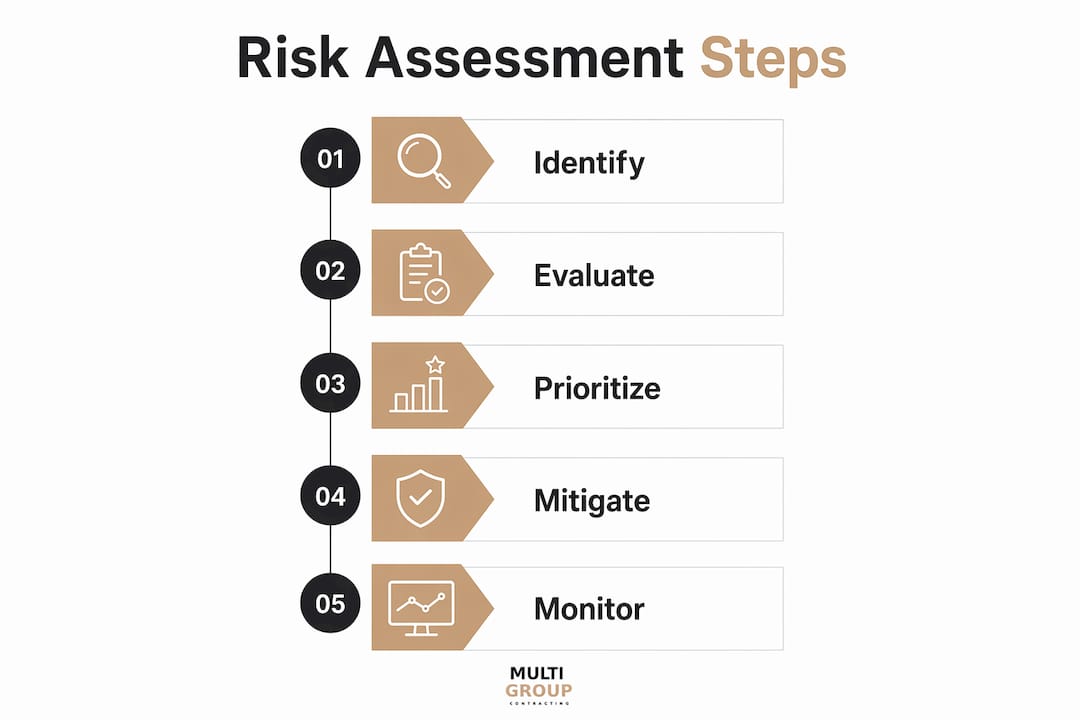
How is construction risk assessment performed?
Risk assessment in Canadian construction uses a layered approach. Each tier serves a different purpose and is conducted by different people at different stages of the project.
- Formal Hazard Assessment (FHA): Conducted before a project or phase begins, typically by a safety officer. The FHA identifies all foreseeable hazards associated with the scope of work and establishes the baseline risk profile.
- Job Hazard Analysis (JHA): A task-specific analysis completed before a particular activity starts. A JHA breaks down each step of a task, identifies the hazard at each step, and assigns a control measure.
- Field Level Hazard Assessment (FLHA): A real-time check performed by frontline workers at the start of each shift or when conditions change. The FLHA is the last line of defence before work begins.
Once hazards are identified, each one is rated using a likelihood-times-severity matrix. A hazard with a high probability of occurring and severe consequences ranks highest and demands immediate control. Controls are then applied in hierarchical order: elimination first, then substitution, engineering controls, administrative controls, and personal protective equipment (PPE) last.
| Risk level | Likelihood | Severity | Required action |
|---|---|---|---|
| Low | Unlikely | Minor | Monitor and document |
| Medium | Possible | Moderate | Apply administrative controls |
| High | Likely | Serious | Engineering controls required |
| Critical | Almost certain | Severe | Stop work; eliminate hazard first |

This matrix is not a bureaucratic exercise. It forces project teams to prioritise where to spend time and money on risk mitigation, rather than treating every hazard as equally urgent.
What are effective construction risk management strategies in BC?
Effective risk management in BC construction combines pre-construction planning, contract structure, financial controls, and continuous monitoring. No single tactic is sufficient on its own.
Pre-construction due diligence is where most risk is either created or avoided. This includes reviewing title searches, zoning, existing permits, environmental assessments, and geotechnical reports before committing to a contract price or schedule.
Contract structure determines how risk is allocated among the owner, general contractor, and trades. CCDC 5B (Construction Manager at Risk) and Integrated Project Delivery (IPD) models share financial and performance risks across stakeholders, reducing the concentration of liability on any one party. Bringing a general contractor into the design phase early under a CM at Risk model cuts risks from design and bidding phases before they become expensive problems.
Financial controls include maintaining statutory holdback accounts, securing performance bonds on larger contracts, and monitoring receivables aggressively. These are not optional practices in BC. They are legal requirements and financial survival tools.
- Maintain a dedicated holdback account separate from general project funds
- Require performance bonds on subcontracts exceeding $100,000
- Review project cash flow weekly, not monthly
- Use insurance and surety bonds to transfer risks that cannot be eliminated
Pro Tip: Review your CCDC contract's dispute resolution clause before signing. Mandatory mediation and arbitration clauses can save months of litigation time and tens of thousands in legal fees if a dispute arises.
Scheduling discipline is equally critical. A realistic schedule with built-in float for permit delays, material lead times, and weather events is a risk management tool, not just a project management convenience.
How do financial and legal risks specifically affect BC contractors?
BC construction carries a distinct set of financial and legal risks that do not apply uniformly across Canada. The Builders Lien Act governs payment rights, holdback obligations, and lien priorities in this province. Understanding it is not optional for anyone managing a construction project here.
Holdback funds are kept in trust for lien claimants and are insulated from competing claims unlike general project funds. This protection only works if the holdback is properly maintained. Contractors who commingle holdback funds with operating accounts lose this protection entirely.
Lien rights, while valuable on paper, are often practically ineffective on distressed projects because secured lenders hold priority over lien claimants. This means a contractor who relies solely on lien rights for payment protection may recover nothing if the project owner becomes insolvent. Enforcing holdback and trust accounts offers stronger, more reliable protection.
Key financial risk signals to monitor on every BC project:
- Payment delays beyond contract terms
- Owner requests to waive or reduce holdback
- Subcontractor complaints about slow payment from the GC
- Unusual changes in project ownership or financing mid-project
- Requests to accelerate work without corresponding payment adjustments
Delayed payments are a high-risk signal for contractor survival and must be managed aggressively. Where contract terms permit, suspending work on an overdue account is a legitimate and often necessary response.
Understanding subcontractor payment obligations under BC law is equally important for general contractors managing multiple trades on a single project.
What practical steps reduce construction risk throughout the project lifecycle?
Proactive risk identification and continuous coordination outperform reactive management on every Canadian construction project. The following steps apply from project start through to closeout.
- Conduct a risk register at project kickoff. List every identified risk, assign a likelihood and severity rating, name an owner for each risk, and set a review date.
- Involve trades early. Early trade involvement in constructability reviews catches coordination conflicts before they become change orders. This is especially valuable on complex tenant improvement and warehouse renovation projects.
- Hold weekly risk reviews. Integrate risk discussion into regular project meetings. Conditions change. A risk that was low-probability in week one may become critical by week four.
- Document everything. Site instructions, RFIs, change orders, and safety observations must be recorded in writing. Documentation is your primary defence in any dispute.
- Respond to escalations immediately. A delayed response to a risk event compounds the damage. Assign clear escalation paths before the project starts.
- Use experienced oversight. Commercial construction best practices consistently show that experienced project managers catch and resolve risks faster than less experienced teams, reducing both cost and schedule impact.
Pro Tip: Tie your contingency budget to specific identified risks, not a blanket percentage of total project cost. A contingency built around real project variables is far more useful than an industry-average figure that may not reflect your actual risk profile.
Effective risk management treats risk as a lifecycle process, integrating contingency planning based on actual project constraints rather than generic assumptions.
Key takeaways
Construction risk management is the single most reliable way to protect project cost, schedule, safety, and legal standing on any BC construction project.
| Point | Details |
|---|---|
| Risk is probability times severity | Use the CCOHS likelihood-times-severity matrix to prioritise which risks demand immediate action. |
| Contract structure allocates risk | CCDC 5B and IPD models distribute financial risk across parties; choose your delivery model deliberately. |
| Holdback accounts are legal protection | Maintain statutory holdbacks in a separate trust account to protect payment rights under the Builders Lien Act. |
| Early involvement reduces downstream risk | Bringing a general contractor into the design phase under CM at Risk cuts costly scope and constructability problems. |
| Delayed payment is a project risk signal | Monitor receivables weekly and be prepared to suspend work where contract terms allow if payments fall overdue. |
Why proactive risk management defines project outcomes in BC
Working on construction projects across Metro Vancouver, I have seen the same pattern repeat itself. Teams that treat risk management as a compliance checkbox end up in disputes. Teams that treat it as a core project discipline finish on time, within budget, and with relationships intact.
The BC market adds layers of complexity that other provinces do not face to the same degree. The Builders Lien Act, WorkSafeBC enforcement, and the sheer density of multi-trade coordination on urban infill sites create a risk environment that punishes reactive management quickly and harshly. I have watched contractors lose six-figure receivables because they did not maintain a proper holdback account. I have seen projects stall for months because a contract was signed without a clear dispute resolution clause.
What actually works is getting involved early. When Multigroup enters a project at the design stage, we catch conflicts between architectural intent and structural or mechanical reality before they become change orders. That single intervention saves more money than most contingency budgets cover. The difference between a project that succeeds and one that fails is rarely a single catastrophic event. It is usually a series of small, unmanaged risks that compound over time. The teams that win are the ones reviewing their risk register every week, not just when something goes wrong.
— MultigroupTeam
Multigroup's approach to risk-managed construction in Metro Vancouver
Property owners and project managers across Metro Vancouver choose Multigroup because risk management is built into every project from day one, not added as an afterthought.
Multigroup is a licensed contractor in BC with deep experience in tenant improvements, warehouse renovations, retail buildouts, and commercial renovations across Burnaby, Richmond, Surrey, Coquitlam, and the broader Metro Vancouver region. Every project includes permit handling, BC Building Code compliance, WorkSafeBC-aligned safety protocols, and structured project management from kickoff to closeout. If you are planning a commercial renovation or leasehold improvement and want a contractor who understands the legal and financial risks specific to BC construction, contact Multigroup to discuss your project.
FAQ
What is construction risk management in simple terms?
Construction risk management is the process of identifying, rating, and controlling threats to a project's cost, schedule, safety, and quality before and during construction. It uses tools like risk registers, hazard assessments, and contract structures to reduce the likelihood and impact of problems.
What are the biggest construction risks in BC?
The biggest risks in BC construction include payment defaults, lien claim disputes under the Builders Lien Act, WorkSafeBC safety violations, unexpected site conditions, and supply chain delays. Financial risks tied to insolvency and improper holdback management are among the most costly.
How does the Builders Lien Act affect construction risk?
The Builders Lien Act requires owners and contractors to maintain statutory holdback accounts to protect payment rights. Holdback funds held in trust are insulated from competing claims, but lien rights alone offer limited protection if a project owner becomes insolvent and a secured lender holds priority.
What is a risk rating matrix in construction?
A risk rating matrix scores each identified hazard by multiplying its likelihood of occurring by the severity of its potential consequences. The resulting score determines the priority and type of control required, from monitoring low-rated risks to stopping work entirely for critical ones.
When should a contractor suspend work due to payment risk?
A contractor should consider suspending work when payments are overdue beyond contract terms and receivables monitoring shows no resolution in sight. Where the contract permits, work suspension is a legitimate risk control measure that limits further financial exposure on a distressed project.