

TL;DR:
- Effective construction workflows divide into planning and implementation phases, ensuring tasks are well ordered and responsibilities clear. Lean principles and digital automation reduce waste, speed processes, and improve project accuracy, especially in complex Metro Vancouver projects with strict codes. Continuous mapping, training, and KPI monitoring sustain workflow improvements, reducing delays and controlling costs.
A project management workflow in construction is the structured sequence of tasks, approvals, and communications that moves a project from pre-construction planning through to site completion. When this sequence is well designed, it reduces wasted time, cuts costs, and keeps every trade and stakeholder aligned. For construction project managers in Metro Vancouver, where BC Building Code compliance and permit timelines add real complexity, a disciplined workflow is not a nice-to-have. It is the difference between a project that finishes on time and one that bleeds budget on every delay.
What are the essential phases of a construction project management workflow?
High-performing construction workflows divide into two distinct phases: Planning (Pre-construction) and Implementation (Site execution), each with separate focuses and deliverables. This structure is not arbitrary. It forces project managers to resolve unknowns before crews mobilise, which is where most schedule overruns originate.
Planning phase
The Planning phase covers everything before a shovel hits the ground. It includes scope definition, permit applications, scheduling, subcontractor procurement, and budget sign-off. For tenant improvements and commercial renovations in Metro Vancouver, this phase must also account for BC Building Code requirements, occupancy classifications, and municipal permit lead times that can run four to twelve weeks depending on the jurisdiction.

Value Stream Mapping (VSM) is the most useful tool at this stage. VSM categorises every task as Value-Added (VA), Non-Value-Added (NVA), or Necessary Non-Value-Added (NNVA). VA tasks directly advance the project. NVA tasks add no value and should be eliminated. NNVA tasks are required by regulation or contract but do not advance the build directly. Separating these three categories before you design your workflow prevents a critical mistake: automating flawed processes rather than fixing them.
Implementation phase
The Implementation phase covers site execution, real-time progress tracking, inspection coordination, and change order management. The key discipline here is keeping data current. Outdated schedules and stale RFI logs are the fastest path to coordination failures between trades.
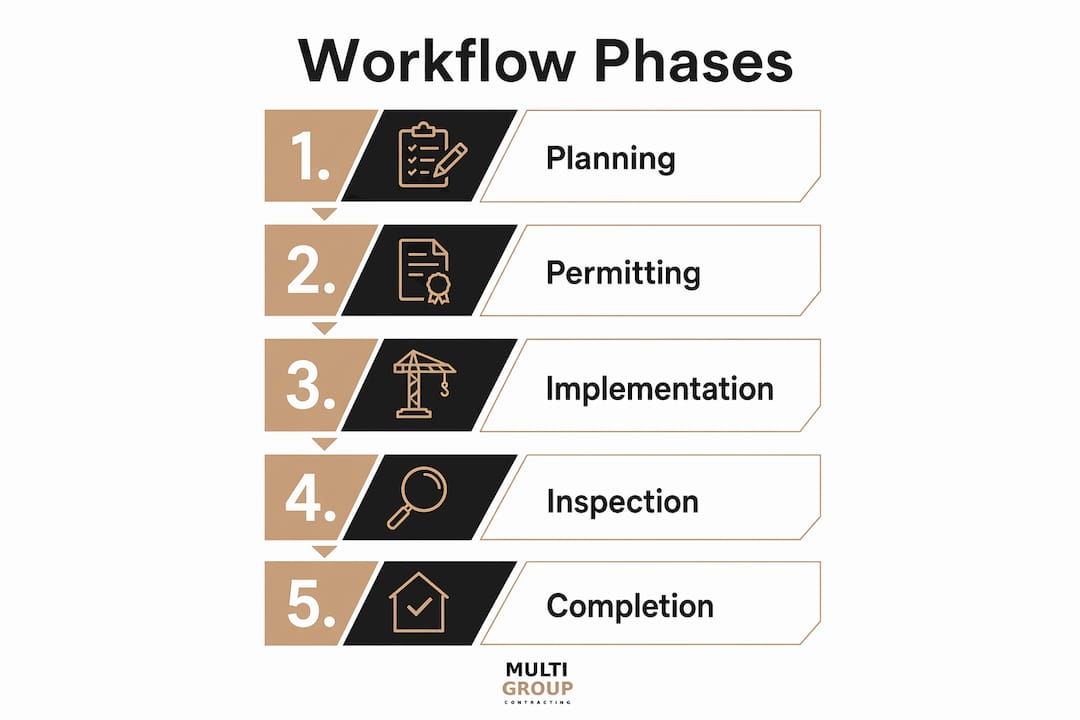
The table below outlines the core components present in both phases:
| Workflow component | Phase | Primary purpose |
|---|---|---|
| Scope and permit documentation | Planning | Establishes legal and design baseline |
| Master schedule (CPM or Gantt) | Planning | Sets task sequence and critical path |
| Resource allocation plan | Planning | Assigns labour, materials, and equipment |
| Daily progress tracking | Implementation | Monitors actual vs. planned performance |
| Inspection and approval routing | Implementation | Maintains code compliance and sign-off records |
| Change order management | Implementation | Controls scope creep and budget impact |
Understanding which components belong to which phase helps project managers assign ownership clearly and avoid tasks falling through the gaps between office and site.
How can construction project managers optimise workflows using lean and digital tools?
Lean construction and digital automation work best together. Lean identifies what to cut; digital tools execute the improved process faster and with fewer errors. Research shows that lean and digital workflows can reduce excavation task duration by 15% and save over 234 total project hours on a single project. That scale of saving on one task category signals what is possible across an entire project schedule.
Process automation delivers even larger financial returns. Automating core construction workflows can save up to $80,000 per process and speed execution by ten times. Those numbers apply to tasks like permit approval routing, material requisitions, subcontractor onboarding, and safety inspection sign-offs. These are high-volume, repetitive tasks that consume project manager time without requiring judgment.
The critical rule is this: digital transformation succeeds only when paper processes are fully replaced, not simply photographed and uploaded. Scanning a paper form into a PDF is not automation. Replacing the form with a digital workflow that routes, notifies, and records automatically is.
Pro Tip: Start automation with high-volume, low-complexity administrative tasks such as daily site reports and material delivery confirmations. These generate quick wins, build team confidence, and produce clean data for your dashboards before you tackle complex approval chains.
The table below compares common workflow optimisation methods by effort and impact:
| Method | Implementation effort | Primary benefit | Best suited for |
|---|---|---|---|
| Value Stream Mapping (VSM) | Medium | Identifies waste before automation | Pre-construction planning |
| Building Information Modelling (BIM) | High | Clash detection and 3D coordination | New builds and complex TI projects |
| Automated approval routing | Low to medium | Faster sign-offs and audit trails | Permit and RFI workflows |
| Real-time dashboards | Medium | Live progress visibility | Site execution monitoring |
| Mobile data entry | Low | Accurate field data capture | Daily reporting and inspections |
Digital lean workflows also enable automated update notifications that speed inspection scheduling and reduce schedule deviations. On institutional building projects, this capability alone has measurably shortened the gap between inspection requests and approvals.
What tools and team practices does an effective construction workflow require?
The right tools matter, but team behaviour determines whether those tools produce results. Standardising workflows before software implementation ensures that technology enforces quality and compliance rather than accelerating chaos. Document your current process first. Then select software that matches the documented process, not the other way around.
Legacy manual and paper-based habits are the primary barrier to digital workflow success in construction firms. Change management is therefore as important as tool selection. Project managers need to train field teams on new interfaces, explain why the change benefits them directly, and set clear expectations for adoption timelines.
The table below outlines the key tool categories and their functional roles:
| Tool category | Examples | Functional role |
|---|---|---|
| Project management platforms | Enterprise-grade field apps | Scheduling, task assignment, progress tracking |
| BIM software | Autodesk Revit, Navisworks | 3D modelling, clash detection, coordination |
| Workflow automation | Power Automate, process automation platforms | Approval routing, notifications, form processing |
| Mobile data entry | Mobile-first field apps | Site reporting, inspections, time tracking |
| Document management | Cloud-based document platforms | Drawing control, RFI logs, submittals |
Mobile-first interfaces with pre-populated forms increase data accuracy and workflow reliability from field teams. When a site supervisor can complete a daily report in three taps rather than fifteen minutes of typing, compliance rates rise and data quality improves. For Metro Vancouver projects where inspectors from multiple municipal authorities may be reviewing records, clean and timestamped data is a practical compliance asset.
Pro Tip: Adopt digital tools in phases. Begin with one workflow, such as daily site reporting, and run it for four weeks before adding the next. Phased adoption gives teams time to build habits and gives managers time to identify gaps before they compound.
For more on how pre-construction planning reduces downstream workflow failures, the connection between early decisions and site efficiency is well documented.
Step-by-step approach to building your construction workflow
A structured build process prevents the most common failure mode: designing a workflow in theory that does not survive contact with the site.
- Map your current state. Walk every task from project award to final inspection. Document who does what, in what order, and how long each step takes. Use VSM to label each task as VA, NVA, or NNVA.
- Design your future state. Remove NVA tasks entirely. Reduce NNVA tasks to their minimum required form. Redesign VA tasks for speed and accuracy.
- Define automation rules and triggers. For each automated step, specify the trigger (e.g., a form submission), the action (e.g., route to the project manager for approval), and the integration (e.g., update the schedule and notify the subcontractor).
- Configure and test. Build the workflow in your chosen platform. Run it on a live but low-risk project before full deployment.
- Set KPIs and feedback loops. Track task completion rates, approval turnaround times, and schedule variance weekly. Review with the team monthly.
Common pitfalls to avoid during implementation:
- Skipping VSM and automating existing broken processes
- Selecting software before documenting the process
- Deploying all workflows simultaneously rather than in phases
- Failing to assign a single owner for each workflow step
- Neglecting to update workflows when project scope or BC Building Code requirements change
A well-structured construction scheduling checklist supports this build process by ensuring no planning task is missed before site mobilisation.
How do you troubleshoot and sustain workflow optimisation on construction projects?
Workflow problems rarely announce themselves clearly. They show up as missed deadlines, repeated RFIs on the same issue, or field teams reverting to paper forms. Identifying the root cause requires monitoring specific indicators rather than waiting for a project manager to escalate a problem.
Key indicators to monitor for workflow health:
- Approval turnaround time (target: under 24 hours for routine approvals)
- Daily report completion rate (target: 100% from all active site supervisors)
- RFI response time (target: under 48 hours)
- Schedule variance at each two-week look-ahead review
- Change order processing time from request to signed approval
AI-driven predictive analytics anticipate delays before they appear on the critical path, shifting project management from reactive to proactive. This capability is now accessible through enterprise project management platforms and does not require custom software development. For a commercial renovation in Burnaby or a retail buildout in Richmond, early delay signals give project managers time to resequence work rather than scramble for recovery.
Staff resistance is the most underestimated sustainability risk. Address it directly with structured training, not just a one-time orientation session. Assign workflow champions on each project team. These are experienced site personnel who understand the new process and can answer questions from peers without escalating to management.
Workflows decay when they are treated as a launch event rather than a living system. The most effective construction project managers schedule a formal workflow review at every project milestone, not just at the start and end of a job.
Keeping workflows current with evolving BC Building Code requirements is a non-negotiable discipline. Code updates affect inspection sequences, documentation requirements, and approval routing. A workflow designed for last year's code can create compliance gaps that delay occupancy permits.
Key takeaways
Effective construction workflow management requires standardising processes before automation, applying lean techniques to eliminate waste, and using digital tools to enforce consistency from planning through site execution.
| Point | Details |
|---|---|
| Standardise before automating | Document and clean up processes before deploying any software or automation tool. |
| Apply Value Stream Mapping | Categorise every task as VA, NVA, or NNVA to target waste before redesigning the workflow. |
| Phase your digital adoption | Start with high-volume, simple tasks to build team confidence and generate clean data. |
| Use mobile-first data entry | Pre-populated mobile forms increase field data accuracy and support BC compliance records. |
| Monitor KPIs continuously | Track approval times, report completion rates, and schedule variance at every project milestone. |
What I have learned from building construction workflows on real projects
After working through tenant improvements, warehouse renovations, and retail buildouts across Metro Vancouver, the single most consistent finding is this: the teams that struggle with workflow optimisation are almost always the ones that skipped the mapping step. They bought software, ran training, and then watched field teams revert to WhatsApp messages and paper logs within three weeks. The tool was not the problem. The process underneath it was broken, and the software made the chaos faster.
The combination of lean principles and digital tools only works when the human layer is addressed first. That means honest conversations with site supervisors about what actually slows them down, not what the project manager assumes slows them down. The answers are often surprising. On one office renovation in Coquitlam, the biggest delay in the daily reporting cycle was not the form itself. It was that supervisors had no reliable Wi-Fi on site to submit it. A mobile data plan solved a workflow problem that no amount of process redesign would have fixed.
BC Building Code compliance shapes workflow design more than most project managers acknowledge during planning. Inspection sequences, documentation requirements, and permit conditions all create mandatory NNVA tasks that must be built into the schedule from day one. Treating them as surprises is a choice, not a circumstance. Multigroup builds these requirements into every project workflow from the pre-construction phase, which is why our projects in Burnaby, Richmond, and Surrey consistently clear inspections without schedule disruption.
The advice I give every project manager starting a workflow improvement effort is simple: map first, automate second, and train continuously. The technology is the easiest part.
— MultigroupTeam
How Multigroup supports your construction workflow from day one
Multigroup brings licensed general contracting expertise and structured project management to every commercial renovation and tenant improvement in Metro Vancouver.

From the first permit application through final inspection, Multigroup coordinates scheduling, subcontractor management, and BC Building Code compliance as part of every project. Our tenant improvement services are built around the same lean and digital workflow principles covered in this article, applied to real projects in Burnaby, Richmond, Surrey, and across the region. For businesses planning a retail buildout in Vancouver, Multigroup manages the full workflow from design coordination to occupancy, keeping timelines and budgets on track. Contact Multigroup to discuss your next commercial renovation project.
FAQ
What is a project management workflow in construction?
A project management workflow in construction is the structured sequence of tasks, approvals, and communications that governs a project from pre-construction planning through to site completion. It defines who does what, in what order, and how handoffs between trades and stakeholders are managed.
What is Value Stream Mapping and why does it matter?
Value Stream Mapping (VSM) categorises every construction task as Value-Added, Non-Value-Added, or Necessary Non-Value-Added before automation or redesign begins. Skipping VSM risks automating broken processes, which produces faster failures rather than better outcomes.
How much can automation save on a construction project?
Process automation in core construction workflows can save up to $80,000 per process and speed execution by ten times. The largest gains come from automating high-volume, repetitive tasks such as permit routing, material requisitions, and inspection sign-offs.
What is the biggest barrier to digital workflow adoption in construction?
Legacy manual and paper-based habits are the primary barrier to digital workflow success in construction firms. Overcoming this requires structured change management and phased tool adoption, not just software training.
How does BC Building Code compliance affect construction workflow design?
BC Building Code requirements create mandatory inspection sequences, documentation standards, and permit conditions that must be built into the workflow schedule from the pre-construction phase. Treating these as fixed workflow steps rather than surprises prevents inspection delays and occupancy permit holdups.