
A straightforward commercial tenant improvement (TI) in Metro Vancouver typically requires a moderate contingency allowance at the design development stage. A renovation with unknown existing conditions or a project still at concept stage requires a higher contingency allowance.
- Start here for a typical Metro Vancouver commercial TI: Set 8–10% contingency on your base construction cost, then run a one-page risk checklist covering site access, existing mechanical/electrical conditions, and permit timeline before locking the number.
- Raise to 15%+ immediately if: the project involves a contaminated site, unknown subsurface conditions, a heritage building, or a scope that is less than 50% designed.
Industry analysis shows that actual contingency consumption averages approximately 18% for new construction and approximately 28% for renovations — well above the 5–10% figures many owners initially budget. Setting too little contingency is a common and costly mistake on Canadian projects.
Key takeaways
| Point | Details |
|---|---|
| Baseline contingency range | Budget 5–15% of base construction cost; renovations and early-stage projects need 15%+ or more. |
| Stage-based reduction | Start at 20–25% at concept stage and reduce progressively to 3–5% post-contract as design matures. |
| Escalation is separate | Add a 3–5% escalation allowance as its own budget line, sized to your project's material and labour mix. |
| Approval thresholds protect the fund | Require written owner approval for any draw above $5,000 or 25% of the contingency line. |
| Multigroup's local expertise | Multigroup provides contingency reviews and CAD budget frameworks for Metro Vancouver TI and commercial renovation projects. |
Table of Contents
- What is a construction contingency, and what types should you know?
- What contingency percentage should you use by project type and stage?
- How do you calculate contingency for a construction project?
- What should contingency actually cover, and when should you use it?
- How do you manage contingency on Canadian projects?
- Quick reference: recommended contingency by project scenario
- How does contingency differ from allowances, retainage, and bonds?
- Three worked budgets with contingency applied
- Canadian market considerations and regional contingency variations
- Legal and contractual requirements affecting contingency in Canadian projects
- How inflation and material cost volatility affect contingency budgeting in Canada
- A contractor's perspective on contingency in Metro Vancouver
- Multigroup's contingency review and budget setup service
- Sources
- FAQ
What is a construction contingency, and what types should you know?
A construction contingency is a reserved budget line set aside to cover cost events that are reasonably foreseeable but not yet specifically identified at the time of budgeting. It is not a slush fund for scope additions; it is a risk reserve tied to genuine uncertainty in the project.
RAIC guidance defines it as a reserve to cover design evolution, price escalation, and unknown conditions, with the contingency reducing as design information improves.
The four types you will encounter on most Canadian projects:
- Design contingency: Held by the design team to cover gaps and evolution in drawings before tender. Typically 5–15% of estimated construction cost during design development.
- Construction contingency: Held by the owner or contractor to cover unforeseen field conditions, minor scope changes, and code-driven adjustments during construction. Typically 3–10%, higher for renovations and constrained sites.
- Owner contingency: A separate reserve the owner controls for decisions, upgrades, and scope changes that fall outside the contractor's contingency. Often 3–5% on top of the construction contingency.
- Escalation/price-risk allowance: A line item to absorb material and labour cost increases between budget and construction. Particularly relevant in the current Canadian market; typically 2–5% but higher during periods of rapid cost movement.
In practice, many project budgets show a single contingency line for stakeholder reporting. Internally, tracking each type separately gives you a cleaner picture of where the money is going and makes approval workflows much easier to manage.
What contingency percentage should you use by project type and stage?
The right construction cost contingency percent depends on two variables: what you are building and how far along the design is. Both matter equally.
By project type
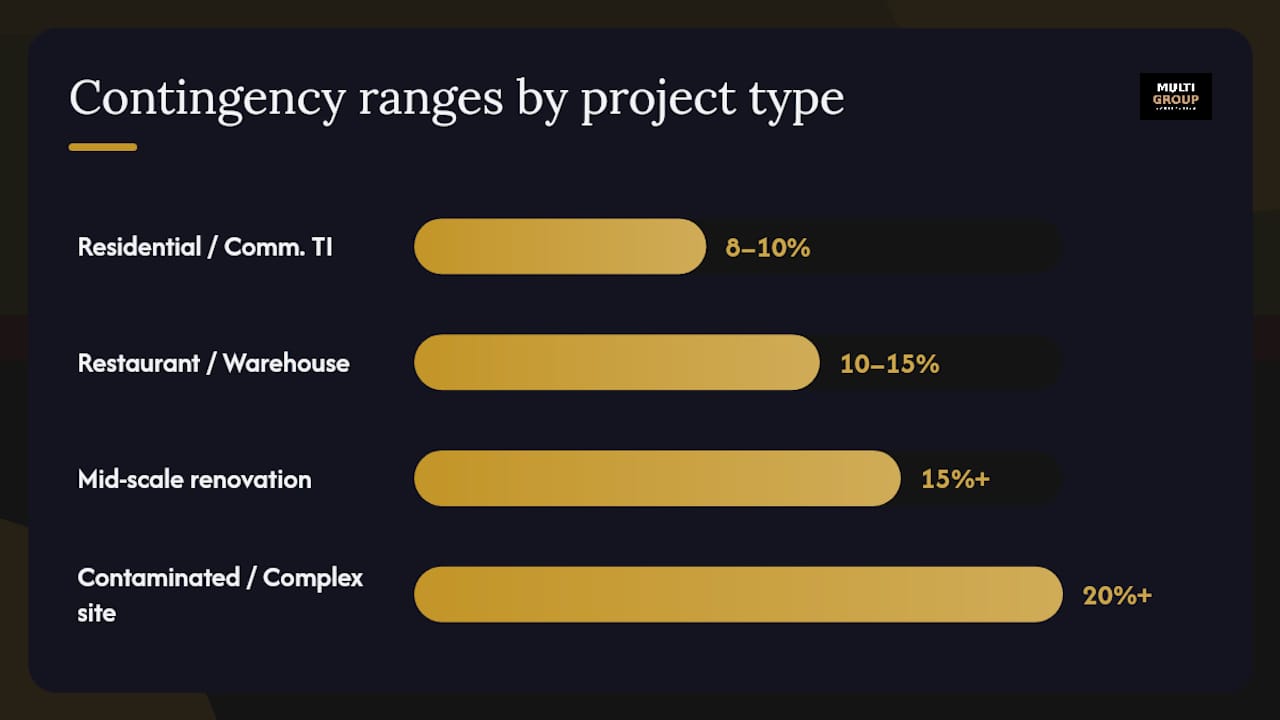
| Project type | Typical contingency range | Key driver |
|---|---|---|
| New residential build (Metro Vancouver) | 8–10% | Site and permit unknowns, material lead times |
| Commercial TI (office, retail, medical) | 8–10% | Existing building conditions, leasehold unknowns |
| Restaurant or coffee shop fit-out | 10–15% | Mechanical/electrical upgrades, hood/ventilation unknowns |
| Warehouse renovation (BC) | 10–15% | Structural unknowns, seismic upgrade potential |
| Mid-scale commercial renovation | 15%+ | Hidden conditions, asbestos/mould risk |
| Contaminated or complex site | 20%+ | Geotechnical and remediation uncertainty |
Precedent Developments' 2025 Canadian Construction Costing Guide lists design development contingency at 5–15%, construction contingency at 3–10% (higher for renovation and constrained sites), and site risk allowances from 0–20%+ for geotechnical or contamination issues.
By design/construction stage
Stage-based contingency reduction is standard practice. ACEC-BC budget guidelines show large early-stage allowances that decline progressively toward tender.
- Concept/feasibility: 20–25% — design is incomplete, site conditions are largely unknown
- Schematic design: 15–20% — major systems defined but details unresolved
- Design development: 10–15% — drawings advancing, most risks identified
- Tender/bid stage: 5–10% — priced scope, known subcontractors, remaining risk is field-level
- Post-contract (construction): 3–5% — active construction, most unknowns resolved
RAIC notes that contingencies can reach 25% at very early stages and reduce to 2–5% as design uncertainty clears.
How do you calculate contingency for a construction project?
Use a percentage-based method for early-stage budgets and a risk-based method before tender when accuracy matters.
Percentage-based method (quick budgets)
- Establish your base construction cost (all hard costs, excluding contingency, taxes, and soft costs).
- Select a contingency percentage based on project type and stage (use the table above).
- Multiply: Base cost × contingency % = contingency fund.
- Add the contingency fund as a separate line below the base cost subtotal.
Worked example — $500,000 commercial TI in Metro Vancouver (design development stage):
- Base construction cost: $500,000
- Contingency rate: 10%
- Contingency fund: $50,000
- Total construction budget: $550,000
Owner approval threshold example: any single contingency draw above $5,000 requires written owner approval before the contractor proceeds.
Risk-based method (pre-tender refinement)
- List the top 5–10 identified risks (e.g., asbestos in existing drywall, unknown plumbing routing, permit delay).
- Assign each risk a probability (0–100%) and a cost impact in CAD if it occurs.
- Calculate the weighted value: Probability × Cost impact = Weighted risk value.
- Sum all weighted risk values to get a risk-adjusted contingency.
Compact worked example:
A construction risk management review before tender is the most reliable way to defend the number to lenders or ownership groups.
What should contingency actually cover, and when should you use it?
Contingency is for unforeseeable or reasonably likely risk events, not for routine design items that should be priced into the base estimate.
Appropriate uses:
- Unforeseen site conditions (buried utilities, soil contamination, undocumented structural elements)
- Code-driven changes identified during construction or permit review
- Minor scope adjustments that do not warrant a formal contract amendment
- Material price spikes up to a defined threshold (e.g., steel or lumber cost increases within a set tolerance)
- Permit-related redesign costs not attributable to design error
Not appropriate uses:
- Owner-directed scope additions (these draw from owner contingency or require a contract amendment)
- Design errors or omissions (these are a consultant liability issue, not a contingency draw)
- Routine construction waste or inefficiency
This protects the fund from being depleted by a series of small, unreviewed draws. Good project management workflow ties every contingency draw to a documented change-order record.
How do you manage contingency on Canadian projects?
Track contingency separately from the base contract, require documentation for every draw, and tie draws to a written approval matrix. That single discipline prevents most contingency disputes.
Contract language to include:
- A clear definition of what constitutes an eligible contingency draw
- A change-order workflow that triggers before any contingency is released
- Escalation clauses tied to a published index (e.g., Statistics Canada Construction Price Index) with a defined trigger threshold
- Progressive holdback release schedule aligned with BC's Builders Lien Act requirements
- Owner approval thresholds in CAD amounts, not just percentages
This holdback is separate from your contingency fund and cannot be used to fund contingency draws. Confirm current holdback requirements with legal counsel or your contracting team, as provincial rules vary across Canada.
MNP's guidance on budgeting for uncertainty in construction recommends escalation clauses and progressive holdback releases to manage cash flow and cost volatility — both are worth including in any Metro Vancouver commercial contract.
In BC, Letters of Assurance under the BC Building Code (Schedule A, B, and C) create obligations for registered professionals and owners before permits are issued. Projects that have not yet secured Letters of Assurance carry higher design and coordination uncertainty — which is a direct argument for a higher contingency at that stage.
This gives the contractor predictable cash flow while keeping the owner protected against incomplete work — a practical balance on Metro Vancouver TI projects where trades are often juggling multiple sites.*
Quick reference: recommended contingency by project scenario
| Scenario | Recommended range | Metro Vancouver rationale |
|---|---|---|
| Small commercial TI | 8–10% | Leasehold unknowns, existing M/E conditions |
| Restaurant or coffee shop fit-out | 10–15% | Hood/ventilation, grease trap, permit complexity |
| Simple new residential build | 8–10% | Known site, complete drawings at tender |
| Mid-scale warehouse renovation | 10–15% | Structural and seismic unknowns, BC code compliance |
| Contaminated or brownfield site | 20–25%+ | Remediation scope uncertainty, geotechnical risk |
How does contingency differ from allowances, retainage, and bonds?
These four budget tools are frequently confused, and mixing them up creates real problems in contract administration.
- Contingency (risk reserve): Owner-controlled funds set aside for unforeseeable cost events. Released only when a documented risk event occurs. Not part of the contract sum.
- Allowance (estimate placeholder): A defined sum included in the contract for a specific scope item whose full cost is not yet known at tender (e.g., a $15,000 allowance for tile selection). Unused allowance is returned; overruns are a change order.
- Retainage/holdback (contractual payment retention): A percentage of each progress payment withheld until substantial completion. In BC, the statutory rate is 10% under the Builders Lien Act. It protects against incomplete work and lien claims — it is not a contingency fund and cannot be redirected to cover cost overruns.
- Bonds (performance and labour/material): Insurance instruments that protect the owner if the contractor defaults. A performance bond does not fund contingency draws; it triggers only on contractor default.
For Canadian projects, who controls each fund matters as much as the amount. Contingency and allowances are owner-controlled budget lines. Holdback is a statutory obligation. Bonds are third-party instruments. Treating any of these as interchangeable in a budget leads to cash-flow shortfalls and contract disputes.
Provincial holdback rules vary: Ontario's Construction Act, Alberta's Builders' Lien Act, and BC's Builders Lien Act each set different timelines and thresholds. Always confirm the applicable provincial statute with legal counsel before finalizing contract terms.
Three worked budgets with contingency applied
1. $250,000 small commercial TI (Metro Vancouver)
Reconciliation: unused contingency at project close is returned to the owner or reallocated to owner contingency. Every draw is documented with a change-order record.
2. $1,000,000 warehouse renovation (BC)
At 13%, this reflects the higher hidden-condition risk typical of warehouse renovation BC projects, where seismic upgrades and undocumented structural elements are common surprises.
3. $400,000 residential renovation
| Total project cost | $495,600 |
Residential renovations carry the highest contingency rate of the three because hidden conditions (knob-and-tube wiring, undocumented plumbing, asbestos in pre-1990 homes) are the rule rather than the exception in Metro Vancouver's older housing stock.
Accounting note: Contingency is shown as a separate budget line, not included in the contract sum. GST/HST applies to the construction contract value; the contingency fund itself is not taxed until drawn and applied to a change order, at which point it becomes part of the taxable contract value.
Canadian market considerations and regional contingency variations
Canada’s construction market adds several layers of complexity that generic contingency guidance does not capture.
Labour shortages in BC, Ontario, and Alberta have extended trade lead times and pushed subcontractor pricing higher. In Metro Vancouver specifically, the combination of high land costs, dense urban sites, and a competitive trade market means that even well-scoped projects face procurement risk that justifies the upper end of standard contingency ranges.
Regional variation is real. A new build in rural Manitoba carries different risk drivers than a tenant improvement in downtown Vancouver. Atlantic Canada projects often face shorter construction seasons and limited local trade capacity. The ranges in this guide are calibrated for Metro Vancouver and southern BC; adjust upward for remote or northern locations.
Indigenous consultation requirements and environmental assessments on certain BC sites can introduce schedule and cost uncertainty that is difficult to price at early stages. Projects near sensitive ecosystems or on land subject to consultation obligations should carry a dedicated risk allowance, separate from standard contingency, sized to the specific regulatory exposure.
Legal and contractual requirements affecting contingency in Canadian projects
No Canadian statute mandates a specific contingency percentage, but several legal and contractual frameworks directly shape how contingency should be sized and managed.
The CCDC 2 (Canadian Construction Documents Committee Stipulated Price Contract) is the standard form contract used on most Canadian commercial projects. It defines the change-order process, the contractor's right to claim for unforeseen conditions, and the owner's right to direct changes. A well-drafted CCDC 2 contract with a clear contingency-use clause reduces disputes about whether a given cost event qualifies for a contingency draw.
Provincial lien legislation sets the holdback framework. This is not contingency; it is a statutory obligation. Failing to maintain the holdback exposes the owner to lien claims from subtrades and suppliers.
BC Building Code compliance and permit requirements also affect contingency sizing. Projects that require Letters of Assurance (Schedule A from the owner, Schedule B from the coordinating registered professional) must have those documents in place before a building permit is issued. Delays in securing registered professionals or resolving permit comments are a real cost risk in Metro Vancouver's busy permit queues, and that risk belongs in your contingency budget.
For construction budgeting purposes, always confirm the applicable provincial statute, the contract form, and the permit requirements with your contractor and legal counsel before finalising the contingency line.
How inflation and material cost volatility affect contingency budgeting in Canada
Canadian construction costs have been volatile. Lumber, steel, concrete, and mechanical equipment have all seen significant price swings over the past several years, and supply chain disruptions have made long lead-time items harder to price with confidence at early budget stages.
Statistics Canada tracks construction price indices for residential and non-residential building. Sizing your escalation line to the actual market rate, not a historical average, is one of the most practical adjustments you can make to a Canadian construction budget.
Material price volatility argues for two specific contract provisions: an escalation clause tied to a published index, and a procurement strategy that locks in pricing for high-risk materials (structural steel, mechanical equipment, glazing) as early as possible. Early procurement reduces the escalation exposure that would otherwise sit in your contingency.
Labour cost escalation in BC is driven by collective agreements in the ICI (Industrial, Commercial, Institutional) sector. Wage increases negotiated under the BC Building Trades agreements affect all union subcontractors and set a floor for non-union pricing as well. A project budgeted in early 2025 and tendered in late 2025 or 2026 should carry an escalation allowance that reflects the gap between those two dates, not just a generic inflation assumption.
The practical rule: treat escalation as a separate budget line from contingency, size it to the specific materials and labour categories in your project, and review it at every major design milestone.
A contractor's perspective on contingency in Metro Vancouver
The contingency ranges in this guide reflect what Multigroup sees on real projects across Metro Vancouver — from small retail buildouts in Burnaby to mid-scale warehouse renovations in Surrey and high-end residential interiors in West Vancouver.
On tenant improvement projects specifically, the single most common contingency draw is undocumented existing conditions: electrical panels at capacity, plumbing that does not match the as-built drawings, or HVAC that cannot support the new occupancy load. These are not exotic risks.
BC Building Code compliance and Letters of Assurance requirements add another layer. Before a building permit is issued, the owner must provide a Schedule A Letter of Assurance, and the coordinating registered professional must provide a Schedule B. If those professionals are not engaged early, permit delays are almost certain — and permit delays cost money that comes directly out of contingency. Engaging your architect and engineers before finalising the contingency budget is not a luxury; it is a cost-control measure. On a $500,000 TI, a six-week permit delay can easily consume $15,000–$25,000 in holding costs, contractor remobilisation, and trade rescheduling.
Multigroup's contingency review and budget setup service
Multigroup works with property owners, business operators, and developers across Metro Vancouver to set realistic contingency budgets before construction begins.

The service covers tenant improvements, retail and restaurant fit-outs, office renovations, and warehouse renovations throughout Metro Vancouver, including Burnaby, Richmond, Surrey, Coquitlam, North Vancouver, and Langley. CAD pricing estimates are available on request. To book a budget review or request a sample contingency worksheet, contact Multigroup at Multigroup.
Sources
- Budgeting for uncertainty in construction | MNP
- Build Realistic Construction Budgets with Contingency Templates
- Chapter 4.2 - RAIC
- BUDGET GUIDELINES FOR ENGINEERING SERVICES
- 2025 Canadian Construction Costing Guide | Precedent Developments
This article is general information, not a substitute for advice from a qualified financial advisor. Consult a qualified financial professional about your own circumstances before acting on anything here.
FAQ
What is a good contingency percentage for construction?
What does a 10% contingency mean?
On a $500,000 project, that is $50,000 held separately from the contract sum to cover unforeseen conditions, code-driven changes, and minor scope adjustments.