

TL;DR:
- Effective project management ensures projects finish on time and within budget by coordinating all phases from start to finish. It reduces risks, controls costs, and improves communication among stakeholders in Vancouver's complex regulatory environment. Using structured planning, centralized coordination, and performance metrics increases the likelihood of project success.
Comprehensive project management is the coordinated process of planning, executing, and controlling all phases of a project to deliver results within scope, time, and budget. For property owners, business operators, and developers in Metro Vancouver, this is not a nice-to-have. It is the difference between a project that finishes on time and one that bleeds money through delays, permit failures, and miscommunication. 82% of construction projects in Ontario met their deadlines in 2023, up from 75% in 2020, directly tied to professional project management adoption. That improvement did not happen by accident. It happened because firms committed to structured delivery frameworks across every phase of their projects.
Why comprehensive project management improves project execution
Structured project management integrates every phase of a build, from initial design and permitting through to final handover. Without that integration, teams work in silos, decisions get made late, and costs compound. With it, each phase feeds cleanly into the next.
For commercial projects in Metro Vancouver, this matters at a practical level. A tenant improvement in Burnaby, for example, involves BC Building Code compliance, City of Burnaby permit approvals, mechanical and electrical coordination, millwork fabrication lead times, and a tenant move-in deadline that cannot slip. Managing each of those elements in isolation guarantees conflict. Managing them together, through a single coordinated plan, keeps the project on track.
The benefits of this approach are concrete:
- Deadline adherence: A structured schedule with defined milestones catches delays before they cascade.
- Budget control: Early cost planning and change-order management prevent scope creep from eroding margins.
- Quality assurance: Defined inspection points at each phase catch deficiencies before they become expensive corrections.
- Permit and compliance management: Coordinating permit submissions with construction sequencing avoids costly stop-work orders.
- Stakeholder communication: Regular reporting keeps property owners and tenants informed, reducing last-minute surprises.
Pro Tip: On tenant improvement projects, submit permit applications during the design phase, not after. This alone can save three to six weeks on a typical Metro Vancouver commercial renovation.
Multigroup applies this phased approach to every commercial renovation in Vancouver, treating permit handling, scheduling, and trade coordination as one connected system rather than separate tasks.
How does planning and governance reduce project risk?
Weak governance and misaligned early planning are the primary causes of cost overruns and delays in construction. KPMG identifies that these failures appear at the front end but only become visible during construction, when correction is far more expensive. The implication is direct: the planning phase is where project risk is either controlled or created.
Effective governance means clear accountability at every decision point. Someone owns the schedule. Someone owns the budget. Someone owns the permit file. When those roles are undefined, decisions stall and problems multiply.
"Early-stage governance and alignment are the strongest predictors of project success or failure. Even the best project software fails without strong governance, aligned project objectives, and skilled project leadership." — KPMG Major Projects Advisory
Front-end planning for a Metro Vancouver retail buildout or warehouse renovation should include:
- Feasibility review: Confirming the project is achievable within the client's budget and timeline before design begins.
- Constructability review: Identifying structural or mechanical constraints early, before they become change orders mid-build.
- Early trade involvement: Engaging key subcontractors during design to validate costs and sequences.
- Continuous risk monitoring: Replacing one-off contingency calculations with real-time risk tracking that updates as conditions change.
- Regulatory mapping: Identifying all BC Building Code requirements and municipal permit conditions before construction begins.
This front-end investment pays back in predictability. Projects that complete thorough planning phases face fewer surprises during construction. Surprises in construction are expensive. Surprises in planning are just conversations.
How does centralized coordination support developers and property owners?
Complex projects require multiple specialists working in sequence and sometimes simultaneously. A developer managing a mixed-use building in Richmond deals with civil engineers, architects, mechanical consultants, electrical engineers, interior designers, and multiple trade contractors. Without a central coordinator, that group operates without alignment.

Development management consultants centralize this coordination from land acquisition through to operations, protecting the developer's interests at every stage. This is distinct from a general contractor's role. A general contractor manages construction. A development manager manages the entire project lifecycle, including decisions that happen long before a shovel enters the ground.
For property owners and business operators running smaller commercial projects, the same principle applies at a scaled level. A single point of coordination, whether a project manager or a general contractor with strong project management systems, produces better outcomes than managing trades directly.
The four functions of centralized coordination that matter most:
- Stakeholder alignment: Keeping architects, engineers, trades, and the client working from the same current plan, not different versions of an old one.
- Financial transparency: Providing regular cost reports that show actual spend against budget, with clear explanations for any variance.
- Schedule management: Maintaining a master schedule that all trades reference, with dependencies clearly mapped so delays in one area trigger immediate replanning in others.
- Portfolio risk management: For developers running multiple projects, centralized reporting surfaces risk across the portfolio, not just within individual builds.
Construction managers in Metro Vancouver who apply these coordination principles consistently deliver projects with fewer disputes, fewer delays, and better client satisfaction outcomes.
How do technology and performance metrics improve project outcomes?
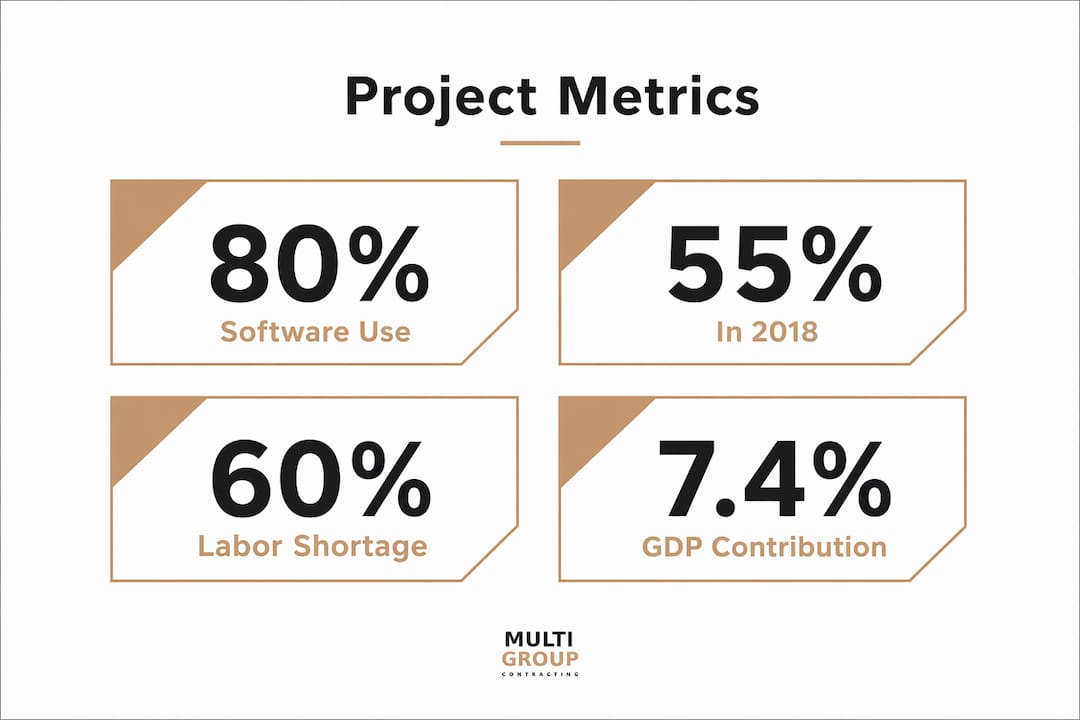
80% of Ontario construction firms use formal project management software as of 2023, up from 55% in 2018. That adoption rate reflects a direct response to stagnant labour productivity and growing project complexity. Technology does not replace skilled project leadership. It gives that leadership better information to act on.
Canada currently lacks a unified construction KPI framework, which makes industry-wide benchmarking difficult. Firms that build their own KPI tracking systems gain a measurable advantage over those that do not. The firms that track performance can improve it. The firms that do not are guessing.
| KPI Category | What It Measures | Why It Matters |
|---|---|---|
| Schedule performance | Actual vs. planned completion by phase | Identifies delays before they compound |
| Cost performance | Actual spend vs. budget by trade | Flags scope creep and pricing errors early |
| Quality deficiency rate | Number of deficiencies per inspection | Tracks workmanship trends across projects |
| Change order frequency | Number and value of changes per project | Reveals planning gaps and design instability |
| Permit cycle time | Days from submission to approval | Benchmarks municipal processing against project schedule |
Canadian construction contributes 7.4% to GDP and employs 1.6 million people, yet 60% of Ontario firms report labour shortages. Technology and KPI frameworks directly offset that pressure by making each worker and each project more productive and predictable.
Pro Tip: Track change order frequency on every project. A high rate of changes almost always points to a planning problem, not a construction problem. Fix the planning process and the change orders drop.
Pairing digital tools with structured project workflows gives project teams the visibility they need to make fast, accurate decisions. Real-time data replaces end-of-month surprises with daily clarity.
Key takeaways
Comprehensive project management is the single most reliable factor in delivering construction projects on time, within budget, and to the required standard.
| Point | Details |
|---|---|
| Front-end planning prevents overruns | Governance and planning failures at the start cause the cost overruns that appear during construction. |
| Deadline performance improves with structure | Ontario's completion rate rose from 75% to 82% as professional project management adoption increased. |
| Technology adoption is now standard | 80% of Ontario firms use formal project management software; firms without it face a productivity disadvantage. |
| Centralized coordination reduces conflict | A single coordination point aligns trades, consultants, and clients, reducing disputes and delays. |
| KPI tracking creates competitive advantage | Firms that measure schedule, cost, and quality performance consistently outperform those that do not. |
What I've learned about project management in the Vancouver market
After working through commercial renovations, tenant improvements, and retail buildouts across Metro Vancouver, one pattern stands out clearly. The projects that go wrong almost never fail because of a bad contractor or a difficult trade. They fail because nobody owned the full picture from the start.
BC's regulatory environment adds real complexity. The BC Building Code, municipal permit processes across Burnaby, Richmond, Surrey, and Vancouver, and the coordination required between City inspectors and project teams all demand a level of oversight that most property owners and business operators cannot manage alone. When that oversight is absent, projects stall at permit, trades show up out of sequence, and costs climb.
What I find most telling is that project success depends more on strategy implementation and aligned oversight than on the tools a team uses. A firm with a basic spreadsheet and strong governance will outperform a firm with enterprise software and no clear accountability structure. That is a hard truth for anyone who believes buying the right software solves the management problem.
The Metro Vancouver market in 2026 is competitive and expensive. Labour costs are high, permit timelines are long, and clients have less tolerance for delays than they did five years ago. The firms and property owners who invest in proper project management at the front end are the ones who finish on time and protect their margins. The ones who skip it pay for it later, usually at a much higher cost.
— MultigroupTeam
Multigroup's project management approach for Metro Vancouver
Multigroup is a licensed general contractor in BC, delivering tenant improvements and commercial renovations across Metro Vancouver with full project management built into every engagement.
Every Multigroup project includes permit handling, trade coordination, scheduling, and direct client communication from day one. For property owners and developers managing retail buildouts, warehouse renovations, or office improvements, that means one accountable team managing the full scope. Multigroup's retail buildout services cover everything from BC Building Code compliance through to final inspection, so clients are never left managing the gaps between trades. Contact Multigroup to discuss your next commercial project in Metro Vancouver.
FAQ
What is comprehensive project management in construction?
Comprehensive project management in construction is the coordinated oversight of all project phases, including planning, permitting, scheduling, budgeting, and delivery, through a single accountable structure. It aligns all stakeholders and trades to a shared plan from start to finish.
Why does comprehensive planning reduce project costs?
Weak front-end planning creates governance gaps that produce cost overruns during construction, when corrections are most expensive. Thorough planning at the feasibility and design stages catches problems before they become change orders.
How do project management tools improve construction outcomes?
Formal project management software gives teams real-time visibility into schedule and cost performance, enabling faster decisions and fewer surprises. Ontario's adoption rate reached 80% in 2023, reflecting the direct productivity gains these tools deliver.
What is the role of a construction manager versus a general contractor?
A general contractor manages the physical construction of a project, including trades and site supervision. A construction manager or development manager provides broader oversight, covering planning, design coordination, risk management, and stakeholder reporting across the full project lifecycle.
How does Multigroup handle project management for commercial renovations in Vancouver?
Multigroup manages permits, scheduling, trade coordination, and client communication as an integrated service on every commercial project. This covers BC Building Code compliance, municipal permit submissions, and construction delivery across Metro Vancouver, including Burnaby, Richmond, Surrey, and Coquitlam.