
TL;DR:
- Commercial construction involves heavier materials, stricter codes, and higher costs than residential building.
- Proper planning and understanding of local codes, permit processes, and project phases are essential to success.
- Costs are driven by code compliance, specialized labor, material strength, and project complexity in Metro Vancouver.
Commercial construction is not simply residential building at a larger scale. The materials are heavier, the codes are stricter, and the consequences of a misstep are far more costly. In Metro Vancouver, where the BC Building Code 2024 and Vancouver Building By-law 2025 set increasingly demanding standards, property owners and business operators face a complex landscape that catches many off guard. This guide breaks down what commercial construction actually covers, how projects move from planning to occupancy, what drives costs in this region, and what compliance requirements you need to understand before signing a contract or approving a budget.
Table of Contents
- Defining commercial construction: Scope and key concepts
- Phases of a commercial construction project
- Materials, building codes, and regulations in Metro Vancouver
- Cost drivers and commercial construction budgets
- Edge cases and special scenarios in Metro Vancouver
- What most guides miss about commercial construction
- How Multigroup helps Metro Vancouver businesses
- Frequently asked questions
Key Takeaways
| Point | Details |
|---|---|
| Specialized scope | Commercial construction demands unique materials, codes, and expertise compared to residential projects. |
| Complex project phases | Each project moves through distinct phases, and expert decisions early on can prevent costly setbacks. |
| Strict Metro Vancouver codes | BC and Vancouver building codes require fire, seismic, and accessibility features unique to this region. |
| Budgeting essentials | TI allowances, labor, and compliance are primary cost drivers—understanding benchmarks prevents budget surprises. |
| Edge cases matter | TI level, occupancy change, and local retrofit requirements can trigger unexpected scope and upgrades. |
Defining commercial construction: Scope and key concepts
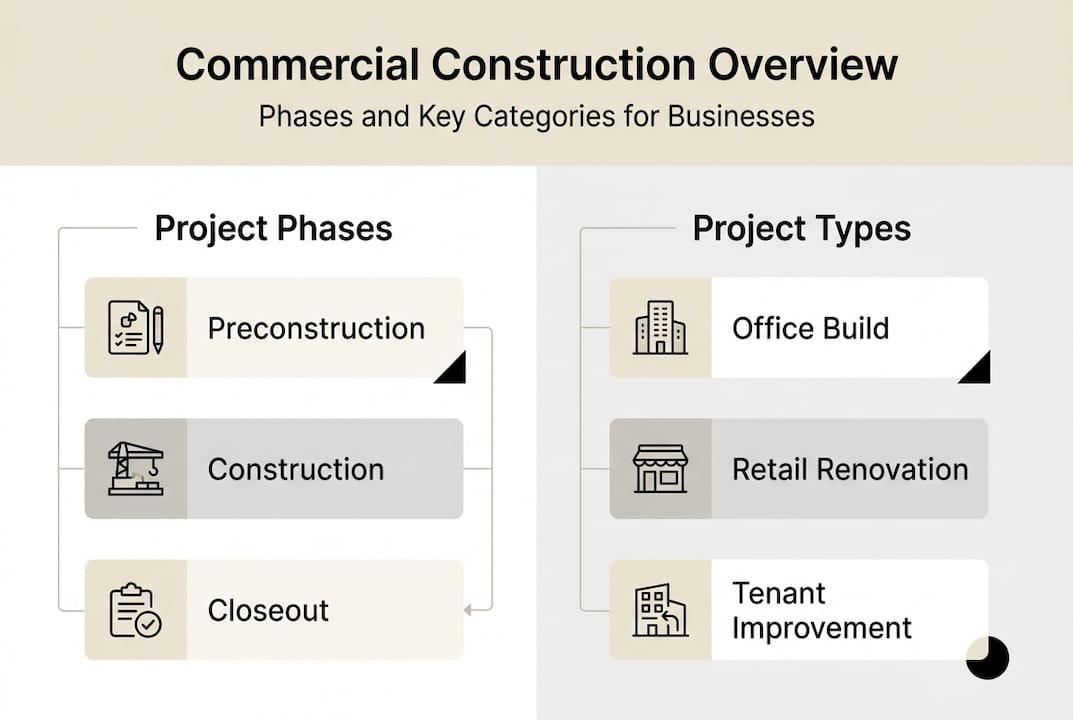
Commercial construction refers to the planning, building, renovation, and expansion of properties used for business or public purposes. Commercial construction covers offices, retail, hospitality, institutional, and mixed-use properties. It also includes tenant improvements (TI), which are modifications made to a leased space to suit a specific occupant's needs, and shell and core work, which refers to the base structure and building systems delivered before any tenant fit-out begins.
Understanding what category your project falls into matters. A new office build, a restaurant renovation, a retail build-out, and a hotel expansion all qualify as commercial construction, but each carries distinct code requirements, material standards, and permitting processes. You can explore examples of Vancouver commercial projects to see how these categories play out in real builds across the region.
Here is a quick comparison of the three main construction categories:
| Feature | Residential | Commercial | Industrial |
|---|---|---|---|
| Primary use | Living spaces | Business/public | Manufacturing/storage |
| Typical codes | BC Building Code Part 9 | BC Building Code Part 3 | Specialized zoning/codes |
| Fire requirements | Standard | Enhanced | Varies by use |
| Accessibility | Limited | Mandatory | Limited |
| Project complexity | Lower | High | High |
Key terms every owner should know:
- Tenant improvement (TI): Work done to customize a leased space for a specific tenant
- Shell and core: Base building structure, envelope, and primary systems without interior finishes
- Build-out: The process of completing interior spaces from a shell condition
- Occupancy classification: The designated use of a building or space, which determines applicable codes
Working with local construction companies that understand these distinctions can prevent costly reclassification issues mid-project.
Phases of a commercial construction project
Every commercial project moves through a defined sequence of stages. Skipping or rushing any one of them is a reliable path to budget overruns and schedule delays.
- Preconstruction: This is where design, budgeting, site analysis, and permit strategy happen. Decisions made here shape everything that follows, including total cost and timeline.
- Procurement and bidding: Subcontractors and suppliers are selected. Contracts are finalized. Material lead times are confirmed.
- Construction execution: Site preparation, structural work, mechanical and electrical rough-in, framing, finishes, and systems installation all take place in this phase.
- Closeout: Final inspections, deficiency corrections, occupancy permit applications, and handover documentation complete the project.
The key phases of commercial construction, from preconstruction through closeout, each carry distinct deliverables and decision points that affect the final outcome. Understanding permit requirements in Vancouver early in preconstruction is especially important, since permit timelines in Metro Vancouver can add weeks or months to a project schedule if not anticipated.
Here is a general timeline reference by project type:
| Project type | Typical duration | Key deliverables |
|---|---|---|
| Tenant improvement (small) | 8 to 12 weeks | Permit, fit-out, occupancy |
| Tenant improvement (large) | 12 to 20 weeks | Full design, systems, finishes |
| New commercial build | 6 to 18 months | Full design, permits, construction |
| Restaurant renovation | 10 to 16 weeks | Ventilation, code compliance, fit-out |
Pro Tip: Invest serious time in preconstruction. The decisions made before a single wall goes up, including delivery method, material specs, and permit strategy, determine whether your project finishes on time and on budget.
Materials, building codes, and regulations in Metro Vancouver
Commercial construction demands materials and systems that residential projects rarely require. The reasons are practical: higher occupancy loads, fire risk, seismic exposure, and public accessibility all require stronger, more durable assemblies.
Common material and system requirements in commercial builds include:
- Structural steel and reinforced concrete for load-bearing frames and floor systems
- Fire-rated assemblies including walls, ceilings, and doors rated for 1 to 2 hours of fire resistance
- Seismic bracing and connections to meet BC's high-risk seismic zone requirements
- Accessible design elements such as wider doorways, compliant restrooms, and barrier-free paths of travel
- Zero-carbon ready systems including high-efficiency HVAC and electrical infrastructure aligned with Vancouver's energy targets
All commercial projects in Metro Vancouver must comply with the BC Building Code 2024 and Vancouver Building By-law 2025, which set the standards for fire safety, seismic performance, accessibility, and energy efficiency. These are not optional guidelines. They are enforceable legal requirements.
Failing to meet commercial code requirements does not just result in a failed inspection. It can trigger mandatory retrofits, occupancy delays, and significant liability exposure for property owners and tenants alike.
Learning about sustainable commercial materials is increasingly relevant as Vancouver tightens its zero-carbon building requirements for new and renovated commercial spaces.
Pro Tip: Before approving any contractor's scope of work, ask for written documentation confirming code compliance strategy, including how seismic, accessibility, and energy performance requirements will be addressed.
Cost drivers and commercial construction budgets
Commercial construction in Metro Vancouver is expensive. Understanding why helps you evaluate bids accurately and avoid being misled by unrealistically low numbers.
Here is a sample cost reference for common commercial project types based on 2026 benchmarks:
| Project type | Estimated cost per sq ft | Notes |
|---|---|---|
| Basic office TI | $80 to $130 | Standard finishes, limited systems work |
| Mid-range office fit-out | $130 to $220 | Full systems, quality finishes |
| High-end office fit-out | $220 to $350+ | Custom millwork, premium materials |
| Retail build-out | $100 to $200 | Varies by finish level and systems |
| Restaurant renovation | $200 to $400+ | Ventilation, plumbing, fire suppression |
Office fit-out cost benchmarks show that TI allowances in Canada typically range from $50 to $100 per square foot, often falling short of actual fit-out costs in high-demand markets like Vancouver.
The main cost drivers in commercial construction are:
- Code compliance: Fire, seismic, and accessibility upgrades add significant cost, especially in older buildings.
- Specialized labor: Commercial projects require licensed trades including electricians, plumbers, and HVAC technicians working under strict supervision.
- Material strength requirements: Heavier structural and fire-rated materials cost more than standard residential equivalents.
- Project phasing: Occupied building work requires careful scheduling, which adds labor hours and coordination costs.
- Engineering and design: Structural, mechanical, and electrical engineering fees are standard on commercial projects and add to total cost.
For context on how interior renovation cost factors compare between residential and commercial projects, the gap is significant. Reviewing future trends impacting cost can also help you plan for where prices are heading in 2026 and beyond.
Edge cases and special scenarios in Metro Vancouver
Not every commercial project is straightforward. Several situations add layers of complexity that business operators need to anticipate.
TI levels and upgrade triggers: The scope of a tenant improvement determines whether path-of-travel upgrades are required. TI projects triggering accessibility and path-of-travel upgrades under BC regulations can add unexpected cost to what seemed like a simple renovation. Higher-level TIs involving occupancy changes almost always trigger broader compliance requirements.
Key edge case scenarios to know:
- Restaurant and food service: NFPA 96 ventilation standards require commercial hood systems, grease duct enclosures, and fire suppression, all of which require specialized contractors and inspections
- Occupied building phasing: Renovating while tenants remain in the building requires careful sequencing, noise management, and temporary barrier construction to minimize disruption
- Landlord turnkey vs. tenant-managed allowance: In a turnkey arrangement, the landlord manages the build to a defined spec. In an allowance structure, the tenant manages the work and is reimbursed up to a per-square-foot cap. Each model carries different risk and control
- Seismic retrofits: Older commercial buildings in Metro Vancouver may require seismic upgrades when significant renovations trigger reassessment under current code
- Change of use: Converting a retail space to a restaurant or a warehouse to office use triggers a full occupancy reclassification review
Exploring common Metro Vancouver TI solutions can help you understand what a well-structured tenant improvement project looks like before you begin negotiations with a landlord or contractor.
What most guides miss about commercial construction
Most articles about commercial construction focus heavily on the execution phase. They describe what happens on site, which trades show up, and how inspections work. That information is useful, but it misses the point.
The decisions made before construction begins determine most of the outcome. Budget accuracy, schedule realism, code compliance strategy, and contractor alignment are all set during preconstruction. By the time shovels are in the ground, the major risks are already locked in or mitigated.
Delivery methods like design-build and prefabrication can dramatically reduce timelines and cost, but only when selected and structured at the very start of a project. Retrofitting these approaches mid-stream rarely works.
The cheapest bid is also the most common source of project failure. A low number often reflects missing scope, underestimated compliance costs, or inadequate contingency. Reviewing renovation trends in 2026 shows that Metro Vancouver's regulatory environment continues to tighten, which means the gap between a realistic budget and an optimistic one keeps growing. Demand thorough preconstruction from your contractor. It is the most valuable service they can provide.
How Multigroup helps Metro Vancouver businesses
For property owners and business operators navigating commercial construction in Metro Vancouver, having an experienced local team matters.

Multigroup Contracting delivers full-service commercial construction, from tenant improvements and retail build-outs to new commercial builds, with complete permit handling, scheduling, and compliance management built in. As Metro Vancouver commercial construction experts, we understand the local codes, the permit timelines, and the practical realities of building in this region. Whether you need tenant improvement solutions for a new lease or a full commercial renovation, we are ready to walk you through your options with no obligation. Reach out to schedule a consultation with our team.
Frequently asked questions
How long do commercial tenant improvement projects usually take in Metro Vancouver?
Most TI projects in Vancouver span 8 to 16 weeks from start to finish, depending on scope and permitting timelines.
Why are commercial construction costs higher than residential?
Commercial projects cost more due to stricter code requirements, stronger materials, larger specialized trade teams, and more complex coordination compared to residential builds.
What building codes should Metro Vancouver commercial projects meet in 2026?
All projects must comply with the BC Building Code 2024 and Vancouver Building By-law 2025, covering seismic performance, accessibility, fire safety, and energy efficiency.
What triggers major upgrades during tenant improvements?
Significant occupancy changes or high-level TI scopes can trigger path-of-travel and full accessibility upgrades under BC and Vancouver regulations.
What is a TI allowance?
A TI allowance is a landlord-provided budget for tenant improvements, typically expressed as a per-square-foot dollar amount that covers specified work or reimburses tenant-managed construction costs up to a set limit.
Recommended
- Commercial buildout guide: 5 phases Vancouver tenants need
- What is a general contractor? Your guide to construction success
- Multigroup Contracting | Vancouver General Contractor – Commercial & Residential Construction
- Multigroup Contracting | Vancouver General Contractor – Commercial & Residential Construction