
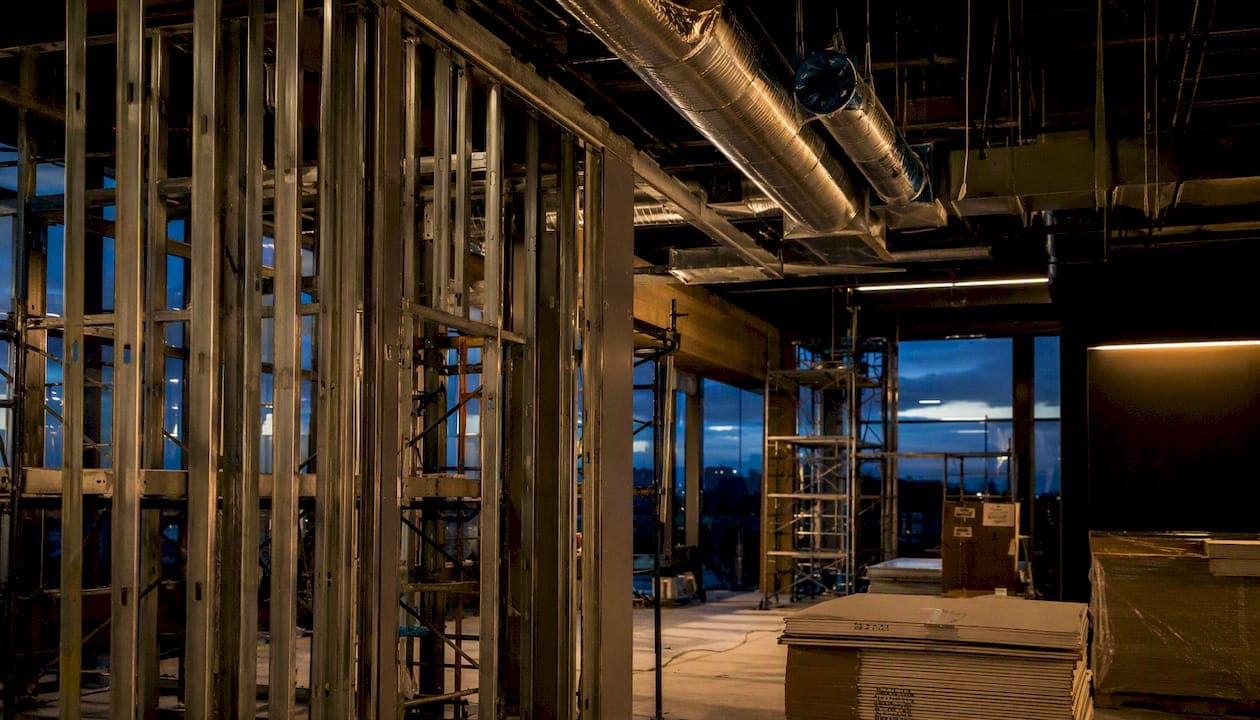
For Metro Vancouver projects, Multigroup Contracting is the most immediately suitable Canadian alternative to coastlinedevelopment.ca. The firm is a licensed BC general contractor with focused expertise in tenant improvements, retail buildouts, warehouse renovations, and medical fit-outs across Metro Vancouver, plus cross-border capacity in Seattle and Portland.
If your project falls outside Metro Vancouver, or you want to compare categories before contacting anyone, the shortlist below covers the main contractor types worth evaluating:
- Full-service Vancouver general contractor (tenant improvements, retail, warehouse, medical, residential)
- Regional tenant improvement specialist (office and medical fit-outs, leasehold improvements)
- Retail buildout specialist (franchise rollouts, store fit-outs, coffee shop renovations)
- Industrial/warehouse renovator (mezzanines, dock modifications, warehouse conversions)
Pro Tip: Request a scoped proposal early. Multigroup handles permit management and scheduling as part of its service, which shortens your pre-construction phase considerably. Contact the team via the Retail Buildout Vancouver or Tenant Improvements page to get a ballpark estimate.
Table of Contents
- How do the main contractor categories compare?
- How do you choose the right alternative contractor?
- Quick-read profiles for each contractor category
- What licences, bonds, and insurance should you verify?
- Why Multigroup is a strong Canadian alternative
- Key takeaways
- Local GC vs. national firm: which fits your project?
- Multigroup is ready to scope your Metro Vancouver project
- Sources and further reading
- FAQ
How do the main contractor categories compare?
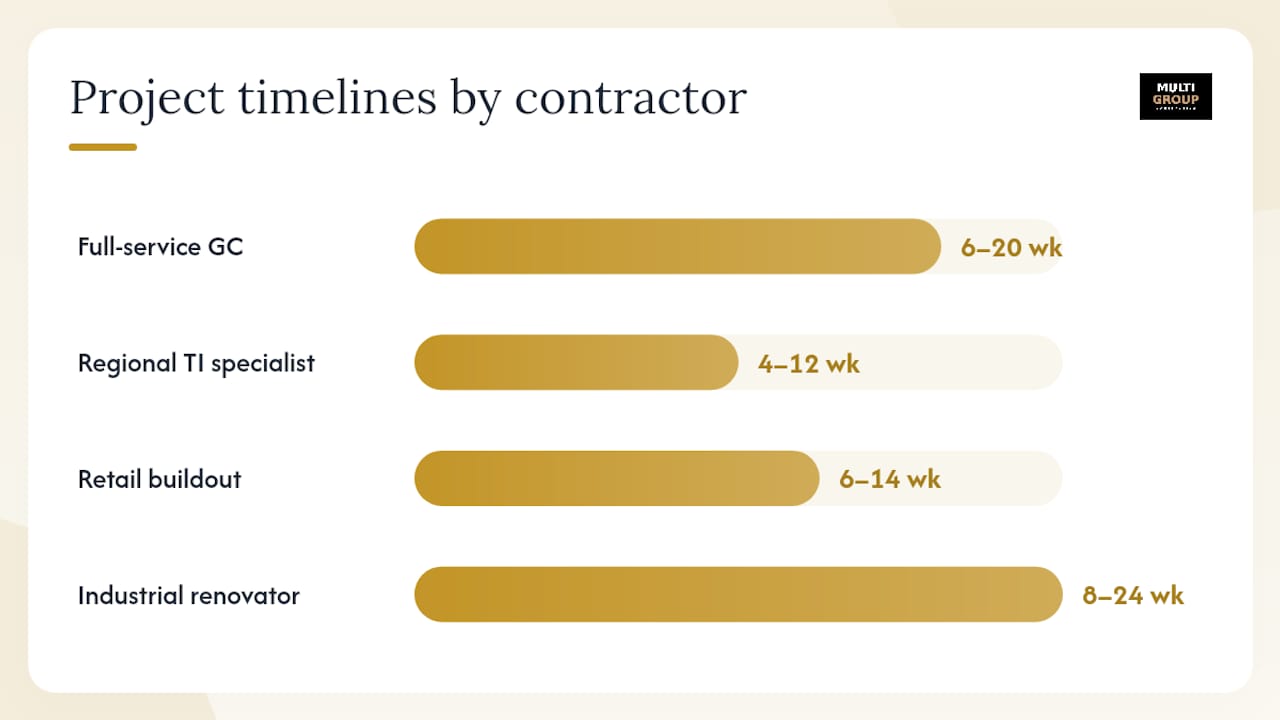
The table below maps the four shortlisted categories against the criteria that matter most when replacing or vetting an alternative to coastlinedevelopment.ca.
| Criterion | Full-service Vancouver GC (Multigroup) | Regional TI specialist | Retail buildout specialist | Industrial/warehouse renovator |
|---|---|---|---|---|
| Primary services | TI, retail buildout, warehouse, medical, residential | Office/medical TI, leasehold improvements | Franchise rollouts, store fit-outs | Mezzanines, dock work, warehouse conversions |
| Service area | Metro Vancouver + Seattle/Portland | Typically one metro area | Often multi-city or national | Regional/provincial |
| Company size & capacity | Mid-size; handles complex commercial TI | Small-to-mid; strong on fit-outs | Varies; some national scale | Mid-to-large; industrial focus |
| Portfolio relevance | Broad commercial + residential gallery | Narrow but deep in TI | Strong franchise track record | Industrial case studies |
| BC licence, WCB, bonding | BC licensed, WCB compliant | Verify per firm | Verify per firm | Verify per firm |
| Typical pricing model | Fixed-price and cost-plus; CAD estimates provided | Fixed-price common | Fixed-price; franchise pricing guides | Cost-plus common |
| Project timeline | 6–20 weeks depending on scope | 4–12 weeks | 6–14 weeks | 8–24 weeks |
| Client references/case studies | Project gallery + testimonials on site | Request directly | Request directly | Request directly |
| Sustainability/certifications | BC Building Code compliance; LEED-ready | Varies | Varies | Varies |
Decisive differences to note:
- A full-service Vancouver GC like Multigroup manages permits, scheduling, and trades under one contract, reducing coordination risk on complex TI projects.
- A regional TI specialist suits smaller medical or office fit-outs where deep leasehold experience outweighs breadth.
- Retail buildout specialists are worth contacting for national franchise rollouts where standardised drawings already exist.
- Industrial renovators are the right call for dock-to-dock warehouse modifications, seismic upgrades, or large-footprint conversions.
Commercial construction in Canada requires stronger bonding, insurance controls, and organised vendor selection than residential work, which means the category you choose must be able to demonstrate those credentials, not just claim them.
How do you choose the right alternative contractor?
Start with portfolio fit, not price. A contractor whose recent projects match your project type (retail, medical, warehouse) will carry fewer surprises into your build than a generalist offering the lowest number. Industry research cautions against choosing strictly by lowest tender; proven niche experience and proactive change-order management are stronger predictors of a successful outcome.
Vetting questions to ask on your first call:
- What is your BC contractor licence number, and can you provide a current WCB clearance letter?
- What is your bonding capacity, and have you bonded projects of this size before?
- Can you share two or three recent TI or retail buildout projects with contact references?
- What does your change-order process look like, and how do you document scope changes?
- What is your current availability, and what is a realistic start date for a project of this scope?
- Who manages permits, and which inspections do you handle directly?
Pre-bid information packet — prepare these before reaching out:
- Architectural drawings or a sketch of the space (even rough dimensions help)
- A one-page scope outline listing key trades (electrical, plumbing, HVAC, millwork)
- Occupancy constraints (operating business, phased handover, noise restrictions)
- Target opening or occupancy date
- Landlord TI allowance amount, if applicable
Pro Tip: Three red flags that should end a shortlisting conversation: a contractor who cannot produce a BC licence number on request; a bid that excludes permit fees and WCB costs without explanation; and a firm with no verifiable references for projects in your category. Realistic planning, proven coordination, and proactive schedule management matter far more than a low opening number.
Well-planned tenant improvement projects for larger office renewals typically require 4–8 months to identify credible alternatives and tour spaces, followed by another 6–10 months to negotiate and complete construction. Build that timeline into your planning before you send the first RFP.
Quick-read profiles for each contractor category
Multigroup Contracting (recommended pick)
Services: Tenant improvements, retail buildouts, warehouse renovations, medical fit-outs, restaurant/coffee shop renovations, office renovations, residential custom builds. Service area: Metro Vancouver (Burnaby, Richmond, Surrey, Coquitlam, North Vancouver, West Vancouver, New Westminster, Langley, Delta), Seattle WA, Portland OR. Credentials: BC licensed general contractor, WCB compliant, permit management included. Ideal for: Property managers and business owners who need a single point of accountability from permit application through to handover.
"Contractors that invest in trade coordination, supplier relationships, and early planning deliver projects that meet regulations and client expectations — the firms that skip this step are the ones that generate change-order disputes mid-build." — Constructem, commercial construction planning guide
What to include in your RFP to Multigroup: space address, square footage, project type, target completion date, and any landlord TI allowance details. The team will respond with a ballpark CAD estimate and a proposed project timeline.
Pro Tip: Multigroup's project gallery includes completed retail, warehouse, and medical fit-outs. Review it before your first call so you can reference comparable projects and get a more precise estimate faster.
Regional TI specialist
Typically a smaller firm (5–15 staff) with deep experience in office and medical leasehold improvements. Strong on permit navigation for specific municipalities. Best suited to fit-outs under 5,000 sq ft where the scope is well-defined and the landlord's base building drawings are already available. Ask for references from medical or professional office clients specifically.
Retail buildout specialist
These firms often work from standardised franchise drawings and can move quickly once permits are issued. Capacity varies widely: some handle single-location rollouts, others manage national programmes. Confirm they have experience with BC municipal permitting, not just Alberta or Ontario, since approval timelines and inspection requirements differ.
Industrial/warehouse renovator
Focused on larger-footprint projects: mezzanine installations, dock leveller replacements, seismic tie-downs, and warehouse-to-office conversions. Bonding capacity tends to be higher. Phased planning and disciplined management are especially important at this scale, so ask for a sample project schedule from a comparable industrial project before signing.
For additional regional comparisons, the Metro Vancouver contractor alternatives guide on the Multigroup blog covers shortlisting criteria for similar searches.
What licences, bonds, and insurance should you verify?
Always confirm four things before signing with any BC contractor: a valid BC contractor licence, a current WCB clearance letter, a certificate of insurance with adequate limits, and evidence of bonding capacity for your project size.
Documents to request:
- BC contractor licence number (verify at BC Housing's Homeowner Protection Office registry)
- WCB clearance letter dated within the last 30 days
- Certificate of insurance showing general liability (minimum $2 million per occurrence is a common commercial threshold), employer's liability, and course-of-construction coverage
- Surety bond or letter of bonding capacity from the contractor's surety provider
- Professional liability certificate if the contractor is providing design-build services
Verification steps:
- Search the BC Housing registry online to confirm the licence is active and in good standing.
- Request the WCB clearance letter directly from the contractor and cross-check the account number with WorkSafeBC.
- Confirm the insurance certificate names your company as an additional insured and that the policy expiry covers your full project duration.
- Ask the surety provider directly if the bonding capacity stated covers your contract value.
Commercial projects require stronger bonding and insurance controls than residential work, and mid-sized GCs that cannot demonstrate adequate bonding capacity are a practical risk on contracts above $500,000 CAD.
On sustainability certifications: LEED certification matters most for office TI projects where the landlord or tenant has a corporate sustainability mandate. Passive House is relevant for residential custom builds. For most retail buildouts and warehouse renovations, BC Building Code compliance and energy-efficient mechanical systems are the practical baseline. Ask whether the contractor has worked on LEED-registered projects if that credential is a requirement for your lease or corporate policy.
Why Multigroup is a strong Canadian alternative
Multigroup is the recommended pick for Metro Vancouver tenant improvements and retail buildouts that require local permitting expertise. The firm's service area covers the full Metro Vancouver region, and its project management model includes permit handling, trade scheduling, and client communication under one contract.
Concrete differentiators:
- Licensed general contractor in BC with WCB compliance
- Specialised in TI, retail buildouts, warehouse renovations, and medical fit-outs
- Permit management and BC Building Code compliance built into the project scope
- CAD pricing estimates provided during the proposal stage
- Cross-border capacity for Seattle and Portland projects
- Project gallery and client testimonials available for review before engagement
For retail franchisees and restaurant operators, the retail buildout service page includes portfolio examples and scope guidance. Property managers and medical clinic owners evaluating leasehold improvements should review the tenant improvements landing page for service details and a direct proposal request.
Pro Tip: When comparing Multigroup to other options, ask each firm how they handle permit delays. A contractor who builds permit contingency into the schedule from day one is managing your project; one who treats it as a surprise is not.
Key takeaways
Multigroup Contracting is the recommended Metro Vancouver alternative to coastlinedevelopment.ca for tenant improvements and retail buildouts that require BC licensing, permit management, and local trade coordination.
| Point | Details |
|---|---|
| Start with portfolio fit | Match the contractor's recent project types to yours before comparing price. |
| Verify four credentials | BC licence, WCB clearance, insurance certificate, and bonding capacity are non-negotiable. |
| Budget realistic timelines | Permitting alone takes 3–8 weeks in Metro Vancouver; total TI projects run 6–20 weeks in construction. |
| Low bids carry hidden costs | Industry research shows lowest-tender selection increases change-order risk; prioritise value engineering and references. |
| Multigroup for Metro Vancouver | Licensed BC GC with TI, retail buildout, and warehouse expertise across Metro Vancouver, Seattle, and Portland. |
Local GC vs. national firm: which fits your project?
For most Metro Vancouver tenant improvements and retail buildouts, a local Vancouver GC wins on three practical grounds: permit familiarity, subcontractor relationships, and responsiveness. A local firm knows which municipalities move quickly and which require additional documentation. Their subtrades are already vetted and available in the region. When a site issue arises on a Tuesday afternoon, the project manager is reachable and can be on-site the same day.
National platforms have a genuine advantage in one scenario: a multi-site rollout across several provinces where brand consistency and standardised drawings matter more than local permitting speed. If you are opening 12 locations across BC, Alberta, and Ontario simultaneously, a national firm's coordination infrastructure may justify the trade-off in local responsiveness.
Post-construction support is worth asking about directly. Warranty periods, deficiency resolution timelines, and who handles a callback six months after handover vary significantly between firms. A local GC with a permanent Metro Vancouver office has a practical incentive to resolve deficiencies promptly; a national firm managing your project remotely may not.
Multigroup is ready to scope your Metro Vancouver project
Searching for coastlinedevelopment.ca alternatives often ends at a list of names with no clear next step. Multigroup offers something more direct: a licensed BC general contractor with permit management, trade coordination, and CAD pricing estimates built into the proposal process, covering Metro Vancouver from Burnaby to Langley and cross-border into Seattle and Portland.
To get a reliable ballpark estimate, prepare a one-page scope (space address, square footage, project type, target date, and any landlord TI allowance), then submit it through the Tenant Improvements or Retail Buildout Vancouver page. The team will respond with a scoped proposal and a realistic project timeline based on current Metro Vancouver permitting conditions.
Sources and further reading
Authoritative references used in this article, plus resources for independent verification:
- Commercial Construction Projects: What Sets Them Apart | Procore CA
- Commercial tenant improvement project management: what Canadian CFOs need to know | ENCOR Advisors
- Step‑by‑step how to plan a successful commercial construction project | Constructem
- Commercial construction contractor: what to look for before hiring | Credence Construction Ltd
- Construction project management in Canada: key steps | Credence Construction Ltd
- Tenant Improvements (TI) | Multigroup Contracting
- Retail buildout Vancouver | Multigroup Contracting
FAQ
What makes a BC contractor a credible alternative to coastlinedevelopment.ca?
A credible BC alternative holds a valid BC contractor licence, carries current WCB clearance and commercial insurance, and has a verifiable portfolio of projects matching your type (TI, retail, warehouse). Multigroup meets all three criteria for Metro Vancouver projects.
How long does a typical tenant improvement take in Metro Vancouver?
Permitting can take several weeks depending on the municipality; construction duration varies widely based on project scope. ENCOR Advisors notes that identifying credible alternatives and completing negotiations can add 4–8 months before construction even starts on larger office renewals.
What ballpark CAD cost should I budget for a retail buildout in Vancouver?
A small retail buildout under 1,000 sq ft generally costs tens of thousands CAD; medium fit-outs in the low hundreds of thousands are typical. Upgrades and special requirements increase costs.
Why does the lowest bid often cause problems on commercial projects?
Industry research shows that the lowest tender frequently omits soft costs, permit fees, and risk buffers. Firms that win on price alone tend to recover margin through change orders mid-build, which disrupts schedules and inflates final costs.
Does Multigroup handle projects outside Metro Vancouver?
Multigroup's primary service area is Metro Vancouver, covering Burnaby, Richmond, Surrey, Coquitlam, North Vancouver, West Vancouver, New Westminster, Langley, and Delta. The firm also takes on commercial projects in Seattle, WA and Portland, OR.