

TL;DR:
- Effective Vancouver clinic renovations require careful workflow optimization, regulatory compliance, and patient experience design.
- Failing to map journeys or involve staff early increases costs and reduces operational efficiency.
Clinic renovations are rarely as straightforward as repainting walls and replacing furniture. For Vancouver clinic owners and managers, the real challenge lies beneath the surface: workflow inefficiencies that frustrate staff, regulatory layers that govern every fixture and finish, and patient experience gaps that no amount of new flooring can fix. A renovation that overlooks these dimensions may look polished on the surface but still underperform operationally. This guide walks through the planning, budgeting, and compliance considerations that actually determine whether a clinic renovation succeeds or falls short.
Table of Contents
- Clinic renovation essentials: Beyond the basics
- Mapping patient and staff journeys for smoother operations
- Navigating Vancouver regulations and standards
- Budgeting your clinic renovation: Vancouver cost benchmarks
- What most clinic owners miss in Vancouver renovations
- Next steps: Partner with Vancouver clinic renovation experts
- Frequently asked questions
Key Takeaways
| Point | Details |
|---|---|
| Workflow matters most | Optimizing patient and staff routes is more vital than aesthetics alone. |
| Regulations drive design | Local and CSA standards shape nearly every aspect of clinic renovations. |
| Budget for compliance | Set aside funds for regulatory upgrades and unplanned contingencies. |
| Engage early | Involve staff and patients in planning to identify real needs and avoid bottlenecks. |
Clinic renovation essentials: Beyond the basics
Building on the need to look beyond aesthetics, let's establish the foundational requirements for effective clinic renovations. Many clinic owners approach renovation as a visual refresh. In reality, clinic renovation projects involve front-end design considerations for patient and staff workflow, including reducing bottlenecks and mapping patient journeys, plus healthcare-specific regulatory layers covering accessibility, infection control, and privacy. These factors shape every decision from layout to material selection.
Workflow optimization is the backbone of any well-functioning clinic. When patients and staff move through a space without confusion or delay, clinical operations run more efficiently and patient satisfaction improves naturally. Poor workflow, on the other hand, causes congestion at reception desks, crowded hallways, and delays between check-in and care.
Key design elements that directly influence workflow and patient experience include:
- Reception flow: The reception area sets the tone for a patient's entire visit. Clear sightlines, accessible check-in stations, and sufficient waiting space prevent immediate bottlenecks.
- Accessible exam rooms and washrooms: British Columbia's accessibility standards require that exam rooms accommodate patients with mobility aids and that washrooms meet specific dimensional and fixture requirements.
- Soundproofing and privacy measures: Conversations between patients and staff must remain confidential. Acoustic insulation in walls, floors, and ceilings is a non-negotiable element of exam room and consultation room design.
- Infection control materials: Surface finishes, flooring types, and cabinetry materials must support cleanability and minimize cross-contamination risk.
Effective clinic design is not just about creating a pleasant environment. It is about engineering a space where every transition, from entrance to exam room to exit, supports both patient well-being and staff performance.
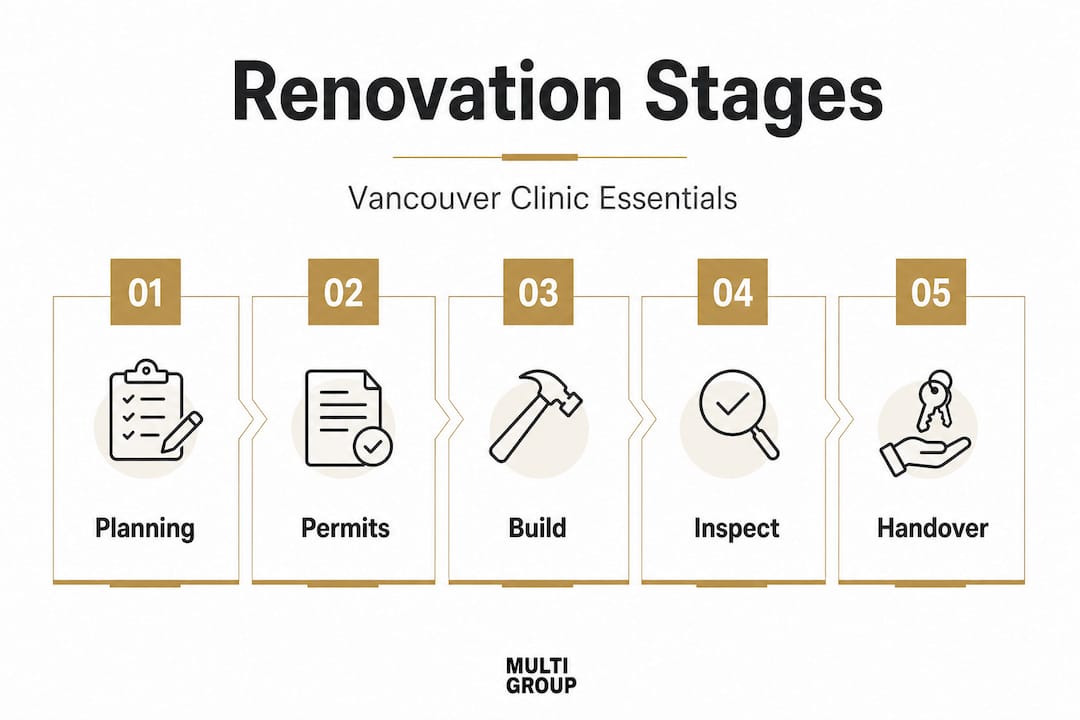
Two of the most common pitfalls in clinic renovations are ignoring journey mapping and underestimating the regulatory scope. Owners who skip journey mapping often discover post-renovation that staff still struggle with inefficient routes or that patients experience confusion finding exam rooms. Those who underestimate regulations face costly mid-project changes when inspectors require compliance upgrades. Thoughtful office buildout planning from the earliest stage prevents both issues. Reviewing detailed Vancouver clinic renovation steps early in your project is also valuable preparation.
Good design workflow in renovations starts with understanding how people physically move through a space before a single wall is touched.
Mapping patient and staff journeys for smoother operations
Once essentials are clarified, zero in on how journey mapping transforms space utilization and workflow. Journey mapping is the process of tracing every step a patient or staff member takes through a clinic, from parking and entry to check-in, waiting, examination, and discharge. It is a practical tool that reveals where people slow down, get confused, or feel uncomfortable. When applied to clinic design, it consistently uncovers layout problems that are invisible on a floor plan but disruptive in real use.
Flow and wayfinding guidance confirms that patients should move smoothly from reception to exam rooms without bottlenecks, and that designs must also address soundproofing, privacy, and accessible exam and washroom considerations. These are not optional design preferences. They are operational requirements that affect staff performance and patient outcomes.

The difference between a traditional layout and an optimized patient-centered design is significant:
| Feature | Traditional layout | Patient-centered design |
|---|---|---|
| Reception placement | Often near main entrance, minimal queuing space | Positioned for clear sightlines and natural patient flow |
| Exam room access | Accessible from shared corridor, limited privacy | Direct access from waiting area with visual and acoustic separation |
| Wayfinding signage | Minimal or absent | Clear, consistent signage at every decision point |
| Staff circulation | Overlaps with patient pathways | Separate staff corridors reduce congestion and privacy risks |
| Waiting area | Generic seating arrangement | Zoned seating with accessibility features and natural light |
| Washroom access | Often at end of corridor | Positioned close to exam rooms for patient convenience |
To translate journey mapping into actionable renovation decisions, follow these steps:
- Document the current patient path: Walk through your clinic as a patient would and note every moment of confusion, delay, or discomfort. Photograph bottlenecks.
- Map staff circulation separately: Identify where staff paths overlap with patient paths and where they should be separated for both efficiency and privacy.
- Identify regulatory constraints: Note where existing doorway widths, washroom dimensions, or ceiling heights may fall short of accessibility standards.
- Develop layout alternatives: Work with a contractor or designer to sketch two or three layout options that address the issues identified.
- Validate with staff and patients: Share proposed layouts with your team and, where possible, gather patient feedback through surveys or focus groups.
- Prioritize changes by impact: Rank proposed changes by how much they improve workflow or regulatory compliance versus cost.
Pro Tip: Involve your clinical staff in the journey mapping process before design decisions are finalized. Nurses, medical assistants, and front desk staff move through the space hundreds of times daily and will identify practical problems that designers and managers often miss. Their input typically results in fewer costly revisions during construction.
The payoff from thorough journey mapping is measurable. Clinics that redesign around patient flow report shorter perceived wait times because patients feel progress rather than stagnation. Staff report less frustration when circulation is logical. Incorporating these insights early through office buildout strategies leads to smoother builds with fewer mid-project scope changes.
Navigating Vancouver regulations and standards
With operational flow mapped, attention must shift to Vancouver's regulatory environment, which shapes every phase of renovation. The regulatory framework governing clinic renovations in British Columbia is more complex than most owners anticipate. It operates at several levels simultaneously: municipal bylaws specific to Vancouver, provincial health facility guidelines, and national standards set by bodies like the Canadian Standards Association (CSA).
Major renovation and maintenance work in British Columbia may need to meet current standards specified in CSA references, as outlined in College of Physicians and Surgeons of BC guidance. This means that even a renovation framed as maintenance or cosmetic improvement may trigger the need to bring specific systems or finishes up to current CSA standards. It is not enough to meet the code that was in effect when the clinic was originally built.
Key standards to verify before beginning any clinic renovation in Vancouver include:
- CSA Z8000: The Canadian Health Care Facilities standard, which covers planning, design, construction, and commissioning of health care facilities.
- BC Building Code accessibility requirements: Doorway widths, turning radii for mobility devices, accessible washroom configurations, and ramp gradients all have specific measurements that must be met.
- Infection prevention and control (IPAC) guidelines: Surface materials, sink placement, and ventilation rates in exam rooms and procedure rooms are governed by IPAC standards issued provincially.
- Vancouver building permit requirements: Any work that changes the use of a space, alters structural elements, modifies plumbing or electrical systems, or changes HVAC configuration will require a permit from the City of Vancouver.
- Privacy-related construction standards: Wall assemblies between exam rooms must achieve specific Sound Transmission Class (STC) ratings to meet privacy requirements under provincial health information legislation.
The consequences of non-compliance are serious. Clinics that proceed without proper permits face stop-work orders that can delay a project by weeks or months. Spaces that do not meet accessibility standards cannot legally operate as patient-facing healthcare facilities. And infection control deficiencies can result in health authority inspections and required remediation at significant additional cost.
Referencing Canadian building codes from the outset provides a useful baseline, though healthcare-specific overlays always apply on top of general building code requirements.
Proactively engaging with Vancouver renovation standards from the planning stage, rather than waiting for regulatory guidance mid-project, is the single most effective way to avoid compliance-driven delays and budget overruns.
Budgeting your clinic renovation: Vancouver cost benchmarks
After regulatory groundwork, tackling budget planning ensures your renovation stays both compliant and within financial targets. Clinic renovations involve two broad cost categories: hard costs and soft costs. Hard costs cover physical construction work, including demolition, framing, mechanical systems, electrical, plumbing, flooring, millwork, and finishes. Soft costs cover everything else: design fees, permit fees, technology installation, furniture, fixtures and equipment (FF&E), and regulatory compliance upgrades.
A widely used industry benchmark for medical outpatient building fit-out puts costs at $412 per square foot all-in for 2026, covering a warm white-box fit-out. This figure provides a realistic starting point for Vancouver planning, though local labor costs, material pricing, and the specific scope of compliance upgrades will influence the final number.
| Cost category | Typical components | Approximate share of total budget |
|---|---|---|
| Hard costs (construction) | Demolition, framing, MEP systems, finishes | 55-65% |
| Technology and AV | Patient management systems, digital signage, security | 8-12% |
| FF&E | Exam room furniture, reception stations, seating | 10-15% |
| Permits and fees | City of Vancouver permits, inspections, professional fees | 6-10% |
| Regulatory compliance | Accessibility upgrades, IPAC materials, acoustic work | 8-12% |
To build a reliable renovation budget, follow these steps:
- Start with a scope definition: Document every space that will be affected, every system that may need upgrading, and every regulatory requirement that applies.
- Get contractor pre-consultation: A Vancouver-based general contractor familiar with healthcare renovations can flag likely compliance costs before design begins.
- Obtain multiple quotes: Get at minimum three detailed quotes from contractors with documented healthcare renovation experience.
- Separate hard and soft costs: Track these separately to identify where overruns are occurring and where contingency funds should be allocated.
- Set a contingency reserve: Healthcare renovations consistently encounter unexpected findings, particularly in older buildings with concealed plumbing, outdated electrical panels, or unaddressed asbestos.
Pro Tip: Budget a minimum 10 to 15 percent contingency on top of your total estimated cost specifically for unplanned regulatory upgrades. In older Vancouver buildings, it is common to discover mid-renovation that existing systems do not meet current standards, and addressing them becomes a condition of permit approval.
Technology investment in particular is a rising cost driver. Integrated patient management systems, electronic health record workstations, digital wayfinding displays, and enhanced security systems can add substantially to a project budget that might otherwise focus mainly on physical construction.
Reviewing Metro Vancouver construction best practices and construction project management tips will help you understand how to structure your project timeline to reduce carrying costs and keep budget performance on track throughout the build.
What most clinic owners miss in Vancouver renovations
Having covered the practical elements, this section distills field experience and reveals what really matters in renovation success. Most clinic owners spend a disproportionate amount of time focused on the look of their space: paint colors, reception desk style, lighting fixtures. These choices matter, but they rarely determine whether a renovation actually improves clinic performance. What does determine performance is something less visible.
The most common oversight is treating regulatory compliance as a checkbox to handle near the end of the project rather than a design driver from the beginning. When compliance requirements enter a project late, they trigger redesigns, material substitutions, and budget revisions that are far more expensive than if they had been incorporated from the start. Proactive planning around CSA standards, IPAC requirements, and accessibility minimums from day one consistently produces better outcomes and fewer surprises.
The second most common oversight is failing to engage staff before design is finalized. Clinicians and support staff have specific, practical knowledge about how the space is actually used. A doctor might flag that the exam room door opens the wrong direction to preserve patient modesty. A nurse might point out that the sharps disposal placement creates an unsafe reach. A receptionist might identify that the proposed check-in layout creates a line that blocks the exit. None of these issues appear on a floor plan without input from the people who use the space daily.
The third oversight is waiting for problems to trigger action. Many clinics defer renovation until equipment fails, patient complaints accumulate, or an inspection identifies deficiencies. Proactive renovation planning, particularly around seamless patient transitions from reception to exam rooms without bottlenecks and with proper soundproofing, protects both patient satisfaction and clinical reputation.
What actually delivers improved patient experience is not new furniture or polished concrete floors. It is the feeling of moving through a space effortlessly, having conversations that feel private, and sensing that the environment was designed with care for the people using it. That outcome requires workflow thinking, regulatory diligence, and experienced project execution. The insider renovation guide and strong project management expertise are two resources worth consulting before finalizing any renovation plan.
Next steps: Partner with Vancouver clinic renovation experts
To move from understanding to action, here's how you can bring expert support into your project.
Clinic renovation in Vancouver involves far more than most owners anticipate when they begin planning. The combination of workflow optimization, regulatory compliance, patient experience design, and detailed budget management requires a contractor who understands healthcare construction specifically, not just general commercial renovations.

Multigroup Contracting brings local Metro Vancouver expertise to every stage of clinic renovation, from pre-design planning and permit handling through construction management and final inspection. We work alongside clinic owners and managers to identify compliance requirements early, map workflows before walls move, and deliver projects on schedule and within budget. Explore our local renovation expertise to see how a structured, step-by-step approach to clinic renovation in Vancouver leads to better outcomes for your practice and your patients.
Frequently asked questions
How long does a typical clinic renovation take in Vancouver?
Most clinic renovation projects require 3 to 6 months from permit approval to final occupancy, though complex regulatory approval processes or mid-project scope changes can extend timelines beyond that range.
What are the must-have features for a renovated clinic?
Accessible exam rooms, efficient reception flow, acoustic soundproofing for patient privacy, and infection control-compliant surfaces and fixtures are the non-negotiable elements of any effective clinic renovation.
What are current Canadian standards for clinic renovations?
Clinic renovation projects in BC must satisfy CSA standards, particularly for major maintenance and restoration work, as well as current standards specified in CPSBC guidance covering fixtures, finishes, and system requirements.
What is the average budget for a Vancouver clinic renovation?
Industry benchmarks place the 2026 fit-out cost at $412 per square foot all-in for medical outpatient facilities, with technology integration, accessibility upgrades, and regulatory compliance features driving variability in the final number.