

TL;DR:
- A building permit authorizes construction work and ensures compliance with safety codes and zoning laws.
- Failure to obtain it can lead to legal issues, fines, project delays, and property value loss.
A building permit is a legal document issued by your local municipality that authorizes you to build, alter, or demolish a structure in accordance with safety codes and zoning regulations. Every Canadian property owner or developer planning a construction or renovation project needs to understand this authorization before breaking ground. Skipping the permit process exposes you to stop-work orders, fines, and insurance complications that can derail even well-funded projects. In Metro Vancouver and across BC, the BC Building Code sets the baseline standard, while local Chief Building Officials administer and interpret requirements at the municipal level.
What is a building permit and when do you need one?
A building permit is the official municipal authorization confirming that your proposed construction meets the BC Building Code, local zoning bylaws, and safety standards. Without it, your project has no legal standing, regardless of how well it is built. The permit triggers an inspection process that verifies compliance at critical stages, from foundation to final occupancy.
Most Canadian municipalities legally require a permit for any new building, structural alteration, addition, or major renovation. That requirement is not optional or advisory. It is the law, and it applies whether you are a homeowner adding a bedroom or a developer building a commercial warehouse in Burnaby.
Projects that consistently require a permit include:
- New residential or commercial builds
- Structural alterations, including load-bearing wall removal
- Additions to existing buildings
- Plumbing and HVAC modifications
- Electrical panel upgrades or new circuits
- Decks above a certain height
- Demolitions
Common exemptions exist, but they are narrower than most property owners assume. Detached accessory buildings under 10 m² (approximately 107 ft²) are frequently exempt from a building permit, but they must still comply with local zoning setbacks. That distinction matters. Cosmetic work such as painting, flooring replacement, and cabinet installation typically does not require a permit, but any work touching structure, plumbing, or electrical usually does.
Pro Tip: Never assume a project is exempt based on what a neighbour did or what you read online. Municipal requirements vary significantly across Metro Vancouver. Always confirm with your local building department before starting work.
For a detailed breakdown of which projects cross the permit threshold, the types of construction permits guide covers structural versus cosmetic work in practical terms.
Why do I need a building permit?
A building permit protects three things: the safety of occupants, your legal standing as a property owner, and the long-term value of your investment. These are not abstract benefits. They have direct financial consequences.
Building permits ensure renovations meet safety standards that prevent structural failures, fire hazards, and health risks. Inspectors review plans before construction starts and visit the site at key milestones to confirm the work matches approved drawings. That process is what separates a compliant build from a liability.
Failing to obtain a required building permit can result in stop-work orders, fines, insurance claim denials, and forced removal of unauthorized structures. The financial and legal exposure from unpermitted work routinely exceeds the cost of the permit itself by a significant margin.
The consequences of skipping a permit compound over time. When you sell a property, buyers and their lawyers check for permits on any significant work. Unpermitted renovations can reduce sale prices, delay closings, or kill deals entirely. Lenders and insurers also scrutinize permit history. A fire safety incident in an unpermitted renovation can void your insurance coverage entirely, leaving you personally liable.
The inspection process itself adds value. Inspections typically occur at these stages:
- Foundation or footing
- Framing (before insulation or drywall)
- Rough-in plumbing, electrical, and HVAC
- Insulation
- Final inspection and occupancy sign-off
Each inspection is a checkpoint that confirms the work is safe and code-compliant. Missing one can require you to open walls or undo completed work. The role of permits in renovation covers these legal and financial risks in full detail.
How to get a building permit: the application process
The building permit application process follows a consistent structure across Canadian municipalities, though timelines and fees vary. Knowing what to prepare before you apply saves weeks of back-and-forth with the building department.
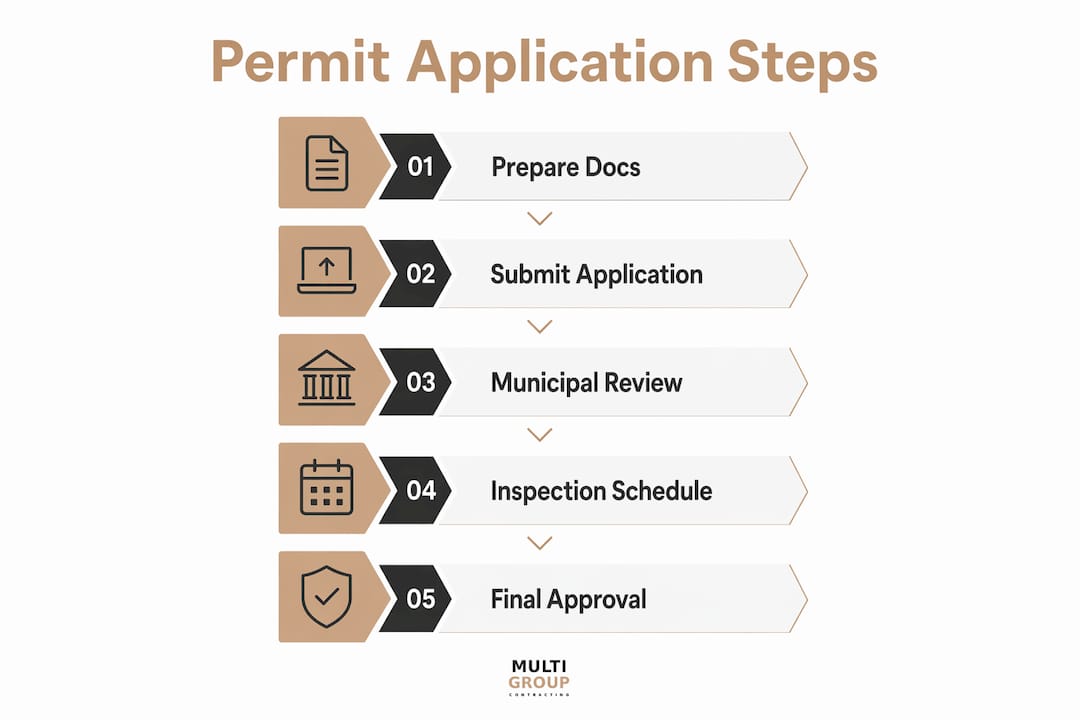
- Prepare your documents. Most municipalities require architectural drawings, site plans, structural calculations for complex projects, and a completed application form. For commercial projects, mechanical and electrical drawings are often required as well.
- Submit your application. Applications go to your local building department, either in person or through an online portal. Metro Vancouver municipalities including the City of Vancouver, Burnaby, and Surrey each have their own submission systems.
- Pay the permit fee. Municipal permit fees for residential projects often start around $200 CAD, with costs rising based on project scope and construction value. Commercial and multi-unit projects carry higher fees, sometimes calculated as a percentage of total construction value.
- Await municipal review. The building department reviews your submission against the BC Building Code and local zoning bylaws. Reviewers may request revisions or additional documentation.
- Receive approval and post your permit. Once approved, you receive the permit and must post it visibly on site. Construction can begin only after this point.
- Schedule inspections. You are responsible for booking inspections at each required stage. Missing an inspection can halt the project until the building department can verify compliance.
| Stage | Typical timeline | Notes |
|---|---|---|
| Document preparation | 1–4 weeks | Depends on project complexity |
| Municipal review | 2–10 weeks | Varies by municipality and project type |
| Revisions and resubmission | 1–3 weeks | If changes are requested |
| Permit issuance | 1–5 business days after approval | Fee payment triggers issuance |
| Final inspection | At project completion | Required before occupancy |
Pro Tip: Submit complete, accurate drawings the first time. Incomplete applications are the single most common cause of permit delays in Metro Vancouver. Hiring a licensed contractor or designer who knows local requirements reduces revision rounds significantly.
The permit process for renovations walks through each application step with practical guidance for homeowners and developers.
Building permits vs. zoning, development, and trade permits
Building permits and development permits are not the same thing. Confusing them is one of the most common mistakes property owners make, and it can stall a project before construction even begins.
Building permits and development permits serve different regulatory functions. A building permit focuses on construction safety and code compliance. A development permit addresses land use, setbacks, lot coverage, and how a building fits within its zoning designation. Many projects require both.
| Permit type | What it regulates | Who issues it |
|---|---|---|
| Building permit | Construction safety, structural integrity, code compliance | Chief Building Official |
| Development permit | Land use, setbacks, lot coverage, design guidelines | Municipal planning department |
| Trade permit (electrical) | Electrical system safety and code compliance | Electrical Safety Authority or local authority |
| Trade permit (plumbing) | Plumbing system safety and code compliance | Local building department |
| Trade permit (gas) | Gas line installation and safety | Technical Safety BC |
Even with a master building permit, specialized electrical, plumbing, or gas work requires separate trade permits and inspections. Each trade permit adds a layer of coordination to your project timeline. A general contractor managing permit acquisition handles this complexity on your behalf, which is one of the practical reasons to work with a licensed professional rather than self-managing permits.
Key points to keep in mind:
- A small shed may be exempt from a building permit but still require zoning approval for setbacks and lot coverage.
- Tenant improvements in commercial spaces typically require both a building permit and a development permit if the use changes.
- Local Chief Building Officials have final authority on permit interpretation, and their decisions can differ from one municipality to the next.
Key considerations for building permits in Metro Vancouver and BC
Metro Vancouver presents a specific regulatory environment that differs from other Canadian regions. The BC Building Code sets provincial minimums, but each municipality layers on its own bylaws, design guidelines, and administrative processes.
Property owners in Metro Vancouver should be aware of these realities:
- Zoning overlays matter. Many Metro Vancouver properties sit within heritage zones, flood plain areas, or agricultural land reserves that impose additional restrictions beyond standard zoning.
- Setback requirements vary by municipality. A structure permitted in Surrey may not meet the setback rules in Burnaby or North Vancouver, even if it is identical in size and design.
- Permit exemptions are narrower than assumed. The 10 m² accessory building exemption applies to the building permit, not to zoning compliance. Both must be satisfied independently.
- Permit timelines have lengthened. Metro Vancouver municipalities have experienced increased application volumes, and review timelines for complex projects can extend beyond two months.
- BC Building Code compliance is non-negotiable. The BC Building Code sets the floor for all construction in the province. Municipal bylaws can be more restrictive but never less.
Pro Tip: For commercial projects such as tenant improvements, retail buildouts, or warehouse renovations in Metro Vancouver, engage a licensed general contractor before submitting any permit application. Contractors with local experience know which municipalities require pre-application meetings and which have expedited review streams for certain project types.
Key takeaways
A building permit is a legal requirement for most construction and renovation work in Canada, and obtaining one protects your safety, your investment, and your legal standing as a property owner.
| Point | Details |
|---|---|
| Definition and legal status | A building permit is official municipal authorization required by law for most construction, alteration, or demolition work. |
| Exemptions are narrow | Accessory buildings under 10 m² may be exempt from a building permit but must still comply with zoning setbacks. |
| Consequences of non-compliance | Unpermitted work can result in stop-work orders, fines, insurance denials, and forced removal of structures. |
| Multiple permits may apply | Most projects require a building permit plus separate trade permits for electrical, plumbing, and gas work. |
| Local verification is mandatory | Chief Building Officials have final authority; always confirm requirements with your local municipality before starting. |
What experience has taught us about building permits
The most expensive permit mistake I see property owners make is treating the permit as an afterthought. They design a project, hire trades, and then ask about permits. By that point, the design may not meet code, the timeline is already compressed, and the budget has no room for revisions.
Permit planning belongs at the start of every project, not the end. When Multigroup takes on a tenant improvement or warehouse renovation in Metro Vancouver, permit strategy is part of the initial scope conversation. We identify which permits apply, what drawings are needed, and what the realistic municipal review timeline looks like before a single dollar is committed to construction.
The other lesson is that permit complexity is not a reason to avoid ambitious projects. It is a reason to work with people who know the system. A licensed contractor who has submitted dozens of applications to the City of Burnaby or the City of Surrey knows how to prepare a complete submission, how to respond to reviewer comments efficiently, and how to schedule inspections without stalling the construction schedule. That knowledge has real dollar value. It keeps projects on time and on budget, which is ultimately what every property owner wants.
— MultigroupTeam
Multigroup's approach to permits and compliant construction in Metro Vancouver
Multigroup is a licensed general contractor serving Metro Vancouver, including Burnaby, Richmond, Surrey, Coquitlam, North Vancouver, and New Westminster. Every project Multigroup delivers, from commercial renovations and tenant improvements to residential custom builds, is managed with full BC Building Code compliance from the first permit application through final inspection.

Multigroup handles permit acquisition, drawing coordination, municipal submissions, and inspection scheduling as part of its project management process. Property owners and developers do not need to navigate municipal building departments alone. Whether you are planning a retail buildout, a coffee shop renovation, or a warehouse fit-out, Multigroup brings the local knowledge and licensed expertise to keep your project compliant, on schedule, and within budget. Contact Multigroup to discuss your next project.
FAQ
What is a building permit in Canada?
A building permit is an official authorization issued by a local municipality confirming that a proposed construction or renovation project meets the BC Building Code and local zoning bylaws. It is legally required for most new builds, structural alterations, additions, and major renovations.
How much does a building permit cost in BC?
Residential permit fees typically start around $200 CAD, with costs increasing based on project scope, construction value, and the specific municipality. Commercial and multi-unit projects carry higher fees, often calculated as a percentage of total construction value.
What happens if you build without a permit?
Building without a required permit can result in stop-work orders, fines, insurance claim denials, and forced removal of the unauthorized structure. Unpermitted work also complicates property sales and can reduce resale value.
Do I need a permit for a small shed or accessory building?
Detached accessory buildings under 10 m² are commonly exempt from a building permit, but they must still comply with local zoning setbacks and lot coverage rules. Always confirm with your local building department, as exemption thresholds vary by municipality.
What is the difference between a building permit and a development permit?
A building permit regulates construction safety and code compliance, while a development permit regulates land use, setbacks, and how a structure fits within its zoning designation. Many projects in Metro Vancouver require both, and they are issued by different departments within the municipality.