

TL;DR:
- Effective construction budgeting relies on defining all six key cost categories, including hard, soft, site work, contingency, allowances, and overhead. Proper scope documentation and real-time tracking, supported by earned value management, enable early detection of budget variances and prevent overruns. Regular updates and enforcing deadlines on allowances are essential to maintaining financial control throughout the project lifecycle.
Budgeting for construction projects is where most builds succeed or fail before a single nail is driven. Cost overruns are not random. They trace back to incomplete scope definitions, missing budget categories, and a lack of real-time cost tracking. Whether you are managing a warehouse renovation in Burnaby, a retail buildout in Richmond, or a new residential build in North Vancouver, the same principles apply. This guide walks you through every stage of the budgeting process, from preconstruction planning through final account reconciliation, so you finish with fewer surprises and a project that stays within your approved budget.
Table of Contents
- Key takeaways
- Budgeting for construction projects: building the right foundation
- Building the budget step by step
- Budget execution and control during construction
- Common budgeting mistakes to avoid
- Verifying and forecasting final costs
- My perspective on budgeting in Metro Vancouver
- How Multigroup keeps your project on budget
- FAQ
Key takeaways
| Point | Details |
|---|---|
| Cover all six cost categories | A defensible budget includes hard costs, soft costs, site work, contingency, allowances, and overhead or profit. |
| Define scope before budgeting | Documenting a detailed project scope before building your budget prevents the most common cause of overruns. |
| Size contingency by project type | New builds typically need 5 to 8% contingency; renovations and remodels need 10 to 15%. |
| Track budget weekly with cost codes | Comparing estimated versus actual costs at the cost code level every week gives you early warning of drift. |
| Use EVM for forecasting | Earned Value Management metrics like CPI and EAC let you predict final costs before problems become critical. |
Budgeting for construction projects: building the right foundation
Before you can build a reliable budget, you need to understand what goes inside one. Many property owners and project managers create budgets that only capture the obvious costs, materials and labor, and leave out entire categories that account for 20 to 30% of total project spend. A defensible construction budget includes six distinct cost categories, and missing any one of them is how overruns start.
Here are the six categories every construction budget must include:
- Hard costs cover all physical construction work: structural, mechanical, electrical, plumbing, finishes, and millwork.
- Soft costs include permits, design fees, engineering, inspections, legal, and insurance.
- Site work covers excavation, grading, utilities, paving, landscaping, and temporary access.
- Contingency is a reserve sized by project risk, drawn down only with a documented change order, never a general expense bucket.
- Allowances are line items where final selections are not yet made, such as light fixtures or flooring. They must carry a selection deadline.
- Overhead and profit represent the contractor's operating costs and margin, which belong in any honest budget from day one.
Scope definition is the other half of this foundation. A vague scope produces a vague budget. Before any numbers go on a spreadsheet, document the project scope in writing: room by room, system by system, finish by finish. A pre-construction cost plan confirms the project budget aligns with the design before contractor selection happens. It covers trade costs, labor, materials, subcontractors, preliminaries, contingency, and risk allowances. Without it, you are approving a design before you know whether it fits your budget.
Pro Tip: Before finalizing any design, request a preliminary cost plan from your contractor. This single step catches budget misalignment early, when changes cost almost nothing to make.
Building the budget step by step
A working budget is not a single document you create once. It is a living system built in layers. Here is how to build one that holds up under pressure.
-
Establish a scope baseline. Write down every assumption behind your numbers. If you are pricing a tenant improvement for a coffee shop in Coquitlam, document ceiling heights, HVAC assumptions, plumbing fixture counts, and finish levels. When scope changes, the assumption log proves what was and was not included.
-
Gather reliable cost inputs. Generic square-foot benchmarks are a starting point, not a budget. Get actual subcontractor quotes, reference local market data, and use published cost indexes for materials subject to price fluctuation. Metro Vancouver labor and material costs do not match national averages, so local data is non-negotiable.
-
Separate every cost category distinctly. Never blend hard costs with soft costs in a single line. When costs run over, you need to know exactly where the variance originated. Blended categories hide problems.
-
Apply escalation and timing. If steel or lumber is being procured six months from now, price it at projected future costs. Detailed procurement timing and escalation modeling directly improve cash flow accuracy and reduce funding gaps.
-
Set contingency based on risk. New builds generally carry 5 to 8% contingency. Remodels and renovations, which involve more unknowns behind existing walls, require 10 to 15%. Keep contingency as a single visible line item rather than spreading it across categories, since spreading it makes the safety net invisible.
-
Document allowances with deadlines. Price allowances at realistic mid-range figures, then assign a specific selection deadline to each one. Allowances without deadlines behave like open-ended change orders and introduce budget drift late in the project when it is most disruptive.
-
Include financing costs. Construction loans carry interest that accrues during the build. Add financing costs as a soft cost line item from the start. They are real money, and ignoring them understates your true project cost.
Pro Tip: Build your budget in the same sequence you will build the project. Structural before mechanical, mechanical before finishes. This sequencing reveals missing scope far more reliably than any checklist.
Budget execution and control during construction
Creating a solid budget is only half the work. The other half is maintaining control once construction begins. This is where most projects lose money.

The foundation of budget control is a cost code structure. Every scope item in your budget gets a unique cost code. That code connects your original estimate, your contracts and purchase orders, your subcontractor pay applications, and your actual invoices. Cost-code level tracking separates commitments from actuals and gives both owners and lenders a clear, auditable picture of where money has been spent and where it is going.
Here is what a functional weekly budget control process looks like:
- Review estimated cost versus actual cost for every active cost code.
- Calculate variance and flag any line exceeding 5% over budget for immediate review.
- Log every change order before work proceeds, and revise the budget immediately after approval.
- Track contingency drawdown as a separate running total so remaining contingency is always visible.
- Produce a monthly cash flow forecast aligned with the construction draw schedule to prevent funding gaps.
Earned Value Management adds a layer of discipline that standard budget tracking alone cannot provide. EVM combines scope, schedule, and cost into three metrics. Planned Value is what you expected to spend by a given date. Earned Value is the budgeted value of the work actually completed. Actual Cost is what you have spent. From those three figures, you calculate the Cost Performance Index and Schedule Performance Index. A CPI below 1.0 means you are spending more than the work is worth, and you can catch that signal weeks or months before the overrun becomes unmanageable. For construction managers overseeing complex Metro Vancouver projects, EVM is one of the most reliable forecasting tools available.
Pro Tip: Treat every approved change order as a mandatory budget update, not an optional administrative task. Delaying that update by even a week obscures your true contingency balance and distorts forecasting.
| Budget control method | Best use case | Key metric |
|---|---|---|
| Estimated vs. actual tracking | All projects, all sizes | Weekly cost variance |
| Cost code commitment tracking | Multi-trade commercial projects | Committed cost vs. budget |
| Earned Value Management | Complex builds with phased scopes | CPI and EAC |
| Cash flow forecasting | Projects with lender draw schedules | Monthly draw alignment |
Common budgeting mistakes to avoid
The most costly budgeting errors are not exotic. They are predictable, repeatable, and entirely avoidable.
-
Omitting general conditions. Dumpsters, temporary power, site cleanup, site supervision, safety signage, and project office costs are real expenses that often get left out of early budgets. On a mid-size commercial renovation in Surrey, these items can represent $30,000 to $80,000 or more.
-
Relying on generic benchmarks. Using a $/SF cost from a national database without adjusting for local labor rates, project complexity, and site conditions produces a number that may be 20 to 30% off. Metro Vancouver commercial construction costs require locally sourced data and subcontractor input.
-
Treating contingency as a slush fund. Contingency exists for documented scope changes and unforeseen conditions. Using it to cover routine cost increases on items that were simply under-priced erodes your true risk reserve. Contingency maintained as a single line item stays visible and stays protected.
-
Setting allowances without selection deadlines. A flooring allowance without a deadline becomes a decision that gets deferred until mid-construction, when the lead time is gone and the cost to upgrade has increased.
-
Delaying change order processing. Every week a change order sits unprocessed, your budget shows a false balance. Prompt processing is not paperwork for its own sake. It is the only way to know your real financial position.
Spending and progress are not the same thing. A project that has spent 60% of its budget should have completed 60% of the work. If those numbers do not match, you have a problem worth investigating immediately.
Verifying and forecasting final costs
Knowing your current budget status is not enough. You need to know where you will finish. That is the role of ongoing cost forecasting.
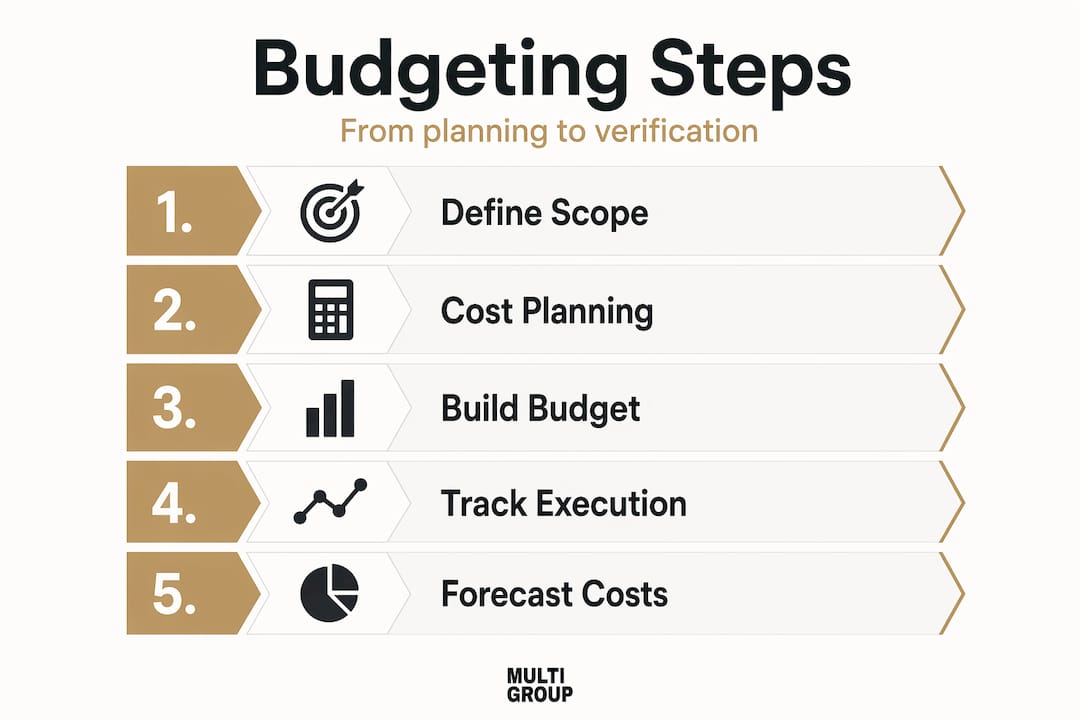
The Estimate At Completion is the most direct forecasting metric. It projects your final cost based on current performance. If your CPI is 0.92, your EAC will be your original budget divided by 0.92, meaning you will finish over budget unless performance improves. EVM metrics inform corrective action early, when you still have options.
A budget becomes truly effective only when paired with ongoing job costing and budget-to-actual comparison. Build this review into your weekly project management cycle. Update your risk register alongside every budget review, noting which risks have materialized, which are still active, and whether contingency needs to be increased or can be partially released.
At project closeout, reconcile the final account by category. Separating adjustments by variation type tied to contract documents produces a clean, auditable record. This protects you in disputes, satisfies lender requirements, and gives you reliable benchmark data for your next project.
Cost plans should evolve as design matures. What starts as a schematic budget at 30% design should be updated at 60%, 90%, and construction document stages. Each update reduces uncertainty and tightens contingency management.
My perspective on budgeting in Metro Vancouver
I have been involved in construction budgeting across Metro Vancouver long enough to know that the projects that finish on budget are not the ones with the fewest surprises. They are the ones that planned for surprises from day one.
In my experience, the single most undervalued practice is the pre-construction cost plan. Most owners want to get to construction as fast as possible. I get that. But skipping the cost plan on a retail buildout in Richmond or a warehouse renovation in North Vancouver is how you end up with a $650,000 commitment on a $500,000 budget. The cost plan forces the conversation before it becomes a crisis.
I have also seen EVM transform how teams understand project health. Before using it, we tracked spending. After implementing it, we tracked progress. Those are different things, and the distinction matters when you are managing a multi-trade commercial project in Surrey with a lender breathing down your neck.
Allowances are still the most common source of late-stage budget grief I encounter. Clients delay selections, costs escalate, and suddenly a $15,000 flooring allowance needs to become $24,000 three weeks before completion. Deadlines fix this. Non-negotiable, documented, built into the project schedule.
Finally: do not let schedule pressure convince you to skip weekly budget reviews. That is exactly when you need them most.
— Momo
How Multigroup keeps your project on budget
Accurate budgeting requires more than a spreadsheet. It requires experienced people who know local costs, manage subcontractors, and update budgets in real time across every phase of your project.
Multigroup brings that expertise to tenant improvements, warehouse renovations, retail buildouts, coffee shop renovations, and residential projects across Metro Vancouver, including Burnaby, Richmond, Surrey, Coquitlam, and North Vancouver. Every project includes detailed cost tracking, change order management, and regular budget reporting so you always know your true financial position. If you are planning a construction or renovation project and want a contractor who treats your budget as seriously as you do, contact Multigroup Contracting today. Call 778-819-5933, email info@multigroup.ca, or visit multigroup.ca to get started.
FAQ
What are the six cost categories in a construction budget?
A construction budget should include hard costs, soft costs, site work, contingency, allowances, and overhead and profit. Missing any one of these categories is a leading cause of cost overruns.
How much contingency should a construction budget include?
New builds typically need 5 to 8% contingency, while renovations and remodels require 10 to 15% due to higher uncertainty. Contingency should be held as a single line item and released only with documented change orders.
What is Earned Value Management in construction?
Earned Value Management integrates scope, schedule, and cost to forecast final project costs using metrics like the Cost Performance Index and Estimate At Completion. It provides early warning when a project is trending over budget.
Why do allowances cause budget overruns?
Allowances without enforced selection deadlines behave like open-ended change orders. When clients defer decisions, lead times shrink and upgrade costs increase, often resulting in allowance busts late in the project when budget flexibility is lowest.
How often should a construction budget be updated?
Budgets should be updated after every approved change order and reviewed weekly against actual costs at the cost code level. Major updates should also happen at each design milestone: 60%, 90%, and construction documents.